Built for Unity

Last week, brother Roman shared at the end of Chapter one how the Church was to “conduct themselves in such a manner as worthy of Christ” (1:27), and then Paul give character traits of what doing this looked like: “standing firm” and “striving together.” Now as we begin to look at chapter 2, Paul is going to focus more on this idea of unity in the church. And he will begin in these first 4 verses by telling the Church in Philippi the motives for living in unity.

Church, let me take you somewhere for just a minute.

If you’ve ever listened to a symphony orchestra, you know something powerful happens when everything is in sync. Strings, brass, percussion – different sounds, different parts, but one unified sound.

But, you let just one section get off, one instrument out of tune, one player doing their own thing, and what should be beautiful, turns into nothing but noise.

Now hear me this morning – the same thing is true in the body of Christ. God didn’t design the church to be noise, He designed it to be in harmony. But many churches today: Big, Churches, Small Church, Tall Churches, Round Churches, Baptist Churches, Methodist Churches, Catholic Churches.

  • They’ve got talent
  • They’ve got truth
  • They’ve got resources

But they don’t have unity. And when unity breaks down – the mission suffers. Because a divided church cannot effectively reach a divided world.

Paul is writing to the Philippian church, a strong church, a faithful church, but even strong churches need to be reminded that Unity doesn’t happen by accident – It’s a culture that must be cultivated.

So the question we have to ask this morning is, “How can we experience true unity in the body of Christ?” Paul answers that question by giving us three powerful truths.

UNITY GROWS FROM ENCOURAGEMENT IN CHRIST (v.1)

Paul says: “If there be therefore any consolation in Christ, if any comfort of love, if any fellowship of the Spirit…

Now understand this, Paul is not doubting these things. He’s not saying “if maybe…” He’s saying:

  • Since these things are true…
  • Since you have encouragement in Christ. . .
  • Since you have comfort from His love. . .
  • Since you share fellowship in the Spirit…

You already have everything you need for unity.

Let me say that again: Unity doesn’t start with you trying harder, it starts with what you already have in Christ.

Think about that orchestra again, they don’t just randomly start playing and hope it works out. No – they follow:

  • The same sheet music
  • The same conductor
  • The same rhythm

That’s what creates harmony. For our church, Christ is our conductor.

Some of us are so focused on individuality, we’ve forgotten what unites us and brings us together.

  • You are saved by the same Savior
  • You are loved by the same God
  • You are filled with the same Spirit

That’s your foundation. Some of you need to Stop majoring on minors and start striving together and standing firm on Christ.

But unity isn’t just about what we share, it’s also about what we surrender.

UNITY REQUIRES HUMILITY OVER SELFISH AMBITION (v.3)

Paul says, “Let nothing be done through strife or vainglory…

Now let’s break that down. Strife = selfish ambition/Vainglory = empty pride. In plain biker language, let me put this verse in a language we understand? “Hey dummieStop making it all about you.”

Here’s the truth, unity dies when pride lives.

You ever been on a group ride where somebody wants to lead, but they won’t follow?

  • They don’t care about formation…
  • They don’t care about safety…
  • They just want to show off.

Rides like that don’t last long. Why? Because selfishness destroys unity.

Pride says, “I want my way.” Humility says, “I want God’s way.” And folks, you cannot have both.

Let’s get real for a minute: Are you easily offended? Do you have to be right all the time? Do you struggle when things don’t go your way?

That’s pride. “Pride goeth before destruction.” And pride will fracture unity every time. Ego and Unity are like love and hate – they can’t occupy the same space. One of them has to go.

But, when humility takes root, it produces something powerful.

UNITY FLOURISHES WHEN WE VALUE OTHERS ABOVE OURSELVES (v.4)

Paul says, “In lowliness of mind let each esteem other better than themselves.” And then he goes even further: “Look not every man on his own things, but every man also on the things of others.”

That is radical. Because everything in our culture says, “Live for self,” “Do you’re your own thing,” “Don’t worry about others, worry about yourself.” But Paul says, “Look out for others.”

Back to that symphony: Every musician doesn’t try to be the loudest. They don’t fight for attention. They play their part for the good of the whole. That’s how harmony happens.

  • The world says, “Promote yourself.”
  • Jesus says, “Deny yourself.

And only one of those produces unity.

So, what does this look like this week? It looks like:

  • Putting someone else’s needs ahead of your own
  • Encouraging instead of competing
  • Serving without needing recognition

That’s real Christianity.

So what would it look like if we actually lived this out?

Picture a church, where nobody is fighting for position, nobody is protecting their pride, nobody is seeking attention, but instead: People are encouraging one another, serving one another, and lifting one another up.

That’s not noise – that’s harmony.

Philippians 2:1–4 teaches us:

  • Unity grows from our shared life in Christ
  • Unity requires humility over selfish ambition
  • Unity flourishes when we value others above ourselves

So here’s your challenge today:

  • Lay down your pride
  • Lift up someone else
  • Live for the unity of the body

Because when the church is unified, the world hears the music of the gospel loud and clear. Church – let’s stop riding solo and start riding together: In unity…In humility…And in Christ.

Built for the Battle – NOT the Bypass

This morning we are continuing this series on Full Throttle Faith. Last week, we shared the message “Built, Tuned, and Finished by God.” Philippians 1:6 tells us that we can be confident “That he which hath begun a good work in you will perform it until the day of Christ.”

  • Our Christian walk didn’t start with us
  • It is not being sustained by us
  • And it will not be finished by us

God started it . . . God sustains it . . . and God will finish it!

Now look with me beginning in Philippians 1:12-18. Pray

Isn’t it funny, when life is going well, when the bills are paid, nobody is sick – it’s easy to for us to see God at work. But as soon as when hardship comes, when sickness hits, money gets tight, relationships struggle, or plans fall apart – we begin to wonder if God is still working at all.

Ironically, God often does His greatest work in the hardest moments. Think about Joseph. He was betrayed by his brothers, sold into slavery, and thrown into prison for something he didn’t do. But later he said, “ye thought evil against me; but God meant it unto good” (Genesis 50:20, KJV). What looked like a disaster was actually part of God’s plan.

Over and over again in the Scriptures we see God turning setbacks into setups! And although we know He is working all things for our good, we as believers struggle when life gets hard. We begin to think God’s hung us out to dry. We start to think:

If things were different, I could serve God better.

If I had more time,” “If I had better health,” “If I had fewer problems…

But the truth is, we often wait for perfect conditions that may never come. Paul reminds us that God’s power isn’t shown in our strength – it’s shown in our weakness. 2 Corinthians 12:9, “My grace is sufficient for thee: for my strength is made perfect in weakness.”

What if the very struggles we want gone are the ones God will use to do His greatest work in our lives?

This is the circumstances the believers in Philippi found themselves in. When they heard their pastor, their mentor, Paul was in prison, it looked like everything had stopped. But Paul is about to give them a lesson on how we are “Built for the Battle, NOT the bypass.

Paul is going to be a living example to this church of how God can use adversity to move His mission forward and to strengthen our faith.

So the question is: how does God use hard times to grow us and expand our witness? Paul shows us exactly how.

GOD USES DIFFICULT CIRCUMSTANCES TO ADVANCE HIS MISSION

Paul begins with a surprising statement: “the things which happened unto me have fallen out rather unto the furtherance of the gospel” (Philippians 1:12). Instead of hindering the gospel, Paul’s imprisonment actually furthered it.

He explains that his chains became widely known throughout the palace guard (Philippians 1:13). These soldiers were elite Roman Pretorian troops assigned to guard prisoners connected with the imperial system.

Imagine this: every few hours a new soldier would be chained next to Paul, and Paul was not the kind of man who stayed silent about Christ. Those guards heard the gospel. Conversations were taking place that never would have happened otherwise. God turned a prison cell into a mission field.

Think about a river flowing strong through a valley. Suddenly, a huge rock falls right in its path. It looks like the river is blocked. But the river doesn’t stop.  It simply flows around the rock. It finds new paths, spreads out, and sometimes even becomes wider and stronger than before. What looked like a blockage actually helps the water reach new places.

You see, the obstacle does not stop the movement; it simply changes the direction of travel.

In much the same way, Paul’s imprisonment looked like a massive obstacle to the spread of the gospel. It appeared that Paul’s ministry had been stopped, confined to a prison cell, chained to guards.

But the gospel did not stop. Instead, it flowed in a new direction. Roman soldiers heard about Christ. The message reached the palace guard. What looked like a barrier became the means by which the gospel spread further than before. And this emboldened the believers in Philippi.

Scriptures repeatedly affirm that God works through every circumstance. Paul writes in Romans 8:28, “And we know that all things work together for good to them that love God.” Not some things. Not easy things. Not the things we understand. Not the things we can explain. All things.

You may feel restricted today. Maybe circumstances have changed your plans. But God’s mission has not stopped; He may just be taking you in a new direction.

Not only did God advance the mission through Paul’s suffering, but:

GOD STRENGTHENS BELIEVERS THROUGH ADVERSITY TO PROCLAIM CHRIST MORE BOLDLY (V14)

Instead of discouraging the church, Paul’s faithfulness inspired them. When they saw Paul remain strong in chains, they found courage to speak.

In December of 1989, my unit was involved in Operation Just Cause to oust Manuel Noreiga from power. On the night the operation began, we were flying in CH-47 helicopters to our first objective. While in the air, we could see enemy fire coming at the helicopter with tracer rounds impacting all around us. You could visibly see the fear on everyone’s face. However, when the helicopter landed and the tail gate dropped, our commander immediately ran off into the fight. The courage he displayed caused everyone on the aircraft to dismount and charge into the fight. Courage is contagious.

This is why encouraged Timothy to “. . . endure hardness, as a good soldier of Jesus Christ” (2 Timothy 2:3).

Faith demonstrated in difficulty strengthens the faith of others.

Someone may be watching your life right now. Your faithfulness during hardship could be the encouragement another believer desperately needs.

But, not only does adversity strengthens believers, it also exposes motives.

GOD ACCOMPLISHES HIS PURPOSES EVEN IN THE PRESENCE OF OPPOSITION AND IMPERFECTION

Paul acknowledges that not everyone preaching Christ had pure motives (Philippians 1:15–17). Some preached Christ sincerely, but others did so out of envy or rivalry. Some even hoped to increase Paul’s suffering. Yet Paul responds with remarkable humility.

In sports, competition often gets more attention than teamwork. When top athletes go head-to-head, it doesn’t hurt the sport – it actually makes it more exciting. Think about big rivalries. When two great players compete, people talk about it, fans get involved, and more people show up to watch. Even if one of them is driven by pride or wanting to win, the spotlight still shines on the game. In the end, the rivalry helps the sport grow. What starts as competition ends up bringing more attention to the game itself.

In a similar way, Paul recognized that even though some people preached Christ with selfish motives, the message of Christ was still being proclaimed. Their motives were imperfect, but the gospel was still reaching people.

God’s truth is so powerful that even human rivalry cannot stop its advance.

Even imperfect motives cannot stop the spread of the message.

God’s Word accomplishes His purposes regardless of human motives. Scripture says, “it shall not return unto me void” (Isaiah 55:11). God’s work does not depend on perfect people.

You know what’s great about that? We do not have to control everyone or fix every situation. God can accomplish His will even through imperfect circumstances.

And this brings me to my final point:

GOD’S PEOPLE HAVE THE FREEDOM TO REJOICE REGARDLESS OF OUR SITUATION

Paul concludes this section by saying, “Christ is preached; and I therein do rejoice, yea, AND WILL REJOICE” (Philippians 1:18). That was a choice!

Paul’s joy was not rooted in comfort or recognition: It was rooted in Christ.

As a soldier, we spent countless days training, running, ruck marching. Many times it was painful – in fact, most of the time it was painful. But we ran farther, trained harder and pushed further, because when the time came and we got that call – we wanted to be ready – we wanted to win the fight! So as soldiers, we learned to be comfortable being uncomfortable.

A runner pushing through the final stretch of a race doesn’t stop because his legs hurt. A football player doesn’t step off the field in the fourth quarter because he’s exhausted. The championship matters more than the pain. The vision of victory gives them the strength to endure the hardship.

In the same way, Paul endured chains, opposition, and suffering because his ultimate goal was not comfort – it was the glory of Christ.

Scripture teaches that true joy comes from the Lord, not circumstances. Nehemiah said, “The joy of the LORD is your strength” (Nehemiah 8:10).

Paul challenges us to build our joy in Christ, because:

  • If our joy depends on comfort, it will disappear when life becomes uncomfortable.
  • If our joy depends on recognition, it will fade when others overlook us.
  • If our joy depends on success, it will crumble when plans fail.

But when Christ is truly the center of our lives, our joy becomes anchored in something unchanging. That means even in hardship we can still rejoice, because Christ is still being honored. Even when life feels difficult, we can rejoice because Christ is still worthy. Even when circumstances are not what we hoped, we can rejoice because God is still working.

So the question for us today is simple: What is at the center of your life?

Conclusion

Imagine Paul sitting in a dim Roman prison cell. The walls are cold stone. His wrists are bound by heavy chains. A Roman soldier stands nearby, watching his every move.

From the outside, it looks like everything has stopped. The great missionary who once traveled from city to city is now confined to a small room. His freedom is gone. His plans have been interrupted. His movement is restricted.

But something remarkable is happening inside that prison.

One guard after another is chained to Paul, and each one hears about Jesus. Conversations about Christ fill the quiet hours. The gospel echoes through the palace guard. Beyond those prison walls, believers hear how Paul remains faithful in chains, and their courage grows. They begin speaking the Word of God with greater boldness.

  • What looked like a prison became a pulpit.
  • What looked like chains became a testimony.
  • What looked like limitation became a platform for the gospel.

Now imagine your own life for a moment. Think about the circumstances that feel restrictive right now:

  • The hardship you did not expect
  • The challenge you did not choose
  • The situation you wish would change.

What if that very place is where God intends to work through you? What if the difficulty you face today is not the end of God’s work, but the very place where His power will be seen most clearly?

So let me ask you: Have you allowed your circumstances to silence my faith?

Instead of waiting for life to become easier, God may be calling you to step forward in faith. The same God who worked through Paul’s chains is still working today. Your circumstances may feel limiting, but God’s power is not!

So trust Him, stand firm, speak boldly, and watch how God can use even the hardest moments of your life to advance the gospel and bring glory to His name.

Because folks, “WE ARE BUILT FOR THE BATTLE – NOT THE BYPASS!”

Full Throttle Next Generations Foundational Model

By: Pastor Joe Moore, Graduate Student, Liberty University Theological Seminary

The Full Throttle Next Gen Discipleship Model (FTNG Model)

The Full Throttle Next Generation Discipleship Model (FTNG Model) is a relational, adoptive, and missional framework designed to disciple children, youth, and young adults within the unique cultural context of a biker church. This model integrates biblical authority, relational discipleship, and generational multiplication into a cohesive strategy that reflects both the New Testament pattern of disciple-making and the communal dynamics of biker culture. Drawing from Chap Clark’s concept of adoptive youth ministry, the FTNG Model emphasizes creating a family-like environment where young people are not merely participants but fully integrated members of the household of God.[1]

Thesis Statement

            Effective next generation discipleship in a biker church context requires a relationally driven, adoptive, and mission-focused model that equips children, youth, and young adults to follow Christ, grow in biblical maturity, and multiply disciples within authentic community. This model is built upon the conviction that discipleship is not programmatic but relational and communal.

As demonstrated in the early church, spiritual formation occurs through teaching, fellowship, and shared mission (Acts 2:42–47).[2] The FTNG Model seeks to intentionally structure these elements within the rhythms of biker life – rides, gatherings, mentorship, and service – so that discipleship becomes a lived experience rather than an isolated event. This model also reflects the equipping mandate of Ephesians 4:12, where leaders prepare believers for ministry rather than perform ministry alone.[3] By prioritizing relational investment and leadership development, the FTNG Model ensures that the next generation is not only discipled but equipped to disciple others.

Introduction

            The FTNG Model is designed to meet the spiritual formation needs of children, youth, and young adults within a biker church environment. Unlike traditional ministry models that rely heavily on structured programs, this model emphasizes relational discipleship, adoptive community, and missional living. At its core, the FTNG Model seeks to create an environment where young people are fully embraced as members of God’s family and are equipped to live out their faith in everyday life. Chap Clark’s concept of adoptive ministry provides a foundational framework, emphasizing that the goal of youth ministry is to “create an environment where young people are encouraged to live into their calling in Christ as agents of the kingdom within the household of God.”[4] This aligns closely with the relational and communal values already present in biker culture, such as loyalty, brotherhood, and authenticity.

The personal motivation behind this model stems from ministry experience within the biker community, where relationships carry more weight than programs and authenticity is essential for trust. Many young people in this context come from broken or fragmented family systems, making the need for an adoptive spiritual family even more critical. The FTNG Model seeks to bridge this gap by providing a discipleship pathway that is both biblically grounded and culturally relevant, ensuring that the next generation is not only reached but transformed.

Preferred Model Benefits

            The FTNG Model offers several significant benefits for discipling children, youth, and young adults in a biker church context. First, it fosters authentic belonging through adoptive community. Many young people today experience isolation, broken homes, or lack of consistent mentorship. By emphasizing a family-based approach to ministry, this model creates an environment where every individual is known, valued, and supported. Clark emphasizes that effective ministry requires a communal identity where all members function as a family of siblings in Christ.[5] This sense of belonging is especially critical for children and youth who are forming their identity.

Second, the model promotes relational discipleship over program dependency. Rather than relying solely on events or classes, discipleship occurs through consistent relationships, mentorship, small groups, and shared life experiences. As demonstrated in the user’s disciple-making plan, discipleship is a journey that involves following Christ, being transformed by Him, and joining His mission. This relational focus aligns naturally with biker culture, where trust is built through shared experiences.

Third, the FTNG Model emphasizes leadership development and multiplication. By equipping young believers early, the model creates a pipeline for future leaders within the church. This reflects the biblical mandate of equipping the saints for ministry (Eph. 4:12) and ensures long-term sustainability. Clark reinforces that ministry effectiveness depends on clear goals and shared ownership among all participants.[6]

Fourth, the model supports missional engagement. Young people are not merely taught but are actively involved in outreach, service projects, and evangelistic efforts. This aligns with the Great Commission (Matt. 28:19-20) and helps young believers develop a lived-out faith rather than a theoretical one.

Finally, the FTNG Model is contextually adaptable. It recognizes that each church setting is unique and must tailor its approach accordingly. Clark notes that understanding context (history, culture, and community) is essential for effective ministry.[7] In a biker church, this means leveraging natural gathering points such as rides, garages, fellowship meals, and youth sporting events as discipleship environments.

Practical Implementation

            The practical implementation of the FTNG Model centers on creating a structured yet flexible discipleship pathway that engages children, youth, and young adults at every stage of spiritual development. First, the model establishes a clear and compelling discipleship goal. Every leader, volunteer, and participant must understand that the mission is to develop mature followers of Christ who make disciples. Clark emphasizes that clarity of goal is the most significant factor in team effectiveness.[8] This goal must be consistently communicated through teaching, training, and personal interaction. Second, the model builds a multi-layered relational structure:

  • Children (Ages 5–11): Focus on foundational biblical teaching, identity in Christ, and belonging. This includes interactive Bible teaching, family-style small groups, and mentorship from trusted adults.
  • Youth (Ages 12–18): Emphasize identity formation, peer accountability, and spiritual disciplines. Small groups, mentorship, and service opportunities become central.
  • Young Adults (18–29): Focus on leadership development, mission engagement, and life application. This includes discipleship groups (3-5 people), leadership training, and active ministry roles.

Third, the model prioritizes partnership and team-based ministry. Rather than a top-down leadership approach, the FTNG Model adopts a partnering leadership style where all members contribute to the mission. Clark contrasts this with the “I’m in charge” model, emphasizing that effective ministry requires collaboration and shared ownership.[9] Volunteers, parents, and leaders are all equipped to disciple the next generation.

Fourth, the model incorporates intentional training and evaluation. Volunteers receive ongoing training in four key areas: spiritual growth, understanding of students, ministry ownership, and encouragement.[10] Regular evaluation ensures that all programs and activities align with the overarching discipleship goal.

Finally, the model integrates discipleship into everyday life. In a biker church context, this includes:

  • Discipleship during rides and events which offers life-on-life discipleship opportunities to have natural conversations that are organic and not forced.
  • Mentorship in informal settings such as garages, which offers hands-on, heart-level discipleship opportunities to work side-by-side with next generation, providing teaching moments and open conversation.
  • Family-style meals and hangouts, offering table discipleship, where kids feel safe, youth open-up, and young adults engage in deep conversation. This allows intentional conversation where older believers can speak into the lives of younger believers.  
  • Campfires and outdoor gatherings that provide opportunities for testimonies and real talk.

Conclusion

In conclusion, the Full Throttle Next Generation Discipleship Model provides a biblically grounded, relationally driven, and culturally relevant framework for discipling children, youth, and young adults within a biker church context. By prioritizing an adoptive community, life-on-life relationships, and missional engagement, this model moves beyond program-based ministry to cultivate authentic spiritual growth and multiplication. Rooted in the New Testament vision of the church as a family and a functioning body, the FTNG Model equips the next generation not only to follow Christ but to actively participate in His mission. As this model is implemented through intentional relationships, shared experiences, and everyday environments, it has the potential to produce mature disciples who live out their faith boldly and reproduce that faith in others, ensuring long-term kingdom impact within the biker community and beyond.

Bibliography

Anthony, Michael J. Perspectives on Children’s Spiritual Formation. Nashville: B&H, 2007.

Bonhoeffer, Dietrich. Discipleship. Minneapolis, MN: Fortress Press, 2003.

Clark, Chap. Adoptive Church: Creating an Environment Where Emerging Generations Belong.

Grand Rapids, MI: Baker Academic, 2018.

Earley, Dave, and Rod Dempsey. Discipleship Making Is: How to live the Great Commission

with Passion and Confidence. Brentwood, TN: B&H Academic, 2013.

Earley, Dave, and Rod Dempsey. Spiritual Formation Is: How to Grow in Jesus with Passion

and Confidence. Brentwood, TN: B&H Academic, 2018.

Linhart, Terry. Teaching the Next Generations: A Comprehensive Guide for Teaching Christian

Formation. Grand Rapids, MI: Baker Academic, 2016.

McKnight, Tim. Engaging Generation Z: Raising the Bar for Youth Ministry. Grand Rapids, MI:

Kregel Publications, 2021.

Ogden, Greg. Discipleship Essentials. Downers Grove, IL: InterVarsity Press, 2007.

Putman, Jim, Bobby Harrington, and Robert Coleman. DiscipleShift. Grand Rapids, MI:

Zondervan, 2013.


[1] Chap Clark, Adoptive Church: Creating an Environment Where Emerging Generations Belong (Grand Rapids, MI: Baker Academic, 2018), 69.

[2] Dave Earley and Rod Dempsey, Discipleship Making Is: How to Live the Great Commission with Love and Confidence (Brentwood, TN: B&H Academic, 2013), 40.

[3] Earley and Dempsey, Discipleship Making Is, 41.  

[4] Clark, Adoptive Church, 69-70.

[5] Clark, Adoptive Church, 74.

[6] Clark, Adoptive Church, 70-71.

[7] Ibid., 72-75.

[8] Clark, Adoptive Church, 70-71.

[9] Ibid., 85-87.

[10] Clark, Adoptive Church, 96-97.

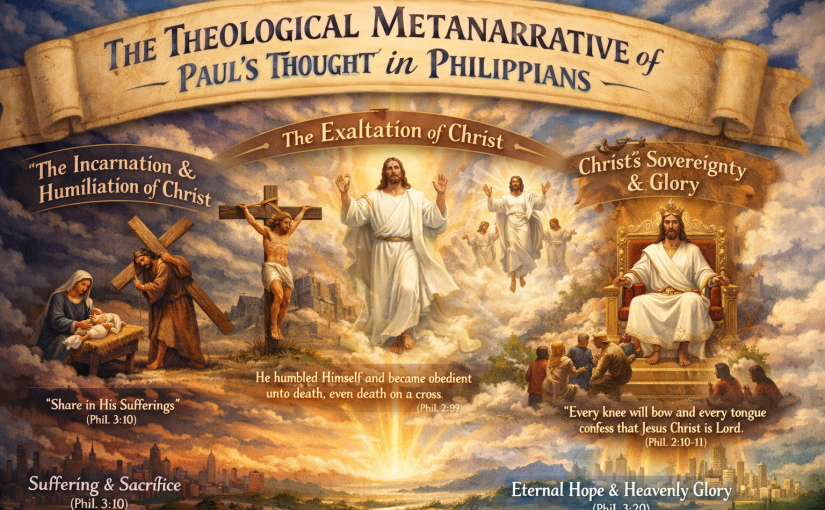
The Theological Metanarrative of Paul’s Thought in Philippians

By: Pastor Joe Moore, Graduate Student, Liberty University Theological Seminary

Summary: Christology as Paul’s Theological Metanarrative in Philippians

A careful reading of Paul’s theology reveals that Christology, the identity and work of Jesus Christ, functions as the central metanarrative through which all other theological themes are interpreted. Paul does not treat Christ as merely one doctrine among many; rather, Christ is the organizing center of his gospel, shaping his understanding of salvation, the church, ethics, and future hope. As noted in Encountering the New Testament, Paul’s theology consistently emphasizes that God’s redemptive work is accomplished through Jesus Christ, whose death and resurrection stand at the heart of the Christian message.[1]

Paul’s high view of Christ is rooted in both divine identity and redemptive function. Christ is not only the Messiah promised in the Old Testament but also how God’s saving purposes are fulfilled. Paul frequently uses the phrase “in Christ” or “in the Lord” to describe the believer’s identity, highlighting a union that defines both salvation and daily living.[2] This union demonstrates that Christology is not abstract theology but deeply relational and transformative.

Additionally, Paul’s theology integrates Christology with the broader story of God’s work in Israel. Rather than rejecting Judaism, Paul sees the gospel as the fulfillment of God’s covenant promises. As Elwell and Yarborough emphasizes, responsible interpretation of Paul requires recognizing his continuity with Judaism and the integrity of his gospel within that context.[3] This reinforces that Christ is the culmination, not the contradiction, of God’s redemptive plan.

Furthermore, the cross and resurrection serve as the central events in Paul’s Christology. The cross represents the means of redemption, where Christ acts as a substitute for sinners, while the resurrection confirms His victory and guarantees future hope for believers.[4] Together, these realities shape Paul’s understanding of salvation and Christian living.

Thus, Christology provides the unifying framework for Paul’s theology. It informs his understanding of salvation (soteriology), shapes his ethical instruction, and anchors his eschatological hope. This metanarrative is especially evident in the letter to the Philippians, where Christ is presented as the believer’s life, model, and goal.

Application: Christology in the Argument and Flow of Philippians

When examined section-by-section, the book of Philippians clearly demonstrates that Christology governs Paul’s argument, exhortation, and pastoral concern, as expressed by Dr. Stacy.[5] Rather than presenting isolated teachings, Paul consistently grounds his exhortations in the person and work of Christ. Each major section of the letter is illuminated when understood through the lens of Christ.

Philippians 1:1–11: Christ as the Source of Salvation and Growth

Paul begins by affirming that the believers’ spiritual journey is grounded in Christ. His confidence that God will complete the work begun in them (Phil. 1:6) reflects a Christ-centered understanding of salvation. This aligns with Paul’s broader theology that redemption originates in God and is accomplished through Christ.[6] Their partnership (1:5) in the gospel is also rooted in their shared identity in Christ (1:7). This demonstrates that Christian fellowship is not merely social but theological, grounded in union with Christ.

Philippians 1:12–30: Christ as the Purpose in Suffering

Paul interprets his imprisonment through a Christological framework. Rather than viewing suffering as defeat, he sees it as advancing the gospel of Christ. His statement, “to live is Christ and to die is gain” (1:21), epitomized the centrality of Christ in his life. This reflects Paul’s broader conviction that the cross is not only the means of redemption but also the pattern for Christian living.[7] Suffering, therefore, becomes participation in Christ’s mission and identity.

Philippians 2:1–11: Christ as the Model for Humility and Unity

This passage provides one of the clearest expressions of Christology shaping Christian ethics. Paul calls believers to unity and humility, grounding his appeal in the example of Christ’s incarnation and obedience. The Christ hymn (2:6-11) demonstrates both Christ’s divine status and His willingness to humble Himself for the sake of others. This reflects Paul’s broader teaching that Christ’s work defines the ethical life of believers.[8] Christian unity is achieved not through human effort alone but through imitation of Christ’s character.

Philippians 2:12–30: Christ as the Power for Obedience

Paul continues by urging believers to live out their salvation, emphasizing that God is at work within them. This reflects the ongoing influence of Christ in the believer’s life (2:13). The examples of Timothy and Epaphroditus (2:19, 25) further illustrate Christ-centered living. Their sacrificial service mirrors Christ’s own humility, reinforcing that Christology shapes not only belief but behavior.

Philippians 3:1–21: Christ as the Supreme Treasure and Future Hope

In this section, Paul contrasts reliance on the law with faith in Christ. His declaration that he counts all things as loss compared to knowing Christ (3:8) reflects the supremacy of Christ in his theology. This also connects to broader debates about the law in Paul’s writings. While the law reveals human need, it ultimately points to Christ as the source of righteousness.[9] Thus, Christ is both the fulfillment of the law and the means of salvation. Additionally, Paul’s emphasis on future transformation (3:20–21) demonstrates that Christ is central to eschatological hope. Believers await the return of Christ, who will complete their redemption.

Philippians 4:1–23: Christ as the Source of Strength and Contentment

Paul concludes by emphasizing Christ as the source of peace and strength. His statement, “I can do all things through him who strengthens me” (4:13), reflects complete dependence on Christ. This aligns with Paul’s broader theology that Christian life is sustained by God’s power through Christ.[10] Whether in abundance or need, believers find contentment in their relationship with Him.

Conclusion

            The book of Philippians clearly demonstrates that Christology is the metanarrative that best explains Paul’s theology and pastoral instruction. Every section of the letter, whether addressing suffering, unity, obedience, or hope, is shaped by the person and work of Christ. Christ is the source of salvation, the model for Christian living, the purpose in suffering, and the hope of future glory. As Paul’s theology consistently affirms, all of life is to be understood “in Christ.” This Christ-centered vision provides both theological coherence and practical guidance for believers, uniting doctrine and daily living into a single, transformative framework.

Bibliography

Campbell, Douglas A., “Christ and the Church in Paul: A ‘Post-New Perspective’ Account,” in Four Views on the Apostle Paul, ed. Stanley N. Gundry and Michael F. Bird. Grand Rapids, MI: Zondervan, 2012.

Elwell, Walter A. and Yarbrough, Robert W., Encountering the New Testament: A Historical and Theological Survey, 4th ed. Grand Rapids, MI: Baker Academic, 2022.

Stacy, Robert W., “The Theological Metanarrative of Paul’s Thought” course presentation. Liberty University.


[1] Walter A. Elwell and Robert W. Yarbrough, Encountering the New Testament: A Historical and Theological Survey, 4th ed. (Grand Rapids, MI: Baker Academic, 2022), 244.

[2] Ibid., 252.

[3] Douglas A. Campbell, “Christ and the Church in Paul: A ‘Post-New Perspective’ Account,” in Four Views on the Apostle Paul, ed. Stanley N. Gundry and Michael F. Bird (Grand Rapids, MI: Zondervan, 2012), 114.

[4] Elwell and Yarbrough, Encountering the New Testament, 249–251.

[5] Robert W. Stacy, “The Theological Metanarrative of Paul’s Thought” course presentation. Liberty University.

[6] Elwell and Yarbrough, Encountering the New Testament, 249.

[7] Ibid., 250.

[8] Elwell and Yarbrough, Encountering the New Testament, 253.

[9] Ibid., 245-246.

[10] Elwell and Yarbrough, Encountering the New Testament, 244-245.  

Built, Tuned, and Finished by God

Take your Bible and turn with me this morning to Philippians chapter 1.

The book of Philippians is a powerful and personal letter written by the Apostle Paul during a time of imprisonment, yet it overflows with joy, encouragement, and unwavering confidence in Christ. Addressed to the believers in Philippi, this letter calls Christians to live with unity, humility, and a deep, abiding faith regardless of circumstances. Throughout Philippians, Paul emphasizes rejoicing in the Lord, adopting the mind of Christ, and valuing a relationship with Him above all else. As we study this book, we will discover how to experience true joy in every season of life and how to live boldly and faithfully for Christ, even in the midst of trials.

Philippians 1… and we’re going to begin in verse 1.

Now I want to talk to you this morning about something every one of us wrestles with at some point in our walk with God… And that is this question:

“Am I really going to make it?” Not just make it through the week…Not just make it through the struggle…But make it all the way to the end.

Because if we’re honest…

  • We’ve all had moments where we felt weak…
  • We’ve all had seasons where we felt inconsistent…
  • We’ve all had times where we thought, “Man, I should be further along than I am right now.”

And the danger is this – We start believing that our Christian life depends more on our grip on God…Than God’s grip on us.

But Paul opens this letter with a powerful reminder:

  • The Christian life didn’t start with you…
  • And it won’t be sustained by you…
  • And it won’t be finished by you.

God started it…God sustains it…And God will finish it.

And that’s what I want to preach on this morning: Reminding us that we are Built, Tuned, and Finished by God.

Paul shows us that God’s faithful work in our lives is seen in several ways.

A FELLOWSHIP ESTABLISHED BY GRACE (vv. 1–2)

Paul and Timotheus… to all the saints in Christ Jesus…

Right out of the gate, Paul reminds them of who they are. They are saints in Christ Jesus. Now don’t miss that.

He didn’t say:

  • “Perfect people”
  • “People who have it all together”
  • “People who never struggle”

He said saints. That means they’ve been set apart by God. Saved by grace. Positioned in Christ.

And listen – Before you ever started acting like a Christian…

God declared you His.

It’s like when you buy a bike.

Before you ever ride it… before you ever customize it… before you ever clean it up…It’s already yours. It belongs to you.

And can I tell you something? God didn’t wait for you to get cleaned up before He claimed you.

He claimed you… then He started cleaning you.

And not only that – He placed you in a fellowship. You’re not riding this road alone. That’s why we’ve got the church. That’s why we’ve got brothers and sisters. Because God’s work in you includes the people around you.

Paul sees their fellowship… and it leads him to something else…

A PARTNERSHIP STRENGTHENED BY THE GOSPEL (vv.3-5)

I thank my God upon every remembrance of you…

Paul says, “Every time I think about you, I thank God.”

Why? “Because of your fellowship in the gospel…” These people weren’t just showing up…They were invested.

  • They were praying…
  • They were giving…
  • They were serving…
  • They were advancing the gospel.

That’s the difference between spectators and riders. Some folks sit on the sidelines and watch…But others get on the bike and ride.

  • They’re in it.
  • They’re committed.
  • They’re moving forward.

The gospel doesn’t just save you…It recruits you. You don’t just receive it…You participate in it.

Let me ask you something this morning: Are you just attending church…Or are you partnering in the gospel? Because when God is working in your life…You don’t just sit…You engage.

And that partnership leads Paul to one of the greatest promises in all the Bible…

A CONFIDENCE SECURED BY GOD’S FAITHFULNESS (v. 6)

Being confident of this very thing…

Now Paul doesn’t say, “I hope…” He doesn’t say, “I think…” He says, “I am confident.”

What is he confident in?

That He which hath begun a good work in you will perform it until the day of Jesus Christ.

Let that sink in…God started something in you…And God is not quitting halfway through.

If you’ve ever worked on a bike or a car…You know what it’s like to start a project…Take it apart…And then leave it sitting in the garage.

  • Half-finished.
  • Parts everywhere.

But can I tell you something? God doesn’t leave projects undone.

He’s not looking at your life saying, “Well, I tried… but they were too much.” No…What God starts—God finishes.

Our confidence is not in, our discipline, our consistency, or even our strength – our confidence is in God’s faithfulness:

So when you feel like you’re failing…When you feel like you’re falling short…When you feel like you’re not where you ought to be…Remember this: God is not finished with you yet.

And that confidence produces something powerful…

A LOVE ROOTED IN SHARED GOSPEL (vv. 7-8)

Paul says, “I have you in my heart…

That’s strong language. This isn’t surface-level connection…This is deep, Christ-centered love.

Why?

Because they were partakers of grace together.

  • They had suffered together…
  • They had stood together…
  • They had served together…

There’s something about people who’ve been through the fire together. They understand each other. They carry something deeper than casual friendship.

Grace doesn’t just connect you to God…It connects you to people.

That’s why church isn’t just an event…It’s a family. It’s a brotherhood. It’s a place where love runs deeper than convenience.

And that love leads Paul to pray something powerful…

A MATURITY GROWING IN DISCERNMENT AND RIGHTEOUSNESS (vv. 9–11)

And this I pray…”

Paul prays that their love would abound more and more…But not just emotional love – Love with knowledge and discernment.

He says:

  • That you may approve what is excellent
  • That you may be sincere and without offense
  • That you may be filled with the fruits of righteousness

In other words – God’s work in you is not just about saving you…
It’s about shaping you.

A healthy tree doesn’t just exist…It grows…And eventually—it produces fruit.

Christian maturity is not just what you feel, or what you say – it’s what your life produces!

God wants your love to grow…Your discernment to sharpen…Your life to reflect Christ…So that everything points back to Him.

SO, let me bring this message home for you.

Some of you walked in here today wondering if you’re going to make it. You’ve been struggling…You’ve been battling…You’ve been questioning…But I came to remind you this morning:

  • You are not held together by your strength…
  • You are held together by God’s faithfulness.

He saved you by grace. . . He placed you in fellowship. . .He called you into partnership. . .He is sustaining you right now. . .And He will finish what He started.

So stop living in fear…Stop living in doubt…Stop acting like it all depends on you…And start walking in confidence – Confidence in the Work of Christ.

Because one day…You’re going to stand before Him…And you won’t stand there half-finished…You’ll stand there complete – Because God finished what He started.

What’s So Good About the Cross?

John Stott said, “Before we can begin to see the cross as something done for us, we have to see it as something done by us.”

Franklin Graham, “It was Christ who willingly went to the cross, and it was our sins that took him there.”

Michael Youssef said, “Only in the Cross of Christ will we receive power when we are powerless. We will find strength when we are weak. We will experience hope when our situation is hopeless. Only in the Cross is there peace for our troubled hearts.”

The songwriter said:

On a hill far away, stood an Ole Rugged Cross

The Emblem of suffering and shame.

And how I love that ole Cross, where the dearest and best

For a world of lost sinners was slain.

To the Old Rugged Cross, I will ever be true,

It’s shame and reproach gladly bear.

Till He calls me some day, to my home far away,

Where His glory forever, I’ll share.

Another songwriter said,

At the Cross, at the Cross, where I first saw the light,

And the burdens of my heart rolled away,

It was there by faith, I received my sight,

and now I am happy all the day.

Janet Paschal sang a song in 2000 that has seared my soul.  It says:

In letters of Crimson, God wrote His love, on a hillside, so long, long ago.

For you and for me, Jesus died, and Love’s greatest story was told.

I love you, I love you – That’s what Calvary says.

I love you, I love you, I love you – Written in red!

Oh Precious, Is the flow – that makes me white as snow.

No other fount I know – Nothing but the blood of Jesus!

Our Lord Himself said, “If anyone would come after me, let him deny himself, pick up his cross and follow me.”

Someone asked me once, if I could only have one book of the Bible, which one would I take?  Though I would certainly hate to part with the Gospel of John, or even the Psalms, but, I would have to say, I would take the Book of Romans.

Now, as the name of the book indicates, The Book of Romans was written to the Christians, the believers, that were living inside the city of Rome, which happened to be, the capital of the entire Roman Empire.  And the Roman Empire was massive, taking in parts of Europe, and Asia and Africa.  Some believe there could well have been over 100,000,000 people in the Roman Empire at its height.

So Paul is writing to the Christian community inside of Rome to encourage them in the faith.  Of the Pauline Epistles, this one is the longest and most complex.  The central message is the Good News. 

  • Jesus Christ came to live a life that we could not live;
  • Yet He died a death that we should have died. 

Yet, if we are going to talk about this Good News, then we have to first recognize that there is some bad news.  And that bad news is that:

  • “all have sinned and come short of the glory of God.”  And because of that sin, there is a penalty.
  • “The wages of sin, is death . . .”

Folks, we are deeply flawed, and so that brings us to the theme of Romans, and that is the Righteousness of God – which you see all throughout this Book.  So in the Book of Romans, Paul sets out to tell us how a deeply flawed people can have the right relationship with God.  And folks, that “Right Relationship” cannot be earned – it has to be received. 

And what Paul sets out to share is that when a person comes to that right relationship with God, our wrongs are transferred to Jesus’ account – and His righteousness is transferred to our account!  It cannot be earned, it is received – it is a free gift, a free pardon of sin. 

Paul seeks to encourage us in this Book by sharing God’s love, and His mercy, and His grace. 

And right in the middle of this wonderful Book, we come to chapter 8.  It begins with No Condemnation. “There is therefore now no condemnation to them which are in Christ Jesus, who walk not after the flesh, but after the Spirit.”

It ends with No Separation.  “Who shall separate us from the love of Christ? Shall tribulation, or distress, or persecution, or famine, or nakedness, or peril, or sword?  As it is written, For thy sake we are killed all the day long; we are accounted as sheep for the slaughter.  Nay, in all these things we are more than conquerors through him that loved us.  For I am persuaded, that neither death, nor life, nor angels, nor principalities, nor powers, nor things present, nor things to come.  Nor height, nor depth, nor any creature, shall be able to separate us from the love of God which is in Christ Jesus our Lord.”

But I want to draw your attention to verse 34, and I want to show you how I think the Apostle Paul was able to find What’s So Good about The Cross!

Now understand with me, Paul understood very well that not everything is good:  I mean:

  • Being shipwrecked – wasn’t a good thing;
  • Being in perils of the sea, perils of the wilderness and perils of false brothers – that wasn’t a good thing;
  • Being in labors more abundantly – wasn’t a good thing;
  • Being whipped 5 times with 40 lashes – wasn’t a good thing;
  • Being stoned – wasn’t a good thing;
  • Being in prison – wasn’t a good thing;
  • Being near death often – wasn’t a good thing;
  • Being cold, hungry and weary  wasn’t a good thing.

Yet, Paul said in Romans 8:18, “For I reckon that the sufferings of this present time are not worthy to be compared with the glory which shall be revealed in us.”

No wonder Paul said, “Rejoice in the LORD always, and again I say Rejoice!”

And I believe verse 34 tells us how Paul found What’s Good about The Cross?:  “Who is he that condemneth?  It is Christ that died, yea rather, that is risen again, who IS even at the right hand of God, who also maketh intercession for us.”

First of all, notice with me:

IT’S GOOD BECAUSE OF THE DEATH OF CHRIST

Now how in the world does somebody find good in the death of somebody?  I mean, when somebody dies, it’s pretty natural that we cry.  It is natural that we weep at funerals.  Yet Paul rejoiced in the death of Christ.

Now, I have rehearsed in my mind, that scene in the Upper Room, when Christ observed the Passover with His disciples for the last time and instituted the Lord’s Supper. (COMMUNION TIME)

I have traced His steps when He came down from that place and went out the Eastern Gate by the Kidron Valley and He walk by the little mountain called the Mount of Olives, and I watched Him as he knelt praying in the Garden of Gethsemane – it would soon all be over.  I imagine it was quite in that garden.  But then there was a commotion, and Judas Iscariot, the one who betrayed Him for 30 pieces of silver, leads those soldiers and says, “He whom I kiss – hold Him fast.”  Hold His hands – He does things with those hands – I’ve seen it.

  • I’ve seen Him run his hands over the eyes of a blind man to let the morning light in.
  • I’ve seen Him touch the ears of deaf and allow them to hear the birds sing;
  • I’ve seen Him touch the lame and watched them as they took their first steps;
  • I’ve seen Him touch the death and watched them rise to newness of life.

Watch His hands, He does things with those hands.

Those soldiers follow, and as Judas betrays Christ with a kiss on the cheek, they lay hold of Jesus and Simon Peter swings into actions, draws his sword and cuts off the ear of one of those soldiers.  Jesus picks it up and puts it back on.  Now folks, I don’t know what you would have done, but if I would have come in with those soldiers and saw that, I would of said, “Now fellows, I came in with you – But I’m going out with Him!”

Judas warned them – He does things with those hands!

Jesus is arrested and carried to the house of the High Priest Caiphus.  He is then sent to Pilate, who sends him to Herod, who sends him back to Pilate.

So Pilate then takes a comfy seat and begins to examine Christ.  Pilate asked Jesus, “Are you the King of the Jews?”  Jesus said, “Thou sayest.” And after his thorough examination Pilate concludes “I find no fault in Him.”  And folks – You won’t either.

And although Pilate found no fault in Him, he condemned Him and sent out to be crucified via the Via Delorossa. 

  • Those Roman soldiers platter a crown of throns and shoved it on his head,
  • They wrapped Him an a purple rob and paraded Him around saying, “Hail, King of the Jews.”
  • They laid that cross on the ground and drove nails in His hands and feet.
  • They hoisted up that Cross and shoved it into a hole, sending jolts of pain all through the body of Christ.

Now, how in the world could anybody find something Good in that?

Jesus made 7 sayings from that Cross.  The last being “Father, into Thy hands I commend my Spirit.”  Then His head dropped and He gave up the ghost.

Someone in the crowd said, “He’s dead now.  He’s gone now.”

Why did He die?  Was He a fanatic dying for a cause?  Was he suicidal?

No friends, that was the Rose of Sharon, the Lily of the Valley, the Bright and morning Star, dying so that you and I could have life, and have it more abundantly!

Paul said, “Sure I deserve to go to hell.  Sure I deserve to die a sinners death.”

But, “Who is he that condemneth?  It is Christ that died . . .”  Paul realized What was So Good About the Cross was the fact thatGod commended His love toward us, in that while we were yet sinners, Christ died for us.”

It’s Good Because of the Death of Christ, But

IT’S GOOD BECAUSE OF THE RESURRECTION OF CHRIST

“. . . It is Christ that died, yea rather, is risen again . . .”  AMEN!

After Jesus died, that secret disciple, Joseph of Arimethea, when to Pilate and begged for the body of Christ.  Then he and Nicodemus took Christ down from that Cross.  Which, by the way, was not an easy thing to do.  They then took the body of Christ and laid him in an empty tomb. 

They washed the blood and dirt from body of Christ then wrapped Him in clean white linen, as was their custom.  Then they did something else, they took a napkin, and placed it over His face (the Shroud of Turan). 

Then, for the next 3 days, I imagined the birds refused to sing, as these were the darkest days the world has ever known. 

The sun didn’t dash over it’s face

But, on the third day, something happened.  God said to an Angel in Heaven, “Go get Him!”  That angel flew from Heaven swiftly, and I imagine that as his foot touched the ground, that stone rolled away.  He walked inside that damp, musky tomb and said to the Son of God, “Your Father wants You.”  Jesus got up and walked out of that tomb.

Up From the Grave He arose, with a mighty triumph over his foes.

He arose a victor from the vast domain, and he lives forever with his saints to reign

He arose, He arose, Hallelujah Christ Arose!

“. . . it is Christ that died, yea rather, is risen . . .” 

If you remember when the ladies came to put spices on the body of Christ, and there was an angel who said to them, “Why look ye for the living among the dead?  For He is not here, for He is risen?

The ladies ran quickly back to the Upper Room to tell the disciples.  The Peter and John ran to the tomb and as they went inside, they found something very unusual.  That napkin, that was laid on the Face of Jesus, it wasn’t thrown over to the side, but it was neatly folded. 

Now, to understand the significance of that, you have to understand something about their culture.  You see, this had to do with the Servant and the Master.  Whenever a servant would set the table, they would place a napkin neatly by the plate, so the master could wipe their hands or face while they were eating.  The servant would then go somewhere out of sight, but where he had a view of the table, so they could quickly clear the table when the Master was finished.  Now, if the Master ate his meal, then took that napkin and wiped his hands and face, then crumbled it up and placed it on the table, then got up to leave, that meant he was finished, and the servant could clear the table.

However, if the Master got up from the table and wiped his hands or face, then folded the napkin and placed it on the table.  The servant wouldn’t dare touch the table.  Because the folded napkin meant “I’m not finished yet – I’m coming back!”

So when Peter and John saw that folded napkin, the Spirit of God spoke to their hearts and said, “He’s not finished yet – He’s coming back!”

Can you imagine how Peter’s heart felt seeing that napkin and knowing that he had just denied Christ, not once, not twice, but three times?  I’m sure he asked himself, “Can He ever forgive me?”  Then he saw that napkin and knew “He’s not finished with Grace, and He’s not finished with mercy.  He’s coming back!”

Who is he that condemneth?  It is Christ that died, yea rather, that is risen again, . . .”

It’s Good Because of  the death of Christ and It’s Good Because of the Resurrection of Christ, but,

BUT IT’S GOD BECAUSE OF THE EXALTATION OF CHRIST

Jesus went back to Heaven, sat down at the right hand of God the Father, and there – He intercedes for you and for me!

I don’t know about you, but I can say that for Joe Moore, I still stumble and fall at times.  And every time I do, I can see the devil going to God the Father saying, “Look at ole Joe fall AGAIN.  He doesn’t deserve Your love, and he doesn’t deserve Your grace.  He doesn’t deserve Your mercy.”

And I’ll tell you folks, if I had to stand on my own merit, I’d be in a world of trouble.  But thank God this morning that I have and Advocate with the Father – Jesus Christ the Righteous.  And every time I stumble, and every time I fall, and every time I come up short, Jesus steps in and says, “Dad, I took care of that!”

  • Every time I go to Him and say, “Lord, I failed you again.”  He says, “I Know.”
  • “Lord, will you forgive me?”  He says, “I did.”

There is a story in the Bible about Onesimus.  Onesimus was a slave of Philemon.  Onesimus ran away from his master, and sometime later, while he was on his journey, Onesimus cross paths with the Apostle Paul.  Onesimus got Saved.  Later, Paul was sending him to Philemon, and he wrote and said something along these lines:

“Philemon, I’m sending some people to you.  But Philemon, when you receive them, I want you to receive them as if you were receiving me.  If you’re my co-laborer, receive them like you would me.  Give them the respect you’ve given me.  Don’t be mad at him, and if he owes you anything – put that on my account!”

Now, let’s bring that over into the spiritual realm.  And I can see Jesus, sitting at the right hand of God, making intercession for Joe, and I imagine Him saying something like this:

Father – DAD – I know he ain’t much.  I know he’s done you wrong.  But when he comes to You, I ask you to receive him as if you were receiving Me.  Dad, I paid for his sins.  If he owes you anything – put that on my account!

Who is he that condemneth?  It is Christ that died, yea rather, that is risen again, who is even at the right hand of God, who also maketh intercession FOR US.”

CONCLUSION:  Let me conclude with this thought.  Isaiah 61:10 begins by saying, “I will greatly rejoice in the Lord, my soul shall be joyful in my God; for he hath clothed me with the garments of salvation, he hath covered me with the robe of righteousness . . .”

  • Maybe you and I can’t rejoice over our circumstances – But we can “GREATLY Rejoice in the LORD.”
  • Maybe we can’t rejoice over failed relationships, or failed partnerships, or failed business attempts, but, we can “Greatly rejoice in the LORD.”
  • Maybe we can’t rejoice over some of the decisions we’ve made in life, but we can “GREATLY Rejoice in the LORD.”

Isaiah is saying here, “I will greatly rejoice.”  He was saying, “From the depths of my soul I will rejoice.”  “MY joy shall be in my God.”

  • “Down in the depths of my soul, I’m gonna rejoice that I’m a Child of the King!”
  • “Down in the depths of my soul, I’m gonna rejoice that I have a place at the King’s table.”
  • “Down in the depths of my soul, I’m gonna rejoice that my name’s written down in the Lamb’s Book of Life.”
  • “Down in the depths of my soul, I’m gonna rejoice that I’ve been redeemed by the Blood of the Lamb!”

What do You do When Jesus Doesn’t do What You Thought He Ought to do?

Pastor Joe Moore, Rally Point Biker Church

I’m grateful that you are here today – whether you come regularly, or your just visiting – we’re honored you chose to worship with us today.  I want you to pray for us this morning.

I am reminded of a young fella that went to his preacher and asked him to pray for his hearing.  Without skipping a beat, that Preacher said, “Well son, we’ll just pray right now.”  That preacher reached both hands up and grabbed that boy’s ears and began to pray, and he prayed, and I mean he really prayed for that boy.  When he got finished, he asked the boy how his hearing was.  The boy said, ‘I don’t know preacher, my hearings not until next week!

I want you to turn your Bible with me to a familiar chapter of John Chapter 11 and verse 6.  And let me say, I’m a lot slower than I used to be, but I’m going somewhere this morning, and I want you to go with me.  John 11:6:

When he had heard therefore that he was sick, he abode two days still in the same place where he was.”  I want to speak to you this morning on this thought:  What do you do when Jesus doesn’t do what you think He ought to do?  Let’s Pray!

John Chapter 11 records for us the death of Lazarus.  It is believed that Jesus spent a lot of time in the home of Mary, Martha and Lazarus, as he ministered in and around Jerusalem.  Yet, in this chapter, this family whom He loved:

  • They are going through the biggest valley they have ever crossed;
  • They are facing the greatest trial they will ever face;
  • They are facing the greatest tragedy they’ve ever faced;
  • And they are carrying the heaviest burden they will ever carry.

And in this moment, in this time when they really needed Jesus – He wasn’t there.

So, what do you do, when Jesus doesn’t do what you think He ought to do?

And then He says in verse 15, “And I am glad for your sake that I was not there.

Not only was Jesus not there – but, He was glad He wasn’t there.

Has there ever been a time in your life when you really needed the Lord to be there, but seemingly, He wasn’t there?  Job said in Job 23, “Oh that I might know where He is that I might find Him.” 

The valley was so deep, and the night was so dark that Job said, “I can’t find God.”  Has there ever been a time when you needed Him, yet you couldn’t find Him?

If you study this chapter, you will find that He was not there, He was glad He was not there, even though they called for Him.  In verse 3, the Bible says,

Therefore his sisters sent unto him, saying, Lord, behold, he whom thou lovest is sick.”  And I love the way they approach the Lord “He whom thou lovest is sick.”

You see folks, they didn’t approach Jesus on the basis that they loved Him, but rather, on the basis of His love for them!

GOD IS LOVE!  And I am grateful that He loves us unconditionally.  If He blessed us based on our love for Him, we’d be in serious trouble!  But, I am grateful this morning that He blesses us on the merit of His love!

Behold, he whom thou lovest is sick.(V.1)”  Even though they called for Him, He was not there.

Have you ever prayed and it just felt like your prayers were falling on deaf ears?  Have you ever prayed and it just seems the Lord would not respond?

Even though they called for Him, He was not there.  And even though He cared for them, He was not there.  Now look at verse 5:  “Now Jesus loved Martha, and her sister, and Lazarus.

Does anybody know who the sister was here?  It was Mary.  Mary was the worshipper in the family.  Mary appears 3 times in the Bible, and all 3 times she is found at the feet of Jesus.

Martha on the other hand, was a take control kinda person.  She didn’t have time to sit at the feet of Jesus.  Martha was too busy serving and working.  She took matters into her own hands, and when she didn’t know what to say, well, she’d just say anything.

She even told Jesus what to do, “LORD, bid her that she might help me.”

Now I’ve heard a lot of wonderful messages over my lifetime about Mary sitting at the feet of Jesus – but I’ve never heard one positive message about Martha.

I’ve heard many poems about Mary – but I’ve never heard a poem about Martha.

  • But notice what the Bible says, “Now Jesus loved Martha – and her sister, and Lazarus.”
  • Jesus loved Martha, and what’s her name, and Lazarus.”

I think everyone of us has a little bit of Martha in us (some of us more than others),:

  • We get to busy;
  • We don’t have time to sit at the feet of Jesus;
  • We don’t have time to hear His word.

A lot of us say the wrong things, we take matters into our own hands.  We ALL have a little bit of Martha in us, yet the Bible says, “Jesus loved Martha, and whatchamacallher, and Lazarus.”

Sometimes our circumstances talks to us and tells us that He doesn’t care!

Have your trials ever whispered to you saying “There’s no need to pray, God is not listening anyway, He’s not gonna hear you.”  He was not there, even though He was conscious of what was happening.

In verse 7, Jesus begins a conversation with His disciples that went like this:  “Then He said to His disciples, “Let us go into Judea again.”  “We’ve gotta go back to Bethany.”  “Our friend Lazarus is sick, he is asleep.” 

The disciples didn’t want to go back to that region, because the Jews were trying to kill them.  They said, “LORD, the Jews tried to kill you there, “And thou goest thither again????”

Jesus said, “I’ve gotta go back.  Lazarus is asleep and I’ve got to go wake him.”

The Disciples said, “Well, Lord, if he’s sleeping, if he’s resting, then he doeth well.”  So Jesus plainly tells them that Lazarus is dead.

  • He knew about their pain;
  • He knew about their sorrow;
  • He knew about every tear that Mary and Martha had shed;
  • He knew when Lazarus drew his last breath;
  • He knew when Lazarus closed his eyes and died.

YET – HE WAS NOT THERE!

So I ask you church, What do you do when Jesus doesn’t do what you think He should do?

Everything that Jesus did was with purpose.  When He spoke – it was with purpose.  Every place He went – it was with purpose.   And when He didn’t show up when they called – there was a purpose.

Now I don’t know about you, but I’m interested in knowing why He waited.  Jesus is about 20 miles from Bethany (1 days walk).  The servants came and told Jesus that Lazarus was sick.  So Jesus abode there 2 more days.  And after 2 days, He said unto His disciples, “Let us rise and go into Bethany.”  (another days walk).  So when you put that all together, Jesus was 4 days late!

When Jesus arrived in Bethany, Martha went out to meet Him and cried, “Lord, if thou hast been here, my brother would not have died.

Notice, Mary, the religious one, didn’t even come.  In fact, she didn’t come until Jesus sent for her.

I believe they were both upset because they knew that Jesus could have prevented this.  And when Mary finally came out, and though she fell at the feet of Jesus, she said exactly what Martha said, “Lord, if thou hast been here.”

  • Lord, if you would have been here, you could have stopped this;”
  • Lord, if you would have been here, you could have prevented this;”
  • Lord, If Thou would have been here, my brother would not have died.”

But, He wasn’t there.  Why did He wait?  Let me give you 3 reasons why I believe He waited:

I THINK HE WAITED IN CONNECTION TO PEOPLE

If you study the traditional Jewish funeral, in Bible days, in that particular culture, you will discover that they buried their dead the same day that they died.

How many of you know that Andy Griffith was from Mt. Airy, NC (Mayberry)?  How many of you knew that when Andy Griffith died at 7 a.m. the morning of July 3rd, 2012, that he was buried at 11 a.m. that same morning?  Now, this was very unusual in our culture – but not for the Jewish culture.

Now they would wrap up their dead with linen, or grave clothes and bury them the same day they died.  For the next 3 days, only the immediate family was allowed to come to the family home.  The immediate family would hire professional mourners, grievers to come and mourn as an expression of respect for the deceased.  For 3 days, only the immediately family was allowed to come.

BUT – on the 4th day!  All the family would come; all the neighbors would come; all the friends would come.

Jesus waited until the 4th day!  Look at verse 45 with me, “Then many of the Jews which came to Mary, and had seen the things which Jesus did, believed on him.”

Jesus didn’t say that He came to call the righteous to repentance, but the sinners.

So, on the 1st day, it’s not time.  On the 2nd day, He didn’t show up.  On the 3rd day, He’s not there.  BUT, on the 4th day, when everyone was there, He arrived.

He was waiting for the people to arrive, because He knew that many of them would believe.

HIS WAITING WAS IN CONNECTION TO POWER

The Gospels record 3 separate occasions when Jesus raised the dead:

  1. He raised Jairus’ daughter a few minutes after she died;
  2. He raised the widow’s son a few hours after he died;
  3. And then He raises Lazarus, who had been dead for 4 days.

When Jesus told them to roll the stone away, they said, “Lord, he’s been dead for 4 days now, surely his body stinketh!  For those that have difficulty understanding the old archaic language of the King James Bible, that meant he stunk!

When Christ raised Jairus’ daughter from the dead, and when He raised the Widow’s son from the dead, there were skeptics who said, “Well, this is no big deal, they probably were not dead anyway – they just thought they were dead.  Lazarus, on the other hand, had been dead for 4 days.  There was no question that he was dead.

You see, Jesus waited, and waited, and waited for the right opportunity to manifest His power!

Looking back over my life as a Christian, there have been many times in my life where it seemed He was not there.  I look back over some of the storms in my life, some of the circumstances in my life, and my conscience says – God just doesn’t care.

But as I look back over my life, I understand now, and I realize now that through the storms of my life; through the valleys of my life; through the trials and tragedies of my life – He was creating opportunities to manifest His power:  Let you illustrate this with a story that really hits home for us all:

Kim and I started attending Freedom Biker Church in March or April of 2014.  We didn’t know a lot of people, but soon after we started coming, there was a trip to Maggie Valley for the Rally there.  Kim and I went.  We got to spend some time with some of the folks.  On Sunday morning, we all attended services at a Baptist Church there.  I remember Marty and Sunshine were there, I also remember JB and Julia being there.  That was the first time we’d really gotten to speak with them one-on-one.  And I enjoyed spending time with J.B.  We all sat in the parking lot after the service for a while talking.  Soon after that trip I had returned to work overseas, and I received the news about JB’s accident from my wife.  My first thoughts were sadness for Julia and for the girls.  What a tragedy I thought.  In fact, one of the most devastating tragedies I believe we face on this earth.

But looking back on that tragedy now, I see how God turned what we thought was bad, into good.  It was that single incident that has Mom and Pops in church now; through that incident, we haven’t seen Julia waiver in her faith one time; through that tragedy, we have watched those girls grow up loving God.  They know where their daddy is and they know one day they’re going to see him again.  We’ve seen David and Glenda get in there and get involved with the Work of God.

Friends, that is God connecting His power!

HE WAITED IN CONNECTION TO PURPOSE

Verse 45 says many of the Jews that came to Mary, and had seen the things that He had done – believed on Him.  But, not all of them believed.

Verse 46 tells us that some of them went back to the Pharisees and the Chief Priest and said, “We saw it with our own eyes.  Lazarus had been dead for 4 days and Jesus called him by name and he came walking out of that tomb with the death clothes still on him.“

Let me give you this for free – Lazarus came out wearing his death clothes, cause he will die again and he’s gonna need them then.  When Jesus came up out of the grave, He left his clothes laying there cause He will not be needing them anymore.

They told the Pharisees, “We saw it with our own eyes.”  And the Pharisees and the Chief Priests said, “We gotta stop Him.”  And the Bible tells us in verse 53, “Then from that day forth they took counsel together for to put him to death.”

Now, remember at the start I told you I was slow, but I’m getting somewhere – so stay with me, cause I don’t want you to miss this.

This was the miracle; This was the event; that initiated and organized effort by the Chief Priests and Pharisees to Put Jesus to death.

By waiting 4 days, Jesus increased the magnitude of this miracle and this was the miracle that caused the chief priests to say “We’ve gotta stop Him.”

Folks, I hope you can see this – this was the single event in the Bible that caused Jesus to take a giant step toward Calvary!

His waiting was in connection with His purpose!

While Mary and Martha were walking the floor weeping asking “Jesus where are you? Why aren’t you here?”  They didn’t understand that behind the scenes, behind the tears and the sorrow, there was a bigger picture.  They didn’t know that Jesus had His eyes on Calvary!

You know, for a long time, I didn’t want a cell phone.  In fact, Kim and I were about as anti-cellphone as they come.  But when Kim started riding (and breaking down on the Big Dog – a lot), we figured we should probably get cell phones.  And after a few months of figuring out how to turn the thing on, I started figuring out how to actually call people with it.

So, one day, my granddaughter is sitting with me on the couch and she facetimes me.  WOW.  So this picture pops up, and for the first time I can see with this phone.  Then she showed me how to turn my phone sideways and the picture got bigger, and I was able to see even better.  I was able to see things I hadn’t seen before.  The bigger the picture got, the more I could see.

There’s a lot of things that I can’t explain; a lot of things that I don’t understand, but I want you to hear what I’m saying, and I believe this with all my heart:

Behind every trial you face;

Behind every valley you cross;

Behind every tragedy you experience;

Behind every tear you shed;

There’s a big picture, a bigger purpose.  You may not see it now, you may not understand it now.  But one day, we will go out to meet our Heavenly Bridegroom and the vail will come off, and then we will know, even as we are known!

There may be somebody here right now that’s going through a storm and you are asking:

  • Why Lord?
  • You could have prevented this;
  • You could have kept this from happening;
  • God, Where are you?

What do you do, when Jesus doesn’t do what you think He should do?

I promise you this morning, behind that storm, behind that valley, behind that tragedy – there is a bigger picture.

With every head bowed and every eyed closed, maybe you are here today and you are in a storm, you are in a valley, I want you to know that God loves you, even in the valley, even in your hardship.  He said He would never leave you or forsake, though sometimes we can’t see that, want you come this morning, get in the presence of God and ask Him for understanding.  Ask Him to help you see the big picture.

Maybe you are here and you’ve never ask Jesus into your heart.  You are going through storms on your own, life hasn’t quite turned out the way you wanted it to, I want you to know that God loves you so much, that He sent His only begotten Son to die for you on Calvary’s Cross.  He took that giant step for you.  All you have to do is look to Jesus, just say Lord, I believe that you died for me.  Forgive me of my sins and make me whole. 

The Jewish Roots of the Early Church in Acts

By: Pastor Joe Moore, Graduate Student, Liberty University Theological Seminary

The Jewish Roots of the Early Church in Acts

In The Republic, Socrates observation in The Republic, “the most important part of every task is the beginning of it,”[1] rings true when studying the early church in the book of Acts. Luke’s account of the church’s beginnings reveals a movement that is unmistakably Jewish in its setting, message, and practices. Understanding this context is essential for grasping both the identity of the early church and the foundation of Christian faith today.

Luke, both historian and companion of Paul, wrote Acts as a continuation of his Gospel, drawing on eyewitness testimony and thorough investigation to provide an accurate account of the early Christian movement.[2] His work is not only historically rich but also theologically intentional, showing how God’s redemptive plan unfolded through real people in real places.[3]

Examples of the Church’s “Jewishness”

One of the clearest demonstrations of the church’s “Jewishness” is found in Acts 2 at Pentecost. This event did not happen in isolation, but took place during the major Jewish festival known as the Feast of Weeks, when devout Jews from many nations had assembled in Jerusalem.[4] The outpouring of the Holy Spirit and Peter’s sermon took place in a thoroughly Jewish context, and his message was directed to fellow Jews, proclaiming that Jesus is the long-awaited Messiah promised in the Scriptures.[5]

Further examples appear throughout the early chapters of Acts. The believers continued to meet “daily in one accord in the temple”(Acts 2:46, King James Version, 2001), demonstrating that they did not see themselves as abandoning Judaism but as fulfilling it.[6] Peter and John went to the temple at the hour of prayer (Acts 3:1), maintaining established patterns of Jewish worship. Additionally, the apostles consistently grounded their preaching in the Old Testament, as seen in Peter’s sermon (Acts 2) and Stephen’s speech (Acts 7), both of which trace God’s covenant faithfulness from Abraham onward.[7]

The presentations on Pentecost and the Jewish setting of early Christianity highlight that the early church understood itself as the continuation of God’s covenant people, or what might be called “restored Israel.” This explains why Luke emphasizes themes such as promise, fulfillment, and the role of the Spirit. The gospel did not begin as a new religion detached from Judaism; rather, it emerged as the fulfillment of God’s promises to Israel.

Why Luke Went to Great Lengths

Luke likely went to great lengths to portray this authentic Jewish foundation for several reasons. First, it establishes the credibility of the Christian message by rooting it in God’s longstanding covenant history. Second, it demonstrates continuity, as Jesus was not a break from Israel’s story but its climax. Third, it helps explain the initial spread of the gospel, which moved from Jerusalem outward, just as Jesus had instructed (Acts 1:8).[8] Additionally, Luke reflected the strong group culture of the family represented by Psalms 133:1, as well as intertestamental writers who wrote, “God is delighted by harmony among brothers.”[9]

Why this is Important to the Church Today

For Christians today, grasping these Jewish foundations is essential: it gives greater understanding of Scripture, brings clarity to Jesus’ identity as the Messiah, and anchors our faith in God’s enduring promises across generations. The church did not begin in a vacuum, it was born in fulfillment of God’s redemptive plan, revealed first to Israel and then to the world.


[1] Walter A. Elwell and Robert W. Yarbrough, Encountering the New Testament: A Historical and Theological Survey, ed. Walter A. Elwell, Fourth Edition, Encountering Biblical Studies (Grand Rapids, MI: Baker Academic, 2022), 196.

[2] Ibid., 196

[3] Ibid., 197.

[4] Ibid., 200.

[5] Ibid., 200-201.

[6] Ibid., 202.

[7] Ibid., 198, 205.

[8] Ibid., 198.

[9] Joseph H. Hellerman, When the Church was a Family: Recapturing Jesus’ Vision for Authentic Christian Community (B&H Academic, 2009), 47.

I AM ON THE WINNING SIDE

There are moments in life when everything feels like a battle. Some battles are obvious – circumstances, opposition, conflict. Others are quieter – discouragement, fatigue, spiritual dryness.

In Exodus 17, Israel has just crossed of the Red Sea out of Egyptian captivity. Now, they are facing their first real enemy after leaving Egypt. The Amalekites come out against them – not because Israel provoked them, but simply because they were vulnerable.

And what unfolds in this passage is a powerful truth:

Victory is not just determined on the battlefield – it is determined by the preparation and positioning ourselves before God.

  • You’ve got Joshua in the valley with a sword.
  • You’ve got Moses on the hill with a staff.
  • And you’ve got Aaron and Hur beside him holding him up.

Different hands… different responsibilities . . . but all leading to the same victory.

And that’s what I want to preach on this morning: I AM ON THE WINNING SIDE.

WARRIOR HANDS (vv. 8 – 10a) “Some hands are called to fight.”

The Bible says Amalek came and fought with Israel. This was an unprovoked attack.

Moses tells Joshua, “Choose us men, and go out, fight with Amalek.”

Joshua doesn’t hesitate—he steps into the battle. his is the first time Joshua appears in Scripture – and he appears in a fight. Because following God does not remove battles from your life. In fact, it often introduces them.

It’s like a firefighter. Nobody becomes a firefighter expecting a quiet, comfortable life. When the alarm sounds, they don’t debate – they respond.

In the same way, when spiritual battles arise, God’s people don’t retreat – we engage.

Some of you are in a battle right now:

  • A battle for your family
  • A battle against sickness
  • A battle for your faith
  • A battle against temptation

And the answer is not to run – it’s to stand and fight. Because Faith doesn’t remove the fight – it gives you strength in it.

WORSHIPPING HANDS (vv. 10b–11) “Some hands are lifted in dependence.”

While Joshua is in the valley fighting, Moses is on the hill holding up the rod of God.

And the Bible says something remarkable:

  • When his hands are raised – Israel prevails.
  • When his hands fall – Amalek gains ground.

DON’T MISS THIS: The battle below is connected to the posture above. Victory is not just about swords – it’s about surrender.

Think about a power outage. You can have all the best equipment in the world, but if it’s not connected to the power source, it’s useless. Israel had soldiers – but the power came from God.

Some of us are trying to win battles with effort alone, but we haven’t lifted our hands in surrender.

  • Prayer is not weakness – it is dependence
  • Worship is not routine – it is alignment

What happens on the hill determines what happens in the valley.

WILLING HANDS (v. 12) “Some hands are needed for support.”

Moses’ hands grow heavy. Even the strongest leaders gets tired. Because as we learned last week, YOU CAN GET WEARY IN WELL DOING!

So Aaron and Hur step in. They sit him on a stone and hold up his hands—one on each side. They didn’t take his place – they supported his purpose.

I know we have a few gym rats in here. It’s like someone trying to hold a heavy weight at the gym. Alone, they can only hold it so long – but with a spotter, they can going a little longer, lift a little more weight.

Aaron and Hur became Moses’ “spotters.”

There are people around you whose hands are getting tired.

  • A pastor
  • A spouse
  • A friend
  • A fellow believer

And they don’t need criticism – they need support.

And here’s the truth: One day, you’ll need someone to hold your hands up too. Because God’s work is never meant to be carried alone.

WINNING HANDS (vv. 13–16) “All hands point to God’s victory.”

Joshua defeats Amalek.

But God makes it clear – this victory wasn’t about Joshua’s sword or Moses’ strength.

Moses builds an altar and calls it:

“The Lord is my Banner” (Jehovah-Nissi).

A banner was a rallying point – a declaration of identity and victory. That’s why we named our Church Rally Point, we are making a bold statement that “the LORD is OUR Banner.”  

Moses is saying: “This wasn’t our victory – this was God’s.”

After a championship game, the team celebrates – but they also raise a banner. That banner represents the victory – but it also reminds everyone who won.

God says, “Don’t forget who gave you the victory.”

Some of you are standing in victories right now – and it’s easy to take credit.

But every victory:

  • Every answered prayer
  • Every breakthrough
  • Every moment of strength

It all comes from God. When God’s people align their hands, God reveals His power.

Conclusion

In this story, we see four kinds of hands:

  • Warrior hands that fight
  • Worshipping hands that lift
  • Willing hands that support
  • Winning hands that give God the glory

Imagine an orchestra.

You’ve got different instruments – strings, brass, percussion. Each one plays a different role. But when they follow the same conductor, they create something powerful.

That’s what we see here. Different hands…same purpose…one God.

So let me ask you:

  • Are you fighting the battles God has called you to fight?
  • Are your hands lifted in worship and dependence?
  • Are you holding someone else up – or just watching from a distance?

Because victory doesn’t come from strong hands alone – It comes from surrendered hands, supported hands, and steadfast hands lifted to the Lord.

So, You Want to be a Mighty Man?

Prior to our text today, some of you may know that David, at one time, was fighting in the wrong Army – he was fighting in the Army of the Philistines.  One day, the men of that Army went to the King and told him they did not trust David, that he’s heart was not in the fight against the Israelites.  So, David became the only man to receive an Honorable Discharge from a Dishonorable Army.  And David went back down to Ziklag – and it was there that he won a great victory over the Amalikites.   

Here in II Samuel 23, we have some of the last words of King David.  Now, we are not sure if these were in fact his last words, or if this were his last recorded words before he died.  But either way, the things that David has to say here are important to him.

So, as David reminisces here in II Samuel 23, as he begins to remember, he begins to recall the many exploits of his Mighty Men.   Now, David had many soldiers, many that were loyal to him, many that had accomplished great feats on the fields of battle.  But, in this chapter, David is going to narrow that down to 30 of those men, and really, he’s going to specifically focus on 3 of those Mighty Men, men that David referred to as “The Chief among the Captains.”

These are the men that stood out in David’s mind, the men that he wanted to remember before he died.  David wanted everybody to know how he felt about these men.  And as we read the chapter, we get down to verse 8, and we are introduced to the first of these 3:

  • Adino, the Ezrite – this is a fellow that drew his spear and slew 800 of the enemy of God at 1 time.
  • In Verses 9, 10, there is Eleazar the Ahohite – but we will come back to him, as he is the focus of the message.
  • In verse 11, Shammah, the Hararite – who stood against the Philistines when everybody else ran away and the LORD wrought a great victory.

II Samuel 23:9, 10: “And after him was Eleazar the son of Dodo the Ahohite, one of the three mighty men with David, when they defied the Philistines that were there gathered together to battle, and the men of Israel were gone away: 10 He arose, and smote the Philistines until his hand was weary, and his hand clave unto the sword: and the Lord wrought a great victory that day; and the people returned after him only to spoil.”  Let us Pray!

I want you to notice with me out of these verses, 4 simple things, 4 things that caught my attention as I was studying this passage of scripture.  As we study this Mighty Man Eleazar, a man who was faithful, a man who was loyal to his king, notice with me first of all:

THE PERSONAL RESPONSIBILITY

    You see, as you read this passage of Scripture, we find apparently what happened is King David, and these 3 Mighty Men, and the others mentioned here, go into battle against the Philistines.  Right in the heat of the battle, everybody turns and runs away.  The end of verse 9 says, “and the men of Israel had gone away.” They fled – they ran – they retreated!

    Now, they either left Eleazar by himself, or maybe the other 2 stayed with him – we don’t know for certain, as Eleazar is the only one mentioned in these two verses.

    He was left alone to fight the entire army of the Philistines.  So, the question comes to my mind: Why do you think he didn’t run?  When everybody else turned and ran away, why do you think he didn’t run with them?  I think he didn’t run because he understood his Personal Responsibility.

    You see, every one of us have some personal responsibilities in our lives; some things in our lives that no one else can do for us – they are our Personal Responsibility:

    • If you are married, you have a Personal Responsibility to your Spouse.  As a husband, it is my responsibility to take care of my wife (not my husband – my wife) and to love her.  That is your responsibility – no one else is supposed to do that for you. 

    And no matter what other husbands do, or do not do, that does not change MY PERSONAL RESPONSIBILITY.

    • If you are a parent, or a grandparent, you have a responsibility to care for those children that God has put in your life, you are to love them, to care for them, and to nurture them.  It is not the communities responsibility, or the school’s responsibility – it is MY personal Responsibility.

    And no matter what other fathers do, or fail to do, that does not change my Personal Responsibility to my children and my grandchildren.

    • If you are a Christian, you have some personal responsibilities to your Church:
      • We have the responsibility to pray for our church, for our leaders, for our pastor and for one another;
      • We have the responsibility to faithful – with our time, talents and tithes;
      • We have a responsibility to reach the lost for Christ.  It is not the Pastor’s responsibility – it is all of our responsibility.

    And no matter what other members of the church do or do not do, no matter what other Christians do or do not do, that does not change my Personal Responsibility to my church.

    I believe Eleazar was a good man, a good soldier, a good husband and a good father because he understood he had a Personal Responsibility.  You see, it didn’t matter what the rest of Israel did that day – it didn’t change Eleazar’s Personal Responsibility

    Eleazar knew that if he survived the battle, he was gonna have to stand before his king.  So he stayed in the battle; he stayed faithful to the fight; he stayed in there when the going got tough.

    I can almost picture this battle in my mind.  I can see Eleazar standing there in the thick of battle, watching all the others run away – I can imagine he had a few thoughts and choice words about them!  I can’t even fathom what was going through his head when he watched everybody run away.  It would have been easy for him to run with them, I mean, who would have held it against him?

    What’s really amazing to me is that Eleazar was just an ordinary guy, just like everybody that ran away, yet he made a decision to do an extraordinary deed – because he had a Personal Responsibility to his king.  It didn’t matter to him what everybody else was doing – he had a Personal Responsibility.  But the 2nd thing I see:

    THE PAINFUL REALITY

      So, here is Eleazar – he’s swinging his sword; he’s slashing and thrusting; hacking and whacking.  He is giving this fight everything that he has.  And notice what verse 10 says, “He arose, and smote the Philistines until his hand was weary . . .”

      He got tired.  Listen, you hold a big shield and sword and sling them around for a while – you’re gonna get weary!  Every time he would kill one of the enemies of God, it seemed 2 more would pop up.  It seemed like there was no end to the battle.  And don’t miss this though:

      • He was doing what was right;
      • He was being faithful.

      But the Painful Reality is that even when you are doing the right things; even when you are giving all you’ve got, there are times when you are going to get weary!

      And when we get weary, that is when we need to be careful, because Satan will come in and get us.  And folks, we can get weary doing all the right things! We can get weary in well doing!

      You know one of the bad things about getting older?  You see, I am still as excited as I’ve ever been – and maybe even more so – BUT, I cannot physically express that excitement like I once could – my body is getting weary.  And we can get weary in well doing – Eleazar did.  He was doing the right things for the right reasons and he got weary.

      Why do you think he got weary? I think there are a couple of reasons:

      • Because of the number of the enemy.  There were a lot of them.  He would kill them, and they’d just kept coming.
      • Because there was no one else to fight the enemy with him – he was all alone.  Truth is, if the Israelites would stayed with him in the battle, none of them would have gotten as weary.

      Listen, sometimes when we get weary, sometimes when we get discouraged, sometimes when we get overwhelmed, it’s because of the number of the enemy.  And sometimes no matter how hard we fight, no matter how right we are, the battles just keep coming.  Some days, we just get weary!

      Sadly, sometimes when we get weary, we look around and see there is so much to do, and so few willing to help.  Nobody was helping Eleazar – they all ran off.  So Eleazar got weary.

      You know, Eleazar could have dropped his sword when he got weary and ran away – and NOBODY would have said a thing about it, after all, he stayed in the battle longer than anybody else.  He could have done what they did and just ran away.  But that’s not what he did.

      The Painful reality was, his hands got tired, they got weary – but let me show you:

      THE PHENOMENAL RENEWAL

        Instead, verse 10 says, “he clave to his sword . . .” That word clave means “to get a better grip,” “To grip it a little tighter.”

        Here he is fighting the Philistines with everything in him, his buddies have all run off, he’s getting weary – and he can either throw down his sword and run away – or he can get a better grip and say “God, I am here for the duration – live or die, sink or swim, I’m here till it’s over!

        Sometimes, I think God is waiting for a point in the battle to see if we really mean business for God; to see if we are really serious about serving him; to see if He can count on us.

        I believe many Christians have given up the fight just as God was about to send a great victory their way.  They threw down their swords.

        But, I am glad the Bible doesn’t say that about Eleazar.  His hands clave to that sword, he got a better grip.  And when he did that, he was making a statement, “God, I’m not going anywhere; I’m gonna fight to my last breathe.”

        Illustration:  I played baseball in school, and during the 9th inning, whenever it was time to bat, and there were runners on base, the coach would say, “Now don’t try to hit a home run, just choke up on the bat – get a better grip – get a hit, get on base, keep the game moving forward.”

        You know what, I believe as Christians, rather than worrying about hitting homeruns all the time, maybe we should just think about getting a better grip on the “Sword” and be faithful.

        You know what husbands, your wives don’t need you to be a Fabio – they need you to be faithful.  Our kids don’t need us to be superman – they just need us to be faithful.

        Now, after Eleazar had been in the fight, he got weary – but rather than throw down his sword, he got a better grip and made up his mind he was going to be faithful.  And because he did – “The LORD wrought a great victory that day.”

        That is the Phenomenal Renewal. That is God’s way of reminding us that it is Him that brings the victory.

        THE PROPER RECOGNITION

          Now this brings us to the final point.  Notice it doesn’t say that Eleazar wrought a great victory, or King David wrought a great victory.  It says, “The LORD wrought a great victory that day.”  Eleazar knew that it was God that gave the victory.

          I pray that everyone of us – when we get in the battle, when we’re sticking to our responsibilities, and we get weary, I pray that God gives us the strength to get a better grip, and when the last battle has been fought, I pray we will be able to say, “To God be the glory, for great things He has done.” 

          Give Him the PROPER RECOGNITION

          Conclusion:  I like Eleazar, just a regular ole guy that wanted to be faithful to his king.  And you know what:

          • I want to be faithful to my King;
          • I want to be faithful to my Lord and Savior;
          • I want to be faithful to my Wife, to my family;
          • I want to be faithful to my Church;
          • I want to be a Mighty Man for God!