By: Pastor Joe Moore, Graduate Student, Liberty University Theological Seminary
The Full Throttle Next Gen Discipleship Model (FTNG Model)
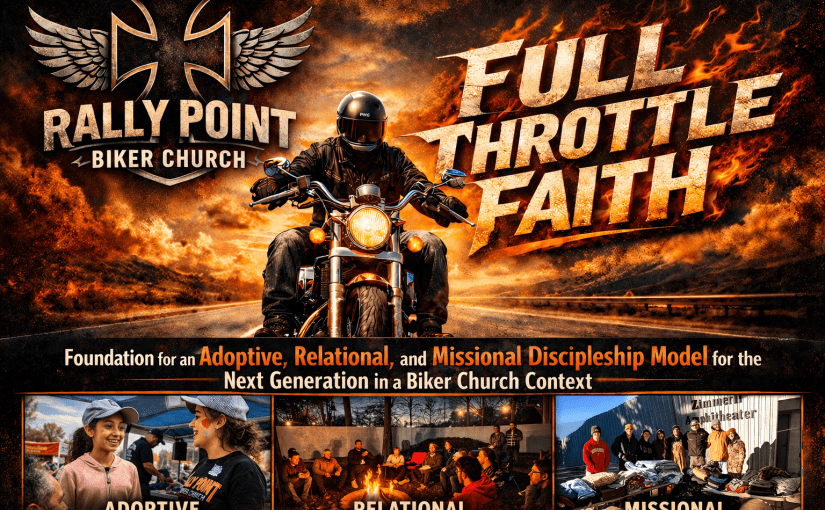
The Full Throttle Next Generation Discipleship Model (FTNG Model) is a relational, adoptive, and missional framework designed to disciple children, youth, and young adults within the unique cultural context of a biker church. This model integrates biblical authority, relational discipleship, and generational multiplication into a cohesive strategy that reflects both the New Testament pattern of disciple-making and the communal dynamics of biker culture. Drawing from Chap Clark’s concept of adoptive youth ministry, the FTNG Model emphasizes creating a family-like environment where young people are not merely participants but fully integrated members of the household of God.[1]
Thesis Statement
Effective next generation discipleship in a biker church context requires a relationally driven, adoptive, and mission-focused model that equips children, youth, and young adults to follow Christ, grow in biblical maturity, and multiply disciples within authentic community. This model is built upon the conviction that discipleship is not programmatic but relational and communal.
As demonstrated in the early church, spiritual formation occurs through teaching, fellowship, and shared mission (Acts 2:42–47).[2] The FTNG Model seeks to intentionally structure these elements within the rhythms of biker life – rides, gatherings, mentorship, and service – so that discipleship becomes a lived experience rather than an isolated event. This model also reflects the equipping mandate of Ephesians 4:12, where leaders prepare believers for ministry rather than perform ministry alone.[3] By prioritizing relational investment and leadership development, the FTNG Model ensures that the next generation is not only discipled but equipped to disciple others.
Introduction
The FTNG Model is designed to meet the spiritual formation needs of children, youth, and young adults within a biker church environment. Unlike traditional ministry models that rely heavily on structured programs, this model emphasizes relational discipleship, adoptive community, and missional living. At its core, the FTNG Model seeks to create an environment where young people are fully embraced as members of God’s family and are equipped to live out their faith in everyday life. Chap Clark’s concept of adoptive ministry provides a foundational framework, emphasizing that the goal of youth ministry is to “create an environment where young people are encouraged to live into their calling in Christ as agents of the kingdom within the household of God.”[4] This aligns closely with the relational and communal values already present in biker culture, such as loyalty, brotherhood, and authenticity.
The personal motivation behind this model stems from ministry experience within the biker community, where relationships carry more weight than programs and authenticity is essential for trust. Many young people in this context come from broken or fragmented family systems, making the need for an adoptive spiritual family even more critical. The FTNG Model seeks to bridge this gap by providing a discipleship pathway that is both biblically grounded and culturally relevant, ensuring that the next generation is not only reached but transformed.
Preferred Model Benefits
The FTNG Model offers several significant benefits for discipling children, youth, and young adults in a biker church context. First, it fosters authentic belonging through adoptive community. Many young people today experience isolation, broken homes, or lack of consistent mentorship. By emphasizing a family-based approach to ministry, this model creates an environment where every individual is known, valued, and supported. Clark emphasizes that effective ministry requires a communal identity where all members function as a family of siblings in Christ.[5] This sense of belonging is especially critical for children and youth who are forming their identity.
Second, the model promotes relational discipleship over program dependency. Rather than relying solely on events or classes, discipleship occurs through consistent relationships, mentorship, small groups, and shared life experiences. As demonstrated in the user’s disciple-making plan, discipleship is a journey that involves following Christ, being transformed by Him, and joining His mission. This relational focus aligns naturally with biker culture, where trust is built through shared experiences.
Third, the FTNG Model emphasizes leadership development and multiplication. By equipping young believers early, the model creates a pipeline for future leaders within the church. This reflects the biblical mandate of equipping the saints for ministry (Eph. 4:12) and ensures long-term sustainability. Clark reinforces that ministry effectiveness depends on clear goals and shared ownership among all participants.[6]
Fourth, the model supports missional engagement. Young people are not merely taught but are actively involved in outreach, service projects, and evangelistic efforts. This aligns with the Great Commission (Matt. 28:19-20) and helps young believers develop a lived-out faith rather than a theoretical one.
Finally, the FTNG Model is contextually adaptable. It recognizes that each church setting is unique and must tailor its approach accordingly. Clark notes that understanding context (history, culture, and community) is essential for effective ministry.[7] In a biker church, this means leveraging natural gathering points such as rides, garages, fellowship meals, and youth sporting events as discipleship environments.
Practical Implementation
The practical implementation of the FTNG Model centers on creating a structured yet flexible discipleship pathway that engages children, youth, and young adults at every stage of spiritual development. First, the model establishes a clear and compelling discipleship goal. Every leader, volunteer, and participant must understand that the mission is to develop mature followers of Christ who make disciples. Clark emphasizes that clarity of goal is the most significant factor in team effectiveness.[8] This goal must be consistently communicated through teaching, training, and personal interaction. Second, the model builds a multi-layered relational structure:
- Children (Ages 5–11): Focus on foundational biblical teaching, identity in Christ, and belonging. This includes interactive Bible teaching, family-style small groups, and mentorship from trusted adults.
- Youth (Ages 12–18): Emphasize identity formation, peer accountability, and spiritual disciplines. Small groups, mentorship, and service opportunities become central.
- Young Adults (18–29): Focus on leadership development, mission engagement, and life application. This includes discipleship groups (3-5 people), leadership training, and active ministry roles.
Third, the model prioritizes partnership and team-based ministry. Rather than a top-down leadership approach, the FTNG Model adopts a partnering leadership style where all members contribute to the mission. Clark contrasts this with the “I’m in charge” model, emphasizing that effective ministry requires collaboration and shared ownership.[9] Volunteers, parents, and leaders are all equipped to disciple the next generation.
Fourth, the model incorporates intentional training and evaluation. Volunteers receive ongoing training in four key areas: spiritual growth, understanding of students, ministry ownership, and encouragement.[10] Regular evaluation ensures that all programs and activities align with the overarching discipleship goal.
Finally, the model integrates discipleship into everyday life. In a biker church context, this includes:
- Discipleship during rides and events which offers life-on-life discipleship opportunities to have natural conversations that are organic and not forced.
- Mentorship in informal settings such as garages, which offers hands-on, heart-level discipleship opportunities to work side-by-side with next generation, providing teaching moments and open conversation.
- Family-style meals and hangouts, offering table discipleship, where kids feel safe, youth open-up, and young adults engage in deep conversation. This allows intentional conversation where older believers can speak into the lives of younger believers.
- Campfires and outdoor gatherings that provide opportunities for testimonies and real talk.
Conclusion
In conclusion, the Full Throttle Next Generation Discipleship Model provides a biblically grounded, relationally driven, and culturally relevant framework for discipling children, youth, and young adults within a biker church context. By prioritizing an adoptive community, life-on-life relationships, and missional engagement, this model moves beyond program-based ministry to cultivate authentic spiritual growth and multiplication. Rooted in the New Testament vision of the church as a family and a functioning body, the FTNG Model equips the next generation not only to follow Christ but to actively participate in His mission. As this model is implemented through intentional relationships, shared experiences, and everyday environments, it has the potential to produce mature disciples who live out their faith boldly and reproduce that faith in others, ensuring long-term kingdom impact within the biker community and beyond.
Bibliography
Anthony, Michael J. Perspectives on Children’s Spiritual Formation. Nashville: B&H, 2007.
Bonhoeffer, Dietrich. Discipleship. Minneapolis, MN: Fortress Press, 2003.
Clark, Chap. Adoptive Church: Creating an Environment Where Emerging Generations Belong.
Grand Rapids, MI: Baker Academic, 2018.
Earley, Dave, and Rod Dempsey. Discipleship Making Is: How to live the Great Commission
with Passion and Confidence. Brentwood, TN: B&H Academic, 2013.
Earley, Dave, and Rod Dempsey. Spiritual Formation Is: How to Grow in Jesus with Passion
and Confidence. Brentwood, TN: B&H Academic, 2018.
Linhart, Terry. Teaching the Next Generations: A Comprehensive Guide for Teaching Christian
Formation. Grand Rapids, MI: Baker Academic, 2016.
McKnight, Tim. Engaging Generation Z: Raising the Bar for Youth Ministry. Grand Rapids, MI:
Kregel Publications, 2021.
Ogden, Greg. Discipleship Essentials. Downers Grove, IL: InterVarsity Press, 2007.
Putman, Jim, Bobby Harrington, and Robert Coleman. DiscipleShift. Grand Rapids, MI:
Zondervan, 2013.
[1] Chap Clark, Adoptive Church: Creating an Environment Where Emerging Generations Belong (Grand Rapids, MI: Baker Academic, 2018), 69.
[2] Dave Earley and Rod Dempsey, Discipleship Making Is: How to Live the Great Commission with Love and Confidence (Brentwood, TN: B&H Academic, 2013), 40.
[3] Earley and Dempsey, Discipleship Making Is, 41.
[4] Clark, Adoptive Church, 69-70.
[5] Clark, Adoptive Church, 74.
[6] Clark, Adoptive Church, 70-71.
[7] Ibid., 72-75.
[8] Clark, Adoptive Church, 70-71.
[9] Ibid., 85-87.
[10] Clark, Adoptive Church, 96-97.


