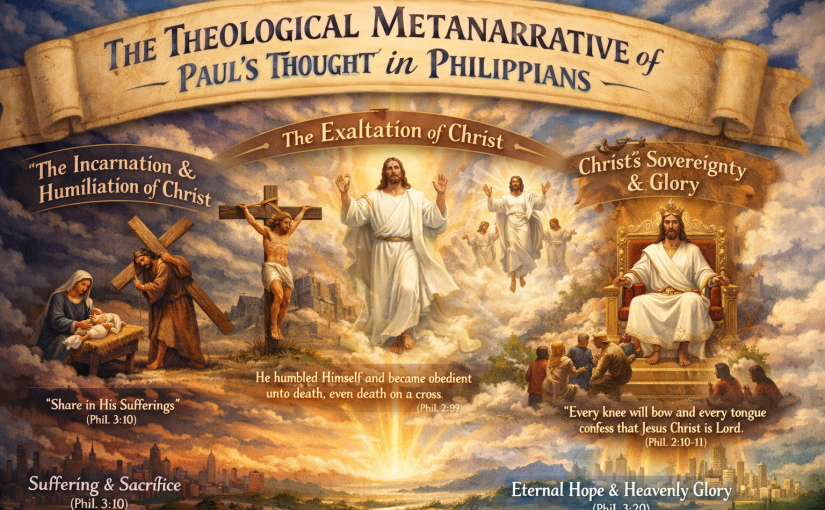
By: Pastor Joe Moore, Graduate Student, Liberty University Theological Seminary
Summary: Christology as Paul’s Theological Metanarrative in Philippians
A careful reading of Paul’s theology reveals that Christology, the identity and work of Jesus Christ, functions as the central metanarrative through which all other theological themes are interpreted. Paul does not treat Christ as merely one doctrine among many; rather, Christ is the organizing center of his gospel, shaping his understanding of salvation, the church, ethics, and future hope. As noted in Encountering the New Testament, Paul’s theology consistently emphasizes that God’s redemptive work is accomplished through Jesus Christ, whose death and resurrection stand at the heart of the Christian message.[1]
Paul’s high view of Christ is rooted in both divine identity and redemptive function. Christ is not only the Messiah promised in the Old Testament but also how God’s saving purposes are fulfilled. Paul frequently uses the phrase “in Christ” or “in the Lord” to describe the believer’s identity, highlighting a union that defines both salvation and daily living.[2] This union demonstrates that Christology is not abstract theology but deeply relational and transformative.
Additionally, Paul’s theology integrates Christology with the broader story of God’s work in Israel. Rather than rejecting Judaism, Paul sees the gospel as the fulfillment of God’s covenant promises. As Elwell and Yarborough emphasizes, responsible interpretation of Paul requires recognizing his continuity with Judaism and the integrity of his gospel within that context.[3] This reinforces that Christ is the culmination, not the contradiction, of God’s redemptive plan.
Furthermore, the cross and resurrection serve as the central events in Paul’s Christology. The cross represents the means of redemption, where Christ acts as a substitute for sinners, while the resurrection confirms His victory and guarantees future hope for believers.[4] Together, these realities shape Paul’s understanding of salvation and Christian living.
Thus, Christology provides the unifying framework for Paul’s theology. It informs his understanding of salvation (soteriology), shapes his ethical instruction, and anchors his eschatological hope. This metanarrative is especially evident in the letter to the Philippians, where Christ is presented as the believer’s life, model, and goal.
Application: Christology in the Argument and Flow of Philippians
When examined section-by-section, the book of Philippians clearly demonstrates that Christology governs Paul’s argument, exhortation, and pastoral concern, as expressed by Dr. Stacy.[5] Rather than presenting isolated teachings, Paul consistently grounds his exhortations in the person and work of Christ. Each major section of the letter is illuminated when understood through the lens of Christ.
Philippians 1:1–11: Christ as the Source of Salvation and Growth
Paul begins by affirming that the believers’ spiritual journey is grounded in Christ. His confidence that God will complete the work begun in them (Phil. 1:6) reflects a Christ-centered understanding of salvation. This aligns with Paul’s broader theology that redemption originates in God and is accomplished through Christ.[6] Their partnership (1:5) in the gospel is also rooted in their shared identity in Christ (1:7). This demonstrates that Christian fellowship is not merely social but theological, grounded in union with Christ.
Philippians 1:12–30: Christ as the Purpose in Suffering
Paul interprets his imprisonment through a Christological framework. Rather than viewing suffering as defeat, he sees it as advancing the gospel of Christ. His statement, “to live is Christ and to die is gain” (1:21), epitomized the centrality of Christ in his life. This reflects Paul’s broader conviction that the cross is not only the means of redemption but also the pattern for Christian living.[7] Suffering, therefore, becomes participation in Christ’s mission and identity.
Philippians 2:1–11: Christ as the Model for Humility and Unity
This passage provides one of the clearest expressions of Christology shaping Christian ethics. Paul calls believers to unity and humility, grounding his appeal in the example of Christ’s incarnation and obedience. The Christ hymn (2:6-11) demonstrates both Christ’s divine status and His willingness to humble Himself for the sake of others. This reflects Paul’s broader teaching that Christ’s work defines the ethical life of believers.[8] Christian unity is achieved not through human effort alone but through imitation of Christ’s character.
Philippians 2:12–30: Christ as the Power for Obedience
Paul continues by urging believers to live out their salvation, emphasizing that God is at work within them. This reflects the ongoing influence of Christ in the believer’s life (2:13). The examples of Timothy and Epaphroditus (2:19, 25) further illustrate Christ-centered living. Their sacrificial service mirrors Christ’s own humility, reinforcing that Christology shapes not only belief but behavior.
Philippians 3:1–21: Christ as the Supreme Treasure and Future Hope
In this section, Paul contrasts reliance on the law with faith in Christ. His declaration that he counts all things as loss compared to knowing Christ (3:8) reflects the supremacy of Christ in his theology. This also connects to broader debates about the law in Paul’s writings. While the law reveals human need, it ultimately points to Christ as the source of righteousness.[9] Thus, Christ is both the fulfillment of the law and the means of salvation. Additionally, Paul’s emphasis on future transformation (3:20–21) demonstrates that Christ is central to eschatological hope. Believers await the return of Christ, who will complete their redemption.
Philippians 4:1–23: Christ as the Source of Strength and Contentment
Paul concludes by emphasizing Christ as the source of peace and strength. His statement, “I can do all things through him who strengthens me” (4:13), reflects complete dependence on Christ. This aligns with Paul’s broader theology that Christian life is sustained by God’s power through Christ.[10] Whether in abundance or need, believers find contentment in their relationship with Him.
Conclusion
The book of Philippians clearly demonstrates that Christology is the metanarrative that best explains Paul’s theology and pastoral instruction. Every section of the letter, whether addressing suffering, unity, obedience, or hope, is shaped by the person and work of Christ. Christ is the source of salvation, the model for Christian living, the purpose in suffering, and the hope of future glory. As Paul’s theology consistently affirms, all of life is to be understood “in Christ.” This Christ-centered vision provides both theological coherence and practical guidance for believers, uniting doctrine and daily living into a single, transformative framework.
Bibliography
Campbell, Douglas A., “Christ and the Church in Paul: A ‘Post-New Perspective’ Account,” in Four Views on the Apostle Paul, ed. Stanley N. Gundry and Michael F. Bird. Grand Rapids, MI: Zondervan, 2012.
Elwell, Walter A. and Yarbrough, Robert W., Encountering the New Testament: A Historical and Theological Survey, 4th ed. Grand Rapids, MI: Baker Academic, 2022.
Stacy, Robert W., “The Theological Metanarrative of Paul’s Thought” course presentation. Liberty University.
[1] Walter A. Elwell and Robert W. Yarbrough, Encountering the New Testament: A Historical and Theological Survey, 4th ed. (Grand Rapids, MI: Baker Academic, 2022), 244.
[2] Ibid., 252.
[3] Douglas A. Campbell, “Christ and the Church in Paul: A ‘Post-New Perspective’ Account,” in Four Views on the Apostle Paul, ed. Stanley N. Gundry and Michael F. Bird (Grand Rapids, MI: Zondervan, 2012), 114.
[4] Elwell and Yarbrough, Encountering the New Testament, 249–251.
[5] Robert W. Stacy, “The Theological Metanarrative of Paul’s Thought” course presentation. Liberty University.
[6] Elwell and Yarbrough, Encountering the New Testament, 249.
[7] Ibid., 250.
[8] Elwell and Yarbrough, Encountering the New Testament, 253.
[9] Ibid., 245-246.
[10] Elwell and Yarbrough, Encountering the New Testament, 244-245.

 Fighting for My Pea Patch