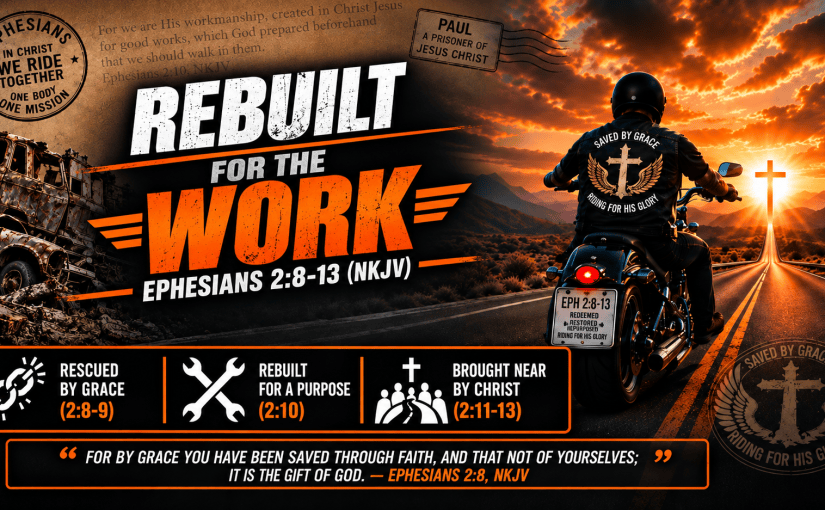
Built, Tuned, and Finished by God

Take your Bible and turn with me this morning to Philippians chapter 1.

The book of Philippians is a powerful and personal letter written by the Apostle Paul during a time of imprisonment, yet it overflows with joy, encouragement, and unwavering confidence in Christ. Addressed to the believers in Philippi, this letter calls Christians to live with unity, humility, and a deep, abiding faith regardless of circumstances. Throughout Philippians, Paul emphasizes rejoicing in the Lord, adopting the mind of Christ, and valuing a relationship with Him above all else. As we study this book, we will discover how to experience true joy in every season of life and how to live boldly and faithfully for Christ, even in the midst of trials.

Philippians 1… and we’re going to begin in verse 1.

Now I want to talk to you this morning about something every one of us wrestles with at some point in our walk with God… And that is this question:

“Am I really going to make it?” Not just make it through the week…Not just make it through the struggle…But make it all the way to the end.

Because if we’re honest…

  • We’ve all had moments where we felt weak…
  • We’ve all had seasons where we felt inconsistent…
  • We’ve all had times where we thought, “Man, I should be further along than I am right now.”

And the danger is this – We start believing that our Christian life depends more on our grip on God…Than God’s grip on us.

But Paul opens this letter with a powerful reminder:

  • The Christian life didn’t start with you…
  • And it won’t be sustained by you…
  • And it won’t be finished by you.

God started it…God sustains it…And God will finish it.

And that’s what I want to preach on this morning: Reminding us that we are Built, Tuned, and Finished by God.

Paul shows us that God’s faithful work in our lives is seen in several ways.

A FELLOWSHIP ESTABLISHED BY GRACE (vv. 1–2)

Paul and Timotheus… to all the saints in Christ Jesus…

Right out of the gate, Paul reminds them of who they are. They are saints in Christ Jesus. Now don’t miss that.

He didn’t say:

  • “Perfect people”
  • “People who have it all together”
  • “People who never struggle”

He said saints. That means they’ve been set apart by God. Saved by grace. Positioned in Christ.

And listen – Before you ever started acting like a Christian…

God declared you His.

It’s like when you buy a bike.

Before you ever ride it… before you ever customize it… before you ever clean it up…It’s already yours. It belongs to you.

And can I tell you something? God didn’t wait for you to get cleaned up before He claimed you.

He claimed you… then He started cleaning you.

And not only that – He placed you in a fellowship. You’re not riding this road alone. That’s why we’ve got the church. That’s why we’ve got brothers and sisters. Because God’s work in you includes the people around you.

Paul sees their fellowship… and it leads him to something else…

A PARTNERSHIP STRENGTHENED BY THE GOSPEL (vv.3-5)

I thank my God upon every remembrance of you…

Paul says, “Every time I think about you, I thank God.”

Why? “Because of your fellowship in the gospel…” These people weren’t just showing up…They were invested.

  • They were praying…
  • They were giving…
  • They were serving…
  • They were advancing the gospel.

That’s the difference between spectators and riders. Some folks sit on the sidelines and watch…But others get on the bike and ride.

  • They’re in it.
  • They’re committed.
  • They’re moving forward.

The gospel doesn’t just save you…It recruits you. You don’t just receive it…You participate in it.

Let me ask you something this morning: Are you just attending church…Or are you partnering in the gospel? Because when God is working in your life…You don’t just sit…You engage.

And that partnership leads Paul to one of the greatest promises in all the Bible…

A CONFIDENCE SECURED BY GOD’S FAITHFULNESS (v. 6)

Being confident of this very thing…

Now Paul doesn’t say, “I hope…” He doesn’t say, “I think…” He says, “I am confident.”

What is he confident in?

That He which hath begun a good work in you will perform it until the day of Jesus Christ.

Let that sink in…God started something in you…And God is not quitting halfway through.

If you’ve ever worked on a bike or a car…You know what it’s like to start a project…Take it apart…And then leave it sitting in the garage.

  • Half-finished.
  • Parts everywhere.

But can I tell you something? God doesn’t leave projects undone.

He’s not looking at your life saying, “Well, I tried… but they were too much.” No…What God starts—God finishes.

Our confidence is not in, our discipline, our consistency, or even our strength – our confidence is in God’s faithfulness:

So when you feel like you’re failing…When you feel like you’re falling short…When you feel like you’re not where you ought to be…Remember this: God is not finished with you yet.

And that confidence produces something powerful…

A LOVE ROOTED IN SHARED GOSPEL (vv. 7-8)

Paul says, “I have you in my heart…

That’s strong language. This isn’t surface-level connection…This is deep, Christ-centered love.

Why?

Because they were partakers of grace together.

  • They had suffered together…
  • They had stood together…
  • They had served together…

There’s something about people who’ve been through the fire together. They understand each other. They carry something deeper than casual friendship.

Grace doesn’t just connect you to God…It connects you to people.

That’s why church isn’t just an event…It’s a family. It’s a brotherhood. It’s a place where love runs deeper than convenience.

And that love leads Paul to pray something powerful…

A MATURITY GROWING IN DISCERNMENT AND RIGHTEOUSNESS (vv. 9–11)

And this I pray…”

Paul prays that their love would abound more and more…But not just emotional love – Love with knowledge and discernment.

He says:

  • That you may approve what is excellent
  • That you may be sincere and without offense
  • That you may be filled with the fruits of righteousness

In other words – God’s work in you is not just about saving you…
It’s about shaping you.

A healthy tree doesn’t just exist…It grows…And eventually—it produces fruit.

Christian maturity is not just what you feel, or what you say – it’s what your life produces!

God wants your love to grow…Your discernment to sharpen…Your life to reflect Christ…So that everything points back to Him.

SO, let me bring this message home for you.

Some of you walked in here today wondering if you’re going to make it. You’ve been struggling…You’ve been battling…You’ve been questioning…But I came to remind you this morning:

  • You are not held together by your strength…
  • You are held together by God’s faithfulness.

He saved you by grace. . . He placed you in fellowship. . .He called you into partnership. . .He is sustaining you right now. . .And He will finish what He started.

So stop living in fear…Stop living in doubt…Stop acting like it all depends on you…And start walking in confidence – Confidence in the Work of Christ.

Because one day…You’re going to stand before Him…And you won’t stand there half-finished…You’ll stand there complete – Because God finished what He started.

What’s So Good About the Cross?

John Stott said, “Before we can begin to see the cross as something done for us, we have to see it as something done by us.”

Franklin Graham, “It was Christ who willingly went to the cross, and it was our sins that took him there.”

Michael Youssef said, “Only in the Cross of Christ will we receive power when we are powerless. We will find strength when we are weak. We will experience hope when our situation is hopeless. Only in the Cross is there peace for our troubled hearts.”

The songwriter said:

On a hill far away, stood an Ole Rugged Cross

The Emblem of suffering and shame.

And how I love that ole Cross, where the dearest and best

For a world of lost sinners was slain.

To the Old Rugged Cross, I will ever be true,

It’s shame and reproach gladly bear.

Till He calls me some day, to my home far away,

Where His glory forever, I’ll share.

Another songwriter said,

At the Cross, at the Cross, where I first saw the light,

And the burdens of my heart rolled away,

It was there by faith, I received my sight,

and now I am happy all the day.

Janet Paschal sang a song in 2000 that has seared my soul.  It says:

In letters of Crimson, God wrote His love, on a hillside, so long, long ago.

For you and for me, Jesus died, and Love’s greatest story was told.

I love you, I love you – That’s what Calvary says.

I love you, I love you, I love you – Written in red!

Oh Precious, Is the flow – that makes me white as snow.

No other fount I know – Nothing but the blood of Jesus!

Our Lord Himself said, “If anyone would come after me, let him deny himself, pick up his cross and follow me.”

Someone asked me once, if I could only have one book of the Bible, which one would I take?  Though I would certainly hate to part with the Gospel of John, or even the Psalms, but, I would have to say, I would take the Book of Romans.

Now, as the name of the book indicates, The Book of Romans was written to the Christians, the believers, that were living inside the city of Rome, which happened to be, the capital of the entire Roman Empire.  And the Roman Empire was massive, taking in parts of Europe, and Asia and Africa.  Some believe there could well have been over 100,000,000 people in the Roman Empire at its height.

So Paul is writing to the Christian community inside of Rome to encourage them in the faith.  Of the Pauline Epistles, this one is the longest and most complex.  The central message is the Good News. 

  • Jesus Christ came to live a life that we could not live;
  • Yet He died a death that we should have died. 

Yet, if we are going to talk about this Good News, then we have to first recognize that there is some bad news.  And that bad news is that:

  • “all have sinned and come short of the glory of God.”  And because of that sin, there is a penalty.
  • “The wages of sin, is death . . .”

Folks, we are deeply flawed, and so that brings us to the theme of Romans, and that is the Righteousness of God – which you see all throughout this Book.  So in the Book of Romans, Paul sets out to tell us how a deeply flawed people can have the right relationship with God.  And folks, that “Right Relationship” cannot be earned – it has to be received. 

And what Paul sets out to share is that when a person comes to that right relationship with God, our wrongs are transferred to Jesus’ account – and His righteousness is transferred to our account!  It cannot be earned, it is received – it is a free gift, a free pardon of sin. 

Paul seeks to encourage us in this Book by sharing God’s love, and His mercy, and His grace. 

And right in the middle of this wonderful Book, we come to chapter 8.  It begins with No Condemnation. “There is therefore now no condemnation to them which are in Christ Jesus, who walk not after the flesh, but after the Spirit.”

It ends with No Separation.  “Who shall separate us from the love of Christ? Shall tribulation, or distress, or persecution, or famine, or nakedness, or peril, or sword?  As it is written, For thy sake we are killed all the day long; we are accounted as sheep for the slaughter.  Nay, in all these things we are more than conquerors through him that loved us.  For I am persuaded, that neither death, nor life, nor angels, nor principalities, nor powers, nor things present, nor things to come.  Nor height, nor depth, nor any creature, shall be able to separate us from the love of God which is in Christ Jesus our Lord.”

But I want to draw your attention to verse 34, and I want to show you how I think the Apostle Paul was able to find What’s So Good about The Cross!

Now understand with me, Paul understood very well that not everything is good:  I mean:

  • Being shipwrecked – wasn’t a good thing;
  • Being in perils of the sea, perils of the wilderness and perils of false brothers – that wasn’t a good thing;
  • Being in labors more abundantly – wasn’t a good thing;
  • Being whipped 5 times with 40 lashes – wasn’t a good thing;
  • Being stoned – wasn’t a good thing;
  • Being in prison – wasn’t a good thing;
  • Being near death often – wasn’t a good thing;
  • Being cold, hungry and weary  wasn’t a good thing.

Yet, Paul said in Romans 8:18, “For I reckon that the sufferings of this present time are not worthy to be compared with the glory which shall be revealed in us.”

No wonder Paul said, “Rejoice in the LORD always, and again I say Rejoice!”

And I believe verse 34 tells us how Paul found What’s Good about The Cross?:  “Who is he that condemneth?  It is Christ that died, yea rather, that is risen again, who IS even at the right hand of God, who also maketh intercession for us.”

First of all, notice with me:

IT’S GOOD BECAUSE OF THE DEATH OF CHRIST

Now how in the world does somebody find good in the death of somebody?  I mean, when somebody dies, it’s pretty natural that we cry.  It is natural that we weep at funerals.  Yet Paul rejoiced in the death of Christ.

Now, I have rehearsed in my mind, that scene in the Upper Room, when Christ observed the Passover with His disciples for the last time and instituted the Lord’s Supper. (COMMUNION TIME)

I have traced His steps when He came down from that place and went out the Eastern Gate by the Kidron Valley and He walk by the little mountain called the Mount of Olives, and I watched Him as he knelt praying in the Garden of Gethsemane – it would soon all be over.  I imagine it was quite in that garden.  But then there was a commotion, and Judas Iscariot, the one who betrayed Him for 30 pieces of silver, leads those soldiers and says, “He whom I kiss – hold Him fast.”  Hold His hands – He does things with those hands – I’ve seen it.

  • I’ve seen Him run his hands over the eyes of a blind man to let the morning light in.
  • I’ve seen Him touch the ears of deaf and allow them to hear the birds sing;
  • I’ve seen Him touch the lame and watched them as they took their first steps;
  • I’ve seen Him touch the death and watched them rise to newness of life.

Watch His hands, He does things with those hands.

Those soldiers follow, and as Judas betrays Christ with a kiss on the cheek, they lay hold of Jesus and Simon Peter swings into actions, draws his sword and cuts off the ear of one of those soldiers.  Jesus picks it up and puts it back on.  Now folks, I don’t know what you would have done, but if I would have come in with those soldiers and saw that, I would of said, “Now fellows, I came in with you – But I’m going out with Him!”

Judas warned them – He does things with those hands!

Jesus is arrested and carried to the house of the High Priest Caiphus.  He is then sent to Pilate, who sends him to Herod, who sends him back to Pilate.

So Pilate then takes a comfy seat and begins to examine Christ.  Pilate asked Jesus, “Are you the King of the Jews?”  Jesus said, “Thou sayest.” And after his thorough examination Pilate concludes “I find no fault in Him.”  And folks – You won’t either.

And although Pilate found no fault in Him, he condemned Him and sent out to be crucified via the Via Delorossa. 

  • Those Roman soldiers platter a crown of throns and shoved it on his head,
  • They wrapped Him an a purple rob and paraded Him around saying, “Hail, King of the Jews.”
  • They laid that cross on the ground and drove nails in His hands and feet.
  • They hoisted up that Cross and shoved it into a hole, sending jolts of pain all through the body of Christ.

Now, how in the world could anybody find something Good in that?

Jesus made 7 sayings from that Cross.  The last being “Father, into Thy hands I commend my Spirit.”  Then His head dropped and He gave up the ghost.

Someone in the crowd said, “He’s dead now.  He’s gone now.”

Why did He die?  Was He a fanatic dying for a cause?  Was he suicidal?

No friends, that was the Rose of Sharon, the Lily of the Valley, the Bright and morning Star, dying so that you and I could have life, and have it more abundantly!

Paul said, “Sure I deserve to go to hell.  Sure I deserve to die a sinners death.”

But, “Who is he that condemneth?  It is Christ that died . . .”  Paul realized What was So Good About the Cross was the fact thatGod commended His love toward us, in that while we were yet sinners, Christ died for us.”

It’s Good Because of the Death of Christ, But

IT’S GOOD BECAUSE OF THE RESURRECTION OF CHRIST

“. . . It is Christ that died, yea rather, is risen again . . .”  AMEN!

After Jesus died, that secret disciple, Joseph of Arimethea, when to Pilate and begged for the body of Christ.  Then he and Nicodemus took Christ down from that Cross.  Which, by the way, was not an easy thing to do.  They then took the body of Christ and laid him in an empty tomb. 

They washed the blood and dirt from body of Christ then wrapped Him in clean white linen, as was their custom.  Then they did something else, they took a napkin, and placed it over His face (the Shroud of Turan). 

Then, for the next 3 days, I imagined the birds refused to sing, as these were the darkest days the world has ever known. 

The sun didn’t dash over it’s face

But, on the third day, something happened.  God said to an Angel in Heaven, “Go get Him!”  That angel flew from Heaven swiftly, and I imagine that as his foot touched the ground, that stone rolled away.  He walked inside that damp, musky tomb and said to the Son of God, “Your Father wants You.”  Jesus got up and walked out of that tomb.

Up From the Grave He arose, with a mighty triumph over his foes.

He arose a victor from the vast domain, and he lives forever with his saints to reign

He arose, He arose, Hallelujah Christ Arose!

“. . . it is Christ that died, yea rather, is risen . . .” 

If you remember when the ladies came to put spices on the body of Christ, and there was an angel who said to them, “Why look ye for the living among the dead?  For He is not here, for He is risen?

The ladies ran quickly back to the Upper Room to tell the disciples.  The Peter and John ran to the tomb and as they went inside, they found something very unusual.  That napkin, that was laid on the Face of Jesus, it wasn’t thrown over to the side, but it was neatly folded. 

Now, to understand the significance of that, you have to understand something about their culture.  You see, this had to do with the Servant and the Master.  Whenever a servant would set the table, they would place a napkin neatly by the plate, so the master could wipe their hands or face while they were eating.  The servant would then go somewhere out of sight, but where he had a view of the table, so they could quickly clear the table when the Master was finished.  Now, if the Master ate his meal, then took that napkin and wiped his hands and face, then crumbled it up and placed it on the table, then got up to leave, that meant he was finished, and the servant could clear the table.

However, if the Master got up from the table and wiped his hands or face, then folded the napkin and placed it on the table.  The servant wouldn’t dare touch the table.  Because the folded napkin meant “I’m not finished yet – I’m coming back!”

So when Peter and John saw that folded napkin, the Spirit of God spoke to their hearts and said, “He’s not finished yet – He’s coming back!”

Can you imagine how Peter’s heart felt seeing that napkin and knowing that he had just denied Christ, not once, not twice, but three times?  I’m sure he asked himself, “Can He ever forgive me?”  Then he saw that napkin and knew “He’s not finished with Grace, and He’s not finished with mercy.  He’s coming back!”

Who is he that condemneth?  It is Christ that died, yea rather, that is risen again, . . .”

It’s Good Because of  the death of Christ and It’s Good Because of the Resurrection of Christ, but,

BUT IT’S GOD BECAUSE OF THE EXALTATION OF CHRIST

Jesus went back to Heaven, sat down at the right hand of God the Father, and there – He intercedes for you and for me!

I don’t know about you, but I can say that for Joe Moore, I still stumble and fall at times.  And every time I do, I can see the devil going to God the Father saying, “Look at ole Joe fall AGAIN.  He doesn’t deserve Your love, and he doesn’t deserve Your grace.  He doesn’t deserve Your mercy.”

And I’ll tell you folks, if I had to stand on my own merit, I’d be in a world of trouble.  But thank God this morning that I have and Advocate with the Father – Jesus Christ the Righteous.  And every time I stumble, and every time I fall, and every time I come up short, Jesus steps in and says, “Dad, I took care of that!”

  • Every time I go to Him and say, “Lord, I failed you again.”  He says, “I Know.”
  • “Lord, will you forgive me?”  He says, “I did.”

There is a story in the Bible about Onesimus.  Onesimus was a slave of Philemon.  Onesimus ran away from his master, and sometime later, while he was on his journey, Onesimus cross paths with the Apostle Paul.  Onesimus got Saved.  Later, Paul was sending him to Philemon, and he wrote and said something along these lines:

“Philemon, I’m sending some people to you.  But Philemon, when you receive them, I want you to receive them as if you were receiving me.  If you’re my co-laborer, receive them like you would me.  Give them the respect you’ve given me.  Don’t be mad at him, and if he owes you anything – put that on my account!”

Now, let’s bring that over into the spiritual realm.  And I can see Jesus, sitting at the right hand of God, making intercession for Joe, and I imagine Him saying something like this:

Father – DAD – I know he ain’t much.  I know he’s done you wrong.  But when he comes to You, I ask you to receive him as if you were receiving Me.  Dad, I paid for his sins.  If he owes you anything – put that on my account!

Who is he that condemneth?  It is Christ that died, yea rather, that is risen again, who is even at the right hand of God, who also maketh intercession FOR US.”

CONCLUSION:  Let me conclude with this thought.  Isaiah 61:10 begins by saying, “I will greatly rejoice in the Lord, my soul shall be joyful in my God; for he hath clothed me with the garments of salvation, he hath covered me with the robe of righteousness . . .”

  • Maybe you and I can’t rejoice over our circumstances – But we can “GREATLY Rejoice in the LORD.”
  • Maybe we can’t rejoice over failed relationships, or failed partnerships, or failed business attempts, but, we can “Greatly rejoice in the LORD.”
  • Maybe we can’t rejoice over some of the decisions we’ve made in life, but we can “GREATLY Rejoice in the LORD.”

Isaiah is saying here, “I will greatly rejoice.”  He was saying, “From the depths of my soul I will rejoice.”  “MY joy shall be in my God.”

  • “Down in the depths of my soul, I’m gonna rejoice that I’m a Child of the King!”
  • “Down in the depths of my soul, I’m gonna rejoice that I have a place at the King’s table.”
  • “Down in the depths of my soul, I’m gonna rejoice that my name’s written down in the Lamb’s Book of Life.”
  • “Down in the depths of my soul, I’m gonna rejoice that I’ve been redeemed by the Blood of the Lamb!”

What do You do When Jesus Doesn’t do What You Thought He Ought to do?

Pastor Joe Moore, Rally Point Biker Church

I’m grateful that you are here today – whether you come regularly, or your just visiting – we’re honored you chose to worship with us today.  I want you to pray for us this morning.

I am reminded of a young fella that went to his preacher and asked him to pray for his hearing.  Without skipping a beat, that Preacher said, “Well son, we’ll just pray right now.”  That preacher reached both hands up and grabbed that boy’s ears and began to pray, and he prayed, and I mean he really prayed for that boy.  When he got finished, he asked the boy how his hearing was.  The boy said, ‘I don’t know preacher, my hearings not until next week!

I want you to turn your Bible with me to a familiar chapter of John Chapter 11 and verse 6.  And let me say, I’m a lot slower than I used to be, but I’m going somewhere this morning, and I want you to go with me.  John 11:6:

When he had heard therefore that he was sick, he abode two days still in the same place where he was.”  I want to speak to you this morning on this thought:  What do you do when Jesus doesn’t do what you think He ought to do?  Let’s Pray!

John Chapter 11 records for us the death of Lazarus.  It is believed that Jesus spent a lot of time in the home of Mary, Martha and Lazarus, as he ministered in and around Jerusalem.  Yet, in this chapter, this family whom He loved:

  • They are going through the biggest valley they have ever crossed;
  • They are facing the greatest trial they will ever face;
  • They are facing the greatest tragedy they’ve ever faced;
  • And they are carrying the heaviest burden they will ever carry.

And in this moment, in this time when they really needed Jesus – He wasn’t there.

So, what do you do, when Jesus doesn’t do what you think He ought to do?

And then He says in verse 15, “And I am glad for your sake that I was not there.

Not only was Jesus not there – but, He was glad He wasn’t there.

Has there ever been a time in your life when you really needed the Lord to be there, but seemingly, He wasn’t there?  Job said in Job 23, “Oh that I might know where He is that I might find Him.” 

The valley was so deep, and the night was so dark that Job said, “I can’t find God.”  Has there ever been a time when you needed Him, yet you couldn’t find Him?

If you study this chapter, you will find that He was not there, He was glad He was not there, even though they called for Him.  In verse 3, the Bible says,

Therefore his sisters sent unto him, saying, Lord, behold, he whom thou lovest is sick.”  And I love the way they approach the Lord “He whom thou lovest is sick.”

You see folks, they didn’t approach Jesus on the basis that they loved Him, but rather, on the basis of His love for them!

GOD IS LOVE!  And I am grateful that He loves us unconditionally.  If He blessed us based on our love for Him, we’d be in serious trouble!  But, I am grateful this morning that He blesses us on the merit of His love!

Behold, he whom thou lovest is sick.(V.1)”  Even though they called for Him, He was not there.

Have you ever prayed and it just felt like your prayers were falling on deaf ears?  Have you ever prayed and it just seems the Lord would not respond?

Even though they called for Him, He was not there.  And even though He cared for them, He was not there.  Now look at verse 5:  “Now Jesus loved Martha, and her sister, and Lazarus.

Does anybody know who the sister was here?  It was Mary.  Mary was the worshipper in the family.  Mary appears 3 times in the Bible, and all 3 times she is found at the feet of Jesus.

Martha on the other hand, was a take control kinda person.  She didn’t have time to sit at the feet of Jesus.  Martha was too busy serving and working.  She took matters into her own hands, and when she didn’t know what to say, well, she’d just say anything.

She even told Jesus what to do, “LORD, bid her that she might help me.”

Now I’ve heard a lot of wonderful messages over my lifetime about Mary sitting at the feet of Jesus – but I’ve never heard one positive message about Martha.

I’ve heard many poems about Mary – but I’ve never heard a poem about Martha.

  • But notice what the Bible says, “Now Jesus loved Martha – and her sister, and Lazarus.”
  • Jesus loved Martha, and what’s her name, and Lazarus.”

I think everyone of us has a little bit of Martha in us (some of us more than others),:

  • We get to busy;
  • We don’t have time to sit at the feet of Jesus;
  • We don’t have time to hear His word.

A lot of us say the wrong things, we take matters into our own hands.  We ALL have a little bit of Martha in us, yet the Bible says, “Jesus loved Martha, and whatchamacallher, and Lazarus.”

Sometimes our circumstances talks to us and tells us that He doesn’t care!

Have your trials ever whispered to you saying “There’s no need to pray, God is not listening anyway, He’s not gonna hear you.”  He was not there, even though He was conscious of what was happening.

In verse 7, Jesus begins a conversation with His disciples that went like this:  “Then He said to His disciples, “Let us go into Judea again.”  “We’ve gotta go back to Bethany.”  “Our friend Lazarus is sick, he is asleep.” 

The disciples didn’t want to go back to that region, because the Jews were trying to kill them.  They said, “LORD, the Jews tried to kill you there, “And thou goest thither again????”

Jesus said, “I’ve gotta go back.  Lazarus is asleep and I’ve got to go wake him.”

The Disciples said, “Well, Lord, if he’s sleeping, if he’s resting, then he doeth well.”  So Jesus plainly tells them that Lazarus is dead.

  • He knew about their pain;
  • He knew about their sorrow;
  • He knew about every tear that Mary and Martha had shed;
  • He knew when Lazarus drew his last breath;
  • He knew when Lazarus closed his eyes and died.

YET – HE WAS NOT THERE!

So I ask you church, What do you do when Jesus doesn’t do what you think He should do?

Everything that Jesus did was with purpose.  When He spoke – it was with purpose.  Every place He went – it was with purpose.   And when He didn’t show up when they called – there was a purpose.

Now I don’t know about you, but I’m interested in knowing why He waited.  Jesus is about 20 miles from Bethany (1 days walk).  The servants came and told Jesus that Lazarus was sick.  So Jesus abode there 2 more days.  And after 2 days, He said unto His disciples, “Let us rise and go into Bethany.”  (another days walk).  So when you put that all together, Jesus was 4 days late!

When Jesus arrived in Bethany, Martha went out to meet Him and cried, “Lord, if thou hast been here, my brother would not have died.

Notice, Mary, the religious one, didn’t even come.  In fact, she didn’t come until Jesus sent for her.

I believe they were both upset because they knew that Jesus could have prevented this.  And when Mary finally came out, and though she fell at the feet of Jesus, she said exactly what Martha said, “Lord, if thou hast been here.”

  • Lord, if you would have been here, you could have stopped this;”
  • Lord, if you would have been here, you could have prevented this;”
  • Lord, If Thou would have been here, my brother would not have died.”

But, He wasn’t there.  Why did He wait?  Let me give you 3 reasons why I believe He waited:

I THINK HE WAITED IN CONNECTION TO PEOPLE

If you study the traditional Jewish funeral, in Bible days, in that particular culture, you will discover that they buried their dead the same day that they died.

How many of you know that Andy Griffith was from Mt. Airy, NC (Mayberry)?  How many of you knew that when Andy Griffith died at 7 a.m. the morning of July 3rd, 2012, that he was buried at 11 a.m. that same morning?  Now, this was very unusual in our culture – but not for the Jewish culture.

Now they would wrap up their dead with linen, or grave clothes and bury them the same day they died.  For the next 3 days, only the immediate family was allowed to come to the family home.  The immediate family would hire professional mourners, grievers to come and mourn as an expression of respect for the deceased.  For 3 days, only the immediately family was allowed to come.

BUT – on the 4th day!  All the family would come; all the neighbors would come; all the friends would come.

Jesus waited until the 4th day!  Look at verse 45 with me, “Then many of the Jews which came to Mary, and had seen the things which Jesus did, believed on him.”

Jesus didn’t say that He came to call the righteous to repentance, but the sinners.

So, on the 1st day, it’s not time.  On the 2nd day, He didn’t show up.  On the 3rd day, He’s not there.  BUT, on the 4th day, when everyone was there, He arrived.

He was waiting for the people to arrive, because He knew that many of them would believe.

HIS WAITING WAS IN CONNECTION TO POWER

The Gospels record 3 separate occasions when Jesus raised the dead:

  1. He raised Jairus’ daughter a few minutes after she died;
  2. He raised the widow’s son a few hours after he died;
  3. And then He raises Lazarus, who had been dead for 4 days.

When Jesus told them to roll the stone away, they said, “Lord, he’s been dead for 4 days now, surely his body stinketh!  For those that have difficulty understanding the old archaic language of the King James Bible, that meant he stunk!

When Christ raised Jairus’ daughter from the dead, and when He raised the Widow’s son from the dead, there were skeptics who said, “Well, this is no big deal, they probably were not dead anyway – they just thought they were dead.  Lazarus, on the other hand, had been dead for 4 days.  There was no question that he was dead.

You see, Jesus waited, and waited, and waited for the right opportunity to manifest His power!

Looking back over my life as a Christian, there have been many times in my life where it seemed He was not there.  I look back over some of the storms in my life, some of the circumstances in my life, and my conscience says – God just doesn’t care.

But as I look back over my life, I understand now, and I realize now that through the storms of my life; through the valleys of my life; through the trials and tragedies of my life – He was creating opportunities to manifest His power:  Let you illustrate this with a story that really hits home for us all:

Kim and I started attending Freedom Biker Church in March or April of 2014.  We didn’t know a lot of people, but soon after we started coming, there was a trip to Maggie Valley for the Rally there.  Kim and I went.  We got to spend some time with some of the folks.  On Sunday morning, we all attended services at a Baptist Church there.  I remember Marty and Sunshine were there, I also remember JB and Julia being there.  That was the first time we’d really gotten to speak with them one-on-one.  And I enjoyed spending time with J.B.  We all sat in the parking lot after the service for a while talking.  Soon after that trip I had returned to work overseas, and I received the news about JB’s accident from my wife.  My first thoughts were sadness for Julia and for the girls.  What a tragedy I thought.  In fact, one of the most devastating tragedies I believe we face on this earth.

But looking back on that tragedy now, I see how God turned what we thought was bad, into good.  It was that single incident that has Mom and Pops in church now; through that incident, we haven’t seen Julia waiver in her faith one time; through that tragedy, we have watched those girls grow up loving God.  They know where their daddy is and they know one day they’re going to see him again.  We’ve seen David and Glenda get in there and get involved with the Work of God.

Friends, that is God connecting His power!

HE WAITED IN CONNECTION TO PURPOSE

Verse 45 says many of the Jews that came to Mary, and had seen the things that He had done – believed on Him.  But, not all of them believed.

Verse 46 tells us that some of them went back to the Pharisees and the Chief Priest and said, “We saw it with our own eyes.  Lazarus had been dead for 4 days and Jesus called him by name and he came walking out of that tomb with the death clothes still on him.“

Let me give you this for free – Lazarus came out wearing his death clothes, cause he will die again and he’s gonna need them then.  When Jesus came up out of the grave, He left his clothes laying there cause He will not be needing them anymore.

They told the Pharisees, “We saw it with our own eyes.”  And the Pharisees and the Chief Priests said, “We gotta stop Him.”  And the Bible tells us in verse 53, “Then from that day forth they took counsel together for to put him to death.”

Now, remember at the start I told you I was slow, but I’m getting somewhere – so stay with me, cause I don’t want you to miss this.

This was the miracle; This was the event; that initiated and organized effort by the Chief Priests and Pharisees to Put Jesus to death.

By waiting 4 days, Jesus increased the magnitude of this miracle and this was the miracle that caused the chief priests to say “We’ve gotta stop Him.”

Folks, I hope you can see this – this was the single event in the Bible that caused Jesus to take a giant step toward Calvary!

His waiting was in connection with His purpose!

While Mary and Martha were walking the floor weeping asking “Jesus where are you? Why aren’t you here?”  They didn’t understand that behind the scenes, behind the tears and the sorrow, there was a bigger picture.  They didn’t know that Jesus had His eyes on Calvary!

You know, for a long time, I didn’t want a cell phone.  In fact, Kim and I were about as anti-cellphone as they come.  But when Kim started riding (and breaking down on the Big Dog – a lot), we figured we should probably get cell phones.  And after a few months of figuring out how to turn the thing on, I started figuring out how to actually call people with it.

So, one day, my granddaughter is sitting with me on the couch and she facetimes me.  WOW.  So this picture pops up, and for the first time I can see with this phone.  Then she showed me how to turn my phone sideways and the picture got bigger, and I was able to see even better.  I was able to see things I hadn’t seen before.  The bigger the picture got, the more I could see.

There’s a lot of things that I can’t explain; a lot of things that I don’t understand, but I want you to hear what I’m saying, and I believe this with all my heart:

Behind every trial you face;

Behind every valley you cross;

Behind every tragedy you experience;

Behind every tear you shed;

There’s a big picture, a bigger purpose.  You may not see it now, you may not understand it now.  But one day, we will go out to meet our Heavenly Bridegroom and the vail will come off, and then we will know, even as we are known!

There may be somebody here right now that’s going through a storm and you are asking:

  • Why Lord?
  • You could have prevented this;
  • You could have kept this from happening;
  • God, Where are you?

What do you do, when Jesus doesn’t do what you think He should do?

I promise you this morning, behind that storm, behind that valley, behind that tragedy – there is a bigger picture.

With every head bowed and every eyed closed, maybe you are here today and you are in a storm, you are in a valley, I want you to know that God loves you, even in the valley, even in your hardship.  He said He would never leave you or forsake, though sometimes we can’t see that, want you come this morning, get in the presence of God and ask Him for understanding.  Ask Him to help you see the big picture.

Maybe you are here and you’ve never ask Jesus into your heart.  You are going through storms on your own, life hasn’t quite turned out the way you wanted it to, I want you to know that God loves you so much, that He sent His only begotten Son to die for you on Calvary’s Cross.  He took that giant step for you.  All you have to do is look to Jesus, just say Lord, I believe that you died for me.  Forgive me of my sins and make me whole. 

The Jewish Roots of the Early Church in Acts

By: Pastor Joe Moore, Graduate Student, Liberty University Theological Seminary

The Jewish Roots of the Early Church in Acts

In The Republic, Socrates observation in The Republic, “the most important part of every task is the beginning of it,”[1] rings true when studying the early church in the book of Acts. Luke’s account of the church’s beginnings reveals a movement that is unmistakably Jewish in its setting, message, and practices. Understanding this context is essential for grasping both the identity of the early church and the foundation of Christian faith today.

Luke, both historian and companion of Paul, wrote Acts as a continuation of his Gospel, drawing on eyewitness testimony and thorough investigation to provide an accurate account of the early Christian movement.[2] His work is not only historically rich but also theologically intentional, showing how God’s redemptive plan unfolded through real people in real places.[3]

Examples of the Church’s “Jewishness”

One of the clearest demonstrations of the church’s “Jewishness” is found in Acts 2 at Pentecost. This event did not happen in isolation, but took place during the major Jewish festival known as the Feast of Weeks, when devout Jews from many nations had assembled in Jerusalem.[4] The outpouring of the Holy Spirit and Peter’s sermon took place in a thoroughly Jewish context, and his message was directed to fellow Jews, proclaiming that Jesus is the long-awaited Messiah promised in the Scriptures.[5]

Further examples appear throughout the early chapters of Acts. The believers continued to meet “daily in one accord in the temple”(Acts 2:46, King James Version, 2001), demonstrating that they did not see themselves as abandoning Judaism but as fulfilling it.[6] Peter and John went to the temple at the hour of prayer (Acts 3:1), maintaining established patterns of Jewish worship. Additionally, the apostles consistently grounded their preaching in the Old Testament, as seen in Peter’s sermon (Acts 2) and Stephen’s speech (Acts 7), both of which trace God’s covenant faithfulness from Abraham onward.[7]

The presentations on Pentecost and the Jewish setting of early Christianity highlight that the early church understood itself as the continuation of God’s covenant people, or what might be called “restored Israel.” This explains why Luke emphasizes themes such as promise, fulfillment, and the role of the Spirit. The gospel did not begin as a new religion detached from Judaism; rather, it emerged as the fulfillment of God’s promises to Israel.

Why Luke Went to Great Lengths

Luke likely went to great lengths to portray this authentic Jewish foundation for several reasons. First, it establishes the credibility of the Christian message by rooting it in God’s longstanding covenant history. Second, it demonstrates continuity, as Jesus was not a break from Israel’s story but its climax. Third, it helps explain the initial spread of the gospel, which moved from Jerusalem outward, just as Jesus had instructed (Acts 1:8).[8] Additionally, Luke reflected the strong group culture of the family represented by Psalms 133:1, as well as intertestamental writers who wrote, “God is delighted by harmony among brothers.”[9]

Why this is Important to the Church Today

For Christians today, grasping these Jewish foundations is essential: it gives greater understanding of Scripture, brings clarity to Jesus’ identity as the Messiah, and anchors our faith in God’s enduring promises across generations. The church did not begin in a vacuum, it was born in fulfillment of God’s redemptive plan, revealed first to Israel and then to the world.


[1] Walter A. Elwell and Robert W. Yarbrough, Encountering the New Testament: A Historical and Theological Survey, ed. Walter A. Elwell, Fourth Edition, Encountering Biblical Studies (Grand Rapids, MI: Baker Academic, 2022), 196.

[2] Ibid., 196

[3] Ibid., 197.

[4] Ibid., 200.

[5] Ibid., 200-201.

[6] Ibid., 202.

[7] Ibid., 198, 205.

[8] Ibid., 198.

[9] Joseph H. Hellerman, When the Church was a Family: Recapturing Jesus’ Vision for Authentic Christian Community (B&H Academic, 2009), 47.

I AM ON THE WINNING SIDE

There are moments in life when everything feels like a battle. Some battles are obvious – circumstances, opposition, conflict. Others are quieter – discouragement, fatigue, spiritual dryness.

In Exodus 17, Israel has just crossed of the Red Sea out of Egyptian captivity. Now, they are facing their first real enemy after leaving Egypt. The Amalekites come out against them – not because Israel provoked them, but simply because they were vulnerable.

And what unfolds in this passage is a powerful truth:

Victory is not just determined on the battlefield – it is determined by the preparation and positioning ourselves before God.

  • You’ve got Joshua in the valley with a sword.
  • You’ve got Moses on the hill with a staff.
  • And you’ve got Aaron and Hur beside him holding him up.

Different hands… different responsibilities . . . but all leading to the same victory.

And that’s what I want to preach on this morning: I AM ON THE WINNING SIDE.

WARRIOR HANDS (vv. 8 – 10a) “Some hands are called to fight.”

The Bible says Amalek came and fought with Israel. This was an unprovoked attack.

Moses tells Joshua, “Choose us men, and go out, fight with Amalek.”

Joshua doesn’t hesitate—he steps into the battle. his is the first time Joshua appears in Scripture – and he appears in a fight. Because following God does not remove battles from your life. In fact, it often introduces them.

It’s like a firefighter. Nobody becomes a firefighter expecting a quiet, comfortable life. When the alarm sounds, they don’t debate – they respond.

In the same way, when spiritual battles arise, God’s people don’t retreat – we engage.

Some of you are in a battle right now:

  • A battle for your family
  • A battle against sickness
  • A battle for your faith
  • A battle against temptation

And the answer is not to run – it’s to stand and fight. Because Faith doesn’t remove the fight – it gives you strength in it.

WORSHIPPING HANDS (vv. 10b–11) “Some hands are lifted in dependence.”

While Joshua is in the valley fighting, Moses is on the hill holding up the rod of God.

And the Bible says something remarkable:

  • When his hands are raised – Israel prevails.
  • When his hands fall – Amalek gains ground.

DON’T MISS THIS: The battle below is connected to the posture above. Victory is not just about swords – it’s about surrender.

Think about a power outage. You can have all the best equipment in the world, but if it’s not connected to the power source, it’s useless. Israel had soldiers – but the power came from God.

Some of us are trying to win battles with effort alone, but we haven’t lifted our hands in surrender.

  • Prayer is not weakness – it is dependence
  • Worship is not routine – it is alignment

What happens on the hill determines what happens in the valley.

WILLING HANDS (v. 12) “Some hands are needed for support.”

Moses’ hands grow heavy. Even the strongest leaders gets tired. Because as we learned last week, YOU CAN GET WEARY IN WELL DOING!

So Aaron and Hur step in. They sit him on a stone and hold up his hands—one on each side. They didn’t take his place – they supported his purpose.

I know we have a few gym rats in here. It’s like someone trying to hold a heavy weight at the gym. Alone, they can only hold it so long – but with a spotter, they can going a little longer, lift a little more weight.

Aaron and Hur became Moses’ “spotters.”

There are people around you whose hands are getting tired.

  • A pastor
  • A spouse
  • A friend
  • A fellow believer

And they don’t need criticism – they need support.

And here’s the truth: One day, you’ll need someone to hold your hands up too. Because God’s work is never meant to be carried alone.

WINNING HANDS (vv. 13–16) “All hands point to God’s victory.”

Joshua defeats Amalek.

But God makes it clear – this victory wasn’t about Joshua’s sword or Moses’ strength.

Moses builds an altar and calls it:

“The Lord is my Banner” (Jehovah-Nissi).

A banner was a rallying point – a declaration of identity and victory. That’s why we named our Church Rally Point, we are making a bold statement that “the LORD is OUR Banner.”  

Moses is saying: “This wasn’t our victory – this was God’s.”

After a championship game, the team celebrates – but they also raise a banner. That banner represents the victory – but it also reminds everyone who won.

God says, “Don’t forget who gave you the victory.”

Some of you are standing in victories right now – and it’s easy to take credit.

But every victory:

  • Every answered prayer
  • Every breakthrough
  • Every moment of strength

It all comes from God. When God’s people align their hands, God reveals His power.

Conclusion

In this story, we see four kinds of hands:

  • Warrior hands that fight
  • Worshipping hands that lift
  • Willing hands that support
  • Winning hands that give God the glory

Imagine an orchestra.

You’ve got different instruments – strings, brass, percussion. Each one plays a different role. But when they follow the same conductor, they create something powerful.

That’s what we see here. Different hands…same purpose…one God.

So let me ask you:

  • Are you fighting the battles God has called you to fight?
  • Are your hands lifted in worship and dependence?
  • Are you holding someone else up – or just watching from a distance?

Because victory doesn’t come from strong hands alone – It comes from surrendered hands, supported hands, and steadfast hands lifted to the Lord.

So, You Want to be a Mighty Man?

Prior to our text today, some of you may know that David, at one time, was fighting in the wrong Army – he was fighting in the Army of the Philistines.  One day, the men of that Army went to the King and told him they did not trust David, that he’s heart was not in the fight against the Israelites.  So, David became the only man to receive an Honorable Discharge from a Dishonorable Army.  And David went back down to Ziklag – and it was there that he won a great victory over the Amalikites.   

Here in II Samuel 23, we have some of the last words of King David.  Now, we are not sure if these were in fact his last words, or if this were his last recorded words before he died.  But either way, the things that David has to say here are important to him.

So, as David reminisces here in II Samuel 23, as he begins to remember, he begins to recall the many exploits of his Mighty Men.   Now, David had many soldiers, many that were loyal to him, many that had accomplished great feats on the fields of battle.  But, in this chapter, David is going to narrow that down to 30 of those men, and really, he’s going to specifically focus on 3 of those Mighty Men, men that David referred to as “The Chief among the Captains.”

These are the men that stood out in David’s mind, the men that he wanted to remember before he died.  David wanted everybody to know how he felt about these men.  And as we read the chapter, we get down to verse 8, and we are introduced to the first of these 3:

  • Adino, the Ezrite – this is a fellow that drew his spear and slew 800 of the enemy of God at 1 time.
  • In Verses 9, 10, there is Eleazar the Ahohite – but we will come back to him, as he is the focus of the message.
  • In verse 11, Shammah, the Hararite – who stood against the Philistines when everybody else ran away and the LORD wrought a great victory.

II Samuel 23:9, 10: “And after him was Eleazar the son of Dodo the Ahohite, one of the three mighty men with David, when they defied the Philistines that were there gathered together to battle, and the men of Israel were gone away: 10 He arose, and smote the Philistines until his hand was weary, and his hand clave unto the sword: and the Lord wrought a great victory that day; and the people returned after him only to spoil.”  Let us Pray!

I want you to notice with me out of these verses, 4 simple things, 4 things that caught my attention as I was studying this passage of scripture.  As we study this Mighty Man Eleazar, a man who was faithful, a man who was loyal to his king, notice with me first of all:

THE PERSONAL RESPONSIBILITY

    You see, as you read this passage of Scripture, we find apparently what happened is King David, and these 3 Mighty Men, and the others mentioned here, go into battle against the Philistines.  Right in the heat of the battle, everybody turns and runs away.  The end of verse 9 says, “and the men of Israel had gone away.” They fled – they ran – they retreated!

    Now, they either left Eleazar by himself, or maybe the other 2 stayed with him – we don’t know for certain, as Eleazar is the only one mentioned in these two verses.

    He was left alone to fight the entire army of the Philistines.  So, the question comes to my mind: Why do you think he didn’t run?  When everybody else turned and ran away, why do you think he didn’t run with them?  I think he didn’t run because he understood his Personal Responsibility.

    You see, every one of us have some personal responsibilities in our lives; some things in our lives that no one else can do for us – they are our Personal Responsibility:

    • If you are married, you have a Personal Responsibility to your Spouse.  As a husband, it is my responsibility to take care of my wife (not my husband – my wife) and to love her.  That is your responsibility – no one else is supposed to do that for you. 

    And no matter what other husbands do, or do not do, that does not change MY PERSONAL RESPONSIBILITY.

    • If you are a parent, or a grandparent, you have a responsibility to care for those children that God has put in your life, you are to love them, to care for them, and to nurture them.  It is not the communities responsibility, or the school’s responsibility – it is MY personal Responsibility.

    And no matter what other fathers do, or fail to do, that does not change my Personal Responsibility to my children and my grandchildren.

    • If you are a Christian, you have some personal responsibilities to your Church:
      • We have the responsibility to pray for our church, for our leaders, for our pastor and for one another;
      • We have the responsibility to faithful – with our time, talents and tithes;
      • We have a responsibility to reach the lost for Christ.  It is not the Pastor’s responsibility – it is all of our responsibility.

    And no matter what other members of the church do or do not do, no matter what other Christians do or do not do, that does not change my Personal Responsibility to my church.

    I believe Eleazar was a good man, a good soldier, a good husband and a good father because he understood he had a Personal Responsibility.  You see, it didn’t matter what the rest of Israel did that day – it didn’t change Eleazar’s Personal Responsibility

    Eleazar knew that if he survived the battle, he was gonna have to stand before his king.  So he stayed in the battle; he stayed faithful to the fight; he stayed in there when the going got tough.

    I can almost picture this battle in my mind.  I can see Eleazar standing there in the thick of battle, watching all the others run away – I can imagine he had a few thoughts and choice words about them!  I can’t even fathom what was going through his head when he watched everybody run away.  It would have been easy for him to run with them, I mean, who would have held it against him?

    What’s really amazing to me is that Eleazar was just an ordinary guy, just like everybody that ran away, yet he made a decision to do an extraordinary deed – because he had a Personal Responsibility to his king.  It didn’t matter to him what everybody else was doing – he had a Personal Responsibility.  But the 2nd thing I see:

    THE PAINFUL REALITY

      So, here is Eleazar – he’s swinging his sword; he’s slashing and thrusting; hacking and whacking.  He is giving this fight everything that he has.  And notice what verse 10 says, “He arose, and smote the Philistines until his hand was weary . . .”

      He got tired.  Listen, you hold a big shield and sword and sling them around for a while – you’re gonna get weary!  Every time he would kill one of the enemies of God, it seemed 2 more would pop up.  It seemed like there was no end to the battle.  And don’t miss this though:

      • He was doing what was right;
      • He was being faithful.

      But the Painful Reality is that even when you are doing the right things; even when you are giving all you’ve got, there are times when you are going to get weary!

      And when we get weary, that is when we need to be careful, because Satan will come in and get us.  And folks, we can get weary doing all the right things! We can get weary in well doing!

      You know one of the bad things about getting older?  You see, I am still as excited as I’ve ever been – and maybe even more so – BUT, I cannot physically express that excitement like I once could – my body is getting weary.  And we can get weary in well doing – Eleazar did.  He was doing the right things for the right reasons and he got weary.

      Why do you think he got weary? I think there are a couple of reasons:

      • Because of the number of the enemy.  There were a lot of them.  He would kill them, and they’d just kept coming.
      • Because there was no one else to fight the enemy with him – he was all alone.  Truth is, if the Israelites would stayed with him in the battle, none of them would have gotten as weary.

      Listen, sometimes when we get weary, sometimes when we get discouraged, sometimes when we get overwhelmed, it’s because of the number of the enemy.  And sometimes no matter how hard we fight, no matter how right we are, the battles just keep coming.  Some days, we just get weary!

      Sadly, sometimes when we get weary, we look around and see there is so much to do, and so few willing to help.  Nobody was helping Eleazar – they all ran off.  So Eleazar got weary.

      You know, Eleazar could have dropped his sword when he got weary and ran away – and NOBODY would have said a thing about it, after all, he stayed in the battle longer than anybody else.  He could have done what they did and just ran away.  But that’s not what he did.

      The Painful reality was, his hands got tired, they got weary – but let me show you:

      THE PHENOMENAL RENEWAL

        Instead, verse 10 says, “he clave to his sword . . .” That word clave means “to get a better grip,” “To grip it a little tighter.”

        Here he is fighting the Philistines with everything in him, his buddies have all run off, he’s getting weary – and he can either throw down his sword and run away – or he can get a better grip and say “God, I am here for the duration – live or die, sink or swim, I’m here till it’s over!

        Sometimes, I think God is waiting for a point in the battle to see if we really mean business for God; to see if we are really serious about serving him; to see if He can count on us.

        I believe many Christians have given up the fight just as God was about to send a great victory their way.  They threw down their swords.

        But, I am glad the Bible doesn’t say that about Eleazar.  His hands clave to that sword, he got a better grip.  And when he did that, he was making a statement, “God, I’m not going anywhere; I’m gonna fight to my last breathe.”

        Illustration:  I played baseball in school, and during the 9th inning, whenever it was time to bat, and there were runners on base, the coach would say, “Now don’t try to hit a home run, just choke up on the bat – get a better grip – get a hit, get on base, keep the game moving forward.”

        You know what, I believe as Christians, rather than worrying about hitting homeruns all the time, maybe we should just think about getting a better grip on the “Sword” and be faithful.

        You know what husbands, your wives don’t need you to be a Fabio – they need you to be faithful.  Our kids don’t need us to be superman – they just need us to be faithful.

        Now, after Eleazar had been in the fight, he got weary – but rather than throw down his sword, he got a better grip and made up his mind he was going to be faithful.  And because he did – “The LORD wrought a great victory that day.”

        That is the Phenomenal Renewal. That is God’s way of reminding us that it is Him that brings the victory.

        THE PROPER RECOGNITION

          Now this brings us to the final point.  Notice it doesn’t say that Eleazar wrought a great victory, or King David wrought a great victory.  It says, “The LORD wrought a great victory that day.”  Eleazar knew that it was God that gave the victory.

          I pray that everyone of us – when we get in the battle, when we’re sticking to our responsibilities, and we get weary, I pray that God gives us the strength to get a better grip, and when the last battle has been fought, I pray we will be able to say, “To God be the glory, for great things He has done.” 

          Give Him the PROPER RECOGNITION

          Conclusion:  I like Eleazar, just a regular ole guy that wanted to be faithful to his king.  And you know what:

          • I want to be faithful to my King;
          • I want to be faithful to my Lord and Savior;
          • I want to be faithful to my Wife, to my family;
          • I want to be faithful to my Church;
          • I want to be a Mighty Man for God!

          An Interpretive Commentary of 2 Chronicles 26-29

          By: Pastor Joe Moore, Graduate Student, Liberty University Theological Seminary

          LIBERTY UNIVERSITY THEOLOGICAL SEMINARY

          Interpretive Commentary of 2 Chronicles 26-29

          Submitted to Dr. Adeeb Mickahail, in partial fulfillment

          of the requirements for the completion of the course,

          OBST 515: Old Testament Orientation 1 (B05)

          By

          Joseph Moore

          March 7, 2026

                                                                             Introduction

          Historical Setting and Date

          Second Chronicles 26-29 records a transitional period in Judah’s history through the reigns of Uzziah, Jotham, Ahaz, and Hezekiah, tracing the movement from prosperity to spiritual decline and ultimately covenant renewal. Spanning roughly 792-715 B.C.[1] during the rise of Assyrian power, the narrative highlights Uzziah’s national success, Judah’s apostasy and political crisis under Ahaz amid the Syro-Ephraimite conflict, and Hezekiah’s reforms that restored temple worship. Although recounting eighth-century events, Chronicles was likely composed between 450-400 B.C. during the Persian period, where the Chronicler interpreted Judah’s past to encourage renewed covenant faithfulness among the postexilic community.

          Authorship and Audience

          Although the author of Chronicles is unnamed, Jewish tradition attributes the work to Ezra, while many scholars view it as the product of a priestly or Levitical historian connected to temple worship.[2] Linguistic and theological similarities with Ezra-Nehemiah suggest composition within a shared postexilic tradition. Written for Jews returning from Babylonian exile, the Chronicler emphasizes temple worship, priestly leadership, repentance, and restoration, teaching that national blessing depended on covenant faithfulness rather than political power. Through the examples of Judah’s kings, the narrative underscores that obedience, humility, and proper worship were essential for experiencing God’s favor.

          Major Theological Themes

          Several theological themes emerge in 2 Chronicles 26-29 (KJV). The Chronicler demonstrates that prosperity depends upon faithfulness, as seen in Uzziah’s success while he sought the Lord (2 Chron. 26:5), while also warning that pride leads to downfall through Uzziah’s unlawful intrusion into priestly duties (2 Chron. 26:16-21). Ahaz’s reign reveals the destructive consequences of idolatry and covenant unfaithfulness (2 Chron. 28:1-25). In contrast, Hezekiah’s reforms highlight repentance and restoration through renewed worship (2 Chron. 29:3-11). Together, these accounts emphasize temple worship as central to covenant identity and affirm that Judah’s security rests not in political power but in faithful devotion to God.

          The Reign of Uzziah: Prosperity and Pride (2 Chron. 26:1-23)

          Uzziah’s Rise and Early Faithfulness (26:1-5)

          Following the death of Amaziah, the people of Judah installed Uzziah as king at the young age of sixteen (2 Chr. 26:1). The Chronicler emphasizes that the people themselves crowned Uzziah, suggesting widespread support and political stability within the kingdom. This may be in part that “he did what was right,” just as his father Amaziah.[3] Boda suggest that Uzziah was his kingly name while Azariah (2 Kings 14-15) was his personal name.[4] His accession represents a continuation of the Davidic dynasty, and the covenant promises associated with it.

          One of Uzziah’s early accomplishments was rebuilding Eloth, a strategic port on the Red Sea that strengthened Judah’s trade routes and regional influence (2 Chr. 26:2).[5] This achievement demonstrated the early success and administrative strength of his reign. His prosperity is linked to his devotion to God and the guidance of the prophet Zechariah, with the text emphasizing that “as long as he sought the LORD, God made him to prosper” (2 Chr. 26:5), highlighting the Chronicler’s theme that obedience leads to blessing.

          Military Expansion and National Strength (26:6-15)

          Uzziah led successful military campaigns against the Philistines, Arabians, and Meunites (2 Chr. 26:6–7), establishing Judah as a dominant regional power and expanding its political influence. Boda implies that Uzziah prospered while under the mentorship of Zechariah.[6] Levin suggest that Uzziah had the same sort of relationship with Zechariah that Joash had with Jehoida.[7] He strengthened Jerusalem’s defenses by building towers along the city wall (2 Chr. 26:9) and invested in agricultural development by constructing towers in the wilderness and promoting farming and livestock production, showing that Judah’s prosperity extended beyond military success to economic growth. Uzziah also organized a large, well-trained army that provided national stability and protection from foreign threats. In addition, the Chronicler notes the development of innovative military machines designed to launch arrows and stones from Jerusalem’s towers, advancements that contributed to Uzziah’s growing fame throughout the region.

          Pride and Unauthorized Temple Worship (26:16-18)

          Despite his remarkable achievements, Uzziah eventually succumbed to pride. The text states that “when he was strong, his heart was lifted up to his destruction” (2 Chr. 26:16). This moment marks the turning point of his reign. Uzziah entered the temple to burn incense on the altar, a responsibility reserved exclusively for the priests. His ma’al (unfaithfulness) was the turning point in his reign.[8] Azariah the priest and eighty other priests confronted the king and warned him that he had no authority to perform this sacred duty.[9] According to John  Goldengay, the people may have colluded with Uzziah’s corruption of the Temple, but the priest didn’t, and apparently God did not either.[10]

          Divine Judgment: Leprosy and Isolation (26:19-21)

          While Uzziah was angrily confronting the priests, the Lord struck him with leprosy on his forehead (2 Chr. 26:19). The judgment was immediate and unmistakable, demonstrating God’s holiness and the seriousness of violating sacred boundaries. As a leper, Uzziah was forced to live in isolation and could no longer participate in temple worship or royal responsibilities. Jonker states, “Oh, how the mighty have fallen.”[11] His son Jotham assumed governmental duties while Uzziah remained secluded.

          End of Uzziah’s Reign (26:22-23)

          The Chronicler notes that the prophet Isaiah recorded the events of Uzziah’s reign, indicating the historical and prophetic significance of this period. Although Uzziah was buried near the royal tombs, he was not placed within them due to his leprosy. This restricted burial symbolized the lasting consequences of his disobedience.

          The Reign of Jotham: Stability without Reform (2 Chron. 27:1-9)

          The reign of Jotham was a time of relative stability and strength for Judah, though it carried a significant limitation: while Jotham himself was faithful to the Lord, the people did not experience widespread spiritual reform. After his father Uzziah was struck with leprosy for unlawfully entering the temple (2 Chron. 26:16–21), Jotham served as co-regent before becoming king around 750–735 B.C., during the rising influence of the Assyrian Empire.[12] The Chronicler portrays him as a generally righteous and capable ruler who strengthened Judah politically and militarily. Yet despite his personal integrity, the nation’s spiritual condition remained compromised, highlighting the Chronicler’s theme that faithful leadership does not always produce national spiritual renewal.[13]

          Character and Faithfulness of Jotham (27:1-2)

          Jotham is introduced in Second Chronicles with details about his accession and character. He was twenty-five years old when he began to reign and ruled sixteen years in Jerusalem (2 Chron. 27:1). The text also names his mother, Jerushah the daughter of Zadok, reflecting the Chronicler’s interest in family lineage and godly heritage. Jotham receives a positive evaluation, as the text states that he “did that which was right in the sight of the LORD,” following the example of his father Uzziah (2 Chron. 27:2), placing him among the righteous kings of Judah who sought to remain faithful to the covenant. In fact, Jotham reigned during the most prosperous time of Judah.[14] However, the Chronicler adds that Jotham did not enter the temple of the Lord, showing humility and respect for the priestly boundaries that his father had violated (2 Chron. 27:2).[15] Having seen the consequences of Uzziah’s pride, Jotham demonstrated wisdom by honoring God’s established order.

          Building Projects and Military Success (27:3-6)

          Jotham’s reign was marked by significant administrative and military accomplishments that brought stability and prosperity to Judah. He strengthened Jerusalem by building the high gate of the house of the LORD and expanding the wall of Ophel (2 Chron. 27:3), reinforcing the city’s defenses and emphasizing the importance of the temple.[16] Beyond Jerusalem, Jotham built cities in the hill country of Judah and established fortresses and towers in forested regions (2 Chron. 27:4), developments that likely protected trade routes, secured rural territories, and supported the kingdom’s economic growth.

          Jotham also demonstrated military strength by defeating the Ammonites, who were then required to pay tribute for three years, including large amounts of silver, wheat, and barley (2 Chron. 27:5). These payments highlighted Judah’s political power and the economic benefits of Jotham’s leadership.[17] The Chronicler ultimately attributes this success to Jotham’s faithfulness to God, concluding that he “became mighty, because he prepared his ways before the LORD his God” (2 Chron. 27:6), reinforcing the theme that covenant faithfulness leads to divine blessing and national strength.

          Summary and Death of Jotham (27:7-9)

          The Chronicler concludes the reign of Jotham with a brief summary typical of royal accounts, noting that the rest of his acts, including his wars and achievements, were recorded in the historical annals of the kings of Israel and Judah. This reminder highlights that the biblical narrative is selective, focusing primarily on theological meaning rather than providing a complete political history. The text also restates key details of his reign, explaining that Jotham was twenty-five when he became king and ruled sixteen years in Jerusalem (2 Chron. 27:8). His reign ended peacefully, and he was buried in the city of David before his son Ahaz succeeded him (2 Chron. 27:9), and as Martin Selman eloquently states, “he rested with his fathers.”[18]

          Although Jotham’s rule brought stability, strength, and personal faithfulness, the Chronicler subtly prepares readers for the spiritual decline that would follow under Ahaz. Because the widespread corruption among the people remained unaddressed, Judah was left spiritually vulnerable to future idolatry and apostasy. In this way, Jotham’s reign serves both as an example of faithful leadership and as a reminder that national renewal requires more than the righteousness of a single leader.[19]

          The Reign of Ahaz: Apostasy and National Crisis (2 Chron. 28:1-27)

          The reign of Ahaz marks one of the darkest spiritual periods in the history of Judah. In stark contrast to the relative stability under his father Jotham, Ahaz’s rule is characterized by widespread idolatry, political failure, and national humiliation. The Chronicler presents Ahaz as the embodiment of covenant unfaithfulness, demonstrating how abandonment of the Lord leads to both spiritual and political collapse. His reign occurred during a turbulent period in the eighth century B.C., when regional powers such as Aram, Israel, and the expanding Assyrian Empire competed for influence in the Levant.[20] Goldingay observes, “He was unfortunate enough to be king at the time when the first great Middle Eastern superpower started taking an interest in Israel.[21] Instead of seeking the Lord for deliverance, Ahaz pursued foreign alliances and adopted pagan religious practices, leading Judah into deeper apostasy. The Chronicler uses this narrative as a theological warning, emphasizing that national security and prosperity depend upon covenant loyalty rather than political strategy or military alliances.

          Ahaz’s Idolatry and Moral Decline (28:1-4)

          Ahaz is introduced in Second Chronicles with a strongly negative evaluation. He was twenty years old when he began to reign and ruled sixteen years in Jerusalem (2 Chron. 28:1), but unlike the faithful kings of the Davidic line, he “did not that which was right in the sight of the LORD, like David his father.” His unfaithfulness was seen in his embrace of idolatry, as he followed the practices of the kings of the northern kingdom and made molten images for the worship of Baal (2 Chron. 28:2), aligning Judah with religious practices that the prophets repeatedly condemned.[22]

          Ahaz’s corruption led to Judah’s lowest point when he practiced child sacrifice in the Valley of Hinnom (2 Chron. 28:3), a pagan ritual connected to deities such as Molech and condemned in the covenant law.[23] In addition, he promoted worship at high places, on hills, and under every green tree (2 Chron. 28:4), locations commonly tied to pagan rituals. Through these actions, Ahaz not only abandoned the temple-centered worship of the Lord but also encouraged idolatry throughout Judah.[24]

          Military Defeat and Divine Discipline (28:5-8)

          Because of the covenant unfaithfulness of Ahaz, Judah suffered severe military defeats that the Chronicler presents as divine discipline. The text explains that the Lord allowed the king of Syria to defeat Judah, resulting in many captives being taken to Damascus (2 Chron. 28:5), signaling a weakening of Judah’s political strength and influence in the region.[25] An even greater disaster came when Pekah led the northern kingdom of Israel against Judah, killing 120,000 soldiers in a single day (2 Chron. 28:6). The Chronicler explains that this devastating defeat occurred because the people had forsaken the Lord, and the humiliation continued as Israel captured 200,000 women and children and carried away great spoil (2 Chron. 28:8), demonstrating how far Judah had fallen under Ahaz’s leadership and how rebellion against God resulted in defeat rather than covenant protection.[26]

          Prophetic Intervention and Mercy to Captives (28:9-15)

          Despite Judah’s rebellion, God showed mercy through the prophet Oded, who confronted Israel’s returning army for their excessive violence against fellow Israelites (2 Chron. 28:9). While acknowledging that Judah’s defeat had come because of their sin, Oded warned that Israel had gone too far and urged them to release the captives, cautioning that God’s wrath would fall on them if they continued (2 Chron. 28:10–11).[27] Several Israelite leaders heeded the warning and refused to bring the captives into Samaria, and the people instead showed compassion by clothing, feeding, and caring for them before returning them safely to Jericho (2 Chron. 28:12–15), revealing that even amid judgment and national crisis, there is light in the darkness.[28]

          Political Failure and Assyrian Dependence (28:16-21)

          Instead of turning to the Lord in repentance, Ahaz sought help from the Assyrian Empire by appealing to its king for assistance against his enemies (2 Chron. 28:16), reflecting the pattern of unfaithful kings who trusted political alliances rather than God’s guidance and protection.[29] The decision proved disastrous, as the king of Assyria brought trouble instead of relief (2 Chron. 28:20), and Ahaz even stripped the temple and royal treasury to send tribute in hopes of gaining support. Despite the costly payment, Judah was not strengthened, demonstrating the futility of relying on human power instead of divine help and showing how foreign alliances only deepened Judah’s political and economic weakness.[30]

          Doubling Down on Apostasy and Temple Desecration (28:22–25)

          Amid crisis, Ahaz did not repent but increased his rebellion against the Lord, as the text states that “in the time of his distress did he trespass yet more against the LORD” (2 Chron. 28:22). Rather than recognizing these events as divine discipline, he turned further to idolatry and even worshiped the gods of Damascus, believing they had helped the Arameans gain victory (2 Chron. 28:23), revealing the spiritual blindness that accompanies idolatry.[31] His rebellion culminated in the desecration of the temple, as he cut apart its sacred furnishings and shut its doors (2 Chron. 28:24), symbolizing the abandonment of covenant worship. In place of the temple, he established altars throughout Jerusalem and high places across Judah to burn incense to other gods (2 Chron. 28:25), actions that deepened the nation’s spiritual corruption and provoked the Lord’s anger.

          Death and a Dishonorable Burial (28:26–27)

          The reign of Ahaz concludes with a summary noting that the rest of his acts were recorded in the annals of the kings of Judah and Israel (2 Chron. 28:26). After his death, he was buried in Jerusalem but was not placed in the royal tombs, reflecting the Chronicler’s negative evaluation of his rule (2 Chron. 28:27).[32] Konkel states that Ahaz’s problem was not a disbelief in God, but failing recognizing God in the daily operations of life.[33] His story also sets the stage for the sharp contrast that follows in the reign of his son Hezekiah, who would lead Judah toward spiritual renewal.

          The Reign of Hezekiah: Revival and Temple Restoration (2 Chron. 29:1–36)

          The reign of Hezekiah represents a dramatic turning point in the narrative of Chronicles. Following the spiritual devastation caused by Ahaz, Hezekiah emerges as a reforming king committed to restoring covenant worship and renewing Judah’s relationship with God.[34] His reign is characterized by decisive action to reopen the temple, purify religious practices, and lead the nation in renewed devotion to the Lord.[35] The Chronicler presents Hezekiah as a model of righteous leadership whose reforms reversed the spiritual decline of the previous generation. Through his actions, the centrality of the temple and the importance of proper worship are reaffirmed as foundational elements of Judah’s covenant identity.

          Hezekiah’s Righteous Leadership (29:1–2)

          The narrative begins by introducing Hezekiah with a positive evaluation similar to that given to other faithful kings. Hezekiah was twenty-five years old when he began to reign and ruled for twenty-nine years in Jerusalem (2 Chron. 29:1). His mother, Abijah the daughter of Zechariah, is mentioned, possibly indicating a godly influence in his upbringing.

          The Chronicler states that Hezekiah “did that which was right in the sight of the LORD, according to all that David his father had done” (2 Chron. 29:2). By comparing Hezekiah to David, the text places him within the ideal tradition of covenant leadership. This evaluation signaled that a period of spiritual renewal was about to begin.

          Reopening and Cleansing the Temple (29:3–19)

          Hezekiah did not have to build or redesign the temple, he simply began his reign by reopening the temple that his father Ahaz had closed, repairing its doors in the first month of his rule and restoring access to worship (2 Chron. 29:3), symbolizing a renewed relationship between Judah and God.[36] He then gathered the priests and Levites, urging them to consecrate themselves and cleanse the temple while acknowledging that the nation’s troubles had resulted from unfaithfulness (2 Chron. 29:4–11).[37] The Levites responded obediently, organizing by their families to remove defiled objects and purify the temple over several days (2 Chron. 29:12–19), restoring the sacred space and preparing the way for the reestablishment of proper worship and covenant renewal with the Lord.

          Restoring Sacrificial Worship (29:20–30)

          After the temple was cleansed, Hezekiah led the nation in restoring sacrificial worship by gathering the leaders of Jerusalem and presenting offerings at the temple, including sin offerings to make atonement for the people and renew their covenant relationship with God (2 Chron. 29:20–24). This marked a formal return to proper worship after the spiritual decline under Ahaz. Hezekiah also reinstated temple music according to the traditions established by David and worship leaders such as Asaph (2 Chron. 29:25–28), and as sacrifices were offered the Levites played instruments while the people bowed in worship and sang to the Lord with great joy (2 Chron. 29:29–30), publicly reaffirming the nation’s commitment to the covenant.[38]

          National Revival and Joyful Worship (29:31–36)

          The chapter concludes with widespread participation and celebration as Hezekiah invited the people to bring freewill offerings and sacrifices to the temple (2 Chron. 29:31–33). The response was overwhelming, with many contributing willingly to support the renewed worship of God. Because the number of sacrifices was so great, the Levites assisted the priests in preparing the offerings (2 Chron. 29:34–35), demonstrating unity and enthusiasm during the spiritual revival.

          The chapter ends with joy and thanksgiving as Hezekiah and the people rejoiced because God had prepared the nation for this moment of renewal (2 Chron. 29:36). The rapid shift from apostasy to worship highlights the power of faithful leadership and genuine repentance.[39] Through Hezekiah’s reforms, Judah experienced a revival that restored the central role of the temple and renewed the nation’s covenant relationship with the Lord.

          Conclusion

          The narrative of 2 Chronicles 26–29 illustrates the profound connection between covenant faithfulness and national stability. Through the reigns of Uzziah, Jotham, Ahaz, and Hezekiah, the Chronicler demonstrates how pride and idolatry lead to decline, while humility, repentance, and proper worship bring restoration. Uzziah’s downfall warns against spiritual pride, Jotham’s reign reveals the limits of personal righteousness without national reform, and Ahaz’s apostasy shows the destructive consequences of abandoning God. In contrast, Hezekiah’s reforms highlight the possibility of renewal when leaders and people return to faithful devotion. Hamilton states that the Chronicler writes to the people, not as a reporter or analyst, but as one who reports a hopeful future for Isreal.[40] Together, these accounts affirm the Chronicler’s central message that Judah’s security and blessing ultimately depend not on political alliances or military strength but on wholehearted obedience to the Lord.

          Footnotes


          [1] Louis C. Jonker, Understanding the Bible Commentary Series: 1 and 2 Chronicles (Baker

          Books, 2013), 254. 

          [2] Mark Boda, 1-2 Chronicles (Tyndale House Publishers, 2010), 4.  

          [3] August H. Konkel, 1 and 2 Chronicles (Herald Press, 2016), 15.

          [4] Boda, 1-2 Chronicles, 5.

          [5] Boda, 1-2 Chronicles, 5. 

          [6] Ibid., 6.

          [7] Yigal Levin, The Chronicles of the Kings of Judah: 2 Chronicles 10 – 36: a New Translation and Commentary (Bloomsbury Publishing Plc, 2017), 15.

          [8] Louis C. Jonker, Understanding the Bible Commentary Series: 1 and 2 Chronicles (Baker Books, 2013), 255-256.

          [9] Levin, The Chronicles of the Kings of Judah, 17.

          [10] John Goldingay, 1 and 2 Chronicles for Everyone (Westminster John Knox Press, 2012), 154.

          [11] Jonker, Understanding the Bible Commentary Series, 256.

          [12] Ibid., 258.

          [13] Ibid., 259.

          [14] Konkel, 1 and 2 Chronicles, 50.

          [15] Jonker, Understanding the Bible Commentary Series, 258.

          [16] Ibid., 259.

          [17] John F. Walvoord and Roy B. Zuck, The Bible Knowledge Commentary: New Testament. (Colorado Springs, CO: David C. Cook, 1983), 640.

          [18] Martin J. Selman, 2 Chronicles: An Introduction and Commentary (InterVarsity Press, 2008), 102.

          [19] Jonker, Understanding the Bible Commentary Series, 259.

          [20] Selman, 2 Chronicles, 102.

          [21] Goldingay, 1 and 2 Chronicles for Everyone, 156.

          [22] Jonker, Understanding the Bible Commentary Series, 262.

          [23] Scott W. Hahn, The Kingdom of God As Liturgical Empire: A Theological Commentary on 1-2 Chronicles (Baker Academic, 2012), 56.

          [24] Selman, 2 Chronicles, 102.

          [25] Selman, 2 Chronicles, 103.

          [26] Jonker, Understanding the Bible Commentary Series, 263.

          [27] Ibid., 263.

          [28] Konkel, 1 and 2 Chronicles, 53.

          [29] Ibid., 53.

          [30] Selman, 2 Chronicles, 105.

          [31] Ibid., 105.

          [32] Jonker, Understanding the Bible Commentary Series, 265.

          [33] Konkel, 1 and 2 Chronicles, 54.

          [34] Selman, 2 Chronicles, 106.

          [35] Goldingay, 1 and 2 Chronicles for Everyone, 159.

          [36] Ibid., 161.

          [37] Selman, 2 Chronicles, 109.

          [38] Jonker, Understanding the Bible Commentary Series, 270.

          [39] Jonker, Understanding the Bible Commentary Series, 271.

          [40] Hamilton, Handbook on the Historical Books, 486.

          Bibliography

          Boda, Mark. 1-2 Chronicles. Tyndale House Publishers, 2010.

          Goldingay, John. 1 and 2 Chronicles for Everyone. Westminster John Knox Press, 2012.

          Hahn, Scott W. The Kingdom of God As Liturgical Empire: A Theological Commentary on 1-2 Chronicles. Baker Academic, 2012.

          Hamilton, Victor P. Handbook on the Historical Books. Baker Academic, 2005.

          Jonker, Louis C. Understanding the Bible Commentary Series: 1 and 2 Chronicles. Baker Books, 2013.

          Konkel, August H. 1 and 2 Chronicles. Herald Press, 2016.

          Levin, Yigal. The Chronicles of the Kings of Judah: 2 Chronicles 10 – 36: a New Translation and Commentary. Bloomsbury Publishing Plc, 2017.

          Selman, Martin J. 2 Chronicles: An Introduction and Commentary. InterVarsity Press, 2008.

          Walvoord, John F. and Zuck, Roy B. The Bible Knowledge Commentary: New Testament. Colorado Springs, Colorado: David C. Cook, 1983.

          A Story Being Written

          First, we won’t to thank you all for being here to celebrate this New beginning, a Fresh Start – for us, and maybe even for some of you!  For those visiting with us, I have to tell you right up front that I am horrible with names.  I told my wife one day that I can’t understand why I can’t remember people’s names since I have such a photographic memory.  Kim said “I know honey, the problem is you just don’t have any film in your camera.”  So, if I forget your name, please don’t take it personal – I’m just running a little low on film!

          I not only want to thank all you for being here, but I want to thank those who have worked so tirelessly over the past few weeks getting us ready for this service.

          • Thanks to our men for helping with the music, the stage, the heavy lifting.
          • Thanks to my wife for being relentless in her efforts to strive for excellence.  
          • A special shoutout to Roy & Phyllis – who so graciously has gave us a place to plant Rally Point where we spent nearly the last 3 years. Nearly 8 years ago, Roy sent me the Macedonian call to “Come over to Pauline help us!” It took me 5 years to hear that plea – but here are today. We will forever be indebted to them for their kindness.
          • And to every person who has prayed, served, sacrificed, and believed in what God is doing here – You are part of this story.

          Turn your Bibles with me if you will to Hebrews Chapter 12.

          When you’re reading Hebrews Chapter 12, you cannot disconnect it from chapter 11.  Chapter 11 is known as the “Hall of Fame of Faith” of the Bible.  It tells us of those great men and women of faith, and how, in spite of facing impossible odds; Despite facing incredible trials; Despite facing personal persecution in many cases, they persevered, they stood “the test of time’ in their faith.

          So the writer to the Hebrews is writing to encourage the readers to persevere in their own personal faith walk as he begins to transition to chapter 12.  And he begins this transition by using the word “Therefore.”  Now whenever you see the word “therefore or wherefore” you are supposed to stop and ask “what it’s there for.” 

          So realizing that, helps us to understand that the writer is beginning this transition in Hebrews 12:1-2 with a full view of chapter 11 in mind.  This helps us to really put

          in perspective the thought the writer is trying to convey.  And he begins by relating this walk of faith to a race:

          Hebrews 12 verse 1, “Wherefore seeing we also are compassed about with so great a cloud of witnesses, let us lay aside every weight, and the sin which doth so easily beset us, and let us run with patience (With perseverance) the race that is set before us . . .”

          The writer is saying: Because they endured…Because they stayed faithful…Because God carried them…Now it’s your turn to run.

          Hebrews 12:1 says: “Let us run with patience the race that is set before us.

          Church, faith is not a sprint – It’s a long-distance race. Some days you run strong. Some days you limp. Some days you crawl. But the goal is simple: Don’t quit running.

          And in verse 2, he tells us how to win that race, “Looking unto Jesus the author and finisher of our faith; who for the joy that was set before him endured the cross, despising the shame, and is set down at the right hand of the throne of God.”

          For just a moment of your time this morning, I just want to pull out that statement, “Looking unto Jesus the Author . . .” 

          Let’s go to the LORD in prayer and we’ll share the message A Story Being Written.

          WHAT IS AN AUTHOR?

          The Greek word for Author is archaegos which means “chief, prince, writer, leader, one who takes the lead in anything and thus becomes an example.”  Another definition is “pioneer, a trail blazer – someone who paves the way.”  So the writer of Hebrews is talking about Jesus, Well, He is the Author of our faith, he is the chief leader, the trail blazer of our faith.

          I am thankful today for Hebrews chapter 11, and for all of those Heroes of the Faithwho through faith subdued kingdoms, wrought righteousness, obtained promises, stopped the mouths of lions. Quenched the violence of fire, escaped the edge of the sword, out of weakness were made strong, waxed valiant in fight, turned to flight the armies of the aliens . . .

          And I thank God for heroes in my own life, people who prayed for me when I didn’t deserve it, corrected me when I needed it, and encouraged me when I wanted to quit.

          But above all…I thank God for Jesus Christ. Because if Jesus had not gone first, none of us could follow. He is the Author…the Leader…the Captain of our faith.

          Now, if Jesus is an Jesus is the “author”:

          WHAT IS HE WRITING?

          First, it is important for us to understand that the Bible is a story written by God. It is a story with perfection and imperfection; a story with successes and failures; a story with joy and sadness; a story with ups and downs; good times and bad times.

          Years ago, I attended an easter play that a large church had put on. They probably had over 100 people that were part of the play. They had all rehearsed their parts, and the play was quite impressive. I enjoyed watching it. So, the following year, I went back again. This time, as the play began, rather than the play starting on the stages, the actors all came through the back door and were mingling with the audience: those who were followers of Christ came proclaiming the Risen Savior; those who were sellers in the market came through trying to sell items to the audience and were actually bringing the audience into the play. So the difference in the two years I attended: the first year, I enjoyed watching the play, I wasn’t watching anymore. I was part of the story. And church, that’s what God has done. The Bible isn’t just history to observe. It is a story God invites us into.

          Jeremiah 1:5, tells “Before I formed thee in the belly . . .” Before you took your first breath, God picked up His pen and began writing the story of your life.

          I believe whenever you read the Bible, there are 3 essential questions you have to ask:

          1. What did it mean then?  (The actual context of the story: what was God’s intent?)
          2. What does it mean now? (How the context of the story fits in our world now)
          3. What does it mean to me?  (How do I fit into this story?)

          When I was attending Bible College years ago, my Homiletic’s professor made a statement that has stuck with me for years.  He said, “Y’all, I’m afraid that If we’re not careful, we will tend to take ourselves out of the Bible stories.”  What that means to me is this – sometimes, because we’ve become so familiar with some of the stories of the Bible, they have simply become “just stories in the Bible” and we tend to forget that they were just people, like you and I are people today.

          • They had emotions and feelings back then, just like you and I have emotions and feelings today;
          • They had trials of their faith back then, just like we have trials of our faith today;
          • They battled their sin nature back then, just like you and I battle our sin nature today;
          • They had times of failure, just like you and I have failures;
          • They had moments of anger, just like you and I have moments of anger;
          • They had moments of great joy, just like you and I have moments of great joy;
          • They had some mountaintop experiences, just like you and I have had some mountaintop experiences;
          • They spent time in the valley, just like and I have spent time in the valley.

           I say all of that to say this, when we read the stories in the Bible, whether they are about Old Testament folks or New Testament folks, whether they are stories about David, or Peter, or Paul, or John, our tendency is to say, “Well they’re just different than us.”  And the truth is, they’re not.  They weren’t superheroes. They were people. They struggled. They doubted. They failed. They feared – Just like us. They had: bad days, broken moments, spiritual battles, mountaintops, and valleys.

          The difference in their stories wasn’t perfection, the difference was God kept writing their story. And He’s still writing yours. So, don’t be so quick to remove yourself from the Bible story.

          HE IS WRITING THE STORY OF RALLY POINT BIKER CHURCH

          For Rally Point Biker Church, God began writing this chapter nearly three years ago.

          And it hasn’t always been easy. There have been uncertainties, growing pains, victories, and valleys.

          But hear me clearly today: This is His church and Jesus said the gates of hell would not prevail against it.

          • Buildings don’t make churches.
          • Programs don’t make churches.
          • People surrendered to Jesus make churches.

          Today isn’t the end, it’s a new chapter Because the Author is still writing.

          HE IS ALSO WRITING YOUR PERSONAL STORY

          When it comes to us individually, every one of our lives tells a different story.  We have all taken different paths on our faith journey.  Some journeys have been on the straight and narrow, while many, if not most (just like the Children of Israel) did not take the most direct route in our lives to get here.  Regardless of how we got on our faith journey, Jesus is the Author.  Since He is the Author of our faith, you can rest assured that no matter how many obstacles you have on your journey – you will never have a roadblock. 

          Like Paul, we too can rest assured, we can be “confident that He which hath begun a good work in you will complete until the day of Christ.”

          CONCLUSION

          Let me ask you something this morning: What chapter are you in right now?

          Maybe: your story feels broken, your faith feels weak, your past feels heavy, or your direction feels lost.

          Some of you feel like your story is over. But hear me: As long as there is breath in your body, God is still writing.

          Maybe today you need: a new beginning, forgiveness, restoration, direction, or salvation.

          You’ve been trying to write your own story…and it hasn’t worked. Today Jesus is saying: “Let Me take the pen.”

          If you’ve never trusted Christ, today can be the moment your real story begins. Not religion. Not membership. A relationship with Jesus Christ- the Author and Finisher.

          Maybe you are saved, but you’ve given up on the race. Let me encourage you to get up and get back in the race – God hasn’t finished writing the story of your life!

          Kingship and Covenant: An Analysis of I Samuel 8-12

          By: Pastor Joe Moore, Graduate Student, Liberty University Theological Seminary

          Introduction

          The transition from tribal leadership under the judges to monarchy represents one of the most significant turning points in Israel’s history. I Samuel 8-12 records Israel’s request for a king, Samuel’s conflicted response, Saul’s divine selection, and the covenant renewal at Gilgal. These chapters present both negative and positive evaluations of kingship, creating theological tension regarding whether monarchy aligned with God’s will. A careful examination of the negative warnings, positive developments, Pentateuchal foundations, and narrative perspective demonstrates that kingship itself was not contrary to God’s purposes; rather, Israel’s motivation for requesting a king revealed spiritual failure. Ultimately, the author of I Samuel portrays kingship as conditionally legitimate, acceptable under divine authority but dangerous when it replaces dependence upon God.

          Does God Want Israel to Have a King?

          The negative passages of I Samuel 8:1-22, 10:17-19, and 12:1-25 initially suggest divine opposition to monarchy. Israel demanded a king because Samuel was aging and his sons proved corrupt judges, repeating patterns previously seen in Eli’s household.[1] While these concerns were practical, the deeper issue lay in Israel’s desire to be “like all the nations.” God interpreted their request not merely as political reform but as rejection of His kingship (I Samuel 8:7, King James Bible, 2001). Samuel warned that human monarchy would bring taxation, forced labor, military conscription, and social oppression.[2] Thus, kingship carried inherent risks that could obscure Israel’s unique covenant identity.

          However, God repeatedly instructed Samuel to “listen to the voice of the people” and appoint a king (I Sam. 8:7, 9, 22). This divine permission complicates the interpretation. Hamilton notes that although Samuel personally opposed monarchy, the narrator never explicitly condemns the institution itself.[3] Therefore, tension lies not in monarchy per se but in Israel’s misplaced trust.

          The positive sections of I Samuel 9:1-10:16 and 11:1-15 reinforce this conclusion. Saul’s rise occurs through unmistakable divine providence. While searching for lost donkeys, Saul unknowingly fulfills God’s prior revelation to Samuel that a leader would come to deliver Israel from Philistine oppression.[4] Samuel privately anoints Saul, symbolizing divine selection and empowerment by the Spirit.[5] The Spirit’s transformation of Saul and his victory over Nahash the Ammonite demonstrate that God actively worked through the monarchy to save His people.

          Furthermore, Saul’s leadership unified Israel militarily at a time when tribal disunity threatened national survival. Payne observes that the Philistine threat made centralized leadership historically inevitable if Israel were to endure as a nation.[6] Successful deliverance at Jabesh-Gilead resulted in national renewal and joyful affirmation of Saul’s kingship at Gilgal (I Sam. 11:14-15). Therefore, the evidence suggests that God neither wholly rejected nor fully endorsed monarchy independent of conditions. Kingship was permitted and even used by God, yet Israel’s sinful motivation exposed spiritual distrust. The problem was not having a king but wanting one as a substitute for divine rule.

          Relationship to Genesis and Deuteronomy

          Earlier biblical texts demonstrate that monarchy was anticipated within God’s covenant purposes. In Genesis 17:6 and 17:16, God promised Abraham and Sarah that kings would arise from their descendants, and Genesis 35:11 repeated this promise to Jacob. These patriarchal assurances indicate that kingship formed part of Israel’s future from the beginning.

          Deuteronomy 17:14-20 provides even clearer evidence. The law anticipated Israel’s future request for a king and established regulations governing royal authority. Hamilton emphasizes that this legislation placed the king alongside judges, priests, and prophets as divinely sanctioned offices within Israel’s covenant structure.[7] Importantly, the king must be chosen by God, remain subject to Torah, and avoid excessive wealth, military pride, or political alliances.

          Thus, the negative statements in I Samuel 8-12 do not contradict earlier Scripture but reveal Israel requesting something God had already foreseen, yet doing so wrongly. Jamieson, Fausset, and Brown note that monarchy had been provided for in the law, but Israel demanded it prematurely and for improper reasons.[8] Rather than seeking God’s chosen leader, they sought conformity with surrounding nations.

          Samuel’s warnings therefore echo Deuteronomy’s safeguards. Israel desired royal power without covenant restraint, while God intended kingship to function under His authority. The monarchy was legitimate only when subordinated to divine kingship.

          The Author’s View of Kingship

          The author of I Samuel presents kingship with deliberate ambiguity. On one hand, strong prophetic critiques emphasize Israel’s sin. Samuel’s farewell speech in chapter 12 reminds the nation that both king and people must fear the Lord or face judgment. Their demand is explicitly labeled “wickedness” (12:17-19). Yet Samuel simultaneously affirms the monarchy’s continuation under covenant obedience.

          Hamilton argues that although Samuel appears anti-monarchical, the narrator’s perspective is more balanced, offering very few editorial condemnations of kingship itself.[9] Indeed, Samuel continues functioning as Israel’s spiritual leader even after Saul’s inauguration, showing that monarchy supplements rather than replaces prophetic authority. Payne similarly observes that Samuel remains the true spiritual head of Israel despite transferring political leadership to Saul.[10]

          This portrayal aligns with the broader theological message of I Samuel and the Old Testament. Israel’s history during the Judges was marked by political and spiritual chaos lasting roughly three centuries.[11] Monarchy offered stability and unity, but success depended upon covenant faithfulness. The narrative therefore prepares readers for Davidic kingship, where ideal monarchy emerges not through political structure alone but through obedience to God.

          Theologically, I Samuel teaches that human leadership must remain accountable to divine authority. Kingship becomes positive when the king serves as God’s representative and negative when royal power competes with God’s rule. This theme continues throughout the Old Testament, culminating in prophetic critiques of later kings and ultimately pointing toward the expectation of a perfectly obedient Messianic King.

          Conclusion

          I Samuel 8-12 does not present a simple rejection or endorsement of monarchy. Instead, it reveals a complex theological transition. God had long anticipated kings arising from Israel, and He sovereignly chose Saul as the nation’s first ruler. Yet Israel’s request exposed a deeper spiritual problem: they sought security in political structures rather than covenant faithfulness. The author portrays kingship as conditionally legitimate. When governed by divine selection, prophetic guidance, and obedience to God’s law, monarchy could serve God’s redemptive purposes. When motivated by conformity or independence from God, it became an expression of rebellion. Thus, the central issue in 1 Samuel is not whether Israel should have a king, but whether Israel, and its king, would recognize that the Lord alone remained their true sovereign.

          Bibliography

          Hamilton, Victor P., Handbook on the Historical Books. Baker Academic, 2001. 229, 233, 234-

          235.

          Jamieson, Robert, Fausset, A.R., and Brown, David. Commentary Critical and Explanatory on

          the Whole Bible, vol. 1. Logos Research Systems, Inc., 1997, 180.

          Merrill, Eugene H. “1 Samuel,” in The Bible Knowledge Commentary: An Exposition of the

          Scriptures, ed. J. F. Walvoord and R. B. Zuck, vol. 1 (Victor Books, 1985), 430-431, 439,

          441.

          Payne, David F. “1 and 2 Samuel,” in New Bible Commentary: 21st Century Edition, ed. D. A.

          Carson et al., 4th ed. (Inter-Varsity Press, 1994), 303.


          [1] Eugene H. Merrill. “1 Samuel,” in The Bible Knowledge Commentary: An Exposition of the Scriptures, ed. J. F. Walvoord and R. B. Zuck, vol. 1 (Victor Books, 1985), 439.

          [2] Merrill. The Bible Knowledge Commentary, 439.

          [3] Victor P. Hamilton. Handbook on the Historical Books (Baker Academic, 2001), 233.

          [4] Ibid., 234-235.

          [5] Merrill. The Bible Knowledge Commentary, 441.

          [6] David F. Payne. “1 and 2 Samuel,” in New Bible Commentary: 21st Century Edition, ed. D. A. Carson et al., 4th ed. (Inter-Varsity Press, 1994), 303.

          [7] Hamilton. Handbook on the Historical Books, 229.

          [8] Robert Jamieson, A. R. Fausset, and David Brown. Commentary Critical and Explanatory on the Whole Bible, vol. 1 (Logos Research Systems, Inc., 1997), 180.

          [9] Hamilton. Handbook on the Historical Books, 233.

          [10] Payne. New Bible Commentary, 303.

          [11] Merrill. The Bible Knowledge Commentary, 430-431.

          I Will Glory in The Cross

          But God forbid that I should glory, save in the cross of our Lord Jesus Christ, by whom the world is crucified unto me, and I unto the world.”

          Jerry Bridges said, “If we want proof of God’s love for us, then we must look first at the Cross where God offered up His Son as a sacrifice for our sins. Calvary is the one objective, absolute, irrefutable proof of God’s love for us.”

          Oswald Chambers stated, “All of heaven is interested in the cross of Christ, hell afraid of it, while men are the only ones to ignore its meaning.”

          Billy Graham said, “God undertook the most dramatic rescue operation in cosmic history. He determined to save the human race from self-destruction, and He sent His Son Jesus Christ to salvage and redeem them. The work of man’s redemption was accomplished at the cross.”

          Matthew Henry said, “Come, and see the victories of the cross. Christ’s wounds are your healings, His agonies your repose, His conflicts your conquests, His groans your songs, His pains your ease, His shame your glory, His death your life, His sufferings your salvation.”

          But perhaps Charles Wesley sums it up best by saying:

          Alas! And did my Savior bleed?

          And did my Sovereign die?

          Would he devote that sacred head

          For such a worm as I?

          Was it for crimes that I had done

          He groaned upon the tree?

          Amazing pity! Grace unknown!

          And love beyond degree!

          But drops of grief can ne’er repay

          The debt of love I owe!

          Here Lord I give myself away,

          Tis all that I can do

          At the Cross at the Cross

          Where I first saw the light

          Where the burdens of my heart rolled away

          It was there by faith

          I received my sight

          And now I am happy all the day!

          That may well have been the theme song for the Apostle Paul, when you read Galatians 6:14 and he says, “but God forbid that I should glory, save in the Cross of our Lord Jesus Christ.”

          Now, if you do a little research, you will find the word “glory” mentioned over 400 times in the New Testament alone.  Throughout the Bible, we can see God’s Glory in Creation.

          You see, years ago, God stepped from behind the curtain of nowhere, and stood upon the platform of nothing and spoke the world into existence.

          And the Psalmist said in Ps. 19:1, “The heavens declare the glory of God; and the firmament sheweth his handywork.”

          • We see the Glory of God in Creation
          • We see the Glory of God in Christ.
          • We can see the Glory of God in the Church;
          • And we see the Glory of God in the Cross.

          Where Paul said, “God forbid that I should glory in anything except the Cross of our Lord Jesus Christ.”

          Now you think about Paul – there’s a lot of things he could have boasted about, there’s a lot of things that happened that could have caused him to pat himself on the back.

          Paul is probably the greatest Christian that ever lived:

          He was a powerful preacher;

          He was a prolific author – having written over half the New Testament;

          He had the right pedigree – circumcised the 8th day, of the tribe of Benjamin, a Hebrew of the Hebrews.

          I mean, Paul was a religious thoroughbred – and had he have stayed a Pharisee, he would have no doubt been the High Priest among them.

          If anybody could pat themselves on the back, it was the Apostle Paul.  But Paul tells us here:

          • I Glory;
          • I Brag;
          • I Boast;
          • In this one thing and this one thing only:

          THE CROSS OF THE LORD JESUS CHRIST! Paul’s PRIDE and PRAISE were limited to the Cross!

          In our day, when we think of a Cross, or when we are discussing the Cross with people, they typically think of a Jeweler – and the Cross as a piece of Jewelry we wear around our necks or on a lapel.

          But, in Paul’s day, when you thought of the Cross, you typically thought of a Jailer!  For in Paul’s day, the Cross was a cruel place, a place of harsh punishment and death.  The Cross was the cruelest form of death known to man.

          I am afraid today that our Churches are cursed with a Cross-less Christianity.

          • We’ve got preachers that tell people that man has low self-esteem and he needs a good dose of positive thinking.
          • We’ve got preachers today who say that man’s problem is his environment, and we should ensure that everyone has an equal opportunity.
          • We have people singing in our churches that say as long as they feel good about what they are doing, everything is OK.

          But I’ll tell you what the Bible says man’s problem is – and that is SIN!  And what man needs is a good dose of the Cross of Jesus Christ.

          Paul said, “But God forbid that I should glory, save in the Cross of our Lord Jesus Christ.”

          Let me show you three things this morning about the Cross:

          WE ARE TO GLORY IN THE PERSON OF THE CROSS.

          Paul said, “But God forbid, that I should glory, save in the Cross of our Lord Jesus Christ.

          Now let me say right upfront – It wasn’t the Cross that made Jesus Christ so special – it was Jesus that made the Cross so special!

          There is a story told of an old Christian scientist that used to travel the world lecturing, by the name of Harry Rhymer.  At one such speaking engagement, after Professor Rhymer finished his lecture, he opened the floor for questions.

          One student, that happened to be Jewish, asked this question, “Professor Rhymer, what is it that Jesus Christ did that no one else has done?”

          Professor Rhymer said, “Son, you are Jewish, am I correct?’  The student said “Yes.”  He then said, “Well I will assume then that you are aware of Jewish history, and you know that 30,000 young Jewish men were Crucified by the Romans during their reign?”  The Jewish student said, “Yes, I am aware that 30,000 were put to death by the Romans.”

          Professor Rhymer then said, “I am going to name one of them, then I want you to name one of them.  I name Jesus Christ.  Now, it is your turn.”

          The Jewish student then said, “Well, I can’t think of another name.”  Professor Rhymer then said, “Exactly, because no one else went to that Cross to bear the sins of man and no one else rose again on the third day with victory over death, hell and the grave,”

          I thank God this morning that you and I can Glory in the Cross of the Lord Jesus Christ!

          • You see, Jesus turned our Cross of Guilt into a Cross of Glory!
          • He turned our Cross from a Beam of Execution to a Balm of Salvation!

          It is Jesus of the Cross that we are to Glory in.  Paul doesn’t say “the Cross of THE Lord Jesus Christ.”  He said “the Cross of OUR Lord Jesus Christ.”

          And there is a difference there my friend.  Until you make it personal – until you make Jesus Christ yours, you will never know the Glory of the Cross!

          Paul said, “I glory in our Lord Jesus Christ.”  That word LORD is interpreted MASTER.  Paul is saying here that Jesus Christ is the Master of his life – HE is in control.

          He then says “LORD JESUS.”  JESUS in the New Testament has the same meaning as Joshua of the Old Testament.  JOSHUA means “Jehovah is our Savior.”

          Jesus is our Savior – He is our Mediator – He is the one standing between God and man making intercession for us!

          Then Paul says He is “Our Lord Jesus Christ.”  This tells us that He is our Messiah – He is our Prophet, Priest and King.

          Now, had the Lord Jesus Christ not gone to Calvary’s Cross, you and I would never have known what it means to be free from the penalty of sin.

          The only way to Heaven is through the Cross of our Lord Jesus Christ!”  And Jesus isn’t “A WAY,” He is “THE WAY.”  There is none other name given in Heaven among men whereby they MUST be saved.  

          Not only are we TO GLORY IN THE PERSON OF THE CROSS;

          WE ARE TO GLORY IN THE PURPOSE OF THE CROSS.

          I want you to understand this morning that God had a very clear, very specific purpose in sending His son to die on Calvary’s Cross.

          1. God wanted us to see His Love on the Cross.

          People are reading newspapers, reading the internet and watching the news on Television and they see all the crime, all the hate, all the violence around the world and they say “Where is this God of Love?”

          Well, I can tell you they are looking for God in the wrong places.  They are not going to find God on MSNBC, or CNN or Fox News. They are not going to find God in Newsweek Magazine of in the Wall Street Journal.

          If you want to truly find the Love of God, you simply need to look to the Cross of Calvary!

          I John 1:4 says, “Herein is love, not that we loved God, but that He loved us and sent His Son to be the propitiation of our sins.”

          Romans 5:8 says, “But God commended His love toward us in that while we were yet sinners, Christ died for us.”

          It was at the Cross that man did his worst to God – but it was at the Cross that God did His best for man!  The Love of God is seen in the Cross.

          • God wanted to Fulfill the Law on the Cross.

          If you study the Old Testament, it becomes clear that sin carried a penalty with it.  The sin of Mankind required a sacrifice.

          The Prophet Ezekiel says, “The soul who sins shall surely die.”

          The Bible tells us “For all have sinned and come short of the Glory of God.”

          Now we’ve got a problem, because “the soul that sins shall surely die” – and we all know that we are sinners.  The Bible also says that “The wages of sin is death.”

          Thank God this morning that when Jesus Christ became my substitute on Calvary’s Cross, not only did He wash away my sinsHe satisfied the Law of God.

          • You and I owe a debt that we could not pay. 
          • He paid a debt that He did not owe!

          He took my place and He took your place on Calvary’s Cross in order to fulfill the Law of God.  If is because of His death on the Cross that you and I have life – and have life more abundantly!

          Because He took my Cross upon Him – I can now take His righteousness upon me!

          No wonder Paul said, “But God forbid that I should glory, save in the cross of our Lord Jesus Christ.”

          Not only are we to Glory in the Person Who Died on the Cross, or in the Purpose declared by the Cross, but:

          WE ARE TO GLORY IN THE POWER OF THE CROSS.

          Before Jesus died on the Cross, the Cross was the symbol of weakness, shame and defeat.  But, since Jesus died on the Cross – it has become the symbol of Power, of Glory and of Victory!

          • How does that apply to me?
          • How does that help me?
          • How does that help you?

          I would suggest to you, that every single day of our lives, we face three enemies:

          • We face Society (that’s the world).
          • We face Self (that’s our flesh).
          • And we Satan (that’s the Devil).
          1. Through the Power of the Cross, we can have Victory over the World.

          Verse 14 continues on to says, “by whom the world is crucified unto me.”

          I submit to you that we are not only saved by the Cross, but we are sanctified by the Cross“set apart” by the Cross. We have come out from the world and the world is now dead to us.

          God did not just save us to live Happily in Heaven, He saved us to love Holy on this Earth!

          • Through the Power of the Cross, we can have Victory over the Flesh.

          Now the Flesh is that old man, the old nature that still lives inside of you.  And though you have become a new creation in Christ Jesus, you still have to fight that old nature that’s still inside of you.

          A reporter is talking to a man that has been a member of AA for 13 years.  The reporter as the man, how long have you been attending AA meetings?  The man replied “13 years.”  The reporter then said, “Shouldn’t you be able to stop attending the meetings after 13 years of Sobriety?”  The man replied, “Just because I quit drinking 13 years ago doesn’t mean I don’t have the urge every single day – that battle never ends.”

          Galatians 5:24 says, “And they that are Christ’s have crucified the flesh with the affections and lusts.

          • Finally, through the Power of the Cross, we can have Victory over the Devil.

          Ever since Calvary, the Devil has been a defeated foe!  He is sailing a sinking ship!  But there is nothing more dangerous than a wounded enemy!

          Through the Cross of Jesus Christ, we have Victory over the World, the Flesh and the Devil.  What amazes me though is the number of Christians living defeated lives.

          • They constantly have their feelings hurt;
          • They are never happy with anyone or anything;
          • They can only see the bad in things and never see the good;
          • Many times their homes are a complete wreck.

          And church. I’m telling you – you don’t have to live that way.

          Conclusion:  So, how can we live the Victorious Christian life?  I am glad this morning that the Bible doesn’t diagnose a problem with giving us a remedy.  Look at the very last portion of that verse, it says, “And I unto the world.”

          The way to have victory in your life is to go daily to the Cross of our Lord Jesus Christ and die a death to self!

          Die to yourself so that He can live in you.  The more of you that you can get out of the way, the more of Him you will have.

          The Bible says in Isaiah 53:6, “All we like sheep have gone astray; we have turned every one to his own way; and the Lord hath laid on him the iniquity of us all.”

          Colossians 2:14, “Blotting out the handwriting of ordinances that was against us, which was contrary to us, and took it out of the way, nailing it to his cross

          No wonder Paul comes to the end of this letter to the Church in Galatia and says, “But God forbid that I should glory, save in the Cross of our Lord Jesus Christ.”