By: Pastor Joe Moore, Graduate Student, Liberty University Theological Seminary
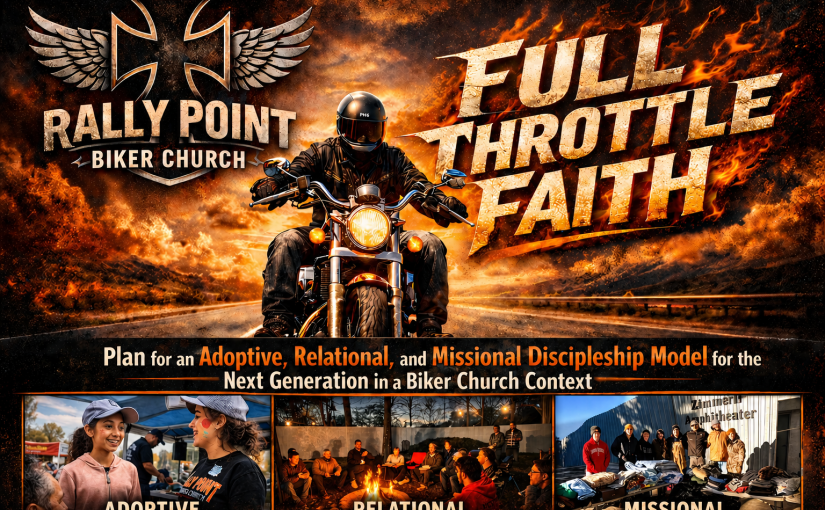
The Full Throttle Next Gen Discipleship Model (FTNG Model)
Next generation discipleship is one of the most pressing challenges facing the church today. As I have worked within a biker church context, I have observed that many traditional discipleship models fail to engage children, youth, and young adults in meaningful, transformative ways. While churches often rely on structured programs, classroom-style teaching, and event-based ministry, these approaches frequently lack the relational depth necessary to produce lasting spiritual maturity. This gap is even more pronounced within the biker community, where authenticity, loyalty, and shared experience are highly valued and where relational trust often outweighs institutional credibility.
Through my ministry experience and academic study, I have become convinced that discipleship must move beyond programs and become a lived, relational process embedded in everyday life. As Dietrich Bonhoeffer reminds us, the central question is not what leaders prefer, but “what Jesus wants.”[1] This conviction drives my approach to next generation ministry and shapes the model I present in this paper. The FTNG Model emphasizes Clark’s thoughts of creating a family-like environment where young people are not merely participants but fully integrated members of the household of God.[2]
Thesis Statement
I argue that effective next generation discipleship in a biker church context requires an adoptive, relational, and missional model that equips children, youth, and young adults to follow Christ, grow in biblical maturity, and multiply disciples through authentic community. This model, which I call the Full Throttle Next Generation (FTNG) Model, integrates biblical authority, relational discipleship, and missional engagement into a cohesive strategy that reflects both the New Testament pattern and the unique cultural dynamics of biker ministry.
As demonstrated in the early church, spiritual formation occurs through teaching, fellowship, and shared mission (Acts 2:42–47).[3] The FTNG Model seeks to intentionally structure these elements within the rhythms of biker life – rides, gatherings, mentorship, and service – so that discipleship becomes a lived experience rather than an isolated event. This model also reflects the equipping mandate of Ephesians 4:12, where leaders prepare believers for ministry rather than perform ministry alone.[4] By prioritizing relational investment and leadership development, the FTNG Model ensures that the next generation is not only discipled but equipped to disciple others.
Introduction
The FTNG Model is designed to meet the spiritual formation needs of children, youth, and young adults within a biker church environment. Unlike traditional ministry models that rely heavily on structured programs, this model emphasizes relational discipleship, adoptive community, and missional living. At its core, the FTNG Model seeks to create an environment where young people are fully embraced as members of God’s family and are equipped to live out their faith in everyday life. Chap Clark’s concept of adoptive ministry provides a foundational framework, emphasizing that the goal of youth ministry is to “create an environment where young people are encouraged to live into their calling in Christ as agents of the kingdom within the household of God.”[5] This aligns closely with the relational and communal values already present in biker culture, such as loyalty, brotherhood, and authenticity.
The personal motivation behind this model stems from ministry experience within the biker community, where relationships carry more weight than programs and authenticity is essential for trust. Many young people in this context come from broken or fragmented family systems, making the need for an adoptive spiritual family even more critical. The FTNG Model seeks to bridge this gap by providing a discipleship pathway that is both biblically grounded and culturally relevant, ensuring that the next generation is not only reached but transformed.
Current Discipleship Models of Next Generation Ministry
Current discipleship of the next generation reveals a variety of approaches that seek to engage, teach, and retain young people within the life of the church. Each model offers meaningful strengths, whether through biblical instruction, relational connection, or experiential learning, but also carries limitations when applied in isolation. In a relationally driven context like a biker church, a more integrated approach is necessary to effectively disciple young people in a way that is both authentic and transformative.
Instructional-Analytic Model
The instructional-analytic model emphasizes structured teaching, biblical literacy, and doctrinal clarity as the foundation for spiritual formation. This model is defined as God working through the instruction of His Word and human agency to create an environment in which a young person comes to know Christ and grow in that relationship.[6] The approach prioritizes intentional instruction, Scripture memory, and systematic training, recognizing that the Word of God is the primary content through which faith is formed and matured.[7]
A central strength of this model is its strong commitment to biblical authority. Scripture is viewed as “living, powerful, and the foundation” for developing a relationship with Christ, and it serves as the means through which the Holy Spirit activates faith and guides spiritual growth.[8] This aligns with passages such as 2 Timothy 3:16-17, affirming that Scripture provides the necessary instruction for righteousness and maturity. The model also emphasizes developmental awareness, teaching children according to their age and capacity, ensuring that biblical truths are both understandable and applicable as they grow.[9] Additionally, its structured nature provides clear progression in learning, making it highly effective in organized ministry environments.
However, despite its strengths, the instructional-analytic model can present certain limitations. One concern is that it may lean toward an overemphasis on cognitive knowledge, potentially reducing discipleship to the accumulation of information rather than transformation of the heart. While the model affirms relational outcomes, it acknowledges that instruction must move beyond rote learning to genuine life change, or the primary goal of conforming to Christ may be missed.[10] In ministry contexts such as a biker church, where authenticity and relational trust are highly valued, a classroom-centered approach may feel disconnected from everyday life. Without intentional relational engagement and lived application, biblical truth may not fully translate into obedient, Christ-centered living.
Pragmatic-Participatory Model
The pragmatic-participatory model emphasizes active engagement, experiential learning, and practical application as central to spiritual formation. This approach is based on the understanding that children learn best when they are directly involved in the learning process, using a variety of interactive methods that connect biblical truth to real-life experience.[11] Rather than relying solely on instruction, this model seeks to engage the whole person – mind, body, and emotions, through participatory activities such as discussion, drama, music, and application-oriented exercises that help bring Scripture to life.[12]
A key strength of this model is its ability to make biblical truth both accessible and relevant. By incorporating creative teaching methods such as large-group presentations followed by small-group discussion, the model allows children to process, apply, and internalize what they are learning.[13] It also recognizes the importance of developmental stages, ensuring that teaching methods align with a child’s cognitive and emotional capacity.[14] Additionally, the pragmatic-participatory model effectively addresses different learning styles (visual, auditory, and kinesthetic) by providing diverse learning experiences that help children understand and respond to Scripture in meaningful ways.[15]
Another significant advantage is its emphasis on application. This model moves beyond simply teaching biblical content and intentionally helps children connect Scripture to everyday life. As a result, spiritual formation is not merely theoretical but practical, encouraging children to live out their faith in real-world situations.[16] This aligns with the broader goal of spiritual formation as the progressive shaping of a person’s life into the image of Christ through intentional growth practices.[17]
However, despite its strengths, the pragmatic-participatory model also presents certain limitations. One concern is that its heavy reliance on creative methods and activities can sometimes overshadow the centrality of Scripture if not carefully balanced. In some cases, activities may become disconnected from the biblical message, reducing their effectiveness in fostering genuine spiritual growth.[18] Additionally, while the model emphasizes engagement and participation, it may lack the theological depth and doctrinal clarity necessary for long-term discipleship if not intentionally reinforced.
Furthermore, this model often requires significant resources, planning, and leadership structure, which may not be feasible in smaller or less program-driven ministry contexts such as a biker church. While its engaging nature can attract participation, it does not inherently provide a clear pathway for disciple multiplication unless it is intentionally integrated with relational discipleship structures. Therefore, while the pragmatic-participatory model is highly effective for engagement and application, it must be balanced with strong biblical teaching and relational investment to produce lasting spiritual transformation.
Media-Driven Active Engagement Model
The Media-Driven Active Engagement Model emphasizes the use of digital media, technology, and interactive communication methods as primary tools for engaging children and students in spiritual formation. This approach recognizes that today’s generation, often referred to as “Generation M” (the Media Generation), is deeply shaped by constant interaction with various forms of media, making technology a natural and effective avenue for communication and learning.[19] Because media is embedded in nearly every aspect of a child’s daily life, this model seeks to leverage those platforms to present biblical truth in ways that are culturally accessible and meaningful.
A central premise of this model is that ministry must be culturally conditioned. In other words, if the church is to effectively reach children, it must communicate the gospel in forms that align with their cultural context and understanding.[20] This includes translating the message of Scripture into what can be described as the “language” of today’s generation, utilizing visuals, storytelling, multimedia, and interactive experiences to make the gospel understandable and engaging.[21] Additionally, the model affirms that God Himself communicates through a variety of means, including visual, verbal, and experiential methods, suggesting that multimedia engagement can be a biblically consistent way to present truth.[22]
One of the major strengths of this model is its ability to capture attention and foster engagement. Research indicates that children spend a significant portion of their time interacting with media, often more than with parents or in school, making digital engagement a powerful tool for ministry.[23] As a result, this model can effectively introduce biblical concepts, promote teamwork and collaborative learning, and enhance retention by integrating a biblical worldview into daily life through repeated exposure and interaction.[24] Furthermore, media platforms extend the reach of ministry beyond the church setting, allowing children to engage with biblical content throughout the week rather than only during scheduled gatherings.
However, despite its strengths, the Media-Driven Active Engagement Model presents several important limitations. One concern is that engagement does not necessarily lead to transformation. While media can capture attention, it does not inherently produce spiritual maturity or deep discipleship. Without intentional relational investment, this model risks creating passive consumers of content rather than active followers of Christ. Additionally, there is a danger that ministry effectiveness becomes overly dependent on production quality, shifting focus from spiritual substance to entertainment value.
Another limitation is the potential reduction of face-to-face relationships, which are essential for authentic discipleship. Although the model seeks to promote interaction, reliance on media can unintentionally replace genuine relational connection. Finally, the model’s pragmatic philosophy, summarized in the idea that “whatever is helpful is biblical,” can lead to an overemphasis on effectiveness rather than faithfulness, potentially distorting the message of the gospel if cultural relevance is prioritized over biblical truth.[25]
In summary, while the Media-Driven Active Engagement Model offers a culturally relevant and engaging approach to ministry, it must be carefully balanced with strong biblical teaching and relational discipleship. When used appropriately, it can serve as a valuable tool for initial engagement and communication; however, it cannot replace the deeper, relational processes necessary for long-term spiritual formation.
Preferred Model: The FTNG Model
Recognizing the need for a discipleship approach that is both clear and accessible, free from unnecessary complexity yet strong enough to guide meaningful engagement and deeper spiritual inquiry,[26] I propose the Full Throttle Next Generation (FTNG) Model. The FTNG Model offers several significant benefits for discipling children, youth, and young adults in a biker church context. First, it fosters authentic belonging through adoptive community. Many young people today experience isolation, broken homes, or lack of consistent mentorship. By emphasizing a family-based approach to ministry, this model creates an environment where every individual is known, valued, and supported. Clark emphasizes that effective ministry requires a communal identity where all members function as a family of siblings in Christ.[27] This sense of belonging is especially critical for children and youth who are forming their identity.
Second, the model promotes relational discipleship over program dependency. Rather than relying solely on events or classes, discipleship occurs through consistent relationships, mentorship, small groups, and shared life experiences. As demonstrated in the user’s disciple-making plan, discipleship is a journey that involves following Christ, being transformed by Him, and joining His mission. This relational focus aligns naturally with biker culture, where trust is built through shared experiences.
Third, the FTNG Model emphasizes leadership development and multiplication. By equipping young believers early, the model creates a pipeline for future leaders within the church. This reflects the biblical mandate of equipping the saints for ministry (Eph. 4:12) and ensures long-term sustainability. Clark reinforces that ministry effectiveness depends on clear goals and shared ownership among all participants.[28] Greg Ogden implies, “the Bible teaches us not only the message of faith, but also the method by which that faith is to be passed on to future generations. We are called to do God’s work God’s way.”[29]
Fourth, the model supports missional engagement. Young people are not merely taught but are actively involved in outreach, service projects, and evangelistic efforts. This aligns with the Great Commission (Matt. 28:19-20) and helps young believers develop a lived-out faith rather than a theoretical one. Earley and Demsey state, “this new community (the body of Jesus) was to have a transforming effect not only on individuals but also on the entire world.”[30]
Finally, the FTNG Model is contextually adaptable. It recognizes that each church setting is unique and must tailor its approach accordingly. Clark notes that understanding context (history, culture, and community) is essential for effective ministry.[31] In a biker church, this means leveraging natural gathering points such as rides, garages, fellowship meals, and youth sporting events as discipleship environments.
Practical Implementation: The “Why” Behind this Model
The practical implementation of the FTNG Model centers on creating a structured yet flexible discipleship pathway that engages children, youth, and young adults at every stage of spiritual development. First, the model establishes a clear and compelling discipleship goal. Every leader, volunteer, and participant must understand that the mission is to develop mature followers of Christ who make disciples. Clark emphasizes that clarity of goal is the most significant factor in team effectiveness.[32] This goal must be consistently communicated through teaching, training, and personal interaction. Second, the model builds a multi-layered relational structure:
- Children (Ages 5–11): Focus on foundational biblical teaching, identity in Christ, and belonging. This includes interactive Bible teaching, family-style small groups, and mentorship from trusted adults.
- Youth (Ages 12–18): Emphasize identity formation, peer accountability, and spiritual disciplines. Small groups, mentorship, and service opportunities become central.
- Young Adults (18–29): Focus on leadership development, mission engagement, and life application. This includes discipleship groups (3-5 people), leadership training, and active ministry roles.
Third, the model prioritizes partnership and team-based ministry. Rather than a top-down leadership approach, the FTNG Model adopts a partnering leadership style where all members contribute to the mission. Clark contrasts this with the “I’m in charge” model, emphasizing that effective ministry requires collaboration and shared ownership.[33] Volunteers, parents, and leaders are all equipped to disciple the next generation.
Fourth, the model incorporates intentional training and evaluation. Volunteers receive ongoing training in four key areas: spiritual growth, understanding of students, ministry ownership, and encouragement.[34] Regular evaluation ensures that all programs and activities align with the overarching discipleship goal.
Finally, the model integrates discipleship into everyday life. In a biker church context, this includes:
- Discipleship during rides and events which offers life-on-life discipleship opportunities to have natural conversations that are organic and not forced.
- Mentorship in informal settings such as garages, which offers hands-on, heart-level discipleship opportunities to work side-by-side with next generation, providing teaching moments and open conversation.
- Family-style meals and hangouts, offering table discipleship, where kids feel safe, youth open-up, and young adults engage in deep conversation. This allows intentional conversation where older believers can speak into the lives of younger believers.
- Campfires and outdoor gatherings that provide opportunities for testimonies and real talk.
Biblical Foundation for the FTNG Model
The starting point for any effective next generation discipleship strategy must be grounded in Scripture itself. Within the context of a biker church, where relationships, authenticity, and shared experience are central, biblical discipleship must be both faithfully interpreted and practically lived out. Several key passages provide a theological framework that not only defines discipleship but also shapes how it is implemented among children, youth, and young adults in this unique ministry setting.
The Great Commission serves as the cornerstone for all disciple-making efforts. Jesus declares His authority and commands His followers to “Go ye therefore, and teach all nations, baptizing them in the name of the Father, and of the Son, and of the Holy Ghost: Teaching them to observe all things whatsoever I have commanded you” (Matthew 28:19–20, KJV). In a biker church context, this command extends beyond traditional classroom environments into everyday life; on rides, in fellowship, and through relational connections. It establishes that the mission of the church is not merely to gather people but to actively make disciples across generations. As Rod Dempsey notes, when believers obey the Great Commission, they “become the hands, feet, and voice of Jesus in their world.”[35] This is particularly significant for next generation ministry, as young people are not only recipients of discipleship but are also called to actively participate in the mission of Christ within their own relational networks.
Another foundational passage is Matthew 4:19, where Jesus invites His first disciples, saying, “Follow me, and I will make you fishers of men” (KJV). This verse highlights that discipleship begins with a personal relationship with Christ and leads to transformation and mission. In a biker church setting, this relational call resonates deeply, as trust and influence are built through shared life rather than formal programming. For children and students, discipleship is not merely taught, it is caught through observing and participating in the lives of mature believers. Putman and Harrington describe a disciple as one who follows Christ (head), is changed by Christ (heart), and is committed to the mission of Christ (hands).[36] This holistic understanding is essential for next generation ministry, where spiritual growth must involve both relational connection and active participation.
Ephesians 4:11–16 further expands the scope of discipleship by emphasizing the role of the entire body of Christ. Scripture teaches that leaders are given “for the perfecting of the saints, for the work of the ministry, for the edifying of the body of Christ” (Eph. 4:12, KJV). In the context of a biker church, this means that discipleship is not limited to pastors or leaders but is a shared responsibility among all believers. Adults within the church, including seasoned riders and ministry leaders, play a critical role in mentoring and discipling the next generation. As Dempsey explains, “pastors are to train or equip the saints, and the saints are to do the work of the ministry.”[37] This equipping model is particularly effective in a relational culture, where influence is often informal and life-on-life discipleship is highly valued.
The early church provides a practical example of this discipleship model in action. Acts 2:42–47 describes a community devoted to teaching, fellowship, breaking bread, and prayer. In a biker church context, this rhythm naturally translates into shared meals, group rides, informal gatherings, and intentional spiritual conversations. Dempsey notes that the early believers “band together for prayer, fellowship, teaching, and intentionally accomplishing the Great Commission.”[38] For the next generation, this creates an environment where faith is not compartmentalized but integrated into everyday life, allowing young people to experience discipleship as a lived reality rather than a weekly event.
Taken together, these passages establish a comprehensive framework for next generation discipleship within a biker church. Discipleship is relational, as it begins with following Christ; communal, as it is lived out within the body of believers; generational, as it is passed from one group to the next; and missional, as it calls every believer to participate in the work of the gospel. This biblical foundation reinforces that disciple-making is not the responsibility of a few but the calling of the entire church, united in obedience to Christ and committed to raising up the next generation of disciples.
Application of the FTNG Model
Tim McKnight states, “we all want our children to know the redemptive work of God and to have their lives transformed by the Gospel.”[39] Yet, realizing the realities of living in a digital age, that is easier said than done. Kinnaman, et al state, “we propose that the goal of discipleship today is to develop Jesus followers who are resiliently faithful in the face of cultural coercion and who live a vibrant life in the Spirit.”[40] To accomplish this, the Full Throttle Next Generation (FTNG) Model is designed to be both theologically grounded and practically implementable within the life of a biker church in this digital age. Its effectiveness depends not only on sound doctrine but also on clear, intentional steps that can be consistently reproduced. The following framework outlines a sequential and measurable approach for implementing this model in next generation ministry.
Establish a Clear Vision
Proverbs 29:18 declares, “Where there is no vision, the people perish . . .” The first step in implementing the FTNG Model is the development and communication of a clear and compelling vision for discipleship. Clarity of purpose is essential for ministry effectiveness, as it aligns leaders, volunteers, and participants around a shared mission. The goal, as stated by Kinnaman, should be to develop lasting relationships between the next generation and Jesus.[41] Therefore, our vision must articulate not only what discipleship is, but also why it matters and how it will be lived within the church. In a biker church context, this vision should be simple, repeatable, and relationally driven, for example, emphasizing growing in Christ through shared life, authentic community, and mission. When clearly communicated, this vision provides direction and ensures that all aspects of ministry remain focused on disciple-making rather than program maintenance.
Build an Adoptive Culture
Once the vision is established, the next step is to cultivate an adoptive culture that prioritizes belonging. In next generation ministry, particularly within a biker church, relational connection is foundational. Many young people come from fragmented or non-traditional family environments, making the church’s role as a spiritual family critically important.[42]
This culture is developed intentionally through intergenerational relationships and shared experiences, which begins at the point where each is adopted into the body of Christ.[43] The ultimate goal is to see this next generation fully integrated into the body of local church.[44] To accomplish this goal, older believers serve as spiritual mentors, modeling faith and investing in younger individuals through everyday interactions. Shared experiences, such as meals, events, and ministry activities, create natural environments for connection and trust-building. In this context, discipleship becomes a lived experience rather than a structured program, fostering a sense of identity and belonging that supports long-term spiritual growth.
Develop Small Group Structures
Earley and Dempsey, quoting John Ortberg, note, “we are created to draw life and nourishment from one another the way the roots of an oak tree draw life from the soil.”[45] The further state, “doing life together in community expresses our DNA.”[46] With that thought in mind, a key component of the FTNG Model is the establishment of small group structures that facilitate relational discipleship. These groups provide a consistent environment for spiritual growth, accountability, and community.
Two primary types of groups should be developed:
- Care Groups focus on connection and belonging. These groups serve as entry points for children and students, creating a safe and welcoming space where relationships can be formed. These are great spaces for everyone to be their authentic self and where they feel included.[47]
- Disciple-Making Groups are more intentional and focused on spiritual development and leadership training. According to Arnold, the mission of the first century church was to expand the kingdom of God.[48] Under that pretext, these groups will emphasize Scripture, accountability, multiplication, and preparing participants to disciple others.
Relational discipleship is central to the FTNG Model, as small groups create the primary environment where spiritual growth, accountability, and authentic community take place. Care Groups provide a welcoming entry point that fosters belonging and connection, while Disciple-Making Groups intentionally develop spiritual maturity, leadership, and multiplication. Together, this dual structure ensures that the ministry remains both accessible to newcomers and effective in producing mature, disciple-making believers.
Train and Equip Leaders
The goal of any discipleship program should be to see lives transformed into the image of Christ.[49] Effective discipleship requires intentional leadership development. Leaders must be equipped not only with biblical knowledge but also with relational skills necessary for mentoring the next generation. Training should include instruction in Scripture, discipleship principles, and practical ministry skills, as well as opportunities for hands-on application. A key to success is allowing the scriptures to teach, and not our opinions.[50]
In a biker church context, our goal is to offer more and expect more from our youth.[51] We will develop leadership through modeling and apprenticeship. Experienced leaders invest in emerging leaders through shared life and ministry involvement. This relational approach to leadership training ensures that discipleship is both taught and demonstrated, reinforcing the values of the FTNG Model.
Engage in Mission
Drawing from the Pragmatic-Participatory Model, the mission of every believer is to use their God-given gifts “in order to advance Christianity and edify the church.”[52] Discipleship is incomplete without mission. The FTNG Model emphasizes that children, youth, and young adults must be actively engaged in the work of the gospel. This includes participation in outreach efforts, service opportunities, and evangelistic initiatives.
In a biker church setting, mission can take on unique and culturally relevant forms, such as community outreach events, service projects, and relational evangelism within existing networks. By involving the next generation in mission, the church helps them understand that discipleship is not only about personal growth but also about advancing the kingdom of God.
Multiply and Reproduce
Mark Dever proclaims, “every Christian has a role in making visible the gospel of the invisible God.”[53] Putnam, et al state that we must, “have a passion to develop people from where they currently are to help them to become the men and women God is calling them to be.”[54] With that though in mind, the final step in the FTNG Model is multiplication. Healthy discipleship systems are not measured solely by attendance or participation but by their ability to reproduce leaders and disciples. Small groups and Next Gen ministries should be designed with multiplication in mind, preparing participants to eventually lead and disciple others.
This process ensures sustainability and growth within the ministry. As new leaders are developed and new groups are formed, the impact of the ministry expands beyond its initial reach. In this way, the FTNG Model reflects the biblical mandate to make disciples who make disciples, creating a cycle of ongoing spiritual reproduction.
The application of the FTNG Model provides a clear, structured pathway for implementing next generation discipleship in a biker church context. By establishing vision, fostering belonging, creating relational structures, equipping leaders, engaging mission, and prioritizing multiplication, this model ensures that discipleship is both intentional and reproducible. Ultimately, it moves beyond programmatic ministry to cultivate a dynamic, relational environment where the next generation can grow, serve, and lead within the body of Christ.
Conclusion
In conclusion, the Full Throttle Next Generation Discipleship Model provides a biblically grounded, relationally driven, and culturally relevant framework for discipling children, youth, and young adults within a biker church context. By prioritizing an adoptive community, life-on-life relationships, and missional engagement, this model moves beyond program-based ministry to cultivate authentic spiritual growth and multiplication. Rooted in the New Testament vision of the church as a family and a functioning body, the FTNG Model equips the next generation not only to follow Christ but to actively participate in His mission. As this model is implemented through intentional relationships, shared experiences, and everyday environments, it has the potential to produce mature disciples who live out their faith boldly and reproduce that faith in others, ensuring long-term kingdom impact within the biker community and beyond.
[1] Dietrich Bonhoeffer, Discipleship (Minneapolis: MN, Fortress Press, 2003), 21.
[2] Chap Clark, Adoptive Church: Creating an Environment Where Emerging Generations Belong (Grand Rapids, MI: Baker Academic, 2018), 69.
[3] Dave Earley and Rod Dempsey, Discipleship Making Is: How to Live the Great Commission with Love and Confidence (Brentwood, TN: B&H Academic, 2013), 40.
[4] Earley and Dempsey, Discipleship Making Is, 41.
[5] Clark, Adoptive Church, 69-70.
[6] Greg Carlson et al., Perspectives on Children’s Spiritual Formation: Four Views (Nashville, TN: Broadman & Holman Publishers, 2006), 104.
[7] Ibid., 104.
[8] Ibid., 104-106.
[9] Ibid., 105.
[10] Carlson, Perspectives on Children’s Spiritual Formation, 121-122.
[11] Ibid., 165.
[12] Ibid., 165-166.
[13] Carlson, Perspectives on Children’s Spiritual Formation, 166.
[14] Ibid., 185.
[15] Ibid., 193.
[16] Ibid., 206.
[17] Ibid., 165.
[18] Ibid., 209-210.
[19] Carlson, Perspectives on Children’s Spiritual Formation, 227-228.
[20] Carlson, Perspectives on Children’s Spiritual Formation, 231.
[21] Ibid., 232.
[22] Ibid., 233.
[23] Ibid., 229-230.
[24] Ibid., 225-226.
[25] Carlson, Perspectives on Children’s Spiritual Formation, 236, 263.
[26] Lin Lin and J. Michael Spector. The Sciences of Learning and Instructional Design : Constructive Articulation Between Communities, (Taylor & Francis Group, 2017), 217.
[27] Clark, Adoptive Church, 74.
[28] Clark, Adoptive Church, 70-71.
[29] Greg Ogden. Discipleship Essentials: A Guide to Building Your Life in Christ, Expanded Ed. (Downers Grove, IL: Intervarsity Press, 2007). 20.
[30] Earley and Dempsey. Discipleship Making Is, 246.
[31] Ibid., 72-75.
[32] Clark, Adoptive Church, 70-71.
[33] Ibid., 85-87.
[34] Clark, Adoptive Church, 96-97.
[35] Earley and Dempsey, Discipleship Making Is, 22.
[36] Jim Putman, Bobby Harrington, and Robert Coleman, DiscipleShift (Grand Rapids: Zondervan, 2013), 51.
[37] Earley and Dempsey, Discipleship Making Is, 41.
[38] Ibid., 40.
[39] Tim McKnight, Engaging Generation Z: Raising the Bar for Youth Ministry (Grand Rapids, MI: Kregel Ministry, 2021), 14.
[40] David Kinnaman, Mark Matlock, and Aly Hawkins, Faith for Exiles: 5 Ways for a New Generation to Follow Jesus in Digital Babylon (Grand Rapids, MI: Baker Books, 2019), 30.
[41] Ibid., 30.
[42] Clark, Adoptive Church, 3.
[43] Ibid., 9.
[44] Ibid. 25.
[45] Dave Earley and Rod Dempsey. Spiritual Formation Is: How to Grow in Jesus with Passion
and Confidence (Brentwood, TN: B&H Academic, 2018), 158.
[46] Ibid., 160.
[47] Jeffrey Arnold, The Big Book on Small Groups (Revised Edition) (InterVarsity Press, 2017), 108-109.
[48] Ibid., 202.
[49] Earley and Dempsey. Spiritual Formation Is, 83.
[50] McKnight, Engaging Generation Z, 102.
[51] Ibid., 175.
[52] Carlson, Perspectives on Children’s Spiritual Formation, 182.
[53] Mark Dever, The Gospel and Personal Evangelism (Wheaton: Il, Crossway, 2007), 50.
[54] Putman, Harrington, and Coleman, DiscipleShift, 53.
Bibliography
Arnold, Jeffrey. The Big Book on Small Groups (Revised Edition). InterVarsity Press, 2017.
Anthony, Michael J. Perspectives on Children’s Spiritual Formation. Nashville: B&H, 2007.
Bonhoeffer, Dietrich. Discipleship. Minneapolis, MN: Fortress Press, 2003.
Clark, Chap. Adoptive Church: Creating an Environment Where Emerging Generations Belong. Grand Rapids, MI: Baker Academic, 2018.
Dever, Mark. The Gospel and Personal Evangelism. Wheaton, IL: Crossway, 2007.
Earley, Dave, and Dempsey, Rod. Discipleship Making Is: How to live the Great Commission with Passion and Confidence. Brentwood, TN: B&H Academic, 2013.
Earley, Dave, and Dempsey, Rod. Spiritual Formation Is: How to Grow in Jesus with Passion and Confidence. Brentwood, TN: B&H Academic, 2018.
Earley, Dave, and Dempsey, Rod. Leading Healthy, Growing, Multiplying Small Groups. Lynchburg, VA: Liberty University Press, 2016.
House, Brad. Community: Taking Your Small Group Off Life Support. Wheaton, IL: Crossway, 2011.
Lin, Lin and Spector, Michael J. The Sciences of Learning and Instructional Design:Constructive Articulation Between Communities. Taylor & Francis Group, 2017.
Linhart, Terry. Teaching the Next Generations: A Comprehensive Guide for Teaching Christian Formation. Grand Rapids, MI: Baker Academic, 2016.
Kinnaman, David, Matlock, Mark and Hawkins, Aly. Faith for Exiles: 5 Ways for a New Generation to Follow Jesus in Digital Babylon. Grand Rapids, MI: Baker Books, 2019.
McKnight, Tim. Engaging Generation Z: Raising the Bar for Youth Ministry. Grand Rapids, MI: Kregel Publications, 2021.
Ogden, Greg. Discipleship Essentials. Downers Grove, IL: InterVarsity Press, 2007.
Putman, Jim, Bobby Harrington, and Robert Coleman. DiscipleShift. Grand Rapids, MI: Zondervan, 2013.


