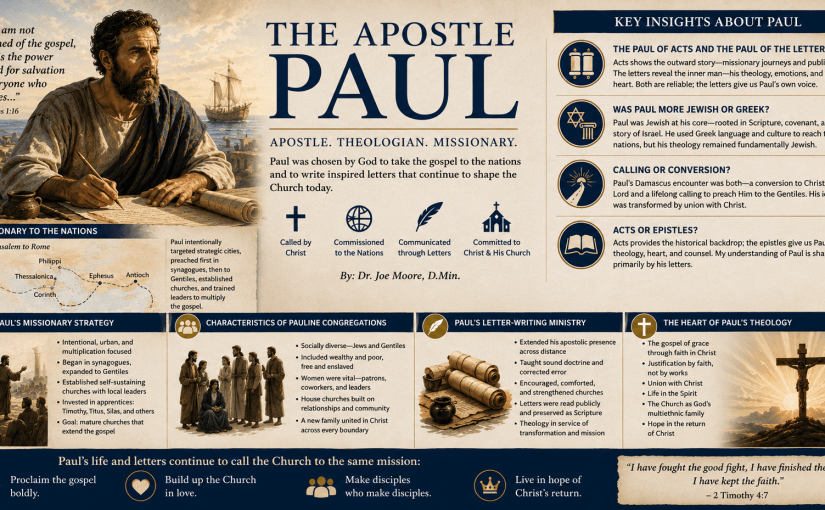
By: Pastor Joe Moore, Graduate Student, Liberty University Theological Seminary
Life
The Paul of Acts and the Paul of the Letters
The “Paul” of Acts and the “Paul” of the letters present complementary but distinct portraits. Luke’s Acts offers a biographical narrative that emphasizes Paul’s missionary journeys, public speeches, and the unstoppable spread of the gospel from Jerusalem to Rome. Luke refers to him as “Saul” in Acts 7 – 13 before transitioning to “Paul,” and highlights his role as an apostolic pioneer to the Gentile world.[1] Paul’s letters, by contrast, are autobiographical and selective. He rarely recounts his life story except when defending his apostleship or clarifying the gospel (Gal. 1- 2; Phil. 3:4-11; 2 Cor. 11-12).
The epistles reveal a more personal Paul; emotionally invested, pastorally burdened, and theologically reflective. In the letters, we hear his anguish for Israel (Rom. 9:1–5), his affection for churches (Phil. 1:3–8), and his vulnerability in suffering (2 Cor. 12:7–10). Acts presents Paul as a heroic missionary figure, while the letters reveal the inner spiritual and emotional life of the apostle. Both portraits are historically reliable, but my understanding of Paul is more heavily shaped by his own testimony in the letters.
Was Paul More Jewish or Greek?
Paul was deeply conversant with Greek language and culture, yet his thought world was fundamentally Jewish. He was “a Hebrew of Hebrews” and a Pharisee trained under Gamaliel (Phil. 3:5; Acts 22:3). His theology is saturated with Old Testament quotations, covenant themes, and the story of Israel. Thomas Schreiner rightly emphasizes that Paul’s theology is rooted in the Old Testament and fulfilled in Christ.[2]
Paul used Greek rhetoric, engaged Gentile audiences, and wrote in koine Greek, but his worldview remained profoundly shaped by Scripture, monotheism, covenant, and eschatological hope. Mark Nanos’s insistence that Paul remained culturally and historically Jewish has helped me appreciate this dimension more fully, even though I maintain that faith in Christ fundamentally reoriented Paul’s understanding of covenant membership.[3] Therefore, I regard Paul as Jewish in his core theological framework and Greek in his linguistic and missionary adaptability.
Calling or Conversion?
Paul’s Damascus Road experience was both a conversion and a calling. It was a conversion because Paul came to believe that Jesus was the risen Messiah and Lord. He shifted from persecuting the church to proclaiming the very gospel he once opposed. Yet it was also a prophetic calling similar to Jeremiah or Isaiah, as Paul himself states that God set him apart from his mother’s womb to preach Christ among the Gentiles (Gal. 1:15–16). If described as conversion, Paul was converted from a Christ-rejecting understanding of covenant faithfulness to a Christ-centric understanding of God’s redemptive plan. He did not cease being Jewish ethnically or culturally, but his identity was decisively transformed by union with Christ. As Blackwell states, “What the law was powerless to do, God did.”[4]
Acts or Epistles?
My understanding of Paul is shaped primarily by his epistles. Acts provides an invaluable historical framework, but Paul’s letters offer direct access to his theology, emotions, and pastoral concerns. Luke interprets Paul from an external perspective; the letters reveal Paul’s own voice. Consequently, although Acts provides an essential historical backdrop for understanding Paul’s ministry, my overall perspective of the apostle is formed primarily by his own testimony in Romans, Galatians, Corinthians, Philippians, and the rest of his letters.
Letters
Paul’s Missionary Strategy
Paul’s missionary strategy was intentional, urban, and multiplication focused. He targeted influential cities such as Philippi, Corinth, Ephesus, and Rome; major centers of commerce and communication from which the gospel could spread into surrounding regions.[5] He typically began in synagogues, preaching first to Jews and God-fearing Gentiles, then expanded to broader Gentile audiences when opposition arose (Acts 13 – 19). Paul also worked to establish self-sustaining congregations led by local leaders, such as Philemon. He invested deeply in apprentices such as Timothy, Titus, and Silas, demonstrating a reproducible model of discipleship and leadership development. His long-term goal was not merely evangelism but the planting of mature churches capable of extending the gospel independently.
Characteristics of Pauline Congregations
Pauline congregations were socially diverse and often composed of both Jews and Gentiles, though many members were Gentiles from pagan backgrounds. They included wealthy patrons such as Lydia and Phoebe, artisans such as Aquila and Priscilla, and slaves and freed persons.[6] Many members were likely from lower social classes, though some held significant economic influence. Women played important roles as patrons, coworkers, and hosts of house churches. Paul’s churches often consisted of community outsiders who found in Christ a new identity and family. These congregations reflected the unifying power of the gospel across ethnic, social, and gender lines.
Paul’s Letter-Writing Ministry
Paul’s letter-writing ministry extended his apostolic presence when he could not be physically present. His letters addressed doctrinal confusion, ethical challenges, leadership issues, and practical concerns. Walter Elwell and Robert Yarbrough note that the epistles provide essential insight into earliest Christian faith and practice beyond what is found in the Gospels and Acts.[7] Paul likely dictated many of his letters to amanuenses, adding handwritten conclusions for authenticity (cf. 1 Cor. 16:21; Gal. 6:11). These letters were intended to be read publicly and circulated among churches, making them both pastoral correspondence and authoritative instruction. For example, Garland states that it would “diminish the effect of Romans to read it as if it were addressed only to a particular church with a particular problem,” but rather, “is intended to bring about the obedience of faith for the entire world.”[8]
Form, Argumentation, and Rhetoric
Paul’s letters generally follow ancient epistolary conventions: opening salutation, thanksgiving, body, paraenesis (ethical exhortation), and closing greetings.[9] Within this structure, Paul employed sophisticated rhetorical techniques including diatribe, rhetorical questions, scriptural proof, and carefully developed arguments. Romans, for example, repeatedly uses question-and-answer exchanges, such as, “by no means” to anticipate objections (Rom. 3:4, 6, 32; 6:2:15; 7:7, 13; 9:14, 11:1, 11). Paul also adapted his style to his audience: Galatians is urgent and confrontational, Philippians warm and affectionate, and Romans carefully structured and theological. His rhetoric was always subordinated to the pastoral aim of persuading believers to live faithfully in Christ.
Theology
The Character of Paul’s Theologizing
Paul’s theology is both profound and pastoral. Luke Timothy Johnson correctly argues that Paul’s theology emerges from lived experience and concrete ministry situations rather than from detached abstraction.[10] Paul did not compose a systematic theology textbook; he wrote occasional letters to real churches facing real problems. Nevertheless, Paul’s writings reveal remarkable theological coherence. Themes such as union with Christ, justification, reconciliation, sanctification, and eschatological hope recur throughout his letters. Therefore, Paul was a pastoral theologian whose doctrine was forged in the context of mission and discipleship, “that ye may with one mind and one mouth glorify God, even the Father of our Lord Jesus Christ” (Rom. 15:6).
Paul and the Teachings of Jesus
Paul’s theology is not a truncated gospel focused only on the cross and resurrection. Although he emphasizes Christ’s death and resurrection as the center of salvation, he also draws extensively from Jesus’ teachings. Paul echoes Jesus on divorce (1 Cor. 7:10-11), support for ministers (1 Cor. 9:14), loving one’s enemies (Rom. 12:14-21), and the Lord’s Supper (1 Cor. 11:23-26). Paul’s ethical teaching is saturated with the example and lordship of Jesus. His gospel is thoroughly Christocentric and therefore fully Christian rather than “sub-Christian.” The cross and resurrection are central because they interpret the significance of Jesus’ entire life and mission.
The Metanarrative of Paul’s Theology
I believe Paul’s theology is best understood within the overarching biblical story of creation, fall, Israel, Christ, church, and new creation. Schreiner’s “already but not yet” framework is especially helpful in explaining how Old Testament promises are inaugurated in Christ and await final consummation.[11] Within this metanarrative, union with Christ is the central theological reality. Believers participate in Christ’s death and resurrection, forming a new covenant people composed of Jews and Gentiles. Paul’s theology is therefore covenantal, Christ-centered, and eschatological.
Is Justification the Center?
Justification by faith is undeniably central to Romans and Galatians, but it is not sufficient by itself to summarize all of Paul’s theology. If Romans and Galatians were absent, one would still identify major themes such as union with Christ, reconciliation, participation in the Spirit, and new creation in letters like Corinthians, Philippians, and Ephesians. Therefore, I do not believe it is fair to define Paul’s entire theology solely through the lens of justification. Justification is foundational, but it functions within the broader reality of God’s redemptive work in Christ.
The Reformation and the New Perspective
The Reformation emphasized the forensic doctrine of justification and the contrast between faith and works-righteousness. This remains a crucial biblical truth. Martin Luther’s reading of Romans rightly underscored that sinners are declared righteous by grace through faith apart from human merit.[12] The New Perspective, associated with scholars such as E. P. Sanders, James D. G. Dunn, and N. T. Wright, has provided an important corrective by showing that first-century Judaism was fundamentally covenantal rather than crudely legalistic. “Works of the law” often refer to covenant boundary markers such as circumcision, dietary laws, and Sabbath observance.[13] My view integrates both perspectives. I affirm the Reformation doctrine of justification by faith alone while recognizing the New Perspective’s historical insight into Judaism and Paul’s concern for Jew-Gentile inclusion.
Significance
Is the Church More Pauline than Jesus-Centered?
The church today can at times appear more “Pauline” than “Jesus-centered,” especially because many doctrinal formulations are expressed through Pauline categories. Yet this is not a problem if Paul is understood correctly. Paul did not replace Jesus; he interpreted and applied the significance of Jesus’ life, death, resurrection, and lordship. McClendon and Lockhart state, “the text of scripture points to Jesus on every page, if not in word, then certainly in idea and end goal.”[14] Paul repeatedly points believers back to Christ. His theology is not independent of Jesus but a Spirit-inspired exposition of the gospel. Therefore, a truly Pauline church should be deeply and unmistakably centered on Jesus.
Paul’s Relevance in a Postmodern World
Paul remains profoundly relevant in a postmodern culture that questions objective truth, moral absolutes, and biblical authority. His writings address enduring human realities: guilt, identity, suffering, reconciliation, community, and hope. His teaching on sexuality, marriage, ethics, and eschatology challenges contemporary assumptions, but that challenge is precisely what makes his message necessary.
Paul also offers a compelling vision of diverse people united in Christ, a truth desperately needed in a fragmented world. His insistence that identity is rooted in Christ rather than ethnicity, status, or achievement speaks directly to modern struggles over meaning and belonging. Far from being obsolete, Paul continues to provide a coherent and transformative framework for Christian faith and practice.
Conclusion
My perspective on Paul has become more historically grounded, theologically nuanced, and pastorally enriched. I now see him as a Jewish apostle to the Gentiles whose encounter with Christ reshaped his understanding of Scripture, covenant, and salvation. His letters reveal a missionary theologian who combined doctrinal depth with pastoral sensitivity. Most importantly, I have come to appreciate that Paul must be interpreted within the grand story of God’s redemptive purposes fulfilled in Jesus Christ. His theology is centered on union with Christ, justification by faith, the work of the Spirit, and the hope of new creation. As both pastor and scholar, Paul remains one of the most important and relevant voices for the church today.
Bibliography
Bird, Michael F. and Gundry, Stanley N, et al., Four Views on the Apostle Paul. Grand Rapids, MI: Zondervan, 2012.
Blackwell, Ben C., Goodrich, John K, and Maston, Jason, Ed. Reading Romans in Context: Paul and Second Temple Judaism. Grand Rapids, MI: Zondervan, 2015.
Elwell, Walter A. and Yarbrough, Robert W. Encountering the New Testament, 4th ed. Grand Rapids, MI: Baker Academic, 2022.
Garland, David E. Romans: An Introduction and Commentary, ed. Eckhard J. Schnabel, vol. 6, Tyndale New Testament Commentaries. Downers Grove, IL: IVP; IVP Academic: An Imprint of InterVarsity Press, 2021.
McClendon, P. Adam and Lockhart, Jared E. Timeless Church: Five Lessons from Acts. Nashville, TN: B&H Academic, 2020.
[1] Walter A. Elwell and Robert W. Yarbrough, Encountering the New Testament, 4th ed. (Grand Rapids, MI: Baker Academic, 2022), 260.
[2] Schreiner, “Paul: A Reformed Reading”, 33-35.
[3] Nanos, “A Jewish View,” 160–167.
[4] Ben C. Blackwell, John K, Goodrich, and Jason Maston, Ed. Reading Romans in Context: Paul and Second Temple Judaism (Grand Rapids, MI: Zondervan, 2015), 104.
[5] Elwell and Yarbrough, Encountering the New Testament, 262–263, 275–277.
[6] Elwell and Yarbrough, Encountering the New Testament, 275–282.
[7] Ibid., 260.
[8] David E. Garland, Romans: An Introduction and Commentary, ed. Eckhard J. Schnabel, vol. 6, Tyndale New Testament Commentaries (Downers Grove, IL: IVP; IVP Academic: An Imprint of InterVarsity Press, 2021), 29.
[9] Elwell and Yarbrough, Encountering the New Testament, 264-265.
[10] Luke Timothy Johnson, “The Paul of the Letters: A Catholic Perspective,” in Four Views on the Apostle Paul, 72–101.
[11] Schreiner, “Paul: A Reformed Reading,” 12–23.
[12] Elwell and Yarbrough, Encountering the New Testament, 260–261.
[13] Elwell and Yarbrough, Encountering the New Testament, 285-287.
[14] P. Adam McClendon and Jared E, Lockhart, Timeless Church: Five Lessons from Acts (Nashville, TN: B&H Academic, 2020), 21.


