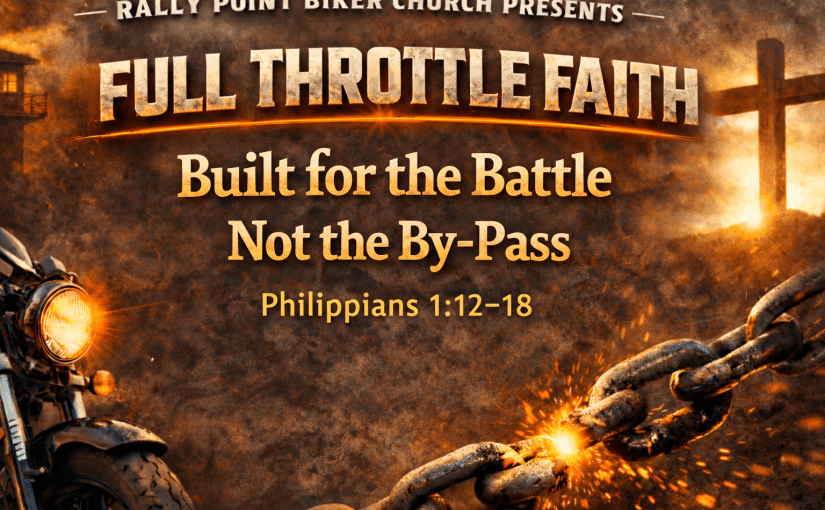
This morning we are continuing this series on Full Throttle Faith. Last week, we shared the message “Built, Tuned, and Finished by God.” Philippians 1:6 tells us that we can be confident “That he which hath begun a good work in you will perform it until the day of Christ.”
- Our Christian walk didn’t start with us
- It is not being sustained by us
- And it will not be finished by us
God started it . . . God sustains it . . . and God will finish it!
Now look with me beginning in Philippians 1:12-18. Pray
Isn’t it funny, when life is going well, when the bills are paid, nobody is sick – it’s easy to for us to see God at work. But as soon as when hardship comes, when sickness hits, money gets tight, relationships struggle, or plans fall apart – we begin to wonder if God is still working at all.
Ironically, God often does His greatest work in the hardest moments. Think about Joseph. He was betrayed by his brothers, sold into slavery, and thrown into prison for something he didn’t do. But later he said, “ye thought evil against me; but God meant it unto good” (Genesis 50:20, KJV). What looked like a disaster was actually part of God’s plan.
Over and over again in the Scriptures we see God turning setbacks into setups! And although we know He is working all things for our good, we as believers struggle when life gets hard. We begin to think God’s hung us out to dry. We start to think:
“If things were different, I could serve God better.”
“If I had more time,” “If I had better health,” “If I had fewer problems…”
But the truth is, we often wait for perfect conditions that may never come. Paul reminds us that God’s power isn’t shown in our strength – it’s shown in our weakness. 2 Corinthians 12:9, “My grace is sufficient for thee: for my strength is made perfect in weakness.”
What if the very struggles we want gone are the ones God will use to do His greatest work in our lives?
This is the circumstances the believers in Philippi found themselves in. When they heard their pastor, their mentor, Paul was in prison, it looked like everything had stopped. But Paul is about to give them a lesson on how we are “Built for the Battle, NOT the bypass.”
Paul is going to be a living example to this church of how God can use adversity to move His mission forward and to strengthen our faith.
So the question is: how does God use hard times to grow us and expand our witness? Paul shows us exactly how.
GOD USES DIFFICULT CIRCUMSTANCES TO ADVANCE HIS MISSION
Paul begins with a surprising statement: “the things which happened unto me have fallen out rather unto the furtherance of the gospel” (Philippians 1:12). Instead of hindering the gospel, Paul’s imprisonment actually furthered it.
He explains that his chains became widely known throughout the palace guard (Philippians 1:13). These soldiers were elite Roman Pretorian troops assigned to guard prisoners connected with the imperial system.
Imagine this: every few hours a new soldier would be chained next to Paul, and Paul was not the kind of man who stayed silent about Christ. Those guards heard the gospel. Conversations were taking place that never would have happened otherwise. God turned a prison cell into a mission field.
Think about a river flowing strong through a valley. Suddenly, a huge rock falls right in its path. It looks like the river is blocked. But the river doesn’t stop. It simply flows around the rock. It finds new paths, spreads out, and sometimes even becomes wider and stronger than before. What looked like a blockage actually helps the water reach new places.
You see, the obstacle does not stop the movement; it simply changes the direction of travel.
In much the same way, Paul’s imprisonment looked like a massive obstacle to the spread of the gospel. It appeared that Paul’s ministry had been stopped, confined to a prison cell, chained to guards.
But the gospel did not stop. Instead, it flowed in a new direction. Roman soldiers heard about Christ. The message reached the palace guard. What looked like a barrier became the means by which the gospel spread further than before. And this emboldened the believers in Philippi.
Scriptures repeatedly affirm that God works through every circumstance. Paul writes in Romans 8:28, “And we know that all things work together for good to them that love God.” Not some things. Not easy things. Not the things we understand. Not the things we can explain. All things.
You may feel restricted today. Maybe circumstances have changed your plans. But God’s mission has not stopped; He may just be taking you in a new direction.
Not only did God advance the mission through Paul’s suffering, but:
GOD STRENGTHENS BELIEVERS THROUGH ADVERSITY TO PROCLAIM CHRIST MORE BOLDLY (V14)
Instead of discouraging the church, Paul’s faithfulness inspired them. When they saw Paul remain strong in chains, they found courage to speak.
In December of 1989, my unit was involved in Operation Just Cause to oust Manuel Noreiga from power. On the night the operation began, we were flying in CH-47 helicopters to our first objective. While in the air, we could see enemy fire coming at the helicopter with tracer rounds impacting all around us. You could visibly see the fear on everyone’s face. However, when the helicopter landed and the tail gate dropped, our commander immediately ran off into the fight. The courage he displayed caused everyone on the aircraft to dismount and charge into the fight. Courage is contagious.
This is why encouraged Timothy to “. . . endure hardness, as a good soldier of Jesus Christ” (2 Timothy 2:3).
Faith demonstrated in difficulty strengthens the faith of others.
Someone may be watching your life right now. Your faithfulness during hardship could be the encouragement another believer desperately needs.
But, not only does adversity strengthens believers, it also exposes motives.
GOD ACCOMPLISHES HIS PURPOSES EVEN IN THE PRESENCE OF OPPOSITION AND IMPERFECTION
Paul acknowledges that not everyone preaching Christ had pure motives (Philippians 1:15–17). Some preached Christ sincerely, but others did so out of envy or rivalry. Some even hoped to increase Paul’s suffering. Yet Paul responds with remarkable humility.
In sports, competition often gets more attention than teamwork. When top athletes go head-to-head, it doesn’t hurt the sport – it actually makes it more exciting. Think about big rivalries. When two great players compete, people talk about it, fans get involved, and more people show up to watch. Even if one of them is driven by pride or wanting to win, the spotlight still shines on the game. In the end, the rivalry helps the sport grow. What starts as competition ends up bringing more attention to the game itself.
In a similar way, Paul recognized that even though some people preached Christ with selfish motives, the message of Christ was still being proclaimed. Their motives were imperfect, but the gospel was still reaching people.
God’s truth is so powerful that even human rivalry cannot stop its advance.
Even imperfect motives cannot stop the spread of the message.
God’s Word accomplishes His purposes regardless of human motives. Scripture says, “it shall not return unto me void” (Isaiah 55:11). God’s work does not depend on perfect people.
You know what’s great about that? We do not have to control everyone or fix every situation. God can accomplish His will even through imperfect circumstances.
And this brings me to my final point:
GOD’S PEOPLE HAVE THE FREEDOM TO REJOICE REGARDLESS OF OUR SITUATION
Paul concludes this section by saying, “Christ is preached; and I therein do rejoice, yea, AND WILL REJOICE” (Philippians 1:18). That was a choice!
Paul’s joy was not rooted in comfort or recognition: It was rooted in Christ.
As a soldier, we spent countless days training, running, ruck marching. Many times it was painful – in fact, most of the time it was painful. But we ran farther, trained harder and pushed further, because when the time came and we got that call – we wanted to be ready – we wanted to win the fight! So as soldiers, we learned to be comfortable being uncomfortable.
A runner pushing through the final stretch of a race doesn’t stop because his legs hurt. A football player doesn’t step off the field in the fourth quarter because he’s exhausted. The championship matters more than the pain. The vision of victory gives them the strength to endure the hardship.
In the same way, Paul endured chains, opposition, and suffering because his ultimate goal was not comfort – it was the glory of Christ.
Scripture teaches that true joy comes from the Lord, not circumstances. Nehemiah said, “The joy of the LORD is your strength” (Nehemiah 8:10).
Paul challenges us to build our joy in Christ, because:
- If our joy depends on comfort, it will disappear when life becomes uncomfortable.
- If our joy depends on recognition, it will fade when others overlook us.
- If our joy depends on success, it will crumble when plans fail.
But when Christ is truly the center of our lives, our joy becomes anchored in something unchanging. That means even in hardship we can still rejoice, because Christ is still being honored. Even when life feels difficult, we can rejoice because Christ is still worthy. Even when circumstances are not what we hoped, we can rejoice because God is still working.
So the question for us today is simple: What is at the center of your life?
Conclusion
Imagine Paul sitting in a dim Roman prison cell. The walls are cold stone. His wrists are bound by heavy chains. A Roman soldier stands nearby, watching his every move.
From the outside, it looks like everything has stopped. The great missionary who once traveled from city to city is now confined to a small room. His freedom is gone. His plans have been interrupted. His movement is restricted.
But something remarkable is happening inside that prison.
One guard after another is chained to Paul, and each one hears about Jesus. Conversations about Christ fill the quiet hours. The gospel echoes through the palace guard. Beyond those prison walls, believers hear how Paul remains faithful in chains, and their courage grows. They begin speaking the Word of God with greater boldness.
- What looked like a prison became a pulpit.
- What looked like chains became a testimony.
- What looked like limitation became a platform for the gospel.
Now imagine your own life for a moment. Think about the circumstances that feel restrictive right now:
- The hardship you did not expect
- The challenge you did not choose
- The situation you wish would change.
What if that very place is where God intends to work through you? What if the difficulty you face today is not the end of God’s work, but the very place where His power will be seen most clearly?
So let me ask you: Have you allowed your circumstances to silence my faith?
Instead of waiting for life to become easier, God may be calling you to step forward in faith. The same God who worked through Paul’s chains is still working today. Your circumstances may feel limiting, but God’s power is not!
So trust Him, stand firm, speak boldly, and watch how God can use even the hardest moments of your life to advance the gospel and bring glory to His name.
Because folks, “WE ARE BUILT FOR THE BATTLE – NOT THE BYPASS!”

 Fighting for My Pea Patch