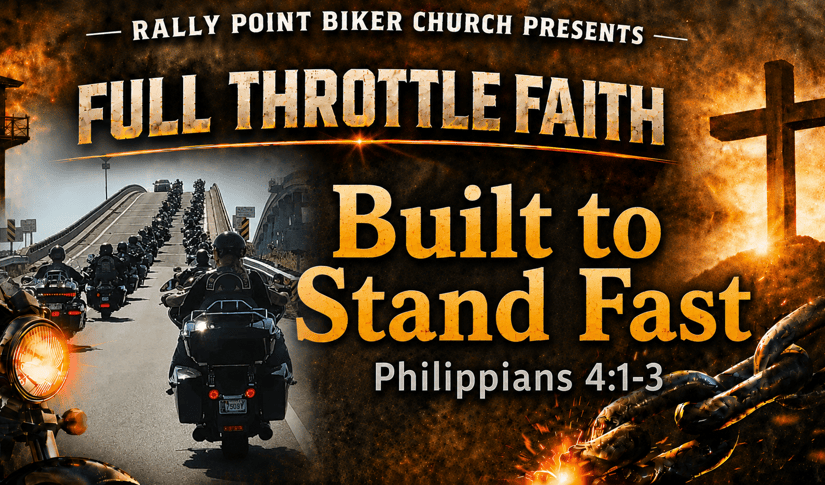
There is something awe-inspiring about watching a pack of motorcycles thunder down the highway together. Every bike is different. Some are old and weathered, bearing the marks of countless miles. Others are freshly rebuilt, polished and shining. Every rider has a different story—different scars, different struggles, different testimonies of how God has brought them through. Some have ridden for decades; others are just learning how to navigate the road. Yet despite all their differences, they ride in formation. They maintain their position, watch out for one another, and move together toward a common destination.
That picture captures the heart of what the church is meant to be.
- The church is not a collection of isolated believers doing their own thing.
- It is not a loose gathering of spiritual consumers who show up when it is convenient and drift apart when conflict arises.
The church is the body of Christ:
- redeemed by the blood of Jesus,
- united by the Holy Spirit,
- and commissioned to advance the gospel together.
God did not save us merely to travel to heaven individually; He saved us to become part of a spiritual family, a brotherhood and sisterhood of believers who stand shoulder to shoulder in faith and mission.
Yet every rider knows that formation riding requires intentionality. If one rider becomes distracted, drifts out of position, or insists on going his own way, the entire group is affected. The same is true in the church. Unity does not happen automatically. It must be protected, nurtured, and sometimes restored when disagreements threaten to pull God’s people apart.
That is exactly the situation Paul addresses in Philippians 4:1–3. As he nears the close of this deeply personal letter, he turns his attention to a relational conflict between two faithful women, Euodias and Syntyche. These women were not troublemakers on the fringe; they were devoted servants who had labored alongside Paul in the gospel. Yet somewhere along the journey, they had lost alignment with one another. Rather than ignoring the issue or allowing division to fester, Paul lovingly confronts the conflict and calls the church to help restore unity.
Paul’s words remind us that a church can have sound doctrine, vibrant worship, and active ministry, but if relationships are fractured, the witness of the gospel is weakened. The enemy knows he may not be able to destroy the church from the outside, so he often seeks to divide it from within. But God has designed His people for something better.
Paul is going to show us 5 ways that God has built His church to stand together in love, unity, and gospel partnership.
STANDING FAST REQUIRES A FIRM FOUNDATION (v.1)
Paul opens this section with one of the most affectionate statements in all of his letters: “Therefore, my brethren dearly beloved and longed for, my joy and crown, so stand fast in the Lord, my dearly beloved” (KJV).
- Before Paul gives a command, he expresses his love.
- Before he addresses the problem, he reminds them of their value.
That is the heart of a true shepherd.
Notice the terms Paul uses. He calls them “brethren.” They are family. The church is more than an organization; it is a spiritual household where believers are joined together by the blood of Jesus Christ.
He calls them “dearly beloved.” This phrase emphasizes deep and abiding love. Paul is not merely tolerating these believers; he treasures them.
He says they are “longed for.” Though Paul is imprisoned, separated by miles and circumstances, his heart aches to see them. Genuine Christian love creates a desire for fellowship.
He calls them “my joy.” These believers brought delight to Paul’s heart. Their growth in Christ, their faithfulness in suffering, and their partnership in the gospel gave him profound encouragement.
He calls them “my crown.” In the ancient world, the crown was a victor’s wreath awarded after a race. Paul sees the Philippian believers as evidence that his labor in the gospel was not in vain. They are living proof of God’s grace at work.
Only after affirming them does Paul issue the command: “So stand fast in the Lord.”
The phrase “stand fast” was a military term meaning to hold one’s position against advancing opposition. It pictures a soldier who refuses to retreat.
- Paul does not say, “Stand fast in your feelings.”
- He does not say, “Stand fast in your pastor.”
- He does not say, “Stand fast in your traditions.”
He says, “Stand fast in the Lord.” Our stability is rooted in Christ alone.
- Circumstances change.
- Programs change.
- Leaders come and go.
- Friends may disappoint us.
- Our feelings rise and fall.
But Jesus Christ is the same yesterday, today, and forever (Hebrews 13:8).
The Bible declares that Christ does not change. His promises are secure, His power is sufficient, and His presence is constant.
And Church, if we are going to ride together, serve together, and endure together, we must first stand together on the unshakable foundation of the Lord Jesus Christ.
STAND FAST IN RECONCILED RELATIONSHIPS (v.2)
Paul writes, “I beseech Euodias, and beseech Syntyche, that they be of the same mind in the Lord.”
At first glance, this may seem like a small personal note tucked into the end of Paul’s letter. But the Holy Spirit preserved these words for all generations because unity in the church is never a minor issue. What Paul addresses here is not simply a disagreement between two women; it is a reminder that relationships matter deeply to God.
Notice that Paul names both women individually: Euodias and Syntyche. He does not single out one as right and the other as wrong. He repeats the word “I beseech” to each of them, giving equal weight and equal responsibility. This is significant. In most conflicts, both parties must be willing to humble themselves and seek reconciliation.
These women were not immature or uninvolved church members. In verse 3, Paul says they “laboured with me in the gospel.” The phrase suggests strenuous effort, like athletes competing side by side or workers sweating together in the same mission. These were faithful servants of Christ. They had invested in ministry, endured hardship, and helped advance the gospel in Philippi.
Yet despite their faithfulness, they had fallen into conflict.
This is an important reminder: spiritual maturity does not make us immune to disagreement. Even devoted Christians can misunderstand one another. Strong personalities can clash. Preferences can become points of contention. Miscommunication can create hurt. Unresolved offense can produce distance.
The issue was serious enough that Paul addressed it publicly in a letter that would be read before the entire church. That tells us their disagreement was affecting the congregation and threatening the unity of the body.
Paul’s solution is simple but profound: “be of the same mind in the Lord.”
This does not mean they had to agree on every preference or possess identical personalities. Paul is not calling for uniformity; he is calling for unity. To be “of the same mind” means to adopt the mindset of Christ described earlier in Philippians 2:5 – humble, selfless, and willing to place the interests of others above one’s own.
The key phrase is “in the Lord.”
- Paul does not say, “Work it out in your own strength.”
- He does not say, “Wait until the other person apologizes first.”
- He does not say, “Protect your pride.”
He says, “in the Lord.”
Jesus reconciled us to God through His blood. The Bible teaches that Christ has broken down walls of hostility and created one new people. If Christ was willing to reconcile us at the cost of His life, how can we refuse to seek peace with our brothers and sisters?
Just like on a motorcycle with wheels out of alignment, when relationships are out of alignment:
- Worship loses its joy.
- Ministry loses its effectiveness.
- Fellowship becomes strained.
- The church’s witness is weakened.
The enemy understands that he may not be able to destroy a church through persecution, but he can often hinder it through division.
That is why reconciliation is not optional. It is essential.
Perhaps the Holy Spirit is bringing someone to your mind right now.
- A brother or sister you have avoided?
- A hurt you have allowed to harden into bitterness?
- A disagreement that has disrupted fellowship?
Do not ignore the pothole. Repair it before it causes greater damage.
Church, God did not build us to drift apart. He built us for reconciled relationships.
STAND FAST WITH HELPFUL HANDS (v.3a)
Paul continues, “And I intreat thee also, true yokefellow, help those women…”
These words remind us that some conflicts are too complicated, too emotional, or too deeply rooted for individuals to resolve on their own. Sometimes hurt runs so deep that both parties need a spiritually mature believer to come alongside them and help restore peace.
Paul addresses someone he calls his “true yokefellow.” The word “yokefellow” refers to two animals joined together under the same yoke to pull a load in unity. The image is one of cooperation, strength, and shared responsibility. This individual was a trusted partner, a true companion, in the ministry – someone dependable, balanced, and spiritually mature enough to assist others.
Notice that Paul does not merely say, “Pray for those women.” He says, “Help those women.” Biblical reconciliation often requires active involvement. It means stepping into difficult situations with wisdom, humility, and grace.
This trusted coworker was asked to:
- Listen carefully.
- Speak truth lovingly.
- Encourage humility.
- Promote forgiveness.
- Guide both parties back to unity.
That is the ministry of a peacemaker.
Jesus, Himself said, “Blessed are the peacemakers: for they shall be called the children of God.” Peacemakers reflect the heart of Christ, who reconciled us to God and calls us to reconcile with one another.
In biker culture, when a rider breaks down on the side of the road, the pack does not leave him behind. Brothers pull over, unload tools, diagnose the problem, and stay until the bike is running again. They do not say, “That is your problem.” They say, “We are in this together.”
That is what the church is called to do.
- When a brother is struggling, we help.
- When a sister is hurting, we come alongside.
- When relationships are strained, we work toward restoration.
Perhaps God is calling you to be that “true yokefellow” for someone else.
- Be a peacemaker.
- Be a bridge-builder.
- Be a burden-bearer.
- Be someone who helps others get back on the road.
Church, God did not build us to ride alone. He built us with helpful hands so that when one believer struggles, the rest of the body comes alongside and helps restore what conflict threatened to destroy.
STAND FAST AROUND GOSPEL PARTNERSHIP (v.3b)
Paul continues by describing Euodias and Syntyche as women “which laboured with me in the gospel.”
That short phrase reveals something powerful about these two women. They were not casual attendees who sat on the sidelines. They were active participants in the work of Christ. They had invested their time, energy, and hearts into advancing the gospel. The word “laboured” speaks of strenuous effort. It carries the idea of athletes competing side by side or workers sweating together to accomplish a common goal.
These women had served alongside Paul during the early days of the church in Philippi. They had prayed, taught, encouraged, and likely helped disciple new believers. They were part of the ministry team that God used to establish one of the most faithful churches in the New Testament.
Yet despite their shared history and faithful service, they found themselves in conflict.
Paul’s reminder is intentional. He is essentially saying, “Do you remember what brought you together in the first place? You are not enemies. You are coworkers. You are fellow laborers in the cause of Christ.”
The gospel was bigger than their disagreement.
That is a truth every church must remember.
When we, as the people of God, lose sight of the mission:
- Molehills become mountains.
- Preferences outweigh purpose.
- Personal opinions become more important than eternal priorities.
- The focus shifts from reaching people to defending positions.
But when the gospel remains central, our differences shrink in comparison to the greatness of our calling. We share one Savior, one message, and one mission.
At Rally Point Biker Church, our mission is not merely to gather for fellowship or enjoy the culture we love – Our mission is to reach bikers and their families with the transforming power of Jesus Christ.
- We ride together.
- We grow together.
- We live for Christ together.
The road ahead matters more than the differences between them. The same is true in the church.
The enemy wants us distracted by small issues so we forget the larger mission. But God has built His church around gospel partnership. We are coworkers in the greatest mission on earth. Church, never forget why we are here. We are laboring together in the gospel. We are part of a divine mission to rescue the lost, disciple believers, and glorify Jesus Christ until He returns.
STAND FAST WITH HEAVENLY ASSURANCE (v.3c)
Paul concludes this section with a phrase that lifts our eyes from temporary disagreements to eternal realities. Speaking of Euodias, Syntyche, Clement, and the other faithful coworkers, he says, “whose names are in the book of life.”
What a powerful reminder.
Paul does not define these women by their disagreement. He defines them by their relationship to Jesus Christ. Before they were two believers in conflict, they were two redeemed saints whose names were permanently recorded in heaven.
The book of life is a biblical image that speaks of those who belong to Christ and have received eternal life through faith in Him. The Bible describes the eternal city as the place where only those whose names are written in the Lamb’s book of life will enter. This is not merely a list of church members; it is heaven’s registry of the redeemed.
These women were secure in Christ.
- Their salvation did not depend on their ability to resolve every disagreement perfectly.
- Their standing before God did not rest on flawless relationships.
- Their names were written because they belonged to Jesus.
That truth should have transformed how they viewed one another. And it should transform how we view one another today.
When we remember that our brothers and sisters are fellow citizens of heaven, it becomes harder to hold grudges.
- The person who offended you is someone for whom Christ died.
- The believer with whom you disagree is someone who will worship beside you around the throne of God for all eternity.
The Bible reminds us, “our conversation [citizenship] is in heaven.” This world is not our final home. We are Pilgrams just passing through.
In biker culture, a patch identifies who you ride with. It tells others where your loyalty lies and to whom you belong. It represents identity, brotherhood, and shared commitment.
The Lamb’s book of life is heaven’s identification.
- A patch identifies who you ride with.
- The book of life identifies who belongs to Jesus.
If your name is written in heaven, Child of God, you are part of God’s eternal family.
That means the person sitting next to you in church is not just another attendee.
- He is your brother in Christ.
- She is your sister in Christ.
- They are your eternal family.
And if we are going to spend eternity together, we ought to learn to walk together now.
One day, every believer whose name is written in the book of life will stand before the Lord Jesus Christ. There will be no conflict, no misunderstanding, no division -only perfect worship and everlasting fellowship.
So why not start living that reality today?
Our names are written in heaven, our citizenship is in glory, and our future is secure in Christ.
CONCLUSION
As we bring this passage to a close, Paul has shown us exactly how God has designed His church to endure, thrive, and advance the gospel together.
God has built His church:
- On a Firm Foundation — Our stability is found in the Lord Jesus Christ.
- For Reconciled Relationships — Unity matters more than personal pride.
- With Helpful Hands — Mature believers come alongside to restore others.
- Around Gospel Partnership — The mission of Christ is bigger than our differences.
- With Heavenly Assurance — Our names are written in the Lamb’s book of life.
But the truth is, some of us today are struggling.
- Some are wobbling because they are not standing firmly in Christ.
- Some are carrying unresolved hurt and broken relationships.
- Some need to step in and help restore peace.
- Some have become distracted and lost sight of the mission.
- Some need the assurance that their names are written in heaven.
One day, the ride will be over. The road will end. Faith will become sight. The skies will open. And every believer whose name is written in the book of life will gather around the throne of Jesus Christ.
On that day, there will be no conflict. No division. No misunderstandings. No tears. So let us begin living now the way we will live forever.
Forgive one another. Love one another. Serve one another. Ride together.
Stand together. Church, God did not build us to shake apart under pressure – He Built us to go Full Throttle TOGETHER for Jesus Christ!


