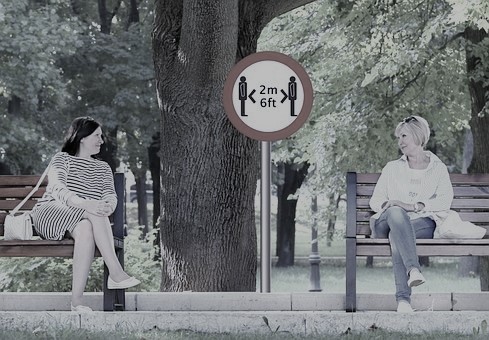
There is a vernacular term known all over the world as “social distancing.” Amazingly, this term was introduced to society just a few months ago, yet is universal. Today, I am not going to share with you any deep theological truths, yet I do want to share a few thoughts that I believe we can take from the Bible and make a practical application to our lives. While I was in Bible College, my homiletic’s professor said often (as it relates to the Scriptures), when studying the Bible, there are three questions you should ask: 1. What did it mean then (what was the authors original intent)? 2. What does it mean now (as it relates to our current world situation)? 3. What does it mean to me (a personal application to my life)? I’ve entitled this “The Original Social Distancing” and want to share a few thoughts from Joshua chapter 3:1-5:
“And Joshua rose early in the morning; and they removed from Shittim, and came to Jordan, he and all the children of Israel, and lodged there before they passed over. 2 And it came to pass after three days, that the officers went through the host; 3 And they commanded the people, saying, When ye see the ark of the covenant of the Lord your God, and the priests the Levites bearing it, then ye shall remove from your place, and go after it. 4 Yet there shall be a space between you and it, about two thousand cubits by measure: come not near unto it, that ye may know the way by which ye must go: for ye have not passed this way heretofore. 5 And Joshua said unto the people, Sanctify yourselves: for to morrow the Lord will do wonders among you.“
We know the story, Moses has died and Joshua has now been chosen to lead the Children of Israel over the Jordan River and into the Promised land. Imagine with me, the children of Israel standing by the river, gazing into their future of uncertainty. They knew they had to cross the river, and other than the reports they had received from the spies they’d sent over, most people had no idea what awaited them on the other side. Before they passed over to the other side, they were instructed to do two things: Keep a 2000 cubits distance between you and the Ark of the Covenant (The Original Social Distancing) and sanctify yourselves (purify yourself, clean yourself up, set yourself apart). This is the contextual setting (what it meant then).
What does it mean now? As a society, we are standing on the edge of our “Jordan River,” gazing on the other side. We know we are going to make it there, but we have no idea what awaits us when we get there. We are also being asked to do the very same thing the children of Israel were instructed to do: Practice a 2 meter/6 foot social distancing and clean yourself – wash your hands often, don’t touch your face, cough into your elbow or a napkin. Sound familiar?
Now, none of what I have shared would mean a thing if I fail to make a practical application in my own life. So what does this mean to me? Just like everyone else, I’m standing on the edge of this “Jordan River.” I am doing the best I can to gaze over to the other side, and though I have no idea what it’s going to look like when I get there, I am going to trust that God is working all things (all the good things, all the bad things, all the things I understand, all the things I don’t understand, all the things I can explain and all the things I can’t explain) for my good and for His glory. Until I get there, I’m going to do as I’ve been instructed, I’m going to practice this new vernacular known as “social distancing” to the extent possible and I’m going to wash my hands regularly, and try not to touch my face (which is proving to be very difficult new norm). In a more spiritual sense, during this time, I am trying to put distance between me and sin and doing everything I can to put into practice the principles of Romans 12, verse 1 and 2, as I try to look less like the world daily and better reflect the image of Christ. I am looking forward to what God has for us on the other side of this.

 Fighting for My Pea Patch
Good stuff!
LikeLike