Your Choice

The thief cometh not, but for to steal, and to kill, and to destroy: I am come that they might have life, and that they might have it more abundantly.”

Introduction

This morning, I want to look at Scripture from a four-fold perspective. We’re going to bounce between the Old Testament and the New Testament and take an honest look at the choices we are faced with every single day. Because whether we like it or not—life is full of choices. And the choices we make either draw us closer to Christ’s abundant life…or into the thief’s destruction.

The world has a lot to say about choices:

  • “Turn your wounds into wisdom.” – Oprah Winfrey
  • “The journey of a thousand miles begins with one step.” – Lao Tzu
  • “We cannot become what we need to be by remaining what we are.” – Max De Pree
  • “If you want to go east, don’t go west.” – Ramakrishna

Even business leaders like John C. Maxwell remind us:

“A man must be big enough to admit his mistakes, smart enough to profit from them, and strong enough to correct them.”

But long before Oprah, Lao Tzu, or Maxwell spoke… Jesus said, “I am come that they might have life, and have it more abundantly.”

He didn’t just come to forgive sin – He came to give you something greater than anything this world can offer. But you must choose it.

Let’s walk through three choices every believer faces:

WALK IN LIGHT OR WALK IN DARKNESS

(Choice of Direction)

Scripture: 1 John 1:5–7, God is light, and in him is no darkness at all…If we say that we have fellowship with him, and walk in darkness, we lie… But if we walk in the light…we have fellowship one with another.”

Jesus says “the thief comes to steal, kill, and destroy.” How does he do it? By leading us into darkness: slowly, quietly, deceptively.

Darkness steals clarity.
Darkness kills joy.
Darkness destroys intimacy with God.

Darkness loves secrecy, shame, hidden sin, bitterness, grudges, and unrepented habits. But light?

Light reveals.
Light heals.
Light restores.

You choose which direction you walk. Sometimes the hardest choice is simply stepping out of the shadows and saying, “Lord, shine on me.”

WALK IN THE SPIRIT OR WALK IN THE FLESH

(Choice of Dependence)

Scripture: Galatians 5:16–17, Walk in the Spirit, and ye shall not fulfil the lust of the flesh.

The flesh will: (Gal 5:19-21)

  • steal your peace,
  • kill your testimony,
  • destroy your relationships.

Sound familiar to John 10:10?

The Spirit, however, brings: (Gal. 5:22-23)

  • love,
  • joy,
  • peace,
  • patience,
  • self-control.

You can always tell which one you’re walking in by the fruit you leave behind.

The flesh reacts – The Spirit responds.

The flesh feeds pride – The Spirit cultivates humility.

The flesh wants comfort – The Spirit leads to calling.

And here’s some biker-church honesty: You can’t walk in the flesh all week and expect Spirit-filled results on Sunday.

Every day you suit up – helmet, boots, jacket – that is your safety gear. How much more do we need to suit up in the “Whole armor of God?” We need to be armed with the tools of:

  • prayer,
  • Word,
  • worship,
  • obedience.

Because abundant life flows from the Spirit’s power – not your power.

WALK IN BEAUTY OR WALK IN ASHES

(Choice of Identity)

Scripture: Isaiah 61:3, To appoint unto them that mourn in Zion, to give unto them beauty for ashes…garment of praise for the spirit of heaviness.”

Does anyone know what ashes are? They are simply remnants of what used to be. Jesus trades our ashes, our brokenness, failures, regrets, for His beauty. But some people become comfortable sitting in the ashes of:

  • past wounds,
  • past sins,
  • past disappointments.

And you can’t receive beauty while clinging to ashes. Ashes remind you where you’ve been. Beauty reminds you where He’s taking you.

The thief whispers: “You’re nothing. You’re stuck. You’re ruined. You’ve gone to far. Nobody loves you. Nobody cares about you.”

Jesus says: “You are mine. You are redeemed. You are restored.”

Abundant life is not the absence of scars (listen, we all have some self-inflicted wounds). Abundant life is the presence of the Savior.

The Danger / Opportunity Principle

John F. Kennedy once said that the Chinese word for “crisis” includes two characters: danger and opportunity.

Every choice you face contains both. The danger is choosing the thief’s voice.
The opportunity is choosing abundant life.

Conclusion

Every day, you choose:

Light or Darkness — which direction will you walk?
Spirit or Flesh — whose power will lead you?
Beauty or Ashes — what identity will you accept?

Jesus offers abundant life—full, meaningful, purposeful, Spirit-saturated.

Not just eternal life later… abundant life now. But hear me clearly…

What you choose today determines the life you experience tomorrow.

George Bernard Shaw said: “We are made wise not by the recollection of our past, but by the responsibility for our future.”

We can’t go back and edit yesterday, but we can choose differently today. The thief is roaming. He comes to:

  • steal your joy,
  • kill your purpose,
  • destroy your faith.

But Jesus stands in front of you saying: “I’ve already won. I have come to give you life, and life more abundantly.”

The choice is yours.

  • If you’re tired of darkness…step into the Light.
  • If you’re drained by the flesh…yield to the Spirit.
  • If you’re holding ashes…trade them for beauty.

The abundant life is available, but it begins with one choice – Just one step.

Looking for the Wounded

Psalm 147:2-3, “The Lord doth build up Jerusalem: he gathereth together the outcasts of Israel. He healeth the broken in heart, and bindeth up their wounds.”

This morning, this message is going to be one of the toughest messages I’ve ever had to share, so ask that you pray for us during this hour. In our text we see the Lord gathering outcasts, healing broken hearts and binding wounds. That is a picture of the Son of God. He is always doing that—gathering unto Himself outcasts, healing broken hearts and binding wounds. This morning, I am concerned with the third thing, “binding up the wounds.”

During the Vietnam War, a certain nurse was the subject of much discussion. After a battle she would wander away from the medical camp onto the battlefield itself. Sometimes she would personally drag in a soldier who was in desperate need of medical attention. More than once she was reprimanded by the doctors. They told her she had no business on the battlefield. Not only that, she brought in Viet Cong soldiers along with the Americans. One day after a big battle an officer saw her on the battlefield amid all the suffering and dying and death. He began to rebuke her: “What are you doing on that battlefield?” She said without hesitation, “I’m looking for the wounded. That’s what I am here for.”

When I read this story I couldn’t help but think, “That’s our job.” When I read about this nurse, so dedicated to the task of healing wounds that she would go onto the battlefield itself and drag-in the wounded personally, I thought to myself, “That’s our job.” When Jesus saved us, He could have taken us to Heaven right then; but He didn’t choose to do that. Instead, He left us here so we might:

  • Go onto the battlefield of this old world and look for the wounded.
  • Our job is to go out into the highways and hedges and look for the wounded.

Jesus said, “Go ye into all the world, and preach the gospel to every creature” (Mark 16:15). What is He saying? “GO! Look for the wounded.” He said, “Go out into the highways and hedges, and compel them to come in…” (Luke 14:23). GO! Look for the wounded! He said, “Ye shall be witnesses unto me both in Jerusalem, and in all Judæa, and in Samaria, and unto the uttermost part of the earth” (Acts 1:8). What’s He saying? “GO! Look for the wounded!”

That nurse believed it was her solemn duty to find the wounded and bring them in where their wounds might be healed so that they might be sent back out into the battle. So it is with us.

Our primary job is to look for the wounded. We are to go out into the battlefields of this world and find them and bring them to the Great Physician who will bind up and heal their wounds; then we are to send them out into the battle to find other wounded.

But where did the war begin? Where did these souls receive their wounds? Well, for the answer to these questions, we have to go back to the very beginning, to Eden. There we see that man was wounded, first of all…

WOUNDED BY SATAN

This first great battle took place in the beautiful Garden of Eden. “And the Lord God formed man of the dust of the ground, and breathed into his nostrils the breath of life; and man became a living soul” (Gen. 2:7). Man stood before Almighty God as the masterpiece of His creation, and God said, ‘It is good.’ Then He gave man a command, saying to Adam, “Of every tree of the garden thou mayest freely eat: But of the tree of the knowledge of good and evil, thou shalt not eat of it: for in the day that thou eatest thereof thou shalt surely die” (vss. 16,17). And the battle began!

Someone else was present in that garden—Satan. Satan began to tempt Eve, saying, “Eve, He doesn’t want your eyes to be opened. That’s the reason He told you not to eat of the forbidden fruit. Eve, your eyes will opened. You will be like God!” She said, “We’ll die.” He whispered in her ear, “Ye shall not surely die” (Gen. 3:4). She ate, and she gave to her husband, Adam, and he ate; and they were wounded by Satan.

We see in the Garden of Eden that beautiful masterpiece that God created, man fallen and wounded by Satan himself! Adam is naked now and stripped of every righteous rag. He is blind now. Satan has gouged out the eyes of his soul and left him in darkness. He is separated now. No longer does he have fellowship with God. Instead, he is hiding among the bushes.

But then God walked onto the battlefield. The Bible says that in the cool of the evening God came into the Garden and began to speak. “Adam…where art thou?” (Gen. 3:9). What is He doing? He’s Looking for the wounded.

Adam and Eve had been wounded by Satan, but God was ready to heal their wound. He found them and clothed them in His righteousness. But the battle that had its beginning in Eden began to spread until the whole world was covered. These two people, wounded by Satan, plunged the whole world into the darkness of sin.

Now we see the second wound.

WOUNDED BY SIN

The sin of disobedience that took place in the Garden of Eden began to grow until it covered the whole world like a plague and came up before Almighty God as a stench in His nostrils. “And it repented the Lord that he had made man on the earth,” and He said, “I will destroy man whom I have created from the face of the earth” (Gen. 6:6,7).

Sin had done its duty! Sin had done its job! But then the eyes of the Lord began to run to and fro across the earth. What was He doing? Looking for the wounded. The eyes of the Lord fell on a man by the name of Noah, and “Noah found grace in the eyes of the Lord” (Gen. 6:8). God told him that He was going to destroy the world with a flood and to build an ark of safety.

Just before the Flood came, God said to Noah, “Come thou and all thy house into the ark” (Gen. 7:1). Noah and his family were saved. Mankind had a new start. But the battle continued, and the wounded began to fall all over the entire world.

WOUNDED BY SOCIETY

God heals those wounds too. One night God called a man by the name of Abraham who was outside his tent. “Abraham, look up at the stars.” In my mind I have pictured that so many times. Abraham, no doubt with his mouth hanging open, began to look up at the stars. God said, “Count them.” But Abraham said, “I can’t count the stars; there are too many.” God said, “So shall thy seed be” (Gen. 15:5).

He promised Abraham a son in his old age. His wife, Sarah, laughed, thinking it humorous that God would say something like that. But God asked, “Wherefore did Sarah laugh?…Is any thing too hard for the Lord?” (Gen. 18:13,14). I submit to you today that there is nothing too hard for Him.

But for a long time it seemed as if God would not keep His promise; they had no children. Sarah, who had laughed at the idea that God would give her a child to begin with, said, “God is not going to keep His promise, so Abram, take my handmaid, Hagar, so that she might give us a child, an heir.” Abraham obeyed his wife, and this was a mistake. He took Hagar, and Ishmael was born. But God did keep His promise; God always keeps His promises.

Not too long after that, Isaac was born. Ah, how they loved Isaac! He was the apple of their eye. How they loved him! Abraham now had an heir! But what about Ishmael? Well, Sarah became jealous of Hagar and Ishmael and told her husband, “Cast them out. We don’t need them now.”

The society of Abraham no longer had any use for Hagar and Ishmael. Abraham gave them a little bottle of water and some food and sent them out into the desert. They wandered into the desert until they had lost their way. Their water was gone, their food was gone, their hope was gone. Hagar took her son, Ishmael, and put him under a bush a little ways away from her so she wouldn’t have to watch him die. Then she sat down on the hot sand, waiting to die. Nothing in all that desert but silence. But then the silence was broken as a voice said, “What aileth thee, Hagar?” (Gen. 21:17). That’s Almighty God speaking! What’s He doing in the desert? Looking for the wounded. He’s out in the desert because someone has been wounded by society. “I have seen you.” He gave them water and healed their wound. Hagar and Ishmael had been wounded by society, cast out and left to die; but God had not cast them out.

A leper was wounded by society. This man had a disease that made him repulsive to all who looked upon him. When he walked down the street, he had to cover his lip and cry out, “Unclean! Unclean!” People who had a little compassion would hang clean rags on the fences and trees so he might take them off and wipe the corruption from his sores of leprosy, then discard them. That’s the only thing society would do for him. He was an outcast from his family and friends.

But there was One who came from Heaven, born in Bethlehem’s manger, walked the shores of Galilee. There was One who loved outcasts. When He came from Heaven, He was looking for the wounded. The leper came close to the Lord Jesus Christ, saying, “Lord, if thou wilt, thou canst make me clean” (Matt. 8:2). What’s he saying? “I know You have the ability, but do You love me enough?” Immediately Jesus said, “I will; be thou clean” (vs. 3). One who had been wounded by society, who had been cast out, was all of a sudden taken back.

The woman of Sychar, the woman at the well, was an outcast. She had had five husbands, and the man she was then living with wasn’t her husband. She might have said, “Once I was pure as the snow, but I fell—fell like the snow, from Heaven to Hell.” She was a fallen woman. One day Jesus was going from Judea to Galilee. Now, usually when the Jews traveled from Judea to Galilee or Galilee back to Jerusalem, they went around Samaria because of their hatred for the Samaritans. They thought they were dogs. They had no use for them and wanted no contact with them. Did you know that a Samaritan was the only man under Heaven who could not be a proselyte to Judaism? This time it was different for the Lord. He said to His disciples, “I must needs go through Samaria.”

Not understanding that, I can imagine they must have said one to another, “Why? Why is He going through Samaria?” Little did they know that the Son of God was looking for the wounded! He had an appointment with a fallen woman at Jacob’s Well. Sitting on the curve of that old well, He saw her coming. He could see the marks of sin on her face, on her countenance. But He gave her living water.

She went back to that city and said, “Come, see a man…” (John 4:29). “Who is He?” “I don’t know, but He is looking for the wounded.” If you have been cast out by society, He is looking for you. Thank God, He still finds outcasts! Sometimes we give up on people, but God deosn’t. The eyes of the Lord were running to and fro throughout the whole earth looking for the wounded!

BUT THERE IS A FINAL WOUND – WOUNDED BY SELF

Now here is where this message is going to get very tough for me. Though I have been wounded by Satan, wounded by sin, and wounded by society – I have a lot of self-inflicted wounds. Those are the wounds I can’t blame anyone for but myself. And I think we all have scars we bear from our self-inflicted wounds.

This past week, someone very special to our church – an All-State athlete, a student-body president – Satan had convinced her that she wasn’t good enough, she didn’t measure up, so she tried to end her life. This is somebody we love, somebody we have seen God bless.

And I think about our church and all the struggles we have gone through. I’ve have been praying for days that God would give me something to help our church. I am reminded of John 10:10 where the Bible says, “the thief cometh not, but for to steal, and to kill, and to destroy: I am come that they might have life, and that they might have it more abundantly.” And I realize God is still looking for the wounded.

This morning, I am going to ask you to do something very bold. Satan is going to do everything he can to defeat you and keep you seated, but I’m asking you to look him in the face and say, “That’s enough Satan.” I am going to ask you a series of questions, and it any of these questions hit you where you live, I want you to find the courage to stand up, and together, let’s punch the devil in the face:

  • “I’m not good enough;”
  • “Nobody loves me;”
  • “I’ve gone too far;”
  • “If you really knew me, you’d have nothing to do with me;”
  • “I will never be enough;”
  • “I don’t have the strength to fight anymore;”
  • “God can never use anyone like me.”

“Father, today I lift up the precious people You’ve entrusted to my care. You see every hidden wound, every whispered lie, every scar they carry—some from the world, some from the enemy, and some from their own hearts. Lord, remind them right now that they are loved, valued, and chosen by You. Where they have believed they are not enough, speak Your truth. Where shame has settled in, wash them with Your grace. Where strength is fading, breathe fresh courage into their spirit.

Heal the self-inflicted wounds that no one else knows about. Silence every voice that tells them they are disqualified. Let them feel Your arms around them, lifting them up, restoring their confidence in You. Father, help us as a church to carry one another, to see the wounded, and to fight for each other. Let Your abundant life flow through this house.

Today, we take back what the thief has tried to steal. We stand against darkness, and we declare freedom, healing, and purpose over every soul here. Use every scar as a testimony of Your redeeming power. In Jesus’ mighty name, Amen.”

Biblical Foundation for Small Group Ministry

By: Pastor Joe Moore, Liberty University Theological Seminary Student

Introduction

            Having a strong foundation is vital for any ministry endeavor, especially small group ministry. In Scripture, we find that God’s design for His people has always involved authentic community, mutual care, and shared mission. Small groups embody the early church model, fostering spiritual growth, accountability, and multiplication. This report explores the biblical basis for small group ministry through the insights of Joel Comiskey (Biblical Foundations for the Cell-Based Church) and Rod Dempsey (Leading Healthy, Growing, Multiplying Small Groups). By summarizing their teachings, analyzing primary biblical passages, and reflecting on the church’s organizational structure, this paper presents a framework for building effective, sustainable small group ministry.

Summary of Comiskey’s Theology of God and Community

In Chapter 2, Joel Comiskey teaches that the only way to truly know God is through His self-revelation in Scripture. While creation displays God’s power and divine nature (Romans 1:20), only the Bible reveals His character and purpose.[1] Theology, derived from theos (God) and logia (word), is therefore the study of what God has disclosed about Himself.[2] Comiskey affirms Paul’s declaration that “for us there is but one God, the Father… and one Lord, Jesus Christ” (1 Corinthians 8:6, King James Version), emphasizing that early theologians developed doctrine to preserve truth against false teachings.[3] Central to God’s self-revelation is the doctrine of the Trinity, one God in three persons, Father, Son, and Holy Spirit, whose unity and diversity reveal the relational heart of divine love.[4]

In Chapter 3, Comiskey asserts that because God is triune, relationship and community are essential aspects of human existence.[5] The Trinity models perfect harmony, love, and interdependence, providing the pattern for Christian fellowship. Augustine described this relationship as the Father being the lover, the Son the beloved, and the Spirit the bond of love (1 John 4:16).[6] Jesus prayed that His followers would share this same divine unity, “that they all may be one; as thou, Father, art in me, and I in thee,” (John 17:21, KJV).[7] Thus, the church is called to reflect the relational nature of God through mutual love, service, and unity. Community, then, is not optional but foundational to the identity and mission of the people of God.[8]

Comiskey concludes in Chapter 4 showing that the church, as the family of God, is designed to mirror the triune nature of divine community.[9] Jesus modeled this truth by gathering a small group of disciples and living among them, teaching through shared life and example.[10] The early believers continued this pattern by meeting in homes for worship, prayer, and ministry (Acts 2:42–47).[11] Small groups thus express God’s design for relational discipleship and ministry multiplication. For Comiskey, this community-centered model is not a modern innovation but a rediscovery of biblical foundations—a church that lives as community, not merely in community.[12] Through the body of Christ, God’s plan is fulfilled to form a people who reflect His love, unity, and holiness (Ephesians 1:22–23).[13]

Summary of Earley and Dempsey (Chapters 5–6)

In chapters 5 and 6 of Leading Healthy, Growing, Multiplying Small Groups, Rod Dempsey and Dave Earley emphasize that the heartbeat of small group ministry is rooted in Jesus’ example and the biblical mandate for discipleship.[14] Chapter 5 centers on aligning every small group with the Great Commandment (Matthew 22:37–40) and the Great Commission (Matthew 28:18–20).[15] The small group’s mission is clear: love God, love others, and make disciples.[16] Dempsey reminds readers that “the heart cry of every human is an overwhelming need for community,” because God designed people to live and grow together.[17] Isolation, he warns, is spiritually and emotionally destructive, while genuine community fosters health, connection, and purpose.[18] As small group experts Bill Donahue and Russ Robinson explain, God has placed within each believer a “communal gene,” a built-in longing for fellowship and belonging.[19]

In chapter 6, Dempsey shifts focus to the leadership and organization of small groups, asserting that small group leaders are called to shepherd others as Jesus did.[20] Jesus Himself was a small group leader who called twelve disciples to be with Him and to be sent out to preach (Mark 3:13–14).[21] He modeled ministry through relationships, transforming lives by gathering a few to reach the many.[22] Dempsey notes that if Jesus, the Son of God, the King of Kings, chose to lead a small group, then every believer should recognize the strategic importance of doing the same.[23] The small group, therefore, becomes the most effective training ground for making disciples, just as Jesus modeled.[24] Dempsey highlights that every follower of Christ must take seriously the call to make disciples, for “the heart of the Great Commission is the call to make disciples.”[25]

Furthermore, Dempsey underscores that small groups are essential to the life and health of the church. The Apostle Paul described the church as “the body of Christ,” where every part depends on the others for proper functioning (1 Corinthians 12:21; Ephesians 1:23).[26] Disconnection or isolation from the body leads to spiritual weakness and dysfunction.[27] When small groups operate as interconnected parts of the body, they create authentic fellowship, what Chuck Swindoll describes as a place where “fences come down, masks come off, and keys to the doors of our lives are duplicated and distributed.”[28] Dempsey concludes that small groups have the power to move people “from isolation to connection and from loneliness to love.”[29] Thus, leading or participating in a small group is not simply a ministry option, it is following in the very footsteps of Jesus Christ Himself.[30]

Biblical Foundation for Small Group Ministry

The biblical foundation for small group ministry begins with Scripture itself, where the pattern of disciple-making is inherently communal. The Great Commission, “Go ye therefore, and teach all nations, baptizing them in the name of the Father, and of the Son, and of the Holy Ghost: Teaching them to observe all things whatsoever I have commanded you: and, lo, I am with you always, even unto the end of the world. Amen,” establishes the mission of the Church to make disciples through teaching, fellowship, and obedience to Christ (Matt. 28:19-20, KJV). Rod Dempsey explains that small groups serve as the most effective environment for fulfilling this command, as they allow believers to “become the hands, feet, and voice of Jesus in their world.”[31] In this context, small groups become the local expression of the Great Commission, communities of believers who learn together, grow together, and are sent together. Similarly, the Great Commandment (Matthew 22:37–40, KJV) gives small groups their relational focus. Within the intimate setting of a group, believers practice loving God and loving others, fulfilling what Bonhoeffer called the cost of community, a call to live out costly grace through genuine fellowship and mutual service.[32]

The New Commandment (John 13:34–35, KJV) given by Jesus, reveals the distinctive mark of Christian community: love that reflects His own. In a small group setting, this commandment becomes practical, visible, and transformative. Chuck Swindoll notes that when true fellowship occurs, “fences come down, masks come off, and joys and sorrows are shared.”[33] For a biker church plant, where brotherhood and authenticity are core values, this passage underscores that small groups are not just gatherings but relational environments where Christlike love builds unity and draws outsiders in. Small group ministry, therefore, is not simply a program but a spiritual formation process, where believers move from isolation to community, from information to transformation.[34]

The call of Jesus, “follow me, and I will make you fishers of men,” shows that small groups are also training grounds for mission (Matthew 4:19, KJV). Jim Putman and Bobby Harrington emphasize that a true disciple is one “who is following Christ (head), being changed by Christ (heart), and committed to the mission of Christ (hands).”[35] Small groups embody this threefold process by creating environments for spiritual growth, relational accountability, and missional engagement. Likewise, Paul identifies the purpose of church leadership as equipping the saints for ministry (Eph. 4:11-16, KJV). Dempsey explains that “pastors are to equip the saints, and the saints are to do the work of the ministry,” shifting the focus from clergy-driven to member-driven ministry.[36]

Finally, Acts 2:42–47 provides the clearest model of early small group life. The believers met in homes, devoted themselves to teaching, fellowship, breaking bread, and prayer (KJV). Joel Comiskey describes these gatherings as “living expressions of Christ’s body,” demonstrating worship, community, and mission in balance.[37] Bonhoeffer declares that a healthy church is not only the “efficacy of salt,” but a visible light shining.[38] When viewed through this lens, small groups are not optional ministries but essential to the structure and health of the church. They serve as the primary context where spiritual formation, leadership development, and missional living naturally occur.[39]

Principles for Small Group Ministry

Having identified the biblical passages that form the foundation for small group ministry, the next step is to articulate the guiding principles that shape how these truths are lived out in the local church. Principles serve as the bridge between biblical conviction and practical application, ensuring that ministry remains faithful to God’s design. Greg Ogden reminds us, “The Bible teaches us not only the message of faith, but also the method by which that faith is to be passed on to future generations. We are called to do God’s work God’s way.”[40] This section will explore three central principles for small group ministry: Discipleship Happens in Community, Every Believer is a Minister, and Multiplication is the Mission.

Discipleship Happens in Community

Jesus’ ministry model reveals that transformation occurs through shared life, not isolated instruction. From His investment in the Twelve to His intimate fellowship with Peter, James, and John, Jesus demonstrated that true growth happens in relationship. Acts 2:42–47 illustrates this same dynamic as the early church “continued stedfastly in the apostles’ doctrine and fellowship, and in breaking of bread, and in prayers” (KJV). Small groups provide a relational setting for accountability, encouragement, and spiritual formation. Comiskey affirms that Jesus “cemented the new concept of family by living among them and showing them how to love and serve one another (John 13:1–17).”[41]

Every Believer is a Minister

Exodus 18 and Ephesians 4:11–16 teach that ministry is not confined to a select few but distributed across the body of Christ. Moses learned to delegate responsibility to capable leaders to shepherd smaller groups of people, a model echoed in the early church. Dempsey and Earley note, “Leading small groups and developing leaders is part and parcel of accomplishing the Great Commission.”[42] Small groups empower ordinary believers to lead, serve, and teach within their circles of influence, creating a culture of participation rather than passive observation. When each member embraces their role, the body functions as God intended, diverse, interdependent, and fully engaged in mission.

Multiplication is the Mission

From Jesus sending out the disciples two by two (Luke 10:1) to Paul’s church-planting strategy across Asia Minor, Scripture reveals that the mission of the church is reproduction. Small groups are not meant to be static gatherings but dynamic movements that birth new leaders and new groups. Earley and Dempsey write, “Following Jesus today means following Him into deep relationships with other believers. His pattern was gathering a few to transform the many.”[43] This principle ensures that small group ministry remains outward-focused, continually expanding its reach through relational networks that carry the gospel to new people and places.

Together, these three principles, Discipleship Happens in Community, Every Believer is a Minister, and Multiplication is the Mission, form the DNA of healthy small group ministry. They keep the church focused on biblical priorities and create a sustainable model of growth rooted in authentic relationships, shared ministry, and continual reproduction.

Church and Small Group Structure

In the life of a Biker Church, discipleship happens most naturally in the context of relationships rather than classrooms or formal programs. Small groups are not just an addition to church life; they are the church in action. For a community that values authenticity, loyalty, and riding together, these groups form the primary environment where spiritual growth occurs. They meet in garages, diners, backyards, bike shops, and even on the road during rides, becoming the spaces where Scripture is read, personal stories are shared, and prayer is offered. Members are treated not as an audience but as a brotherhood and sisterhood, carrying one another’s burdens and challenging each other to follow Christ faithfully. These gatherings reflect the “IS” philosophy of small groups: they are the heartbeat of the church, not merely a supplement.[44]

Small groups in a Biker Church are relational and practical, shaping discipleships around the culture of the community. Leadership is shared, accountability is lived out on the road as well as in meetings, and ministry happens through service to one another and to the wider community. These groups cultivate trust and authenticity, where members can wrestle with life’s challenges, celebrate victories, and grow in Christ together. The small group setting also reflects the core values of biker culture, loyalty, trust, and mutual respect, while aligning them with the mission of Christlike love and discipleship. As Bonhoeffer emphasizes, “Christian community thus lives its own life in the midst of this world, continually bearing witness in all it is and does . . .”[45]

At the same time, these groups remain connected to the larger identity and mission of the church. They are “of” the church in sharing a common purpose, receiving pastoral care, and aligning with the vision to make disciples who ride with Christ and live intentionally. They are also “with” the church as members participate in corporate worship services, outreach rides, and seasonal celebrations. Yet, these larger events are not the primary setting for discipleship; they are opportunities to introduce new people to the relational web of small groups, where authentic transformation and spiritual growth take root. Dempsey and Earley highlight that healthy small groups serve as the primary environment for “knowing them, feeling their hurts, sharing their joys, and encouraging their hearts.”[46]

Conclusion

In the unique culture of a Biker Church, small groups represent far more than weekly meetings—they are the living embodiment of Christ’s design for His Church. Rooted in biblical community and modeled after the ministry of Jesus, these groups become places where discipleship is personal, authentic, and transformative. Through shared life, mutual care, and mission, small groups turn the values of brotherhood and loyalty into expressions of Christlike love. They provide the relational framework where spiritual growth occurs, leaders are developed, and the gospel is carried into new circles of influence. Joel Comiskey, quoting Helen Doohan, writes, “the actions and attitudes in the community speak to the fundamental family values, with trust, respect, love, patience, tolerance, resilience, and generosity, the kind of interaction essential to being the church.”[47] For the Biker Church, then, small groups are not just the heart of its structure but the engine of its mission, riding together, growing together, and reaching the world together for Christ.


[1] Joel Comiskey. Biblical Foundations for the Cell-Based Church: New Testament Insights for the 21st Century Church (CCS Publishing, 2012), 37.

[2] Ibid., 37.

[3] Ibid., 38.

[4] Comiskey, Biblical Foundations for the Cell-Based Church, 38-39.

[5] Ibid., 44.

[6] Ibid., 43.

[7] Ibid., 44-45.

[8] Ibid., 46.

[9] Ibid., 64.

[10] Ibid., 77-78.

[11] Ibid., 78-79.

[12] Comiskey, Biblical Foundations for the Cell-Based Church, 80.

[13] Ibid., 72.

[14] Rod Dempsey and Dave Earley. Leading Healthy, Growing, Multiplying, Small Groups (Lynchburg, Va: Liberty University Press, 2016), 23.

[15] Ibid., 27.

[16] Ibid., 9.

[17] Ibid., 23.

[18] Ibid., 24.

[19] Dempsey and Earley, Leading Healthy, Growing, Multiplying, Small Groups, 24.

[20] Ibid., 26.

[21] Ibid., 26.

[22] Ibid., 26.

[23] Ibid., 27.

[24] Ibid., 27.

[25] Ibid., 27.

[26] Ibid., 23.

[27] Dempsey and Earley, Leading Healthy, Growing, Multiplying, Small Groups, 23.

[28] Ibid., 24.

[29] Ibid., 24.

[30] Ibid., 27.

[31] Ibid., 27.

[32] Dietrich Bonhoeffer, The Cost of Discipleship. (New York: Macmillan, 1963), 45.

[33] Dempsey and Earley, Leading Healthy, Growing, Multiplying, Small Groups, 24.

[34] Ibid., 23-24.

[35] Jim Putman and Bobby Harrington. DiscipleShift: Five Steps That Help Your Church Make Disciples Who Make Disciples, (Grand Rapids: Zondervan, 2013), 51.

[36] Rod Dempsey and Dave Earley. Disciple Making Is . . .: How to Live the Great Commission with Passion and Confidence (Brentwood, Tn: B&H Publishing Group, 2013), 41.

[37] Comiskey, Biblical Foundations for the Cell-Based Church, 45.

[38] Dietrich Bonhoeffer. Discipleship. (Minneapolis, MN: Fortress Press, 2003), 112.

[39] Putnam and Harrington, DiscipleShift, 58.

[40] Gary Ogden. Disciple Essentials: A Guide to Building Your Life in Christ, Expanded Edition. (Downers Grove, IL: InterVarsity Press, 2007). 21.

[41] Comiskey, Biblical Foundations for the Cell-Based Church, 60.

[42] Dempsey and Earley, Leading Healthy, Growing, Multiplying, Small Groups, 12.

[43] Ibid., 26.

[44] Dempsey and Earley. Disciple Making Is, 279.

[45] Bonehoeffer, Discipleship, 250.

[46] Dempsey and Earley, Leading Healthy, Growing, Multiplying, Small Groups, 24-25.

[47] Comiskey, Biblical Foundations for the Cell-Based Church, 63.

Bibliography

Putman, Jim, Harrington, Bobby, and Coleman, Robert E. DiscipleShift: Five Steps that Help Your Church to Make Disciples Who Make Disciples. Grand Rapids: MI: Zondervan Reflective, 2013. 19. 

Bonhoeffer, Dietrich. Discipleship. Minneapolis, MN: First Fortress Press, 2003. 21.

Earley, Dave and Dempsey, Rod. Discipleship Making Is . . .: How to Live the Great Commission with Passion and Confidence. Brentwood: B&H Academics, 2013. 21, 22.

Ogden, Greg, 2007. Discipleship Essentials: A Guide to Building Your Life in Christ, Expanded Ed. Downers Grove, IL: Intervarsity Press, 20.

Earley, Dave and Dempsey, Rod. Spiritual Formation Is . . .: How to Live the Great Commission with Passion and Confidence. Brentwood: B&H Academics, 2018. 32.

Comiskey, Joel. Biblical Foundations for the Cell-Based Church. Moreno Valley, CA: CCS Publishing, 2012.

Dempsey, Rod, and Dave Earley. Leading Healthy, Growing, Multiplying Small Groups. Lynchburg, Va. Liberty University Press, 2016.


Why Small Groups?

By: Pastor Joe Moore, Liberty University Theological Seminary Student

INTRODUCTION

In Biblical Foundations for the Cell-Based Church, Joel Comiskey shows that small groups are not a modern strategy but a biblical design for how the church was meant to function. Comiskey states that the goal was “to discover the biblical underpinnings for small groups.”[1] He further states, “When a church does not develop a strong foundation upon which to build cell-groups, the reason for doing cell ministry will also shift like sand.”[2] From the house gatherings of Acts 2 to the modern church, Comiskey reminds us that “small groups have been crucial to church life for a long time.”[3] One can gather from Comiskey’s writings that the strength of the larger church is directly tied to the health of its smaller gatherings.

In Leading Healthy, Growing, Multiplying Small Groups, Rod Dempsey and Dave Earley build on that foundation by describing how the Great Commission (Matthew 28:18-20) establishes a biblical model for “going where people are, baptizing them when they surrender to Christ and then teach them the ways of Christ.”[4] They emphasize that healthy groups don’t just meet, they grow and multiply. By focusing on relational connection, spiritual growth, practical service, and intentional outreach, small groups become “connected to the mission.”[5] Their model challenges leaders to raise new disciple-makers and multiply groups so that the church expands naturally and sustainably.

As a church planter in the biker community, I’ve seen these truths come to life. Just nine weeks ago, our church launched its first small group with a handful of young riders gathering around food, Scripture, and honest conversation. What started as one group has now multiplied into two additional groups just this past week. Seeing riders open-up about faith, praying for one another, and stepping forward to lead has confirmed everything Comiskey and Dempsey & Earley describe.

BUT WHY SMALL GROUPS?

There are several reasons I believe small groups are essential in our ministry. First, bikers thrive on brotherhood and authenticity, qualities small groups naturally foster. Second, discipleship happens best in circles, not rows; people grow when they can talk, ask questions, and apply the Word together. Third, small groups create new leaders and new opportunities for outreach.

My primary reason for developing small groups is to see transformation happen through authentic relationships, where bikers don’t just attend church but become the church. My hope and dreamis to see a network of biker small groups across our region: riders discipling riders, praying together, serving their communities, and reaching others for Christ. In that vision, the rumble of motorcycles becomes a soundtrack to revival, where fellowship, freedom, and faith ride together for the glory of God.


[1] Joel Comiskey. Biblical Foundations for the Cell-Based Church, (Moreno Valley, CA; CCS Publishing, 2016), 13.

[2] Ibid., 20.

[3] Ibid., 35.

[4] Rod Dempsey and Dave Earley. Leading Healthy, Growing, Multiplying Small Groups, (Lynchburg, VA: Liberty University Press, 2016), 7.

[5] Ibid., 8.

Reflections on Discipleship

By: Pastor Joe Moore, Liberty University Theological Seminary Student

Introduction

            Discipleship stands at the heart of the Christian faith—it is not an optional ministry but the very essence of following Jesus Christ. Dietrich Bonhoeffer’s understanding of discipleship, rooted in obedience to the living call of Christ, challenges believers to move beyond mere belief into faithful action.[1] His insistence that faith and obedience are inseparable serves as a powerful corrective to a culture that often seeks comfort without commitment. In the context of a biker church, this vision becomes tangible. Among riders who value loyalty, authenticity, and community, discipleship takes on a raw and relational form, one defined not by programs, but by lives transformed through shared journeys of faith, obedience, and brotherhood in Christ expressing the communal way of life found in Acts 2:42-47 (King James Bible).

Dietrich Bonhoeffer’s View of Discipleship

For Dietrich Bonhoeffer, discipleship is rooted in the immediate and obedient response to the call of Jesus Christ. The call itself creates faith, and the disciple’s proper answer is not verbal confession but action by obedient deed.[2] Bonhoeffer emphasizes that faith and obedience are inseparable; there is no genuine faith without obedience, and no obedience without faith.[3] When Christ calls, the disciple follows, and this simple yet profound act defines discipleship.[4]

The content of discipleship is summed up in Jesus’ command, “Follow me” (Matt. 4:19, KJV). This summons is not to a program or ideal but to the person of Christ himself.[5] Those who respond must leave everything, stepping out of worldly security into what seems like complete insecurity, yet find true security in communion with Jesus.[6] Thus, discipleship requires a decisive break from one’s former life, creating a new situation where faith becomes possible.[7]

Bonhoeffer rejects “cheap grace,” which separates faith from obedience, insisting instead on the costly grace of active following.[8] To obey Christ’s command, “Do this! Stop that! Come!” means to enter a living relationship with the incarnate Son of God, the mediator between God and humanity.[9] Ultimately, Bonhoeffer portrays discipleship as commitment to Christ alone, a continual call to act in faith and love toward others.[10] Through obedience to the living Word, believers participate in the transforming fellowship of the One who still calls, “Follow me.”

My Personal Reflection on Discipleship

As a church planter in the biker community, I view discipleship as both a calling and a lifestyle; the heartbeat of what it means to follow Jesus Christ. Dietrich Bonhoeffer’s insistence that true discipleship is found in obedience to the living Christ deeply shapes my understanding. Bonhoeffer reminds us that faith and obedience are inseparable; when Jesus says, “Follow me,” the disciple’s only response is action.[11] In this light, discipleship cannot be reduced to programs or study, it must be lived out in the grit and grace of everyday relationships.

In biker culture, where loyalty, authenticity, and brotherhood define belonging, these same traits mirror the relational and missional nature of biblical discipleship. Like Bonhoeffer, I believe obedience begins with personal surrender and grows within community.[12] Our disciple-making plan, built around the five P’s – Passages, Principles, Philosophy, Practices, and Proof, seeks to make Christ’s command tangible. Through Scripture, small-group brotherhood, and service to others, disciples learn to ride together in faith, live out love, and carry the gospel into their world (Matt. 28:19–20; John 13:34–35, KJV). This is what Jim Putman and Bobby Harrington refer to as the foundation of a disciple-making plan.[13]

For me, Bonhoeffer’s challenge that “we want to know what Jesus wants” anchors everything.[14] Jesus wants followers who embody His love, proclaim His message, and reflect His presence among those often forgotten by the church. In a biker church, discipleship looks like men and women transformed by grace, riding shoulder to shoulder for the cause of Christ and putting faith in motion through obedient love. Rod Dempsey inserts, disciples are to “band together for prayer, fellowship, teaching, and intentionally accomplishing the Great Commission.”[15] 

Passages and Principles of Discipleship

Every disciple-making effort must begin with the Word of God. The Bible provides the foundation and direction for how we lead people to follow Jesus. This section explores the key discipleship passages that establish a Biblical foundation to guide the ministry as well as the principles that reflect our vision of “disciples making disciples.”

The Great Commission,  “Go ye therefore, and teach all nations, baptizing them in the name of the Father, and of the Son, and of the Holy Ghost: Teaching them to observe all things whatsoever I have commanded you: and, lo, I am with you always, even unto the end of the world. Amen” (Matt. 28:19-20, KJV), is the heartbeat of discipleship. Jesus commands us to go, make disciples, baptize, and teach. It’s not a suggestion; it is our mission. As Rod Dempsey reminds us, disciples “become the hands, feet, and voice of Jesus in their world.”[16]

The Great Commandment (Matt. 22:37–40, KJV) teaches that loving God and loving others are inseparable. The New Commandment (John 13:34–35, KJV) goes even deeper, calling us to love one another as Christ has loved us. In the biker community, where loyalty, respect, and brotherhood run deep. It is this Christlike love that sets us apart. It is how people know we truly belong to Jesus.

When Jesus said, “Follow me, and I will make you fishers of men” (Matt. 4:19, KJV), He showed that discipleship begins in relationship. We follow Him, are changed by Him, and join His mission. As Putman and Harrington say, a disciple is someone “following Christ (head), being changed by Christ (heart), and committed to the mission of Christ (hands).”[17]

Ephesians 4:11–16 reminds us that pastors are called to equip the saints to do the work of ministry. Acts 2:42–47 shows the early church living out discipleship in community through worship, teaching, fellowship, and outreach.[18]

At Rally Point Biker Church, our mission field extends to riders, their families, shop employees, and recovery communities, many of whom have been hurt or overlooked by traditional churches. Our calling is to meet people where they are and guide them in spiritual growth through three core principles: Biblical Authority, living faithfully according to God’s Word; Relational Discipleship, growing together in authentic love and community; and Missional Living, actively reaching others for Christ. These principles embody the vision of Rally Point Biker Church: to be a place where riders encounter Christ, mature in their faith, and ride together in mission for His glory.

Best Practices and Plan for Developing Disciples in a Biker Church

Discipleship in a biker church thrives in the context of real relationships rather than formal classrooms. Authenticity, loyalty, and shared experience are central values in biker culture, so the best practice is to build discipleship around those same values. Small groups are not an add-on; they are the church. These groups meet in garages, diners, and homes, where the Bible is opened, stories are shared, and prayer is offered.

Best Practices

Best practices for discipleship at Rally Point Biker Church emphasize relational, practical, and authentic approaches. First, keep it relational by fostering brotherhood and sisterhood in Christ, encouraging riders to care for one another both on and off the road. Second, keep it simple by using Scripture as the core curriculum, supported by reproducible tools such as Discipleship Essentials by Gary Ogden.[19] Third, empower lay leaders by raising individuals from within small groups who model Christlike character and lead through service. Fourth, stay missional by treating every ride, outreach, and service project as a disciple-making opportunity. Finally, model authenticity by being transparent about struggles and victories, since bikers value realness over polish.

Plan for Implementation

Discipleship in a biker church is strengthened through intentional structures and practices. First, establish small groups that meet consistently in garages, diners, or homes, places where riders naturally gather. Next, train and mentor group leaders in practical disciple-making and spiritual care, equipping them to guide others effectively. Integrate mission by connecting small groups with community outreach rides and service projects, ensuring that faith is expressed actively in the world. Celebrate growth by recognizing baptisms, testimonies, and leadership milestones as tangible markers of spiritual maturity. Finally, evaluate and adjust regularly, reviewing group health, leadership development, and community impact to ensure discipleship remains vibrant, effective, and aligned with Christ’s mission.

Conclusion

In the end, Bonhoeffer’s call to costly discipleship finds fresh expression in the biking community through authentic relationships, faithful obedience, and mission-minded living. Discipleship is not confined to church walls but lived out on the open road—in garages, coffee shops, and ride routes where Christ’s presence is made real among His followers. The plan for disciple-making at Rally Point Biker Church centers on building strong small-group communities, empowering lay leaders, and integrating service with spiritual growth. As riders “ride with Christ, live with purpose, and make disciples along the way,” they embody Bonhoeffer’s vision of faith in motion, disciples who not only believe, but follow, obey, and reflect the transforming power of Jesus Christ to a watching world.


[1] Dietrich Bonhoeffer, Discipleship, ed. Martin Kuske et al., trans. Barbara Green and Reinhard Krauss, vol. 4, Dietrich Bonhoeffer Works (Minneapolis, MN: Fortress Press, 2003), 57.

[2] Ibid, 57.

[3] Ibid, 63-64.

[4] Ibid, 59.

[5] Ibid, 58-59.

[6] Bonhoeffer, Discipleship, 58.

[7] Ibid, 61-62.

[8] Ibid, 68.

[9] Ibid, 59, 66.

[10] Ibid, 73, 76.

[11] Ibid, 57-59.

[12] Bonhoeffer, Discipleship, 63-64.

[13] Jim Putman, Bobby Harrington, and Robert E. Coleman, DiscipleShift: Five Steps that Help Your Church to Make Disciples Who Make Disciples, (Grand Rapids: MI: Zondervan Reflective, 2013), 51.

[14] Bonhoeffer, Discipleship, 76.

[15] Dave Earley and Rod Dempsey. Disciple Making Is . . .: How to Live the Great Commission with Passion and Confidence, (Brentwood: B&H Academics, 2013), 40.

[16] Earley and Dempsey, Disciple Making Is . . ., 22.

[17] Putman, Harrington, and Coleman, DiscipleShift, 51.

[18] Earley and Dempsey, Disciple Making Is . . ., 41.

[19] Greg Ogden. Discipleship Essentials: A Guide to Building Your Life in Christ, Expanded Ed. (Downers Grove, IL: Intervarsity Press, 2007).

Bibliography

Putman, Jim, Harrington, Bobby, and Coleman, Robert E. DiscipleShift: Five Steps that Help Your Church to Make Disciples Who Make Disciples. Grand Rapids: MI: Zondervan Reflective, 2013. 

Bonhoeffer, Dietrich. Discipleship. Minneapolis, MN: First Fortress Press, 2003.

Earley, Dave and Dempsey, Rod. Discipleship Making Is . . .: How to Live the Great Commission with Passion and Confidence. Brentwood: B&H Academics, 2013.

Ogden, Greg, 2007. Discipleship Essentials: A Guide to Building Your Life in Christ, Expanded Ed. Downers Grove, IL: Intervarsity Press.

Earley, Dave and Dempsey, Rod. Spiritual Formation Is . . .: How to Live the Great Commission with Passion and Confidence. Brentwood: B&H Academics, 2018.

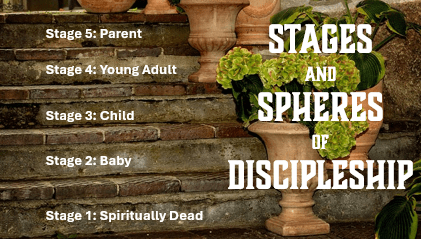
Stages and Spheres of Discipleship

By: Pastor Joe Moore, Liberty University Theological Seminary Student

Introduction

From the earliest chapters of the Gospels, Jesus invites individuals into follow Him on a transformative journey that is not instantaneous but progressive (Matthew 4:19, King James Version). After more than three years of following Christ, the lives of the disciples had transformed to the point that they were entrusted carrying out the mission of taking the Good News to all the world (Matt. 28:19-20, KJV). This research will focus on the stages the disciples of both yesterday and today must go through, how these stages affect the spheres of their lives, where I am personally in this disciple development process, as well as the areas I need improvement, and finally, what it means to submit to Christ.

The Five Stages of Discipleship

            Dempsey and Earley describe the key to discipleship as every “disciple realizing their potential is trusting God and taking the next step of faith and obedience.”[1] Dietrich Bonhoeffer says the steps of following Christ is more than a spoken confession of faith in Christ, but is an obedient deed.[2] Bonhoeffer further states that discipleship is “a commitment solely to the person of Jesus Christ.”[3] This section will focus on the Five Stages of Discipleship described by Putman and Harrington[4] that begins with the realization that without Christ, all are dead in their trespasses and sin. Upon answering the call to follow Christ, the disciple becomes a spiritual babe, grows into a child, then progresses to a young adult, and culminates with becoming an adult. It is the responsibility of the disciple to identify where people are in these stages to help them get where they need to be.[5]

Stage 1: Spiritually Dead

This level is best described as an exploratory stage. Until a person makes the conscious decision to follow Christ, the Apostle Paul describes them as those “who are dead in trespasses and sins” (Ephesians 2:1, King James Bible). Putman and Harrington refer to this as the pre-conversion discipleship phase.[6] Greg Ogden states, “Just because Jesus focused on a few doesn’t mean He lost focus on the multitude.”[7] In fact Jesus’ purpose in coming was to “seek and to save that which was lost” (Luk. 19:10, KJV). His purpose in discipling His disciples is reflects this in His final command to, “Go into all the world and preach the Gospel to every creature” (Mark. 16:15, KJV). Peter reinforces this by stating that the Lord is “not willing that any should perish, but that all should come to repentance” (II Peter. 3:9, KJV).

It is in the stage that those who are dead in the trespasses and sins “act according to their dead nature.”[8] Putman and Harrington state that it is in this stage “they need love through honest friendships and relationships with believers. We often preach our best sermons with our lives and not our words”[9] The great news is, a person in this stage “can be born again (John. 3:3-5).”[10]

Stage 2: Infants

This is the stage where those who were dead in trespasses and sins make a commitment to follow Christ. Putman and Harrington describe those in this stage as those who “have made a decision to follow Christ, but that’s about as far as they have gotten.”[11] I Peter 2:2-3 describes these as “new-born babes” (KJV). As babes, those in this stage are needy and require a lot of attention. Discipling babes requires a lot of patience and an understanding that a lot of mistakes will be made.[12] Putman and Harrinton state “eventually they will learn to feed themselves, but at this point, they don’t really know how.”[13] They conclude this stage by stating “they need the truths of the Christian faith taught and modeled for them.”[14]

Stage 3: Children

The next spiritual stage of growth is becoming children. John says, “My little children, these things write I unto you . . .” (I John 2:1, KJV). In referring to these believers in Ephesus, John refers to them as children. This maybe a term of endearment, recognizing they are part of the family of God, but could also addresses where they are in the discipleship development stage. In this stage, they are learning to feed themselves and are learning to speak the believer’s language.[15] However, they have not figured out that ministry is not about them. Putman and Harrington state, “Children still need care and guidance from their parents.”[16] In this stage, the authors state, “they need teaching about who they are in Christ, how to have close relationships with other believers, and what to expect (and not expect) from Christians.”[17]

Stage 4: Young Adults

Putman and Harrington state that those in this stage are, “making a shift from being self-centered to being Christ-centered.”[18] At this stage they are becoming doers of the Word, not just hearers (James 1:2, KJV). They are eager and find joy in serving God.[19] For those in this stage, Putman and Harrington state, “they need a place where they can learn how to serve . . . They need deep relationships with people who will both encourage them and hold them accountable.[20] This is also the stage where the transformation process is taking shape in their lives (Rom. 12:1, 2, KJV).

Stage 5: Parents

For this stage, Putman and Harrington chose to use the term parent over adult to emphasis the need for spiritual reproduction.[21] These are mature Christians that are able to teach others and are steeped in the Word of God.[22] Spiritual parents are not perfect, but they do reflect maturity and readiness to carry out the Great Commission. Putman and Harrington said, “They are feeding themselves God’s Word so that they can feed others.[23]

The Four Spheres of Discipleship

            Though discipleship unfolds in stages, it touches every area of our lives. Putman and Harington describe growing into disciples “involves four main spheres of life . . . since people grow at different speeds, we should take care to disciple them in a way that is appropriate to their level of spiritual maturity.”[24] The four spheres encompass our relationship with God, with our families, with other believers, and with the lost, and highlight that Christ’s Lordship must be central.

Relationship With God

The first and most important sphere is our relationship with God. Bonhoeffer said, “the call to discipleship is a commitment solely to the person of Jesus Christ.[25] Now that the believer is “in Christ Jesus” (Rom. 8:1, KJV), according to Earley and Dempsey, “they are to be transformed by the renewing of their minds.”[26]  Believers are to be in a transformational stage where they are learning daily to look less like themselves and look more like Jesus. This sphere is essential to grasp the other spheres.

Relationship with Other Believers

Acts 2:42-47 describe how the believers lived out the four pillars of faith: teaching, fellowship, breaking of Bread, and prayer. Living in community or doing life with other believers “strengthens the relationship with have with God by being in a relationship with other believers . . . as we walk with God, we learn to love our brothers and sisters in Christ.[27]

Relationship with Family

            Discipleship extends into the home. Paul’s instructions in Ephesians 5:22–6:4 show that marriage and parenting are places where the gospel is lived out. Learning to live in Christian community and learning the Christian language should naturally bleed over to the home. After all, as Putman and Harrington state, “the best place to make disciples is in your family.”[28]

Relationship with the World

Though we are called not to love the world, nor the things of the world, we are called to live in the world, to be a light to the world (I John 2:15-17, KJV). How we act at work, at sporting events, in the grocery store, at the gas station reflects our relationship with Christ. Putman and Harrington state, “our relationship with Jesus necessarily affects how we live and work in the world.[29]  

My Current Stage of Discipleship

            I most closely identify with being an Adult/Parent in my current stage. Though age is not the determinate factor by any means, I am 62 years old, have been in a relationship with Christ since I was six years old, surrendered to the call preach after 14 years of active military service, and now 30 years into ministry. I have mentored 7 men of over my 30 years pastoring that have answered the call to preach and are now making disciples themselves.

Two years ago, I planted a church for the motorcycle community. This has been both rewarding and challenging. Rewarding in the fact that I have people I am mentoring at every stage of their relationship to Christ. This has also proven to be a challenge as I have very few people capable of mentoring others themselves. So, the burden to disciple rests squarely on me.

Spheres of Life Needing Submission to Christ

I believe one of my spheres of life is my relationships with other believers. The older I get, the less patience I have. It is frustrating to disciple people, only to see them begin to regress in the spiritual stage they are in. Sometimes the shear amount of work to do and lack of laborers to help in the harvest weighs heavy on me. Of course, this frustration also bleeds over to my relationships in the home. Altogether, the work of making disciples can be so overwhelming that it cuts into my relationship with God. Reminds me of Eleazar, who was fighting for his king, right where he was supposed to be, fighting when everybody else ran off, but he was giving it everything he had. Although he was where he was supposed to be and doing what he was supposed to do, “his hands got weary” (II Sam. 23:10). In short, getting weary can affect every sphere of submission to Christ.

Submission to Christ: A Theological Perspective

            Submission to Christ, from a theological perspective, is both the foundation and the ongoing posture of discipleship. The Gospels show us that Christ’s invitation to “follow Me” (Matt. 4:19, KJV) is not merely a call to observe His teaching but to enter into a lifelong process of transformation. Submission is not a one-time act but a progressive journey of surrender, as seen in the disciples’ own lives. For more than three years, they walked with Jesus, learning obedience through both their failures and growth, until finally they were entrusted with the mission to carry the Gospel to all nations (Matt. 28:19–20, KJV). Theologically, this points to the reality that discipleship requires both recognition of Christ’s Lordship and an active yielding of one’s will, desires, and ambitions to Him. Bonhoeffer rightly insists that discipleship is not simply confession but obedience—the willingness to give up autonomy and embrace Christ’s authority in every sphere of life.

True submission means aligning one’s entire being under the reign of Christ, allowing His Spirit to guide the process of sanctification. As Putman and Harrington describe through the stages of discipleship, believers must move from spiritual infancy to maturity, learning at each stage to submit more deeply to Christ’s Word and will. Likewise, submission touches every sphere of life: our relationship with God, our fellowship with believers, our families, and our witness to the world. Theologically, submission is inseparable from transformation (Rom. 12:1–2, KJV); it requires dying daily to self (Luke 9:23, KJV) so that the life of Christ may be fully formed within us. To submit to Christ, then, is to embrace His call to discipleship as the central organizing reality of life, trusting that obedience, even when it is difficult, leads to greater intimacy with Him and effectiveness in carrying out His mission.

Conclusion

In conclusion, discipleship is a progressive journey of transformation that requires intentional submission to Christ in every stage and sphere of life. From spiritual death to becoming a spiritual parent, the process of growth involves both God’s grace and our active obedience to His call. The stages described by Putman and Harrington remind us that discipleship is not instantaneous but marked by continual steps of faith, learning, and service. Likewise, the four spheres emphasize that following Christ is not limited to personal devotion but extends into our families, relationships with believers, and witness to the world. True discipleship is about faithfully abiding in Christ, allowing His life to flow through me so that I may continue to make disciples who, in turn, will make disciples.

Bibliography

Jim Putman, Harrington, Bobby, and Coleman, Robert E., 2013.  DiscipleShift: Five Steps that

Help Your Church to Make Disciples Who Make Disciples. Grand Rapids: Zondervan

Reflective, 55-75.

Earley, Dave and Dempsey, Rod, 2018. Spiritual Formation Is . . .: How to Grow in Jesus with Passion and Confidence. Brentwood: B&H Academic, 84.

Earley, Dave and Dempsey, Rod, 2013. Discipleship Making Is . . .: How to Live the Great

Commission with Passion and Confidence. Brentwood: B&H Academics, 58.

Bonhoeffer, Dietrich, 2003. Discipleship. Minneapolis, MN: First Fortress Press, 45.

Ogden, Greg, 2007. Discipleship Essentials: A Guide to Building Your Life in Christ, Expanded

Ed. Downers Grove, IL: Intervarsity Press, 20.


[1] Dave Earley and Rod Dempsey. Discipleship Making Is . . .: How to Live the Great Commission with Passion and Confidence, (Brentwood: B&H Academics, 2013), 58.

[2] Dietrich Bonhoeffer. Discipleship, (Minneapolis, MN: First Fortress Press, 2003), 45.

[3] Ibid, 59.

[4] Jim Putman, Bobby Harrington, and Robert E. Coleman. DiscipleShift, Five Steps that Help Your Church Make Disciples that Make Disciples, (Grand Rapids, MI: Zondervan Reflective, 2013), 55-75.

[5] Putman, Harrington, and Coleman. DiscipleShift, 55.

[6] Ibid, 63.

[7] Greg Ogden. Discipleship Essentials: A Guide to Building Your Life in Christ, Expanded Ed. (Downers Grove, IL: Intervarsity Press, 2007), 20.

[8] Putman, Harrington, and Coleman. DiscipleShift, 61.

[9] Ibid, 62.

[10] Ibid, 62-63.

[11] Putman, Harrington, and Coleman. DiscipleShift, 63.

[12] Ibid, 64.

[13] Ibid, 64.

[14] Ibid, 65.

[15] Ibid, 65.

[16] Ibid, 65.

[17] Putman, Harrington, and Coleman. DiscipleShift, 67.

[18] Ibid, 67.

[19] Ibid, 68.

[20] Ibid, 69.

[21] Ibid, 69.

[22] Ibid, 69.

[23] Ibid, 70.

[24] Putman, Harrington, and Coleman. DiscipleShift, 78.

[25] Bonhoeffer. Discipleship, 48.

[26] Dave Earley and Rod Dempsey, Spiritual Formation Is . . .: How to Grow in Jesus with Passion and Confidence, (Brentwood, TN: B&H Academics, 2018), 51.

[27] Putman, Harrington, and Coleman. DiscipleShift, 87.

[28] Putman, Harrington, and Coleman. DiscipleShift, 88.

[29] Ibid, 89.

Spiritual Formation and Discipleship

By: Pastor Joe Moore, Liberty University Theological Seminary Student

Introduction

Spiritual formation lies at the very heart of Christian discipleship. To be a disciple of Jesus is not merely to follow His teachings externally, but to be inwardly transformed into His likeness (Romans 12:2, King James Version). The New Testament emphasizes that discipleship with believing in Christ and then being conformed to His image (Rom. 8:29, KJV). According to Putman and Harrington, thisis the process by which the Holy Spirit shapes the mind (head), transforms the heart, and gives the believer purpose (hands),[1] so that one may love God, love one another, and love one’s neighbor more fully. To support this process, this paper will examine the relationship between spiritual formation and discipleship, outline the three areas of spiritual growth, discuss the role of the Holy Spirit in the process, reflect on a personal growth assessment, and conclude with specific habits and disciplines for continued development.

Relationship Between Spiritual Formation and Discipleship

            Dempsey and Earley describe spiritual formation (and the goal) as, “the process of transformation that occurs as a believer becomes more and more like Jesus.”[2] In another writing, regarding discipleship, the same authors state, “in every phase of our existence – salvation, spiritual growth, service, suffering, and bearing fruit – God has created us to bring Him glory.”[3] They also define discipleships as, “abandoning the world and following Jesus.”[4] At its core, discipleship requires that a believer deny self, take up the cross, and follow Christ (Luke 9:23, KJV). However, this “following Jesus” is not accomplished simply by external conformity, but by inward transformation. Spiritual formation is what Earley and Dempsey said enables us to “gaze into the face of Jesus so we may be transformed to think, act, feel, and look more like him.”[5] Therefore, spiritual formation is the inner work that makes discipleship possible.

Kevin VanHoozer describes the steps required for Christians, who on the outside look normal, yet are dysfunctional in that they are not conforming to the image of Christs, can begin to grow in His likeness.[6]  True discipleship integrates the believers inwardly renewed by the Spirit and outwardly living as followers of Christ. In this way, spiritual formation fuels discipleship, while discipleship provides the context and purpose for spiritual formation.

Overview of the Three Areas of Spiritual Formation

According to Earley and Dempsey, “we are to love God totally with all our mind, soul, body, spirit, and to the full capacity of our strength.”[7] In other words, spiritual formation touches the whole person (as chapter 6 is aptly titled).[8] Together, these dimensions reflect the biblical command to love the Lord with all one’s heart, soul, mind, and strength (Mark 12:30, KJV).

Spiritual Growth of the Mind

The mind shapes how Christians perceive reality, interpret Scripture, and discern truth from error. Putman and Harrington state, “the invitation to follow Him, speaks to us at a head level.”[9] That means making a voluntary, mental decision to forsake all and follow Jesus. They further state, “when people make a decision to follow Jesus, at some level they must first know and accept who he is, even if they don’t fully grasp all that will be required of them as a disciple.”[10]

Developing a Christian worldview will enable the believer to, “set your affections on things above, not on the things on the earth” (Col. 3:2, KJV). Earley and Dempsey state, “following Christ means realigning your thinking away from the things of the earth and focusing on eternal values.”[11] Learning to think biblically will foster practices that feed the mind. Earley and Dempsey would classify this as the Upward Disciplines: taking in the Word of Christ, prayer, journaling, fasting, stillness. include systematic study of Scripture, theological reflection, and memorization of key passages.[12] By filling the mind with truth, the believer resists conformity to the world and cultivates the wisdom necessary for faithful discipleship.

Spiritual Growth of the Heart

The heart represents the seat of desires, emotions, and affections. Spiritual growth in the heart means aligning one’s loves with God’s love. Putman, et.al., state, “there must be a process of transformation in which a work takes place in our heart and affections.”[13] They further state that to grow in Christ, believers must respond the call of Christ and allow him to “unmake them and then remake them into His image.[14] Bob Smietana wrote, “The goal is to make disciples who become more Christlike, who act and love as Christ did.”[15]

This process of transformation allows faith to work through love (Gal. 5:6). Earley and Demsey state that the way to walk in daily transformation is by practicing the Inward Practices such as doing life together, being part of healthy small group, accountability, learning to love one another, and practice in the private places.[16] These disciplines heal wounds, reflect the love of Christ, and provide a sense of community in which to grow in Christ-likeness.

Spiritual Growth of the Will

The will concerns choices and obedience. Jesus’ prayer in Gethsemane, “Not my will, but yours be done” (Luke 22:42, KJV), exemplifies the surrender of the human will to God’s purposes. Earley and Dempsey well said, “this is a partnership where God does his part and we do ours.”[17] Putman and Harrington call this our “call to action,” to be the “hands of Jesus.”[18]

Earley and Dempsey refer to this as the Outward Disciplines, which include praying for saved and unsaved, being a light, sharing the Good News, loving the least and loving your enemies.[19] Through these practices, the believer learns to yield control, embrace humility, and walk consistently in obedience to God’s Word.

The Role of The Holy Spirit in Spiritual Formation

            The Holy Spirit is the agent of spiritual formation. While habits and disciplines provide structure, it is ultimately the Spirit who transforms hearts and minds. Jesus promised that the Spirit would guide believers into all truth (John 16:13, KJV), convict of sin (John 16:8, KJV), and empower obedience (Acts 1:8, KJV). Earley and Dempsey state, “through the power of the Holy Spirit we now have the power to make the right choice in Christ.”[20] Allowing the Holy Spirit to work within equips the believer to live faithfully, even in the face of adversity or the adversary.

Because of the Holy Spirit living within, believers have the “power to say no to the flesh” and are “obligated to be who we are, not who we used to be (Earley and Dempsey, 2018).”[21] They further state that “by submitting to him, we allow him, not the flesh, to call the shots.”[22] They go on to say, “the spirit dominated life is available in Christ. But it must be chosen.”[23] Without reliance on the Spirit, spiritual formation becomes self-reliant moralism rather than true transformation.

Personal Growth Assessment Reflection

            The personal growth assessment highlighted both my spiritual strengths and weaknesses. My strengths lie primarily in both my commitment to Scripture and to serving others. I find consistent growth in the mindset, as I regularly study, read, and reflect on biblical truth. I also value opportunities to help others and contribute to the mission of the church.

However, my weaker points involve the disciplines of prayer and alone time with God. My spiritual life often becomes overwhelmed by activity, sometimes at the expense of intimacy with God alone. The intensity of life can crowd out practices that nurture the heart, leaving prayer inconsistent. Recognizing this, I realize the need to focus more on the habits of the heart that cultivate a relational dependence on God.

Developing Habits and Disciplines for Growth

            To grow holistically, I must be intentional in cultivating new habits that strengthen weak areas while reinforcing existing strengths. To develop better habits of my mind, I need to stay committed to memorizing key Scriptures, maintain a daily journal, engage with others who are well-versed in the Scriptures. To better develop the habits of my heart, I know I need a crave out time to have a consistent prayer life, intentionally remember and recall the goodness of God in my life, and I need to learn to love others more. To strengthen habits of will in my life, I need to fast on a consistent basis and invite others to hold me accountable.  

Conclusion

Spiritual formation and discipleship are inseparable realities of the Christian life. Discipleship calls believers to follow Jesus, while spiritual formation ensures they are transformed into His likeness from within. Growth in mind, heart, and will reflects the wholeness of the gospel and the total surrender God desires from His people.

While disciplines create pathways for growth, only the Holy Spirit can bring about lasting transformation. My own reflection highlights the need for greater balance, particularly in prayer and intimacy with God. By adopting intentional habits of the mind, heart, and will, I hope to move forward in loving God, loving others, and walking faithfully as a disciple of Christ.

Bibliography

Jim Putman, Harrington, Bobby, and Coleman, Robert E. DiscipleShift: Five Steps that Help

Your Church to Make Disciples Who Make Disciples. Grand Rapids: Zondervan Reflective, 2013), 46-51.

Earley, Dave and Dempsey, Rod. Spiritual Formation Is . . .: How to Grow in Jesus with Passion and Confidence. Brentwood: B&H Academic, 2018, 6, 7, 51, 72, 77, 83, 84.

Earley, Dave and Dempsey, Rod. Discipleship Making Is . . .: How to Live the Great

Commission with Passion and Confidence. Brentwood: B&H Academics, 2013, 15, 22.

Vanhoozer, Kevin J. Putting on Christ: Spiritual Formation and the Drama of Discipleship.

Journal of Spiritual Formation and Soul Care. 8, no. 2 (2015): 147–71. https://doi.org/10.1177/193979091500800203.

Smietana, Bob. Show Me the Way: What It Takes to Make Disciples. Insights: Discipleship

&Evangelism, 2016. https://research.lifeway.com/2016/06/09/show-me-the-way-why-churches-arent-making-disciples.


[1] Jim Putman, Bobby Harrington, and Robert E. Coleman, DiscipleShift: Five Steps that Help Your Church to Make Disciples Who Make Disciples, (Grand Rapids: MI: Zondervan Reflective, 2013), 46-50.

[2] Dave Earley and Rod Dempsey. Spiritual Formation Is . . .: How to Grow in Jesus with Passion and Confidence, (Brentwood: B&H Academic, 2018), 6, 7.

[3] Dave Earley and Rod Dempsey. Discipleship Making Is . . .: How to Live the Great Commission with Passion and Confidence, (Brentwood: B&H Academics, 2013), 15.

[4] Ibid, 22.

[5] Earley and Dempsey, Spiritual Formation Is . . ., 7.

[6] Vanhoozer, Kevin J. Putting on Christ: Spiritual Formation and the Drama of Discipleship.

(Journal of Spiritual Formation and Soul Care. 8, no. 2, 2015), 147–71. https://doi.org/10.1177/193979091500800203.

[7] Earley and Dempsey, Spiritual Formation Is . . ., 51.

[8] Ibid, 47.

[9] Putman, Harrington, and Coleman. DiscipleShift, 47.

[10] Ibid, 47.

[11] Earley and Dempsey, Spiritual Formation Is . . ., 51.

[12] Ibid, 84.

[13] Putman, Harrington, and Coleman. DiscipleShift, 48.

[14] Putman, Harrington, and Coleman. DiscipleShift, 48.

[15] Bob Smietana, Show Me the Way: What It Takes to Make Disciples. (Insights: Discipleship & Evangelism, 2016). https://research.lifeway.com/2016/06/09/show-me-the-way-why-churches-arent-making-disciples.

[16]Earley and Dempsey, Spiritual Formation Is . . ., 84.

[17] Ibid, 83.

[18] Putman, Harrington, and Coleman. DiscipleShift, 51.

[19] Earley and Dempsey, Spiritual Formation Is . . ., 84.  

[20] Earley and Dempsey, Spiritual Formation Is . . ., 72.   

[21] Ibid, 77.

[22] Ibid, 77.

[23] Ibid, 77.

Data Analysis and the Bible

By: Pastor Joe Moore, Liberty University Theological Seminary Student

Abstract

In our data-driven world, it’s easy to get lost in the numbers and forget the spiritual significance of our work. However, the Bible reminds us that every task, no matter how small, holds importance in God’s eyes. This report discusses the application of biblical principles in data analysis, focusing on diligence, integrity, and a holistic understanding. Through examining relevant verses like Proverbs 3:5-6 and James 1:5, as well as understanding data analysis in a biblical context, it becomes clear that aligning our practices with God’s wisdom leads to more meaningful and impactful analysis. Finally, the report highlights the importance of integrating biblical truth into decision-making processes which uphold the values of honesty, integrity, and accountability. By trusting and relying on the Lord in our data analysis endeavors, we fulfill a higher purpose and honor His guidance in all that we do.

Data Analysis and the Bible

Data analysis involves gathering information, discerning patterns, and drawing conclusions to inform actions (Camm, J., et al., 2022). Similarly, Philippians 1:9-10 states, “And this I pray, that your love may abound yet more and more in knowledge and in all judgment; That ye may approve things that are excellent; that ye may be sincere and without offence till the day of Christ” (King James Version, 1982). These verses highlight the importance of gathering wisdom and understanding, discerning God’s guidance in the complexities of life, and drawing conclusions that align with His will. Essentially, the spiritual aspect of discernment and decision-making parallels the analytical process of data analysis.  

Bible Verses and Their Application

            Proverbs 3:5-6 advises, “Trust in the Lord with all thine heart; and lean not unto thine own understanding. In all thy ways acknowledge him, and he shall direct thy paths” (King James Version, 1982). These verses speak directly to the foundational principles of data analysis. They remind us to approach our work with humility, understanding our limitations and relying on God’s wisdom. In the fast-paced world of data, where trends and algorithms constantly evolve, this verse serves as a guiding light, urging us to anchor our analyses in the unwavering truth of God’s Word.

            Another pertinent verse is James 1:5, which states, “If any of you lacks wisdom, let him ask God, who gives generously to all without reproach, and it will be given him” (King James Version, 1982). Data analysis often requires navigating complex datasets and making critical decisions based on limited information (Camm, J., et al., 2022). In such moments, the wisdom of God becomes essential. By seeking His wisdom and direction, we can approach our analyses with perspicuity and enlightenment, ensuring that our conclusions align with His truth.

Data Analysis in Biblical Context

            The concept of data analysis, though not directly mentioned in the Bible, can be understood through the lens of biblical principles such as diligence, accuracy, and integrity. In biblical times, individuals were called to meticulously record and interpret information, whether in the form of genealogies, census data, or historical accounts. Chris Harrison, a computer science graduate from Carnegie Mellon University, stated, “There’s a high degree of continuity between the Old and New Testament, a huge amount of flow between the two volumes in terms of characters, metaphors, themes” (Kean, S., 2009). Just as the scribes of old were entrusted with preserving the accuracy of Scripture, modern data analysts have a similar responsibility to uphold the integrity of their analyses.

            Moreover, the Bible itself can be viewed as a treasure trove of data, containing timeless truths and insights waiting to be discovered through systematic study and interpretation. A study conducted on the componential analysis of biblical names states, “Once the basic meanings of the Divine Names are identified, they will be compared to those used in the literature (i.e. sacred texts) of the Heavenly Religions” (Elewa, A., 2020). Just as the purpose of data analysis is to gain meaningful insights into patterns and trends, biblical exegesis seeks to uncover deeper layers of meaning and significance. In both cases, the goal is to shed light on the complexities of the world around us.

Importance of Applying Biblical Truths

            A group of analysts from Korea stated in their study that “the goals and expressive approaches are decided depending on the unique characteristics of the Bible text” (Kim, H., et al., 2013). Understanding those unique characteristics and applying biblical truth in decision-making processes, both personal and professionally, enables us to recognize God’s sovereignty and direction in our lives. In data analysis, where there is a tendency to prioritize expediency over integrity, integrating biblical principles fosters a culture of honesty, accountability, and transparency. By aligning practices with the values taught in scripture, individuals ensure the accuracy and reliability of their analyses while honoring God in their work. Ultimately, by acknowledging the Lord in their work, individuals fulfill a higher calling and contribute to the pursuit of truth and righteousness in all aspects of life.

References

Kim, H., & Park, J.W. (2013). Case analysis of Bible visualization based on text data traits – Focused on content, structure, quotation of text – Korean Science Institute, 13(8), 82 –92. https://doi.org/10.5392/JKCA.2013.13.08.083

Kean, S. (2009). Rereading the Bible in a Computer Age: Social networking and data analysis programs let computer scientists see the Bible in a whole new way. Search., 20(1), 18–19. https://doi.org/10.3200/SRCH.20.1.18-19

Elewa, A. (2020). Componential analysis of the divine names in scripture translation. Asia Pacific Translation and Intercultural Studies, 7(1), 39-51. https://doi.org/10.1080/23306343.2020.1718847

Camm, J., Fry, M., Cochran, J., & Ohlmann, J. (2022). Data Visualization: Exploring and Explaining with Data. Cengage. https://ng.cengage.com/static/nb/ui/evo/index.html?deploymentId=604840245608103101

King James Bible (1982). Cambridge University Press (Philippians 1:9-10; Proverbs 3:5-6, James 1:5)

Living in the Light – Commanded to Love PT. II

Again, to recap this series of message, we have learned that “God is Light and in Him is no darkness at all.” That means God has no dark side, no downside, nothing hidden away in His closest. Of course, you and I do. We have a dark side, a downside, we have junk in our trunk. Yet, God has called you and I to come out of the darkness and to live in the Light. Meaning that “For God so loved the world that He gave His only begotten Son, that whosoever believeth in Him should not perish, but have everlasting life.” It means that “God commended His love toward us in that while we were yet sinners, Christ died for us.”

We have now become the “Sons of God,” He had given us a new name, and He expects us to live up to that new name! And the only way we can live up to that new name is to allow Him to abide in us. And though you and I are living in the world, we are not to be OF the world.

In the last message, we talked about how God is unmaking us in order to remake us into the image of His Son. We talked about how God’s love is not transactional or relational, but it is unconditional. We talked about:

  • God has loved us at our best, and He has loves us at our worst;
  • God has loved us when we’re in and he loves us when we’re out;
  • He loves us when we’re up and He loves us when we’re down;
  • He loves me when I’m right and He loves me when I’m wrong;
  • He loves us on the mountain, and He loves us in the valley.
  • He loves me at my most loveable moments and my most unlovable moments.

And because of the constancy of God’s love, we have been called to constantly be in love with others! God doesn’t call us to something that He doesn’t model and empower us to do. John is calling us to “Love people because we have been loved.

We talked during the last message how we are Commanded to Love, we have been Empowered by God to Love, and we discussed how Love and Hate cannot live in the same heart. During that last point we briefly discussed Cain and Abel. And it is there that I want us to pick up today. Let’s begin reading I John 3:11-15:

11 For this is the message that ye heard from the beginning, that we should love one another. 12 Not as Cain, who was of that wicked one, and slew his brother. And wherefore slew he him? Because his own works were evil, and his brother’s righteous. 13 Marvel not, my brethren, if the world hate you. 14 We know that we have passed from death unto life, because we love the brethren. He that loveth not his brother abideth in death. 15 Whosoever hateth his brother is a murderer: and ye know that no murderer hath eternal life abiding in him.”

Let’s Begin with the point we left off on:

LOVE AND HATE CAN’T SHARE THE SAME HEART

During the last message, we talked about Cain and Abel, they were the sons of Adam and Eve. Cain was a farmer and Abel was a Shepherd. They both brought a sacrifice to God – God accepted Abel’s offering but rejected Cain’s.

We discussed the question, “Why did God accept one offering and reject the other?”

I think the writer of Hebrews gives us some insight in Hebrews 11:4, “By faith Abel offered unto God a more excellent sacrifice than Cain, by which he obtained witness that he was righteous, God testifying of his gifts: and by it he being dead yet speaketh.”

We talked about how some of us, when we are singing and really praising God, lifting worship to God from the heart – and some of us are just singing.  And there is a difference.

Since this message, I keep going back these verses about Cain and Abel and I realize there is so much more to unpack here. 

As I think about what would cause a brother to kill another brother, all I can think is that God accepting Abel’s sacrifice made Cain so angry, he reviled him, hated him. This is what happens in every local church when you get people that are filled with the Spirit and love the Lord and not their agenda – and begin to worship in church.  The religious folks start getting mad!

Let me tell you statistically what would happen if 400 people got on fire and started coming to this church – there would be some in this room today that would stop coming. Because you would be angry at the crowds that were coming. You would be angry that other people are getting access to where you once got access. They would be sitting in seats where you usually sit.

I remember the first church I pastored. I had a older gentleman who came to know Christ at an older age. Which means he had lived long enough to have done some really bad things in his life. He had had some run ins with the law and other stuff. And he heard the Gospel, and the Gospel changed his life and he was excited. I mean, like every song in church was his song! You know what I’m talking about?

I mean some of you came in today and we were singing “The Goodness of God,” and you are saying, “OK, we haven’t sung that one in the past two weeks,” so you start singing, “All my life you have been faithful, All my life you have been so, so good, with every breathe that I am able, Oh I will sing of the goodness of God.” And you sang it like you meant it. You were excited to be in the moment. But some of you, although you were singing, in your mind you were saying, “Good Lord, I wish they’d learn another song.” But new believers, they are like:

  • “Well if they’re singing – I’M PRAISING!”
  • “If the doors are open – I’M COMING!”
  • “If there is an opportunity to serve – I’M SERVING!”

You ever met one of those? Are they not a little annoying? You know why they’re a little annoying? Because they are like rubbing up against your apathy! They are rubbing up against your indifference! What you see as normal they see as unique. They are giving honor where you now give, “Huh, whatever.”

You see folks, it’s very easy to sit in church and become Jesus’ hometown. The group of people that grew up with Him, and know Him, and they look at Him like He’s just another person and He is replaceable.

It is this attitude that caused Cain to murder Abel – that new believer in Genesis. You know what’s a shame, I can’t tell you as a pastor how many times I’ve had seasoned “Christians” come up to me and say of these excited new converts, “Give it time preacher, they’ll settle down.” Basically, what they are saying is, “We’ll make them like us – complacent, indifferent, numb.”

I hope I get in trouble by saying this, but I hope they NEVER slow down, I hope they NEVER calm down, I hope they NEVER stop being excited. I hope they RUN you out of here or get you running beside them!

Folks, if you are going to know the love of God, you have to realize the Love of God cannot exist where there is hate! Let’s read our text again:

11 For this is the message that ye heard from the beginning, that we should love one another. 12 Not as Cain, who was of that wicked one, and slew his brother. And wherefore slew he him? Because his own works were evil, and his brother’s righteous. 13 Marvel not, my brethren, if the world hate you. 14 We know that we have passed from death unto life, because we love the brethren. He that loveth not his brother abideth in death. 15 Whosoever hateth his brother is a murderer: and ye know that no murderer hath eternal life abiding in him.”

Now what this Scripture is talking about, it is not about setting boundaries against someone who is doing wrong – we should set boundaries. What this is talking about is a deep-rooted, a deep-seeded hatred against another believer in Christ. What John is saying here is that if that is where you are, if you claim to be a follower of Christ, and you absolutely hate another brother in Christ, there is reason to question whether the love of God even exists in you at all.

Some of you, as soon as we start talking about really Loving God and Loving one another, you start getting real quiet and you start retreating into the bushes.

So that brings us to another point:

GOD’S LOVE IS TO BE SEEN, SHOWN, AND SHARED

I John 3:16, “Hereby perceive we the love of God, because he laid down his life for us: and we ought to lay down our lives for the brethren.”

The ESV Bible says, “By this we know love, that he laid down his life for us, and we ought to lay down our lives for the brothers.”

So, here in this verse we have an example, and then there is living up to that example. Christ’s love for YOU, cost Him His life, and Your love for Christ is demonstrated by laying down your life for others.

Years ago, Steven Curtis Chapman wrote a song titled, “God is God.” And it goes like this:

God is God and I am not,

I can only see a part.

Of the picture he’s painting.

God is God and I am man,

This song he wrote was written for a family of missionaries that had gone to an unreached people. These missionaries had children, but they knew they had to go to these unreached people. So, they go. Well, the parents were killed by this tribe of natives.

Years later the children grow up, and they become missionaries as well. The son, of the parents that were slain feels led to go to the same unreached people that killed his parents. People thought he was crazy and surely God would call him to go there. Well, he went there – and praise God they did not kill him.

“When the son returned to the states, he was standing on stage to share his story. As he got up, I mentioned that as he was speaking to that tribe, over a period of several nights, several people had converted to Christianity. One night, an older gentleman came to him and told him that he was the one that had killed his father. The son then called that man to come up on stage and he said this, “Ladies and gentleman, I would like to introduce you to my earthly father, and my brother in Christ.” And he introduced the man who years earlier had killed his parents.”

Folks, that is the kind of love John is calling us to. The Bible is calling us to a sacrificial love.

 I John 4:9-10, “In this was manifested the love of God toward us, because that God sent his only begotten Son into the world, that we might live through him. Herein is love, not that we loved God, but that he loved us, and sent his Son to be the propitiation for our sins.”

Gotta love that word PROPITIATION. It means payment! How many of you got some debt in your life right now? How many of you know the pressure of being under the crushing weight of a debt that you cannot pay?

We owe a debt to Holy God that we are one day going to stand before. But, God, although I don’t deserve it, I haven’t earned it, I didn’t even ask for it – He sent His only begotten Son to pay my debt. I’m glad thank God this morning that I can stand knowing my bill has been PAID IN FULL. And that is the GOSPEL – the Good News!

Back when I was in school, when we did something wrong, we got a whipping. In fact, my teacher has a paddle that had holes in it, and I’m telling you that thing hurt like nobodies’ business. My Teacher, Mrs. Pennington, would keep a scorecard so to speak on the chalkboard of bad deeds. At the end of the day, you got however licks you had coming to you. I will never forget this one particular day. We had one guy in the class that was very quiet, and very huge – much bigger than the rest of us. We had another little wiry redheaded guy that was an absolute terror. He got in fights all the time, always starting trouble. Well, he had 9 licks coming to him. Mrs. Pennington call him up to the front to get his licks, and as he was going, that big guy, asked if he could come up front and stand with him. The teacher said yes. That big guy, I think his name was Terry, came up and stood over that little wiry dude and put his arms around him and told the teacher to go ahead. With tears in her eyes Mrs. Pennington gave Terry those 9 licks – the little guy never felt a one of them. She then looked at us and said, “I want you to know that is what Jesus did for you. He paid a debt that we owed. He didn’t do anything wrong, yet he willing gave his life to pay my debt.”

Jesus didn’t just say He loves us, but He demonstrated that love toward us in paying our sin debt. Remember a few weeks ago when we talked about Him meeting us right at the worst moment of our lives? Well, He died so that moment didn’t define you.

I’m going to finish with this story from Luke 15. Jesus is being asked why he’s hanging out with bad people. He gets to this story about the prodigal son. This is a guy who robbed his dad’s fortune to go live life on the edge. He wanted no rules, no one to tell how to live his life, and he wasted all the money on riotous living. And he got to a place where he was doing things he never thought he‘d find himself doing. You see that’s what sin does – it takes you further than you want to go and makes you stay longer than you wanted to stay.

Listen, some of you here this morning have been there. You went further than you thought you’d go and you’ve done things you never thought you would do. That’s what sin does.

In fact, some of you might be there right now. You are probably thinking to yourself, I don’t deserve God’s grace, I don’t deserve His forgiveness. I don’t feel right being around this preacher are these Christians. But, in the back of your mind, you know we are right. In the back of your mind you are saying to yourself, “I can’t believe I’m down here eating in the pig pen of life.”

But back at home, you have a Dad that loves you. Once that young man came to his senses, he went back home. Daddy saw him and he went running to him, but new clothes on him, put shoes on his feet, and prepared the best meat for him to eat.

Listen to me church, Satan has convinced some of you that you’ve gone to far and there is no way home for you. Well, I’m here to tell you that the devil is a liar! I’m here to tell you that you are a child of the Most High God, and He commended His love toward in while we were yet sinners, while we were yet addicted to alcohol, while we were addicted to drugs, while we were yet cheating on our spouses, while we were yet liars and deceivers – CHRIST DIED FOR US. He paid the debt we owed – my sins and your sins – so that we can have life and have it more abundantly.

The Power of a Flood

By: Pastor Joe Moore, Liberty University Theological Seminary

Introduction

In the wake of devastating floods caused by the remnants of Hurricane Helene, which has caused catastrophic flooding in the southeast United States, Dr. Steven A. Austin’s article “Grand Canyon, Creation, and the Global Flood,” lends credence and insight to the power and impact of a flood event on a grand scale. This article discusses the differences between naturalistic, and old-earth view that the Grand Canyon was formed by slow moving events over a long period of time, verses the young-earth view that a single, catastrophic event like the flood of Noah caused the formation of the land mass, or earth’s surface, as we know it today. The power of a great flood event is presently being demonstrated on a small scale in the complete destruction and movement of earth in places like Lake Lure, Chimney Rock, and Asheville, North Carolina, Maggie Valley and Gatlinburg, Tennessee, and seen in the devastation caused to major arteries of travel throughout the southeast.

Article Strengths

In laying out a “framework of assumptions,” Dr. Austin contrasts the naturalistic, old-world (evolutionists) assumptions of the sedimentary strata of the Grand Canyon against the assumptions made by young-earth (Creationists) scientists. The evolutionists assume sedimentary layers of the Grand Canyon are a result of millions of years of history, formed by calm waters that advanced and retreated multiple times over a long period of time. Creation science assumes that the Grand Canyon was formed by the flood of Noah’s day, a catastrophic event that began on the ocean floor, covered the entire earth surface, and lasted for a period of one year.

To strengthen the young-earth science view, Dr. Austin discusses the discovery of fossilized marine organisms found within the layers of sandstone, limestone, and shale that died quickly and violently due to the force of ocean water rapidly covering the earth’s surface. According to the author, this can easily explain a major flood event. The various sediments themselves appear to validate this discovery. Coconino sandstone, once believed to be deposits of wind, show elements of dolomite, which is a marine sediment. According to Dr. Austin, these diagonally sloped cross-beds of sandstone closely resemble modern oceanic dunes caused by rapidly moving storms in the ocean.

In addition, Dr. Austin states that recent studies of a seven-foot-thick section of Redwall Limestone shows millions of shells of squid, which supports that this was caused by a submarine mudflow that happened within minutes. He also states that new discoveries of how shale layers are playing an important role in understanding the rapid formation of the Grand Canyon’s strata. Marine fossils found within these layers support rapid deposition by ocean water.

To further strengthen the young-earth view, Dr. Austin states that geologist reject the idea that the Grand Canyon was formed by a flowing river lasting millions of years. The deposits found in the Grand Canyon support a view that it was formed by a catastrophic event. He also states that recent findings show evidence of an event causing uplift and collapse that show a different event occurring that previously believed. All these findings support the young-earth view that a single event, the flood of Noah’s day, was an event in magnitude that could cause the movement of the earth to its present form.

Article Weaknesses

The weaknesses found in the article are not so much found in the research of the author, but rather in the perspectives brought to it by geologist. Dr. Austin gave an excellent example in his conclusion about two geologists looking at the same structure. Each geologist is looking at science from their own framework of assumptions. The evolutionists will approach science from that viewpoint that the earth was formed over millions of years and will test theories to prove their research using methods such as isotopes or radioisotopes. The creationists will approach science from the perspective that God could speak the earth into existence and that the formation of the earth as it is now, could well have been caused by a single, catastrophic event, such as the flood of Noah. Each, through their own bias, can cause one to not consider the proven science of the other. Interestingly, Dr. Austin mentioned several times how geologists have changed their views with recent discoveries of how the Grand Canyon was formed. Though some may have changed their initial view, rather than accept the possibility this was caused by s singular event, they will seek to find other explanations.  

Conclusion

On a scale of one through five, I would rate it at a five. One of Dr. Austin’s concluding thoughts is that neither evolution geologists, nor creationist geologists, were alive at the time of the formation of the Grand Canyon. Therefore, this science must consider the historical events that have occurred. Dr. Austin’s research presents a solid geological view of the power contained within the forces of a singular catastrophic flood event. The evidence shown through discoveries of marine fossils in the Grand Canyon support and strengthen his view. Romans 1:20 states, “or the invisible things of him from the creation of the world are clearly seen, being understood by the things that are made, even his eternal power and Godhead; so that they are without excuse:” (KJV). God’s creation has revealed enough of itself to us that we have no excuse for rejecting the science of this one-time catastrophic event in history.

Reference

Austin, Steven A. (2012). Grand Canyon, Creation and the Global Flood. Christian Research Journal, volume 35 p. 1-6. https://www.equip.org/PDF/JAF11351.pdf

The Holy Bible: King James Version. Iowa Falls, IA: World Bible Publishers, 2001 (Romans 1:20)