Living in the Light – Commanded to Love PT. II

Again, to recap this series of message, we have learned that “God is Light and in Him is no darkness at all.” That means God has no dark side, no downside, nothing hidden away in His closest. Of course, you and I do. We have a dark side, a downside, we have junk in our trunk. Yet, God has called you and I to come out of the darkness and to live in the Light. Meaning that “For God so loved the world that He gave His only begotten Son, that whosoever believeth in Him should not perish, but have everlasting life.” It means that “God commended His love toward us in that while we were yet sinners, Christ died for us.”

We have now become the “Sons of God,” He had given us a new name, and He expects us to live up to that new name! And the only way we can live up to that new name is to allow Him to abide in us. And though you and I are living in the world, we are not to be OF the world.

In the last message, we talked about how God is unmaking us in order to remake us into the image of His Son. We talked about how God’s love is not transactional or relational, but it is unconditional. We talked about:

  • God has loved us at our best, and He has loves us at our worst;
  • God has loved us when we’re in and he loves us when we’re out;
  • He loves us when we’re up and He loves us when we’re down;
  • He loves me when I’m right and He loves me when I’m wrong;
  • He loves us on the mountain, and He loves us in the valley.
  • He loves me at my most loveable moments and my most unlovable moments.

And because of the constancy of God’s love, we have been called to constantly be in love with others! God doesn’t call us to something that He doesn’t model and empower us to do. John is calling us to “Love people because we have been loved.

We talked during the last message how we are Commanded to Love, we have been Empowered by God to Love, and we discussed how Love and Hate cannot live in the same heart. During that last point we briefly discussed Cain and Abel. And it is there that I want us to pick up today. Let’s begin reading I John 3:11-15:

11 For this is the message that ye heard from the beginning, that we should love one another. 12 Not as Cain, who was of that wicked one, and slew his brother. And wherefore slew he him? Because his own works were evil, and his brother’s righteous. 13 Marvel not, my brethren, if the world hate you. 14 We know that we have passed from death unto life, because we love the brethren. He that loveth not his brother abideth in death. 15 Whosoever hateth his brother is a murderer: and ye know that no murderer hath eternal life abiding in him.”

Let’s Begin with the point we left off on:

LOVE AND HATE CAN’T SHARE THE SAME HEART

During the last message, we talked about Cain and Abel, they were the sons of Adam and Eve. Cain was a farmer and Abel was a Shepherd. They both brought a sacrifice to God – God accepted Abel’s offering but rejected Cain’s.

We discussed the question, “Why did God accept one offering and reject the other?”

I think the writer of Hebrews gives us some insight in Hebrews 11:4, “By faith Abel offered unto God a more excellent sacrifice than Cain, by which he obtained witness that he was righteous, God testifying of his gifts: and by it he being dead yet speaketh.”

We talked about how some of us, when we are singing and really praising God, lifting worship to God from the heart – and some of us are just singing.  And there is a difference.

Since this message, I keep going back these verses about Cain and Abel and I realize there is so much more to unpack here. 

As I think about what would cause a brother to kill another brother, all I can think is that God accepting Abel’s sacrifice made Cain so angry, he reviled him, hated him. This is what happens in every local church when you get people that are filled with the Spirit and love the Lord and not their agenda – and begin to worship in church.  The religious folks start getting mad!

Let me tell you statistically what would happen if 400 people got on fire and started coming to this church – there would be some in this room today that would stop coming. Because you would be angry at the crowds that were coming. You would be angry that other people are getting access to where you once got access. They would be sitting in seats where you usually sit.

I remember the first church I pastored. I had a older gentleman who came to know Christ at an older age. Which means he had lived long enough to have done some really bad things in his life. He had had some run ins with the law and other stuff. And he heard the Gospel, and the Gospel changed his life and he was excited. I mean, like every song in church was his song! You know what I’m talking about?

I mean some of you came in today and we were singing “The Goodness of God,” and you are saying, “OK, we haven’t sung that one in the past two weeks,” so you start singing, “All my life you have been faithful, All my life you have been so, so good, with every breathe that I am able, Oh I will sing of the goodness of God.” And you sang it like you meant it. You were excited to be in the moment. But some of you, although you were singing, in your mind you were saying, “Good Lord, I wish they’d learn another song.” But new believers, they are like:

  • “Well if they’re singing – I’M PRAISING!”
  • “If the doors are open – I’M COMING!”
  • “If there is an opportunity to serve – I’M SERVING!”

You ever met one of those? Are they not a little annoying? You know why they’re a little annoying? Because they are like rubbing up against your apathy! They are rubbing up against your indifference! What you see as normal they see as unique. They are giving honor where you now give, “Huh, whatever.”

You see folks, it’s very easy to sit in church and become Jesus’ hometown. The group of people that grew up with Him, and know Him, and they look at Him like He’s just another person and He is replaceable.

It is this attitude that caused Cain to murder Abel – that new believer in Genesis. You know what’s a shame, I can’t tell you as a pastor how many times I’ve had seasoned “Christians” come up to me and say of these excited new converts, “Give it time preacher, they’ll settle down.” Basically, what they are saying is, “We’ll make them like us – complacent, indifferent, numb.”

I hope I get in trouble by saying this, but I hope they NEVER slow down, I hope they NEVER calm down, I hope they NEVER stop being excited. I hope they RUN you out of here or get you running beside them!

Folks, if you are going to know the love of God, you have to realize the Love of God cannot exist where there is hate! Let’s read our text again:

11 For this is the message that ye heard from the beginning, that we should love one another. 12 Not as Cain, who was of that wicked one, and slew his brother. And wherefore slew he him? Because his own works were evil, and his brother’s righteous. 13 Marvel not, my brethren, if the world hate you. 14 We know that we have passed from death unto life, because we love the brethren. He that loveth not his brother abideth in death. 15 Whosoever hateth his brother is a murderer: and ye know that no murderer hath eternal life abiding in him.”

Now what this Scripture is talking about, it is not about setting boundaries against someone who is doing wrong – we should set boundaries. What this is talking about is a deep-rooted, a deep-seeded hatred against another believer in Christ. What John is saying here is that if that is where you are, if you claim to be a follower of Christ, and you absolutely hate another brother in Christ, there is reason to question whether the love of God even exists in you at all.

Some of you, as soon as we start talking about really Loving God and Loving one another, you start getting real quiet and you start retreating into the bushes.

So that brings us to another point:

GOD’S LOVE IS TO BE SEEN, SHOWN, AND SHARED

I John 3:16, “Hereby perceive we the love of God, because he laid down his life for us: and we ought to lay down our lives for the brethren.”

The ESV Bible says, “By this we know love, that he laid down his life for us, and we ought to lay down our lives for the brothers.”

So, here in this verse we have an example, and then there is living up to that example. Christ’s love for YOU, cost Him His life, and Your love for Christ is demonstrated by laying down your life for others.

Years ago, Steven Curtis Chapman wrote a song titled, “God is God.” And it goes like this:

God is God and I am not,

I can only see a part.

Of the picture he’s painting.

God is God and I am man,

This song he wrote was written for a family of missionaries that had gone to an unreached people. These missionaries had children, but they knew they had to go to these unreached people. So, they go. Well, the parents were killed by this tribe of natives.

Years later the children grow up, and they become missionaries as well. The son, of the parents that were slain feels led to go to the same unreached people that killed his parents. People thought he was crazy and surely God would call him to go there. Well, he went there – and praise God they did not kill him.

“When the son returned to the states, he was standing on stage to share his story. As he got up, I mentioned that as he was speaking to that tribe, over a period of several nights, several people had converted to Christianity. One night, an older gentleman came to him and told him that he was the one that had killed his father. The son then called that man to come up on stage and he said this, “Ladies and gentleman, I would like to introduce you to my earthly father, and my brother in Christ.” And he introduced the man who years earlier had killed his parents.”

Folks, that is the kind of love John is calling us to. The Bible is calling us to a sacrificial love.

 I John 4:9-10, “In this was manifested the love of God toward us, because that God sent his only begotten Son into the world, that we might live through him. Herein is love, not that we loved God, but that he loved us, and sent his Son to be the propitiation for our sins.”

Gotta love that word PROPITIATION. It means payment! How many of you got some debt in your life right now? How many of you know the pressure of being under the crushing weight of a debt that you cannot pay?

We owe a debt to Holy God that we are one day going to stand before. But, God, although I don’t deserve it, I haven’t earned it, I didn’t even ask for it – He sent His only begotten Son to pay my debt. I’m glad thank God this morning that I can stand knowing my bill has been PAID IN FULL. And that is the GOSPEL – the Good News!

Back when I was in school, when we did something wrong, we got a whipping. In fact, my teacher has a paddle that had holes in it, and I’m telling you that thing hurt like nobodies’ business. My Teacher, Mrs. Pennington, would keep a scorecard so to speak on the chalkboard of bad deeds. At the end of the day, you got however licks you had coming to you. I will never forget this one particular day. We had one guy in the class that was very quiet, and very huge – much bigger than the rest of us. We had another little wiry redheaded guy that was an absolute terror. He got in fights all the time, always starting trouble. Well, he had 9 licks coming to him. Mrs. Pennington call him up to the front to get his licks, and as he was going, that big guy, asked if he could come up front and stand with him. The teacher said yes. That big guy, I think his name was Terry, came up and stood over that little wiry dude and put his arms around him and told the teacher to go ahead. With tears in her eyes Mrs. Pennington gave Terry those 9 licks – the little guy never felt a one of them. She then looked at us and said, “I want you to know that is what Jesus did for you. He paid a debt that we owed. He didn’t do anything wrong, yet he willing gave his life to pay my debt.”

Jesus didn’t just say He loves us, but He demonstrated that love toward us in paying our sin debt. Remember a few weeks ago when we talked about Him meeting us right at the worst moment of our lives? Well, He died so that moment didn’t define you.

I’m going to finish with this story from Luke 15. Jesus is being asked why he’s hanging out with bad people. He gets to this story about the prodigal son. This is a guy who robbed his dad’s fortune to go live life on the edge. He wanted no rules, no one to tell how to live his life, and he wasted all the money on riotous living. And he got to a place where he was doing things he never thought he‘d find himself doing. You see that’s what sin does – it takes you further than you want to go and makes you stay longer than you wanted to stay.

Listen, some of you here this morning have been there. You went further than you thought you’d go and you’ve done things you never thought you would do. That’s what sin does.

In fact, some of you might be there right now. You are probably thinking to yourself, I don’t deserve God’s grace, I don’t deserve His forgiveness. I don’t feel right being around this preacher are these Christians. But, in the back of your mind, you know we are right. In the back of your mind you are saying to yourself, “I can’t believe I’m down here eating in the pig pen of life.”

But back at home, you have a Dad that loves you. Once that young man came to his senses, he went back home. Daddy saw him and he went running to him, but new clothes on him, put shoes on his feet, and prepared the best meat for him to eat.

Listen to me church, Satan has convinced some of you that you’ve gone to far and there is no way home for you. Well, I’m here to tell you that the devil is a liar! I’m here to tell you that you are a child of the Most High God, and He commended His love toward in while we were yet sinners, while we were yet addicted to alcohol, while we were addicted to drugs, while we were yet cheating on our spouses, while we were yet liars and deceivers – CHRIST DIED FOR US. He paid the debt we owed – my sins and your sins – so that we can have life and have it more abundantly.

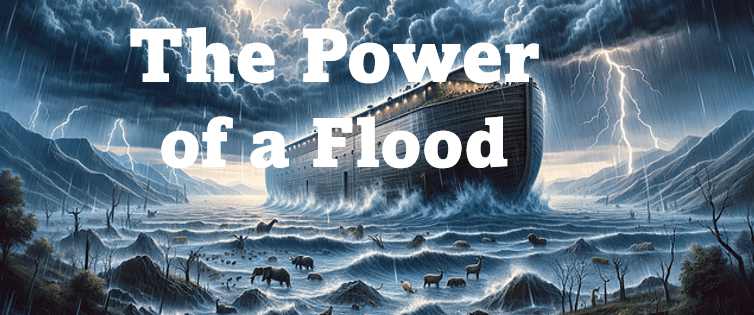
The Power of a Flood

By: Pastor Joe Moore, Liberty University Theological Seminary

Introduction

In the wake of devastating floods caused by the remnants of Hurricane Helene, which has caused catastrophic flooding in the southeast United States, Dr. Steven A. Austin’s article “Grand Canyon, Creation, and the Global Flood,” lends credence and insight to the power and impact of a flood event on a grand scale. This article discusses the differences between naturalistic, and old-earth view that the Grand Canyon was formed by slow moving events over a long period of time, verses the young-earth view that a single, catastrophic event like the flood of Noah caused the formation of the land mass, or earth’s surface, as we know it today. The power of a great flood event is presently being demonstrated on a small scale in the complete destruction and movement of earth in places like Lake Lure, Chimney Rock, and Asheville, North Carolina, Maggie Valley and Gatlinburg, Tennessee, and seen in the devastation caused to major arteries of travel throughout the southeast.

Article Strengths

In laying out a “framework of assumptions,” Dr. Austin contrasts the naturalistic, old-world (evolutionists) assumptions of the sedimentary strata of the Grand Canyon against the assumptions made by young-earth (Creationists) scientists. The evolutionists assume sedimentary layers of the Grand Canyon are a result of millions of years of history, formed by calm waters that advanced and retreated multiple times over a long period of time. Creation science assumes that the Grand Canyon was formed by the flood of Noah’s day, a catastrophic event that began on the ocean floor, covered the entire earth surface, and lasted for a period of one year.

To strengthen the young-earth science view, Dr. Austin discusses the discovery of fossilized marine organisms found within the layers of sandstone, limestone, and shale that died quickly and violently due to the force of ocean water rapidly covering the earth’s surface. According to the author, this can easily explain a major flood event. The various sediments themselves appear to validate this discovery. Coconino sandstone, once believed to be deposits of wind, show elements of dolomite, which is a marine sediment. According to Dr. Austin, these diagonally sloped cross-beds of sandstone closely resemble modern oceanic dunes caused by rapidly moving storms in the ocean.

In addition, Dr. Austin states that recent studies of a seven-foot-thick section of Redwall Limestone shows millions of shells of squid, which supports that this was caused by a submarine mudflow that happened within minutes. He also states that new discoveries of how shale layers are playing an important role in understanding the rapid formation of the Grand Canyon’s strata. Marine fossils found within these layers support rapid deposition by ocean water.

To further strengthen the young-earth view, Dr. Austin states that geologist reject the idea that the Grand Canyon was formed by a flowing river lasting millions of years. The deposits found in the Grand Canyon support a view that it was formed by a catastrophic event. He also states that recent findings show evidence of an event causing uplift and collapse that show a different event occurring that previously believed. All these findings support the young-earth view that a single event, the flood of Noah’s day, was an event in magnitude that could cause the movement of the earth to its present form.

Article Weaknesses

The weaknesses found in the article are not so much found in the research of the author, but rather in the perspectives brought to it by geologist. Dr. Austin gave an excellent example in his conclusion about two geologists looking at the same structure. Each geologist is looking at science from their own framework of assumptions. The evolutionists will approach science from that viewpoint that the earth was formed over millions of years and will test theories to prove their research using methods such as isotopes or radioisotopes. The creationists will approach science from the perspective that God could speak the earth into existence and that the formation of the earth as it is now, could well have been caused by a single, catastrophic event, such as the flood of Noah. Each, through their own bias, can cause one to not consider the proven science of the other. Interestingly, Dr. Austin mentioned several times how geologists have changed their views with recent discoveries of how the Grand Canyon was formed. Though some may have changed their initial view, rather than accept the possibility this was caused by s singular event, they will seek to find other explanations.  

Conclusion

On a scale of one through five, I would rate it at a five. One of Dr. Austin’s concluding thoughts is that neither evolution geologists, nor creationist geologists, were alive at the time of the formation of the Grand Canyon. Therefore, this science must consider the historical events that have occurred. Dr. Austin’s research presents a solid geological view of the power contained within the forces of a singular catastrophic flood event. The evidence shown through discoveries of marine fossils in the Grand Canyon support and strengthen his view. Romans 1:20 states, “or the invisible things of him from the creation of the world are clearly seen, being understood by the things that are made, even his eternal power and Godhead; so that they are without excuse:” (KJV). God’s creation has revealed enough of itself to us that we have no excuse for rejecting the science of this one-time catastrophic event in history.

Reference

Austin, Steven A. (2012). Grand Canyon, Creation and the Global Flood. Christian Research Journal, volume 35 p. 1-6. https://www.equip.org/PDF/JAF11351.pdf

The Holy Bible: King James Version. Iowa Falls, IA: World Bible Publishers, 2001 (Romans 1:20)

Rally Point Biker Church Discipleship Plan

By: Pastor Joe Moore, Liberty University Theological Seminary Student

Introduction

As a church planter in the biker community, I recognize that discipleship is not an optional ministry but the very essence of what it means to follow Jesus Christ. In establishing a disciple making plan, I am reminded of a statement from Dietrich Bonhoeffer, “it is not ultimately important to us what this or that church leader wants. Rather, we want to know what Jesus wants.”[1] The local church is the God-ordained context for making disciples who live out the mission of Christ in their world. Jim Putman, Bobby Harrington, and Robert Coleman write that “a disciple is one who is following Christ, being changed by Christ, and committed to the mission of Christ.”[2] This definition serves as the foundation for my disciple-making plan.

This plan follows the five P’s of ministry: Passages, Principles, Philosophy, Practices, and Proof. Each section builds upon the other, forming a cascading model that moves from biblical foundations to practical structures and measurable outcomes. In the context of a biker church, where authenticity, loyalty, and community are highly valued, the goal is to make disciples who reflect Christ in everyday life while reaching others with the gospel.

Passages

The starting point for a disciple-making plan must be Scripture itself. Among the many biblical texts that speak to discipleship, several stand as foundational. This section explores the key discipleship passages that establish a Biblical foundation to guide the ministry and outlines the primary audience and context of focus for a biker church plant.

Biblical Foundation for Discipleship

The Great Commission in is the cornerstone passage. Jesus declares His authority and commands His disciples to “Go ye therefore, and teach all nations, baptizing them in the name of the Father, and of the Son, and of the Holy Ghost: Teaching them to observe all things whatsoever I have commanded you: and, lo, I am with you always, even unto the end of the world. Amen” (Matthew 28:19-20, King James Version). This passage establishes discipleship as the primary mission of the church, grounded in Christ’s authority and empowered by His abiding presence. By obeying the Great Commission, Rod Dempsey asserts disciples, “become the hands, feet, and voice of Jesus in their world.”[3]

Following the Great Commission is the Great Commandment. When asked about the greatest commandment, Jesus responded: “thou shalt love the Lord thy God with all thy heart, and with all thy soul, and with all thy mind. This is the first and great commandment. And the second is like unto it, Thou shalt love thy neighbour as thyself. On these two commandments hang all the law and the prophets” (Matt. 22:37-40, KJV). Here, discipleship is framed in relational and holistic terms. Loving God fully leads to loving others sacrificially. This shapes discipleship as worshipful obedience rooted in love.

In John 13, Jesus gave His disciples a new commandment, “A new commandment I give unto you, That ye love one another; as I have loved you, that ye also love one another. By this shall all men know that ye are my disciples, if ye have love one to another” (John 13:34-35, KJV). Thinking about this New Commandment, one must ask the question “why a new commandment?” Perhaps the answer is found in the fact that there are times believers do not love themselves, much less loves others. The distinguishing mark of discipleship is not knowledge or power but Christlike love. In a biker church context, where loyalty and brotherhood are central, this commandment resonates deeply, showing that true discipleship is relational and visible.

Another critical passage is Matthew 4:19, where Jesus calls His first disciples to “follow me, and I will make you fishers of men” (KJV). This statement reveals that discipleship begins with personal relationship, following Jesus, and leads to a remaking into those who will bring others into a relationship with Christ. Putman and Harrington declare, “a disciple is a person who is following Christ (head), is being changed by Christ (heart), and is committed to the mission of Christ (hands).”[4] Discipleship therefore is both relational and missional.

Ephesians 4:11–16 emphasizes that discipleship involves the whole body of Christ. Pastors and leaders are given “for the perfecting of the saints, for the work of the ministry, for the edifying of the body of Christ” (Eph. 4:12, KJV). Dempsey states, “pastors are to train or equip the saints, and the saints are to do the work of the ministry.”[5] This is designed to so that every believer contributes to the building up of the church until it reaches maturity. This text shifts the focus away from clergy-centered ministry toward an equipping model in which all believers are responsible for disciple-making.    

Dempsey asserts that the early church provides a living example of this process in Acts 2:42–47, where believers “band together for prayer, fellowship, teaching, and intentionally accomplishing the Great Commission.”[6] This holistic rhythm of worship, community, and mission demonstrates that discipleship is not merely individual spiritual growth but a communal way of life shaped by shared practices.

Taken together, these passages frame discipleship as relational, communal, generational, and mission oriented. They also clarify that disciple-making is not the responsibility of pastors alone but of the entire body of Christ, united in obedience to Jesus’ command.

Audience and Demographics

The specific ministry context shapes how discipleships are carried out. In my context, this church plant has identified our target audience as adult riders within the motorcycle subculture, as well as family members, shop employees, recovery communities, and younger riders. Many in this demographic struggle with shallow spiritual formation or disengagement from church life. Discipleship efforts must therefore emphasize both biblical grounding and practical support for living faithfully in daily life.

Geographically, the church is situated in a rural, multiethnic community, which requires cultural sensitivity and adaptability. While the gospel is universal, the methods of disciple-making must address the unique needs of community. Earley and Dempsey observe that “we grow when we are serving, not merely sitting.”[7] Serving is characteristic of living in a rural community where neighbors are dependent on neighbors. This is also a challenge where most are steeped in traditional churches and are not as accepting of a biker church. Communicating a clear, biblical message is essential in this demographic.

Principles

Having identified the biblical passages that serve as the foundation for disciple-making, the next step is to establish the guiding principles that shape how those truths are lived out in ministry. Principles serve as the bridge between biblical conviction and practical application, ensuring that the work of discipleship remains focused, consistent, and faithful to God’s design. Greg Ogden implies, “the Bible teaches us not only the message of faith, but also the method by which that faith is to be passed on to future generations. We are called to do God’s work God’s way”[8] This section will cover the principles of biblical authority, relational discipleship, and missional living.

Biblical Authority

Scripture is the foundation of discipleship. As II Timothy 3:16–17 teaches, “All scripture is given by inspiration of God, and is profitable for doctrine, for reproof, for correction, for instruction in righteousness: That the man of God may be perfect, thoroughly furnished unto all good works” (KJV). Discipleship must be anchored in God’s Word, as this is “how you come to know what God’s will is.”[9]

Relational Discipleship

Discipleship is not primarily a classroom experience but a relational journey. Jesus said, “A new commandment I give unto you, that ye love one another; as I have loved you, that ye also love one another. By this shall all men know that ye are my disciples, if ye have love one to another” (John 13:34–35, KJV). Genuine community and love are essential for disciple-making, as believers learn best in the context of authentic relationships. Putman and Harrington conclude “as we walk with God, we learn to love our brothers and sisters in Christ.”[10]

Missional Living

Discipleship cannot stop with personal growth; it must lead to multiplication. Matthew 28:19–20 emphasizes going, baptizing, and teaching, all outward-focused actions. Demsey states, “this new community (the body of Jesus) was to have a transforming effect not only on individuals but also on the entire world.”[11] A true disciple is also a disciple-maker, living out faith in ways that draw others to Christ.

These three principles provide clarity and focus for ministry and establish the core values of: making disciples, going, growing, baptizing, teaching, loving God, and loving each other. These values create the DNA of a healthy disciple-making church.[12]

Philosophy

As a church plant intentionally rooted in the biker community yet open to all, our ministry philosophy is shaped by both the unique culture we serve and the timeless truths of Scripture. Philosophy, in this sense, refers not only to our perspective on ministry but also to the definitions and convictions that shape the way we pursue discipleship. For us, philosophy provides clarity, alignment, and consistency as we navigate the challenges of a young church plant that is only two years old. This framework allows us to remain focused on our mission: making disciples who authentically follow Jesus, live in community, and share the gospel with others.

How Disciples Are Made in the Context of a Healthy Church

In our church, discipleship is best understood as a journey, not a program. Putman and Harrington define a disciple as, “a person who follows Jesus, is transformed by Jesus, and join Jesus on His mission; that’s the job of every believer.”[13] Disciples are made through intentional relationships, consistent biblical teaching, and active participation in the life of the church. A healthy church creates an environment where believers are nurtured by Scripture, supported by community, and challenged toward mission. Within the biker community, trust and loyalty are highly valued, and these cultural traits create fertile ground for relational discipleship. Just as Paul instructed Timothy to pass on what he had learned to faithful men who would teach others also (II Tim. 2:2, KJV), we embrace a model of multiplication: disciples who are being transformed by Christ are then equipped to lead others into transformation.

We recognize that discipleship does not happen in isolation. The early church devoted themselves to the apostles’ teaching, fellowship, breaking of bread, and prayer (Acts 2:42, KJV), creating a rhythm of both learning and living together. For our church plant, this means discipleship takes place not only on Sundays but also around tables, in garages, and on rides. It is about walking alongside one another in everyday life, speaking the truth of God’s Word, and modeling what it means to follow Jesus in both ordinary and extraordinary settings.

The Body of Christ and the TAHO Model

The New Testament describes the church as the Body of Christ, where every believer is a vital member joined together under Christ the Head (I Cor. 12:12–27, KJV). Just as a body depends on each part to function properly, our church depends on every rider, family, and friend bringing their God-given gifts to strengthen the whole. In this way, no one is a spectator; all are participants in the mission of God. When considering the TAHO model, our church most closely aligns with the Organic approach, while also carrying elements of Hybrid.

As a two-year-old plant in the biker community, we are less focused on programs or polished attractional models and more committed to relational, grassroots disciple-making that grows naturally out of everyday life. Gatherings around rides, meals, and personal connections form the heartbeat of our ministry, reflecting an organic expression of the Body of Christ. At the same time, we recognize the value of hybrid practices, blending intentional structure and organization with the flexibility of organic relationships. This balance allows us to stay true to biker culture’s emphasis on authenticity and brotherhood, while ensuring that discipleship remains biblical, intentional, and sustainable.

Healthy Church Assessment

As a two-year-old church plant within the biker community, our church shows several encouraging signs of health while also revealing areas that need intentional growth. Using the characteristics of a healthy church, biblical teaching, genuine fellowship, worship, mission, leadership, and spiritual formation, we can identify both strengths to celebrate and weaknesses to address.

One of our greatest strengths is authentic community. The biker culture highly values loyalty, brotherhood, and trust, and these values translate into strong relational bonds within the church. Visitors and members alike often describe the church as a family, where transparency and acceptance are evident. This aligns closely with Jesus’ teaching that the world will know His disciples by their love for one another (John 13:34–35, KJV). Another strength is biblical commitment. Our gatherings are rooted in Scripture, with preaching and teaching intentionally focused on grounding new and seasoned believers alike in God’s Word. A third area of strength is missional orientation. The church plant has already engaged in outreach rides, community service, and intentional evangelism among bikers, showing a clear desire to live out the Great Commission (Matt. 28:19–20, KJV).

At the same time, several weaknesses reflect the growing pains of a young church. The most significant is the need for a clearer discipleship pathway. While relationships are strong, there is not yet a well-defined process to help new believers move from conversion to maturity. Similarly, leadership development remains limited, with much of the ministry depending on a small group of leaders. To ensure long-term health, more lay leaders must be equipped, empowered, and entrusted with responsibility (Eph. 4:12, KJV). Another area for improvement is worship structure. While gatherings are heartfelt and authentic, they sometimes lack intentional planning that could deepen engagement and spiritual formation. Finally, a more coordinated strategy for discipleship would expand the church’s ministry impact.

Suggestions for growth include implementing a discipleship pathway that provides steps for spiritual maturity (e.g., starting with basic foundations, then moving into mentoring, and eventually equipping for leadership). Leadership multiplication should be prioritized by identifying potential leaders and providing training in biblical leadership, pastoral care, and evangelism. Worship gatherings could benefit from intentional planning that balances flexibility with spiritual depth. Finally, outreach could be strengthened through regular rhythms of engagement, partnering with local biker groups and community organizations for service and gospel witness.

Overall, the church demonstrates clear signs of life and health—authentic love, biblical grounding, and a passion for mission. With intentional development in discipleship, leadership, and structure, this young biker church has the potential to grow into a vibrant, multiplying expression of the Body of Christ that continues to impact the biker community and beyond.

The Role of the Church, Pastor, Saints, and Spiritual Gifts

God has ordained the local church as the central context for disciple-making. As seen in Acts 2:42–47, discipleship happens through worship, teaching, fellowship, and mission within the gathered body. The pastor plays a vital role as shepherd and equipper, but he is not the sole disciple. According to Ephesians 4:11–12, pastors are called to equip the saints for ministry, ensuring that all believers participate in disciple-making.

The saints represent all believers and are essential. 1 Peter 2:9 describes the church as a “royal priesthood,” emphasizing that all Christians are called to serve and witness. Discipleship flourishes when ordinary members embrace their role as disciple-makers. Dempsey states, “With one command Jesus announced two thousand years of direction for the church, still in effect for all churches today.”[14]

Finally, spiritual gifts enable the body to function effectively. As 1 Corinthians 12 explains, every gift contributes to the building up of the church. Teaching, exhortation, service, mercy, and leadership are all needed for a healthy disciple-making culture. When gifts are identified and exercised, the church grows into maturity, fulfilling God’s design for His people.

Practices (With a Biker Church Focus)

In the life of a Biker Church, discipleship happens most naturally in the context of relationships, not in classrooms or formal programs. Because of this, small groups are not simply an addition to church life, they are the church. For a community that prizes authenticity, loyalty, and riding together, these groups form the primary environment where discipleship takes place. They meet in garages, diners, backyards, and bike shops, becoming the place where Scripture is read, stories are shared, and prayer is offered. Here, members are not treated as an audience but as a brotherhood and sisterhood who carry one another’s burdens and encourage each other to follow Christ. These gatherings reflect the “IS” philosophy of small groups: they are the heartbeat of the church, not merely a supplement.[15]

With that said, the groups remain connected to the wider identity and mission of the church. They are “of” the church in that they share a common purpose, pastoral care, and alignment with the overall vision to make disciples who ride with Christ and live with purpose. They are also “with” the church as they gather for larger events such as corporate worship, outreach rides, or seasonal celebrations.[16] But these larger events are not the main stage for discipleship, they serve instead as opportunities to connect new people into the relational web of small groups where real growth takes place.

The church’s calendar, budget, and personnel all reflect this commitment. The calendar revolves around group life and fellowship rides more than weekly programming. The budget emphasizes simple tools such as Bibles, discipleship booklets, and community meals, rather than expensive facilities or programs. In fact, our church meets in a tin building, in the woods of rural South Carolina, with porta-potties and a 10×20 utility building that serves as our “Kids Ministry.” Our baptistry is horse feeding troth.

Regarding leadership, we model a principle of my years of experience in the military where we are developing grassroots leadership, with lay leaders raised up from within the groups themselves. Curriculum remains simple and reproducible, often centered on Scripture passages discussed around a table, though resources like Discipleship Essentials are used to provide structure when helpful. Communication is equally straightforward, often spread by word of mouth within biker networks, reinforced by slogans such as “Ride with Christ, Live with Purpose.” This approach keeps discipleship accessible, relational, and deeply embedded in the rhythms of biker culture.

Proof (Biker Church Focus)

In a Biker Church, the proof of disciple-making is found less in polished reports and more in the visible fruit of changed lives. Baptisms remain one of the clearest measures, showing men and women publicly declaring loyalty to Christ in front of their brothers and sisters. Another key sign is group participation, since the small groups are the church’s lifeblood. When riders are meeting in garages, diners, and homes week after week, it proves discipleship is happening at the level where life is lived. Strong participation shows that people see these groups as family, not just an event.

Leadership development is another measure of health. In the bike culture, respect is earned, not given, and the same is true in spiritual leadership. When riders who once sat quietly in the back begin leading prayers, facilitating Bible discussions, or mentoring newer believers, it shows that discipleship is taking root. The church looks not such much at how many are in attendance, but how many are taking the “next step” in their faith walk. Testimonies are also central. Stories of riders leaving destructive lifestyles, reconciling broken relationships, or finding freedom from addiction serve as living proof that Christ is at work among them.

Beyond the personal, the church looks at its impact on the community. Outreach rides, service projects, and recovery nights give visible evidence that the church is embodying the fullness of Christ described in Ephesians 1:23. This presence is measured not only by numbers but by reputation, when, not only the biker community, but the community in general begins to say, “they are the real deal, they’ve got our back,” the church knows its disciple-making mission is being lived out. Even small things, like a rider starting to pray before a meal, or a family from the community showing up at a cookout because a biker invited them, count as proof that discipleship is multiplying.

Finally, these measures form a cycle of accountability. If baptisms slow down, the church asks whether evangelism has cooled. If group participation drops, leaders revisit how groups are structured and supported. If leadership pipelines stall, mentoring is emphasized again. Proof is never just about keeping statistics; it is about making sure the church is faithful to its calling: to ride together with Christ, to grow as disciples, and to make more disciples along the way. As Dempsey and Earley state, “we only have one life. Lost people matter to God.”[17]

Conclusion

This disciple-making plan establishes a foundation in biblical passages, guiding principles, and a ministry philosophy contextualized for a biker church. It moves into practical structures and concludes with measurable proof. By grounding ministry in Scripture, building relational discipleship, and embracing a missional philosophy, this plan seeks to fulfill the Great Commission and embody the Great Commandment in tangible ways. The ultimate measure of success is not only numbers but the visible presence of Christ through His body, the church, living out discipleship authentically in the world.


[1]Dietrich Bonhoeffer. Discipleship, (Minneapolis, MN: First Fortress Press, 2003), 21.

[2]Jim Putman, Bobby Harrington, and Robert E. Coleman, DiscipleShift: Five Steps that Help Your Church to Make Disciples Who Make Disciples, (Grand Rapids: MI: Zondervan Reflective, 2013), 51.

[3] Dave Earley and Rod Dempsey. Discipleship Making Is . . .: How to Live the Great Commission with Passion and Confidence, (Brentwood: B&H Academics, 2013), 22.

[4] Putman, Harrington, and Coleman, DiscipleShift, 51.

[5] Earley and Dempsey. Discipleship Making Is . . .: 41.

[6] Ibid, 40.

[7] Dave Earley and Rod Dempsey. Spiritual Formation Is . . .: How to Live the Great Commission with Passion and Confidence, (Brentwood: B&H Academics, 2018), 32.

[8] Greg Ogden. Discipleship Essentials: A Guide to Building Your Life in Christ, Expanded Ed. (Downers Grove, IL: Intervarsity Press, 2007). 20.

[9] Putman and Harrington. DiscipleShift. 89.

[10] Putman and Harrington. DiscipleShift. 87.

[11] Earley and Dempsey. Discipleship Making Is . . .: 246.

[12] Earley and Dempsey. Discipleship Making Is . . .: 70.

[13] Putman and Harrington. DiscipleShift. 120.

[14] Earley and Dempsey. Discipleship Making Is . . .: 80.

[15] Earley and Dempsey. Discipleship Making Is . . .: 279.

[16] Ibid, 281.

[17] Earley and Dempsey. Discipleship Making Is . . .: 123.

Bibliography

Putman, Jim, Harrington, Bobby, and Coleman, Robert E. DiscipleShift: Five Steps that Help Your Church to Make Disciples Who Make Disciples. Grand Rapids: MI: Zondervan Reflective, 2013. 19. 

Bonhoeffer, Dietrich. Discipleship. Minneapolis, MN: First Fortress Press, 2003. 21.

Earley, Dave and Dempsey, Rod. Discipleship Making Is . . .: How to Live the Great Commission with Passion and Confidence. Brentwood: B&H Academics, 2013. 21, 22.

Ogden, Greg, 2007. Discipleship Essentials: A Guide to Building Your Life in Christ, Expanded Ed. Downers Grove, IL: Intervarsity Press, 20.

Earley, Dave and Dempsey, Rod. Spiritual Formation Is . . .: How to Live the Great Commission with Passion and Confidence. Brentwood: B&H Academics, 2018. 32.

Navigating Faith in a Digital Age

By Joseph Moore, Liberty University Theological Seminary Student, September 27, 2025

Introduction

In our fast-paced society that rarely slows down, the intersection of faith and technology has reshaped not only how we connect with one another but also how we grow in Christ. As I seek to reflect on my personal walk of faith with Christ in both the physical and digital spheres, I realize I must be intentional about growing and developing and give an honest assessment of where I am in life, understanding that “real-life ecologies provide formative opportunities for growth.”[1] The challenge for me is to think about how discipleship, formation, and community look in our perpetually linked age.

As I have engaged with the ideas in this book, I’ve been considering how I might more intentionally integrate digital ecology into my ministry. To explore this, I begin with two key questions: Can a digital footprint strengthen the work of ministry? And if so, what can I do that I am not presently doing? These questions speak not only to my personal development but also to the unique needs of my ministry setting. In the reflections that follow, I will share how these questions shape my thinking, outline my plans for integration, and conclude with one practical piece of advice for seminary students drawn from Surviving and Thriving in Seminary.

Question One: Can a digital footprint strengthen the work of ministry?

As pastor of a small start-up church, a digital footprint through Facebook, websites, and blogging has significantly strengthened our ministry by extending reach, fostering collaboration, and cultivating spiritual growth. Lowe and Lowe note that digital ecologies provide “formative opportunities for growth.”[2] For a young congregation without large numbers or resources, a digital presence has allowed the gospel to extend beyond the church’s physical location and into the daily lives of people online.

Digital platforms also shift ministry from individualistic expression toward collaborative discipleship. The Lowes observe that “social media are contributing to a shift from a more individualistic approach to one that focuses attention on collaboration with others.”[3] A church’s online posts, livestreams, and interactive prayer threads embody Paul’s “one-anothering” vision of the body of Christ.[4] In addition, digital ministry reflects the “bidirectional nature of learning” where believers exchange ideas, testimonies, and encouragement.[5] Blogs or comment sections on our Facebook and website has allow the congregation and seekers alike to contribute their voice, creating a richer ecology of faith.

Ultimately, as Lowe and Lowe remind us, “individual contributions serve a larger purpose” within the wider ecology of God’s kingdom.[6] For a small church, digital footprints magnify ministry impact, enabling it to reach further, disciple deeper, and build authentic community online.

Question Two: What Can I do that I am not Presently Doing?

As a small start-up church already using Facebook, a website, and blogging, the next step is to create more interactive spaces that foster discipleship online. Lowe and Lowe note that the “bidirectional nature of learning allows for a reciprocal exchange of ideas, knowledge, and experiences.”[7] Currently, our presence is mostly informational; to strengthen ministry, we must shift toward relational practices.

Hosting live prayer gatherings or Q&A sessions on Facebook could model the “one-anothering” dynamic the Lowes describe, where encouragement and growth come through shared participation.[8] Similarly, inviting testimonies through blog comments or video clips allows congregants to contribute their voices, demonstrating how “individual contributions serve a larger purpose.”[9] We can also post short devotionals, or discussion prompts during the week, creating rhythms that connect daily life with faith. As Lowe and Lowe remind us, “normal growth results from being in the right environment.”[10] By cultivating interactive online environments, our digital footprint can move from outreach to ongoing formation.

A Plan of Action

To strengthen ministry and expand our digital footprint, our small start-up church must move intentionally from simply having an online presence to cultivating an interactive, disciple-making environment. Lowe and Lowe remind us that “spiritual growth occurs when learners participate in dynamic, reciprocal communities of practice.”[11] This calls for both strategy and consistency.

First, we will enhance our social media engagement by using Facebook not only for announcements but for live prayer gatherings, Q&A sessions, and short devotionals. This creates the kind of “one-anothering” space the Lowes emphasize, where encouragement and discipleship emerge through shared participation.[12]

Second, we will expand storytelling opportunities by inviting congregants and friends to share testimonies through blogs, video clips, or comments. This will help build identity and belonging in our digital community.

Third, we will schedule consistent weekly digital touchpoints, such as short devotional videos or discussion prompts, to connect faith with everyday life. As the Lowes observe, growth depends on the “right environment,” consistent rhythms create that environment online.[13]

Finally, we will evaluate and adapt regularly, using feedback and analytics to ensure our digital efforts serve both outreach and discipleship. By intentionally shaping these practices, our church’s digital footprint will not only extend our reach but also deepen formation, allowing us to embody the gospel in digital spaces.

A Word to a Seminary Student

As you begin your seminary journey, let me offer both encouragement and realism. The good news is that you will learn and understand the Bible more deeply than ever before through your theological training.[14] The bad news is that you may not be as prepared as you think. Seminary will stretch you with new terms, ideas, and concepts that may challenge not only your intellect but also your faith.[15] This is not meant to discourage you, but rather is part of God’s refining work.

As a former soldier, a term we used often was “get comfortable being uncomfortable.” With that thought in mind, if I could leave you with one piece of advice, it would be this: embrace the discomfort. Zacharias and Forrest remind us that change is uncomfortable, but “discomfort can be good for you. More than that, it is essential if you want to keep growing.”[16]  When you encounter new perspectives that unsettle your current beliefs, do not run from them. Instead, let them push you to articulate your convictions more clearly, to examine Scripture more carefully, and, when necessary, to adjust your understanding in faithfulness to God’s Word.[17]

Seminary will change you, academically, spiritually, and personally. That change may feel stretching, but it is part of digging a well of spiritual depth that will sustain you and your future ministry.[18] Trust that God will use both the joy and the discomfort of seminary to prepare you for a lifetime of faithful service.

Conclusion

In the end, both ministry in the digital age and the journey through seminary call us to the same posture—intentional growth, openness to change, and faithfulness to God’s calling. Digital tools can strengthen ministry by extending our reach and deepening discipleship, but they require deliberate effort to cultivate authentic community. Likewise, seminary offers opportunities to be stretched and reshaped in ways that prepare us for a lifetime of service. Whether navigating online spaces or academic challenges, the key is embracing discomfort as a means of growth and trusting that God is using every step to deepen our faith, sharpen our calling, and equip us to serve His church more faithfully.

Footnotes:


[1] Stephen D. Lowe and Mary E. Lowe, Ecologies of Faith in a Digital Age: Spiritual Growth through Online Education (Downers Grove, IL: IVP Academic, 2018), 92.

[2] Lowe and Lowe. Ecologies of Faith in a Digital Age, 92.

[3] Ibid, 94.

[4] Ibid, 102.

[5] Ibid, 95.

[6] Ibid, 105.

[7] Ibid, 95.

[8] Ibid, 102.

[9] Ibid, 105.

[10] Ibid, 132

[11] Ibid, 95.

[12] Ibid, 102.

[13] Ibid, 132.

[14] H. Daniel Zacharias and Benjamin K. Forrest, Surviving and Thriving in Seminary: An Academic and Spiritual Handbook (Bellingham, WA: Lexham Press, 2017). 7.

[15] Ibid, 8-9.

[16] Ibid, 11.

[17] Ibid, 9.

[18] Ibid, 27-28.

Bibliography

Lowe, Stephen D. and Lowe, Mary E.  Ecologies of Faith in a Digital Age: Spiritual Growth through Online Education. Downers Grove, IL: IVP Academic, 2018.

H. Daniel Zacharias and Benjamin K. Forrest, Surviving and Thriving in Seminary: AnAcademic and Spiritual Handbook. Bellingham, WA: Lexham Press, 2017.

Living in the Light – Commanded to Love

The first 9 weeks of this series really focused on the fact that “God is light, and in him is no darkness at all.” John’s theological message here is, that although you and I have a dark side, a downside, junk in our trunk – God does not. There is nothing that can be discovered or known that would make God look less Holy or less Righteous. God has nothing to hide – He has no junk in His trunk. God is Light and he has called those who have once walked in darkness, to come out of the darkness and walk in the Light. He has made a place at the table for us, so that through repentance, those of us who once walked in darkness, could come out of that darkness and into the light – into fellowship with Him.

If you and I could just get a grasp on the fact that YOU AND I HAVE A SEAT PREPARED AT THE TABLE: We have been purchased by the blood of the Lamb and as we discovered in the last message in this series, that through the saving grace – WE HAVE BECOME THE SONS OF GOD. “God commended His love toward us, in that while we were yet sinners, Christ died for us.” And although we might not look like we should, but we sure don’t look like we used to.

I John 3: 11-24, “11 For this is the message that ye heard from the beginning, that we should love one another. 12 Not as Cain, who was of that wicked one, and slew his brother. And wherefore slew he him? Because his own works were evil, and his brother’s righteous. 13 Marvel not, my brethren, if the world hate you. 14 We know that we have passed from death unto life, because we love the brethren. He that loveth not his brother abideth in death. 15 Whosoever hateth his brother is a murderer: and ye know that no murderer hath eternal life abiding in him. 16 Hereby perceive we the love of God, because he laid down his life for us: and we ought to lay down our lives for the brethren. 17 But whoso hath this world’s good, and seeth his brother have need, and shutteth up his bowels of compassion from him, how dwelleth the love of God in him? 18 My little children, let us not love in word, neither in tongue; but in deed and in truth. 19 And hereby we know that we are of the truth, and shall assure our hearts before him. 20 For if our heart condemn us, God is greater than our heart, and knoweth all things. 21 Beloved, if our heart condemn us not, then have we confidence toward God. 22 And whatsoever we ask, we receive of him, because we keep his commandments, and do those things that are pleasing in his sight. 23 And this is his commandment, That we should believe on the name of his Son Jesus Christ, and love one another, as he gave us commandment. 24 And he that keepeth his commandments dwelleth in him, and he in him. And hereby we know that he abideth in us, by the Spirit which he hath given us.”

If you haven’t noticed, John writes in a cyclic manner. He will make a point, then he goes all over the place, and then he returns to the point he was making. For example, in chapter 4, John is going to begin addressing trying the spirits to know who is good and evil, then in the middle of the chapter, he will come right back to this message of I John 3:11 – “LOVE ONE ANOTHER.”

In our message today, John is about to give us a master class on love. I’m going to put out there from the get-go, we naturally do not know how to live God’s way. What that really means is, when you become a Christian, you must relearn how to live every aspect of your life. You must allow God to UNMAKE you in order to REMAKE you.

For some of us, we grew up in church, we memorized Scriptures and got badges in Sunday School, in other words, we got our pockets full of stuff, but all we had is a pocket full of bible memorization, and not heart that’s been transformed from stone into flesh.

What I am trying to say is: YOU can’t know love, until you know the God of Love and He has put the Spirit of Love in YOU!

Unfortunately, our views of love come from our broken perspective of love, such as: When people do things that we like, we then reciprocate that action by loving them; Or, when I do something that is loveable, then I am worthy of being loved.

This is human, transactional, man-made views of love. But that is not how God’s love works.

When we read about God’s love in the Bible, it is not transactional, and it is not reactional to what you do! In fact, it is the complete opposite. And John is about to give us a Master Class on how, if you are loved by God, how you have been empowered to love like God – to love God’s way and not the world’s way! SO, John is going to show us several things between chapters 3 and 4:

WE HAVE BEEN COMMANDED TO LOVE (3:11)

1 John 3:11, “For this is the message that ye heard from the beginning, that we should love one another.”

Any of you ever have a parent when you were growing up that told you that you “should” do something, and you knew exactly what that something was? I can’t say about your house, but I can say for mine, that “Should” was not a suggestion.

How about you married folks, those, “When you have time, you SHOULD,” never meant that, but almost always meant, “Now would be a good time.”

John is not saying, “Maybe on Wednesday, if you are feeling up to it, and if life is happening the way you want it to happen, and if people done everything you think they should do, if they are in my click – then, if you have time to get around to it, I will love them.

NO, what John is saying, “Based on what you have received, based on how God has loved you, You should love one another.”

Based on the fact that God loved us at the most unlovable point in our lives means that we “SHOULD” love others at the most unlovable point of their lives.

But we have a problem understanding that, because we think that because we are now saved, we have to work exceptionally hard to stay saved, or to prove we are worthy of that salvation – but according to I John 4:10 says, “Herein is love, not that we loved God, but that He loved us, and sent His son to be the propitiation for our sins.”

  • God has loved us at our best, and He has loves us at our worst;
  • God has loved us when we’re in and he loves us when we’re out;
  • He loves us when we’re up and He loves us when we’re down;
  • He loves me when I’m right and He loves me when I’m wrong;
  • He loves us on the mountain, and He loves us in the valley.
  • He loves me at my most loveable moments and my most unlovable moments.

And because of the constancy of God’s love, we have been called to constantly be in love with others! God doesn’t call us to something that He doesn’t model and empower us to do. John is calling us to “Love people because we have been loved.

LOVE GOD and LOVE EACH OTHER has been the theme of our church from day 1. We quote it, we repeat it, we testify about it, we invite others to come and see it, but I’m telling you right now, there are some in here that still have a problem living it. And to hear it for two years and still not practice it is looking God in the face and saying, “I hear what you’re saying, but I don’t care.” I know that makes some of you uncomfortable, and I am not trying to be mean, I’m just telling you the truth – and the truth is quick and power and sharper than any two-edged sword.

I John 4:7 says, “Beloved, let us love one another: for love is of God; and every one that loveth is born of God, and knoweth God.”

John is saying “WE SHOULD LOVE BECAUSE WE ARE LOVED.”

When you and I begin to love people beyond our human capacity, that is what it means to live up to God’s standard of Love.

I won’t all of you to think with me for a moment about the most unlovable moment in your life (and if you say you don’t have one, then you are a liar and truth is not in you), but think back that that moment you are ashamed of, that moment you hurt your family, or you hurt your wife; think back to that moment of your life that you know if it were to flash across the scene of this church this morning, you have no doubt in your mind everybody in here would instantly form a different opinion of you. I won’t you to think back to that moment, because it is in that moment, “When God commend His love toward us, in that while we were yet sinners, Christ died for us.”

And because of God’s love, that moment no longer defines you – FOLKS, That is the love John is saying we “should have” toward one another. Why” Because We Have Been Commanded to Love;

WE HAVE ALSO BEEN EMPOWERED TO LOVE (3:24: 4:13)

I John 3:24, “And he that keepeth his commandments dwelleth in him, and he in him. And hereby we know that he abideth in us, by the Spirit which he hath given us.

I John 4:13, “Hereby know we that we dwell in him, and he in us, because he hath given us of his Spirit.”

Coming from a fundamentalist background, what I read in that verse is Commandment Keeping! Try harder, work faster, do more! “Don’t smoke, chew, or kiss girls who do!

If you are Pentecostal, there is another word there you are chomping at the bit to get to, that word is SPIRIT. Which is a que that I get to go nuts and say all kinds of crazy stuff!

But here is the true beauty of verse 24 and 13, “The call to obedience, is rooted in the abiding of the Spirit.

By abiding in the spirit, we are able to keep the commandments. And if we abandon the Spirit, we are doomed to fail to the flesh.

Let me illustrate this for you – It is not, “Well, I think I’m going to go do something great for God today.” NO – it is getting up every morning and saying, “Well, I’m going to get up, die to myself, pick up my Cross and follow Jesus and allow the Spirit of God to have its way in me.”

Our problem is, we want God in our hearts, but we don’t want His hands on our lives.

How do we love like God? We abide in the Spirit! What happens when we abide in the Spirit? We produce fruits of the Spirit! What is the first fruit of the Spirit in Galatians chapter 5? LOVE.”

  • You won’t to know if our pastor’s have the right relationship with God? Look at their capacity to love.
  • You want to know if our elders have the right relationship with God? Look at their capacity to love.
  • You want to know the signs of life in a church? It’s not in the numbers, but in their capacity to love.

But here is a tell/tell sign of the Spirit living in you: What you do in your own personal life when you are confronted with sin – do you repent? Or do you run? Because you are doing one or the other.

God is not calling us to abuse GRACE, but He does expect us to admit that we NEED GRACE.

God has Commanded Us and Empowered us to Love:

FINALLY, LOVE AND HATE CAN’T SHARE THE SAME HEART (3:12-15)

I’ve told you the illustration before about a plane trip I took, how this rather large lady was trying to sit in a seat next to me. All I knew about that situation is that two solid objects could occupy the same space. That is what John is saying about Love and Hate – they simply cannot occupy the same space.

I know if you are like me, when I am mad at somebody, if I am angry at somebody, I see everything they have done in that moment as that moment. It doesn’t matter if everything they’ve done up to that point was perfect – I can only see them in that moment. WHY? Because love and hate can’t occupy the same heart.

I John 3:12-15, “Not as Cain, who was of that wicked one, and slew his brother. And wherefore slew he him? Because his own works were evil, and his brother’s righteous. 13 Marvel not, my brethren, if the world hate you. 14 We know that we have passed from death unto life, because we love the brethren. He that loveth not his brother abideth in death. 15 Whosoever hateth his brother is a murderer: and ye know that no murderer hath eternal life abiding in him.”

All of us, when we hate our brother like verse 15 says, we act more like Cain than we do Abel.

For the benefit of those not familiar with Cain and Abel, they were the sons of Adam and Eve. Cain was a farmer and Abel was a Shepherd. They both brought a sacrifice to God – God accepted Abel’s offering, but rejected Cain’s.

Now, I know you are asking the question, “Why did God accept one offering and reject the other?

I think the writer of Hebrews gives us some insight in Hebrews 11:4, “By faith Abel offered unto God a more excellent sacrifice than Cain, by which he obtained witness that he was righteous, God testifying of his gifts: and by it he being dead yet speaketh.”

Let me show you how this works. This morning, as we were singing, some of you were singing and really praising God, lifting worship to God from the heart – and some of you were just singing.

What is the difference between the two? FAITH. What is faith? The writer of Hebrews would go on to say it is the “confidence of things not seen.” It is us getting to the place that although we do not understand it all, we are putting our trust and confidence in Him – no matter what.

My question to us all this morning is this: WHERE HAVE YOU PUT YOUR FAITH?

Conclusion & Invitation:

Church, John’s message is clear – God is light, and in Him is no darkness at all. He has loved us when we were unlovable, He has called us out of darkness into His marvelous light, and He has prepared a seat at the table for us through the blood of Jesus Christ. That love is not only something we receive, but something we are commanded and empowered to live out.

The truth is simple but challenging – you cannot say you know God and refuse to love. Love and hate cannot share the same heart. God has poured His Spirit into us so that His love might flow through us – not just in word, but in deed, and in truth.

So today the question is this: Are you living like Cain – just bringing what you think you owe, keeping God at arm’s length? Or are you living like Abel – bringing your best by faith, trusting God with your life, your heart, and your future?

Listen, you have a seat at the table. Jesus has already made the way. He laid down His life for you so that you might pass from death into life, from darkness into light, from hate into love.

Invitation:

If you’ve never stepped out of the darkness and into the light – if you’ve never truly trusted Christ as your Savior – today is the day. Don’t wait another moment. Come, receive His forgiveness, and take your seat at the table.

And for those who are already saved – maybe God is calling you to surrender that bitterness, to let go of the hate, to stop withholding love. Maybe He’s calling you to abide deeper in His Spirit so His love can flow through you. Whatever it is – this altar is open.

Come today – come out of the darkness, come into the light, and come take your place at the table of God’s amazing love.

My Grandstand People

Wherefore seeing we also are compassed about (we are surrounded by, we are being watched by or observed by) with so great a cloud of witnesses, let us lay aside every weight, and the sin which doth so easily beset us (giving us a picture of a runner in a race who has taking off every bit of heavy clothing or any items that would slow him down in the race – or the sin that so that so easily grips a hold on us – in other words, if there is anything blocking  you from getting from where you are right now to where God wants you to be, get rid of t, get it out of the way, lay it aside) , and let us run with patience the race that is set before us.

In 1969-70, some folks working a Bus Ministry for 4th Street Baptist Church in Hartsville, SC, came to my home and asked my parents if they could pick-up me and my brother and take us to church.  My parents, though they had no intention of going church, felt it was a good idea for us kids to go.  So, we became bus kids.  I remember as if it were yesterday my Sunday School Teachers – Freddie and Claudia James.  They taught me about the Lord, and when I felt I was less than the other kids – they shared with me how God loved me. 

I remained a bus kid in my home church until 1979, when my church voted to do again with the bus ministry because us “bus kids” were not what they wanted in their church.  I was devastated – what I had known and loved all my young life was instantly gone.  I rebelled against God and the church.  At 17, I joined the US Military and ran as far away from God as I could – only to find that He was there waiting for me.

When I was 24 years old, a home missions preacher came by my house to see if we would be interested in visiting.  I wasn’t home at the time, so my wife told him he would have to come back when I was there.  Well – he did.  So, to get him off my back, we visited the church.  I will never forget it.  He asked the question “What are you gonna do with Jesus?”  My heart was pounding – all the sin, all the bitterness in my heart came crashing down on me.  I got out of there as fast as I could.  All week long that question came back to my mind, “What are you gonna do with Jesus?”  So, after struggling all week, I woke my family up and told them we were going riding.  I was going to do anything I could to avoid going back to that church.  Somehow, God steered our vehicle right back there.  I can’t even remember what the preacher was preaching that morning, as my heart was pounding, all I could do was think, “Joe – what are you gonna do with Jesus.”  When we were leaving that day, the preacher caught me.  He told me he doesn’t know why he was supposed to tell me this, but God wanted me to know HE loves me.  I told that preacher there was no way God could love me, He had no idea what I had done in my life.  That preacher told me, “I don’t care what you’ve done in your life – God loves you.”  I broke down crying right there.  I just couldn’t hurt the LORD anymore – and I rededicated my life to Christ.

6 years later, we had become a fully self-supporting church, I had nearly 14 years in the Army, God was dealing with me about preaching.  I had a plan all worked out though – I was gonna retire from the military, have a pension, then I would go preach – to me seemed like a noble plan.  However, that was not God’s plan.  Shortly after this great plan of mine, I was seriously injured.  During my recovery, I remember sitting on the steps of our church one Sunday morning, and I will never forget seeing a lot of molehills in the yard.  Somehow, the Spirit of God spoke to me and said, “Joe, there are men, women, boys and girls walking all over Christians on their way to hell – just as easily as people walk over those molehills.”  I asked, “Well Lord, why is it so easy for them to walk all over us on their way to hell?”  And that verse in II Peter 3:9 came flooding to my mind (25 years after I memorized it) “The LORD is not slack concerning His promise as some men count slackness, but is longsuffering to us-ward, not willing that any should perish, but that all should come to repentance.”  It occurred to me that if people were walking all over us on their way to hell, it wasn’t God’s fault – it was our fault – and more in particular – it was MY fault.  I knelt down on the steps of that church and prayed, “LORD, I’m tired of being a Molehill Christian, Make me a Mountain.”  I departed the military and attended Bible College. 

After graduating College, I pastored for 8 years.  In 2002, I was at the height of my ministry.  Our church was growing, we were running a little bus ministry, I was working on a Th.M. Degree when out of no-where, my home was rocked by sin.  I was so busy in the ministry I couldn’t even see what was happening in my home.  I went before the church and poured my heart out to them it.  For a while, things seemed to be OK.  Then there seemed to be constant battles inside the church – I was fighting a deacon board, trying to do things right, trying to finish my Degree program.  And little by little, I found myself in the Gutter.  I found myself in a place where I didn’t want to be around anyone – I just wanted to leave.  I began looking at the potential of rejoining the military – I just wanted to get away.  Before I knew it, I allowed sin to come in my life and completely destroy my home, destroy my marriage, and destroy the ministry God had entrusted me with. 

And for 10 years I was in the Gutter.  I had no joy, I had no peace.  The real problem with being in the basement is – you will look right past the 99 good things being done to laser focus on the 1 thing that’s wrong – the 1 thing you don’t like. 

So, 12 years ago, there I am in the Gutter – as miserable as I could be.  My granddaughter Emma (7 at the time), asked me “Papa, did you used to be a preacher?”  With a lump in my throat, I said, “Yes Sweetie, Papa used to be a preacher.”  After a couple of minutes, she then said, “Well Papa, will you take us to Church?”  Emma’s sister Maddie chimed in, “Yea Papa, will you take us to church?”

Let me show you something here about Grandstand people – unlike Gutter people, Grandstand people will look past the 99 wrong things to find the 1 good thing!

Wherefore (whenever you see a wherefore or a therefore, you are supposed to stop and see what it’s there for) seeing we also are compassed about with so great a cloud of witnesses, let us lay aside every weight, and the sin which doth so easily beset us, and let us run with patience the race that is set before us.”

Hebrews 12:1 gives us the picture of an athlete out on the field competing.  And in the Grandstands is a great cloud of witnesses, those listed in Hebrews 11, the Hall of Fame of Faith – WHAT ARE THEY DOING?  They are cheering on the favorite competitor.

So, there I was 12 years ago, down on that track.  I had given up any chance of winning.  I had all but thrown in the towel – when my granddaughters helped remind me of the “Great Cloud of Witnesses.”

I want you to get a mental picture of this now:

  • Here I am on this field with defeat on my face;
  • I am on this field and I just don’t care anymore;
  • The race isn’t even over and I have all but given up;
  • I am on this field and I’m feeling like a failure:
    • I have failed my God;
    • I have failed my family;
    • I have failed my kids;
    • I have failed my church.
  • I am Winded;
  • I am gasping for air;
  • I have all but lost the race;
  • I am bent over with my hands on my knees, looking down in defeat.

All of a sudden I hear a familiar voice in the crowd.  I glance up and see Freddie and Claudia James up in that “Great Cloud of Witnesses,” and they are yelling down to me, “Come on Joey, get up son.  You can do this, God still loves you!”

Next to Claudia and Freddie, I can see my Grandma Moore, and with tears in her eyes she says, “Oh Joey, it’s OK son, God loves you and He’s forgiven you.  Just get up and get back in the race.”

I can see my brother Sonny with Grandma, holding her hand and say, “Joey, I know you messed up, but it’s OK – God and loves you, and I’m here because of you and I’m waiting for you brother – so please, just get back in there and give all you’ve got.”

These are my Balcony People.  And I have some Balcony people here today as well:

  1. My kids – Jenni and Josh – they watched their dad fail; they watched their pastor fail.  Yet, they have always been there, cheering me on.  They are my grandstand People.
  2. My Grandkids – who just wanted to see their Papa get back in the race – and they will never know the work God did through them in my life.
  3. My wife Kim – for years our home was a mess.  We almost couldn’t even stand being around each other.  But God has come to live at the Moore residence – and Kim has become one of my greatest grandstand People.
  4. Clay and Hope Houchins.  Some of my biggest supporters in the ministry.  Hope came back to a church that had hurt her daddy when he was the pastor to support my ministry.  Even when I failed and left the ministry – they’ve never stopped reaching out to me – never stopped praying for me – never stopped praying for my kids.  Clay and Hope are my grandstand People.
  5. Our family here at RPBC– faithful servants of God that have supported Kim and I and backed our ministry together.  Selfless servants that are my Grandstand People.

Folks, I’m gonna tell you it’s a whole lot better facing the race of life knowing you have people in the balconies cheering for you, encouraging you – than it is laying around in the bowels of the basement!

This Invitation is threefold:

  1. If you are here, and you are in the Basement – I want to encourage you today to just get back in the race;
  2. If you are here, and you see someone you know is in the Balcony cheering you on – go to them right now and hug them and tell them thank you;
  3. Maybe you know someone here today that needs you to be their balcony People – go to them and let them know you are in the balcony cheering for them

Living in the Light – As the Sons of God

If you have been with us, over the past few months we have been going through this series of messages in I John under the title Living in the Light. If you remember there are two main messages in I John: The first is found in chapter 1:5, “This then is the message, which we have heard of him, and declare unto you, God is light and in him is no darkness at all.” The second message is found in chapter 3:11, “This then is the message that you have heard from the beginning, that we should love one another.

For the first two chapters (and I might add – two months), we have clearly articulated the fact that when it comes to God, He has no dark side, no downside, no skeletons in His closest, nothing in His life to be ashamed of. However, you and I do. Yet, in spite of our dark side, downside, and skeletons in our closest, “God so loved the world that He gave His only Begotten Son, that whosoever believeth in Him should not parish, but have everlasting life.”

God has called us out of the dark to Live in the Light; He has given us a new name; He expects us to Live up to that new name; He also expects us to be a place where His word can abide in us, and it is that Word abiding in us that gives us the ability to live “in the world, but not of the world.” His Word also gives us the tools to identify and mark those who are deceivers and liars – those antichrists who “went out from,” meaning they have had a departure from the Truth of God’s Word.

Today, we are in a little transition period between the first message that “God is Light and in Him is no darkness at all,” and the second message of “We should love one another.” If you have your Bible, please turn with me to I John 3:1-3:

1Behold, what manner of love the Father hath bestowed upon us, that we should be called the sons of God: therefore the world knoweth us not, because it knew him not. Beloved, now are we the sons of God, and it doth not yet appear what we shall be: but we know that, when he shall appear, we shall be like him; for we shall see him as he is. And every man that hath this hope in him purifieth himself, even as he is pure

A couple of weeks ago, I shared how God has been working in my heart, how through conversations with our young adults He has opened my eyes to the fact that, although we do a great job of displaying love toward one another – for the most part, yet we really don’t “KNOW” one another like we should. So, I have really been spending some time in prayer and study asking God to help me to be a better pastor, a better leader, but more importantly, how to be a better disciple of Jesus Christ.

For me to be a better disciple, I really need to know what that means, I need to “count the cost” you might say. What I know about being a disciple of Jesus Christ is that upon my conversion to Christianity, I became a disciple, a follower of Christ. But that was only the beginning to my journey – it didn’t end there. Being a disciple of Jesus Christ is a life-long journey.

Discipleship is more than following commands, it is about living out the new identity we have in Jesus Christ. In their book DiscipleShift, authors Dempsey & Earley emphasize that true discipleship is a balance of both being and doing. They state that discipleship is a process of transformation where we “abandon the things of the world and follow Christ.”  They further state, “The epistles emphasize the relational community where disciples are developed in the context of the body of believers.”  In this setting, they state, “they discover and use their spiritual gifts to love and serve each other and nonbelievers.” 

So, I would simply summarize a disciple as “someone who both knows and follows Christ.”  Simply put, following Christ means allowing Him to unmake us and then remake us into His image.  Discipleship is both relational and missional. When I hold these together with 1 John 3:1–2, I see discipleship as living out the privilege of being a child of God while growing into the likeness Christ.

With that thought in mind, I want to share with you three characteristics of a true Disciple of Jesus Christ. In doing so, I am going to bounce the message of I John 3:1-3 off 4:19 to ensure we get this in context.

What I mean by context, I’m reminded of the story of am Amish man who was hit by a patrol officer while riding his horse and buggy and was now suing the Highway patrol for $250,000.00. While standing before the judge, the judge asked, “Sir, is it true that you are suing the Highway Patrol for $250,000.00?” the man replied, “Yes, your honor.” The judge then said, “Is it also true that you were overheard at the scene saying you’d never felt better in all your life?” The Amish man replied, “Yes sir, but you have to take that statement in it’s context.” The judge then replied, “Well sir, what do you mean by that?” The Amish man said, “Well sir, on the day of the accident, the officer hit my buggy and knocked it over; my dog was thrown to one side of the road, my horse was thrown to one side of the road, and I was thrown from the buggy. The officer, with his pistol drown, walked over to my dog and seeing the condition of my dog, he shot him. He then walked over to my horse and seeing the condition of my horse, he shot him as well. And then, with that same pistol drown, he walked over to me and said “well sir, how do you feel?’ and I replied, ‘I’ve never felt better in all my life.”

A DISCIPLE LIVES IN THE NEW IDENTITY AS A CHILD OF GOD (v.1)

1Behold, what manner of love the Father hath bestowed upon us, that we should be called the sons of God.”

The first part of Matthew 4:19 says,And he saith unto them, Follow me . . .”

This means discipleship begins with identity – I in Him and Him in Me, not performance. A disciple is not someone trying to earn God’s love, but someone who responds to the love that was freely given by grace through faith. One author states that this new identity requires “mental acceptance of Jesus, understanding that He is now the One in charge of our lives.”

Jesus said, “Follow me . . .” If you are going to be a disciple of Jesus Christ, you have to make a conscious decision to follow Him. Dempsey and Earley state that this invitation to accept of Jesus – His authority and His truth – is at a head level – this is a mental acceptance of Jesus, understanding that He is now the one in charge of our lives.

If we are going to be a disciple of Jesus, He must lead – and we must follow! And when we make the decision to “follow” Christ, we become the ‘sons of God.”

So, a Disciple lives in the New Identity as a Child of God.

A DISCIPLE PURSUES TRANSFORMATION INTO THE LIKENESS OF CHRIST (v.2)

I John 3:2, “Beloved, now are we the sons of God, and it doth not yet appear what we shall be: but we know that, when he shall appear, we shall be like him; for we shall see him as he is.”

The second part of Matthew 4:19 says, “. . . and I will make you . . .

These two verses speak to a transformation. This is the process of the disciples of Jesus being changed into the image of Jesus.

I’ve interpreted I John 3:2 for you before in Joeology, but here it goes again, “I don’t know what I look like right now. I mean, I don’t look like I used to look but I also don’t look quite like Jesus. I am somewhere in the transformational process. It is that daily process of being transformed that will cause me to look more like Him and less like me.”

Jesus said in Matthew 4:19, “I will make you, I will transform you.”

Dempsey and Earley state that “While ‘follow me” is at the head level – the process of Jesus transforming our lives is at the heart level.” Through the grace of God, you and I are being transformed into the image of Christ. That is both intentional and developmental.

As I stated in the introduction, following Jesus means that we are allowing Him to unmake us and remake us into His image. Jesus didn’t chose us because we were anything special, He chose us with an eye to what we could become. Jesus wants to better teach you and I how to better love Christ. This is more than a transfer of information – this is behavior modification!

If you ask me what the greatest need, and what I believe is the most important need of our churches today, what I believe every preacher needs, what I believe Core Team member needs, what every elder needs, and what every member sitting in our church’s need – what I need myself is this:

That we somehow learn daily, to become less like the world, and become more like Jesus. That is the greatest need that I have, and if you’re honest with yourself, that is probably the greatest need that you have.

In Romans 12, the Word of God begs us, implores us, beseeches us – to somehow, not to be conformed, or made like the world, but to become less like the world and be remade by the renewing of our minds, and be transformed into the image of Christ. 

You see folks, this is a process.  When Christ saved us, He cleansed us, He made us whole, and then we began the process of transformation which is a day-in and day-out process.  This is how we become less like the world and more like Christ.

A Disciple Lives in the New Identity as a Child of God;

A Disciple Pursues Transformation into the Likeness of Christ;

Finally:

A DISCIPLE EMBRACES OUR MISSION IN THE PRESENT (v.19)

Let’s look at Matthew 4:19 once more, “And He saith unto them, follow me, and I will make you fishers of men.”

Matthew 28:19-20, “Go ye therefore, and teach all nations, baptizing them in the name of the Father, and of the Son, and of the Holy Ghost: Teaching them to observe all things whatsoever I have commanded you: and, lo, I am with you always, even unto the end of the world. Amen.”

Acts 1:8 states, “But ye shall receive power, after that the Holy Ghost is come upon you: and ye shall be witnesses unto me both in Jerusalem, and in all Judaea, and in Samaria, and unto the uttermost part of the earth.”

These verses are a call to action for the disciples of Jesus Christ. Earley and Dempsey said, “If our acceptance of Jesus begins in our head and transformation starts in our hearts, then this leads to a change that we do with our hands.” LADIES AND GENTLEMEN, WE ARE THE HANDS AND FEET OF JESUS. D.L. Moody said “Out of 100 people that will read the Bible – 1 will actually read the Bible, the other 99 will read your life.”

God has saved us for a purpose, and that purpose is to not only become disciples, but to make disciples – EVERYBODY WIN SOMEBODY.

I have asked myself over the past few weeks, “Joe, how do you define discipleship – because if YOU can’t define discipleship, how do you expect this church to define discipleship?” So here is what I have defined discipleship to mean – for me, and for our church, based off the verses I shared today:

A disciple is loved by God, secure in that love, and lives with the hope of becoming like Christ at His return, and who participates in His mission by growing in holiness, living in community, and sharing that hope with the world (1 John 3:1–2).

For me, this definition helps frame discipleship not as a burden but as a joy. It’s about identity as God’s child first, then daily transforming in the image of Christ, and finally being intentional in sharing that hope with others. It is not a burden to be a disciple of Christ, but a privilege we get to live daily.

CONCLUSION

Right here within a 5-mile radius of the Pauline community, there are hundreds of people, right here in our community, who are waiting – they are waiting on God – and they are waiting for us. They are waiting to see if we see their lives are as important to God as our lives are. They are waiting to see if we will share the Good News with them.

I think we have come to a sad place in our churches where we so frequently have to be reminded of what we are here for. Our mission is to be a witness, a light set on a hill – to take the Gospel Message (The Good News) to the ends of the earth.

Can you imagine what would happen in Rally Point Biker Church if our people, who are commanded to go would simply obey that command? 

I want to leave you this challenge in closing: Folks, God wants us to “GO”.  He wants us to “take the next step.”  He said, “Go, and lo, I am with you, even until the ends of the earth.” “Take the next step, and Lo, I am with you.” Let me show you how this works:

  • We say to God, “Well God, I sure which someone would start a rehab program in our church.” And God replies, “You GO and I will go with you.”
  • “Well God, I sure which somebody would go visit my neighbor.” God says “You go, and Lo I am with you.”
  • “Well God, I sure wish somebody would tell my kids about Jesus.” And again God say, “YOU GO, and LO I am with you.”

And God says, “You take the next step – I’ll Go with You.” 

  • “Where YOU GO – I GO”
  • “Who You Speak with, I’ll speak with”
  • “Who you invest in, I will invest in.”

Hear the Lord of Harvest sweetly calling

Who will go and work for me today?

Who will bring to me the lost and dying?

Who will point them in the narrow way?

Millions now in sin and shame are dying,

Listen to their sad and bitter cries.

Hasten brother, hasten to the rescue,

And quickly answer, ‘Master, Here and I!’

Living in the Light – Shedding Light on Lies

We are continuing this study in I John titled “Living in the Light.” There are two main messages throughout this book, the first is that “God is light, and in him is no darkness at all,” and the second is that “God is Love and we are to Love like He loves.” That second message we touched briefly on thus far but will really begin to focus on that message in the next week or two.

What we have really focused on so far is that first message “God is light and in Him is no darkness at all.” Now, we all have a dark side, a downside, we all have junk in our trunk, things that we really don’t want to illuminate because we’d be ashamed of them. BUT GOD DOESN’T. God has no dark side, no downside, no skeleton’s hiding in His closest. “God is light and in Him is NO DARKNESS AT ALL.

Yet, although we have a downside, a dark side, God has graciously invited us through His love (and His Son) to come out of the darkness and into the Light. He has given us a New Name and expects us to live up to that new name. His desire is that we SIN NOT. But, the truth is, we are human, and as such, we have a bad case of the “I can’t help myself.” And because we have a bad case of the “I can’t help myself,” He gave us His Son, who is our Advocate with the Father, He is the propitiation of our sins” – past, present, and future.

God’s desire is that we keep His commandments – what that really means to live in the Light. But you and I in and of ourselves are incapable of living up to God’s commandments. John tells us that if those who do not keep the commandments are liars. It is important to understand that John is not talking about those who mess up, or make mistakes, because the truth is, we all do. But he is talking about those who say they are part of the family of God, but there is no evidence or change in the life they live. These are people who say they Love God yet work behind the scenes to damage the work of God in the church.

Several safeguards John mentions to assist us in Living up to our New Name are: Keep our Word (I John 2:5) – that means to be truthful, say what you mean and mean what you say – don’t talk out of both sides of your mouth. And the second, before you go off and do something incredibly stupid, ask yourself, “What did Jesus do?” or “What would Jesus do? (I John 2:6)”

Then John began to speak to the church both collectively and individually in I John 2:12-14. Collectively, he reminds them all that their sins have been forgiven and they Know the Father – he assures the whole group that they are a part of the family of God. He writes to the young Christians, to congratulate them on becoming a part of the family of God; he mentions their strength and the Word of God that abides in them – and it is the Word of God living in them that allows them to overcome the wicked one. He wrote to us older Christians to remind us what God has already done in our lives, and to encourage us to not Retire from the work of God, but to stay in the fight, because there is a whole generation coming up behind us that will need us to encourage them in their walk, to lift them up when they fall, to be example to that next generation.

In message 6, John mentions that we are not to love the world, because the world is tempting and it is temporal. Yet, although we are not to Love the World, we are called to Live in the World, that means we are not to hide from the world, or provoke the world, but we are to engage the world; we are to stick-out in the world like a sore thumb, we are to be a “Light set on a hill.”

Last week, we spoke about Light Illuminating the Deceiver. We talked about two groups: the antichrist (singular) who is to come, and antichrists (plural) who have already come. The antichrist to come really deals with Eschatology, end-time prophecy. This will be that charismatic figure who will opposes the work of God, will one day pose as God, and seat upon the seat of God. He will be destroyed by Christ and cast into the Lake of Fire.

The second group are the antichrists that have come (and are in the church even today). They walk like Christians, they talk like Christians, but their purpose is to sew doubt in the Deity of Christ and to sew discord in the church. They like to make mountains out of molehills. They like to get us to focus on little things that have no significance when it comes to salvation by grace through faith. They like to make you think there are other ways to God and that you are good enough to make it on your own through your good works like being a member of the right church, using the right version of the Bible, having the right type of baptism, and the right view of end-times.   

The key message to end-time prophecy is this – The book of Revelation, II Thessalonians 2:1-10 were not written to scare us, or to trouble our spirit, but to give us the assurance that Christ will come again. Jesus told His disciples in John 14, “Let not your heart be troubled (don’t be scared, don’t be afraid) . . . “I go to

prepare a place for you, and if I go to prepare a place for you, I WILL COME AGAIN and receive you unto myself that where I am, there you may be also.” That is not a threat to us as believers but a promise we can rest in.

Now that is a recap of what we have covered so far in this series of messages. Today, we are going to discuss Living in the Light: Shedding Light on Lies. Let’s look at I John 2:19-29.

24 Let that therefore abide in you, which ye have heard from the beginning. If that which ye have heard from the beginning shall remain in you, ye also shall continue in the Son, and in the Father. 25 And this is the promise that he hath promised us, even eternal life. 26 These things have I written unto you concerning them that seduce you. 27 But the anointing which ye have received of him abideth in you, and ye need not that any man teach you: but as the same anointing teacheth you of all things, and is truth, and is no lie, and even as it hath taught you, ye shall abide in him. 28 And now, little children, abide in him; that, when he shall appear, we may have confidence, and not be ashamed before him at his coming. 29 If ye know that he is righteous, ye know that every one that doeth righteousness is born of him.”

WE MUST RECOGNIZE THE COUNTERFEIT (vv. 19–23)

“19 They went out from us, but they were not of us; for if they had been of us, they would no doubt have continued with us: but they went out, that they might be made manifest that they were not all of us. 20 But ye have an unction from the Holy One, and ye know all things. 21 I have not written unto you because ye know not the truth, but because ye know it, and that no lie is of the truth. 22 Who is a liar but he that denieth that Jesus is the Christ? He is antichrist, that denieth the Father and the Son. 23 Whosoever denieth the Son, the same hath not the Father: he that acknowledgeth the Son hath the Father also.”

When I was working in Iraq and Afghanistan, I came across a lot of counterfeit products: counterfeit movies, counterfeit clothing, counterfeit equipment, and yes, counterfeit money. Most of the time, the counterfeits were easy to see: For example, some of the movies you could clearly see that they were being filmed by some sitting in a movie theatre filming a movie. That was an easy counterfeit. Some of the movies were harder to discern. Same thing with clothing. Some of the more famous counterfeits there were North Face clothing.  You could pick up a nice Northface jacket in the Haji mart for next to nothing – it would have the emblem, it looked like the real thing, but it was a knock-off, a counterfeit.

What John is telling us here is that in the church – every church, there are some knockoffs, some counterfeits. They look like Christians, they talk like Christians, they sometimes act like Christians. They know the right things to say to pass themselves off as authentic – but they are counterfeits.  

Now, when John says in verse 19, “They went out from us, but they were not of us…” he is not saying that they actually departed the church, because remember, he is writing to the church to let them know about the antichrists currently IN the CHURCH. And there are several ways to identify the counterfeits.

First, there is a Departure

This is not necessarily a departure from the church (though sometimes it is – that usually happens when they have sowed discord and then God illuminated the fact that they are a counterfeit, so they depart and go hide in the shadows and sew discord in another church). But the departure John is speaking of here is a departure from the Truth. 

Most of the time, this departure is not obvious, like denying Christ is the Son of God, but it is subtle and hard to detect.  

  • They will twist the Word of God to make it mean what they want it to mean by adding human emotion, or human opinions to it, or maybe even socially acceptable trends, and try to pass them off as Truth.
  • Another way they Depart from the Truth is by only accepting the Scriptures that fit their personal preference while ignoring the verses that deal with their own personal sin or call to obedience.
  • Another way to depart from the Truth is by elevating denominational standards, cultural customs, or popular opinions above the Scriptures.
  • There are also those who will accept the world’s values and moral standards, even if they oppose the Word of God.

John says of these, “They were not (and I might add – are not) of us.” They do not share the same spirit or perspective of those who have been brought out of darkness to now “Live in the Light.”

But not only is there a Departure,

There is Also a Denial (v.22, 23)

Who is a liar but he that denieth that Jesus is the Christ? He is antichrist, that denieth the Father and the Son. Whosoever denieth the Son, the same hath not the Father; [but] he that acknowledgeth the Son hath the Father also.”

John doesn’t mince words here – he describes the liar in verse 22 as the one who denies that Jesus is the Christ: he says denying Christ is not just and intellectual mistake, it is moral deception. Verse 23 says that to reject Christ as the Messiah is to also reject the Father. You simply can’t claim fellowship with God while rejecting His Son. Christianity with Christ is nothing. II John 2:9 says, “Whosoever transgresseth, and abideth not in the doctrine of Christ, hath not God…

We must be rooted and grounded in the truth of God’s Word in order to distinguish between truth and error, especially when those errors come wrapped up in religious language. Don’t be shaken when some leave the faith. Instead, be rooted in Christ so that you recognize spiritual counterfeits instantly.

John tells us we must Recognize the Counterfeits;

WE MUST RELY ON THE SPIRIT (vv. 24–27)

24 Let that therefore abide in you, which ye have heard from the beginning. If that which ye have heard from the beginning shall remain in you, ye also shall continue in the Son, and in the Father. 25 And this is the promise that he hath promised us, even eternal life. 26 These things have I written unto you concerning them that seduce you. 27 But the anointing (Unction v. 20) which ye have received of him abideth in you, and ye need not that any man teach you: but as the same anointing teacheth you of all things, and is truth, and is no lie, and even as it hath taught you, ye shall abide in him.”

The Word of God Grounds You (v. 24)

Let that therefore abide in you, which ye have heard from the beginning . . .

John is encouraging them to let the truth that they have heard from the beginning remain in them. What have they heard? The Word. What is the Word? It is the Word that became flesh and now dwells in us.”

The Spirit of God Teaches You (v.20 and 27)

But ye have an unction (anointing) from the Holy One, and ye know all things.”

But the anointing (unction) which ye have received of Him abideth in you, and you need not that any man teach you . . .

Paul tells us “The natural man receiveth not the things of the spirit of God; for they are foolishness to him; neither can he know them for they are spiritually discerned” (I Cor. 2:14).

When we were brought out of darkness to Live in the Light, Jesus Christ sent His spirit to live inside of us, to abide in us, and it is that Spirit living in us that opens our eyes to the truth of God’s Word.

The Spirit of God and the Word of God work together in our lives. The Spirit never teaches contrary to the Word, and the Word is never rightly understood without the Spirit’s illumination.

Just as a GPS not only gives you directions, it corrects you when you get off course, that is how the Spirit and the Word work together in our lives guiding and correcting us.

Not only must we Recognize the Counterfeits and Rely on the Spirit;

WE MUST REMAIN IN CHRIST (v. 28–29)

28 And now, little children, abide in him (continue in Him); that, when he shall appear, we may have confidence, and not be ashamed before him at his coming. 29 If ye know that he is righteous, ye know that every one that doeth righteousness is born of him.”

Continuing in Christ Brings Confidence (v. 28)

By “Abide in Him . . .” John assures us that if we continue in Christ, if we abide in Him, if we have fellowship with Him, we will have nothing to be ashamed when He returns. We will be able to come boldly before Him in confidence. Abiding in Him gives peace for the present and boldness for the future. A branch can’t live apart from the vine. We must stay connected to Christ.

Continuing in Christ Brings the Right Results (v. 29)

Verse 29 says those who practice righteousness show they have been born of Him.

John is telling the believers in Ephesus to not just start well – but finish well. Live every day with eternity in mind. Matthew 7:16 says, “You shall know them by their fruits . . .” and verse 20, “Wherefore by their fruits you shall know them.”

Let me ask you this morning, if God were to look in your basket, what kind of fruit would He get?

Conclusion:

John’s message is clear: we are to Recognize the Counterfeits – so you don’t fall for them; we are to Rely on the Spirit – so you stay anchored in truth; and we are to Remain in Christ – so you’re ready for His return.

Christ is coming. Will you meet Him with confidence or with shame?
Now is the time to stand firm, stay faithful, and live as though His return could be today – because it could.

Living in the Light – Illuminating the Deceiver

We are continuing this study in I John titled “Living in the Light.” Remember with me that John is writing to this group of churches in Ephesus and encouraging them to “Live in the Light,” because “God is Light and in Him is no darkness at all.” That means God has no downside, dark side, or scandals in His life. The in nothing in the life of God that He has to be ashamed of. Of course we do – we have scandals, we have a dark side, a downside, we have “junk in our trunk.” We have things in our lives we are ashamed of.

Yet, through the saving grace of Jesus Christ, He has brought us out of darkness and into the Light, and given us a “New Name.” We, as children of God should live up to the New Name we have received, yet we fail and are incapable, in and of ourselves. God’s desire for our lives is that we “SIN NOT,” yet we do – we are incapable of keeping His commandments. And because of that, we have an “Advocate with the Father, Jesus Christ the Righteous.” If is Jesus who stands before the Father as the “propitiation for our sins, and not our only, but the sins of the whole world.”

Last week we discussed how we are to be “Light Engaging the Darkness.” John encourages us not to “Love not the world, neither the things of the world.” We discovered two lessons about the world:

  1. The world is tempting;
  2. The world is temporal.

We also learned that although we are not to love the world, are called to “Live in the World.” That means we are not to Hide from the World, or even Provoke the World, but we are to engage the world, we are to stick-out like Mike Brown would stick out in the Dominican Republic, we are to be “Light Engaging Darkness” everywhere we go.

Today, we are taking that a little further and find that John is warning us to “Be Aware of the Deceiver.

I John 2:18, 19, “Little children, it is the last time: and as ye have heard that antichrist shall come, even now are there many antichrists; whereby we know that it is the last time. They went out from us, but they were not of us; for if they had been of us, they would no doubt have continued with us: but they went out, that they might be made manifest that they were not all of us.”

Now there are two things he gives us here: There is the “antichrist” who is to come, and then there are many “antichrists” who have already come. Here in I John and again in II John are the only place in the Bible that you will see that word “antichrists.”

There are other terms used to describe the antichrist, such as:

  • Daniel 7:8, “little horn.”
  • Daniel 9:26, “The prince that shall come.”
  • Revelation 13:1, “The beast of the sea.”
  • And 28 more times in the Book of Revelation the antichrist is referred to as “the beast.”

So, who is the Antichrist? Well, he is a charismatic, political world leader who will be empowered and possessed by Satan to rule the world for a time until the Lord returns. He will deceive the world into believing that he is god. He will be worshipped as god, and after the Return of Christ, he will be overthrown by the one true God. And he, the antichrist, will be cast into the lake of fire for all eternity.

John says of this “antichrist,” that he is yet to come. Then he references the many “antichrists” that have come. These are people in the church who were claiming that there were other ways to God apart from Jesus Christ.

In every church, there are closed-handed and open-handed issues. The Divinity of Christ is a closed handed issue. That Jesus was perfect, lived a sinless life so that He could be the accepted atonement for sin, and spotless – he was perfect. For us, that is a closed-handed issue. If you do not believe that Jesus is perfect, sinless and spotless, then you are still dead in your trespasses and sin. And that is not Joe’s Apologetics – that Biblical Apologetics.

Jesus said, “I am the way, the truth and the life. No man comes unto the Father but by me.” We do not believe that there are many ways to God – there is only One way, and exclusive way – and His name is Jesus. And if you don’t believe that, then you have no way to God, because He is the Only Way. For us as a church, that is a closed-handed issue.

I know the question on your mind then is: “Well what are your open-handed issues?” There are a lot of them, but one of them we will get into is the study of Eschatology – the study of End times.

Now here is the problem we have in the church – a lot of people want to take closed-handed issues and make them open-ended issues. And then there are those who want to take open-ended issues like, Eschatology, or Baptism, or feet-washing, versions of the Bible, church membership – and they want to make those closed-ended topics. They say, “If you don’t believe what I believe on this, then you can get out of here because we have no business being yoked together. I am right and you are wrong.We like to make these issues our “Hill to Die on!

Here is the beauty of non-denominational churches, at least this one. We don’t take a denominational stand on issues – we study the Bible for ourselves. And we try to do what we believe the Bible is calling us and leading us to do.

We believe that God is Sovereign and that He has given man freewill – and the two do not contradict or overlap one another.

We believe that God has called everyone – male and female – to be image bearers of Christ. We believe we are equal in the eyes of God and will be equally judged.

We also believe that God has given us distinct gifts and roles. Everyone should use their calling and gifts for the edifying and building up of the Body of Christ. And everything done in the church should be done decently and in order.

So, let’s talk about some of those open-ended subjects I mentioned earlier: Eschatology, water-baptism, feet-washing, Biblical versions, and church membership.

ESCHATOLOGY

Now when it comes to Eschatology, there are a lot of views. Some are pre-trib, mid-trib, or post trib. Some are amillenial, premillennial, post-millenial. There are a lot of views. But what is clear, is that the anti-christ will come before the return of Christ. And Christ will come and set everything that is broken and upside down right.

II Thessalonians 2:1-10 is probably some of the strongest Scriptures regarding the end times. Verse 1 and 2 says this, “Now we beseech you, brethren, by the coming of our Lord Jesus Christ, . . .”

Now does this mean that in studying eschatology we should be end-time preppers, run off into our own corner of the world together and hide from the world? NO. What is supposed to do is stir our love and longing for Jesus Christ return. The study of Eschatology is not meant for us to show how wise we are in predicting the end times, but to fall in love with Jesus and rest in the assurance that He will return.

Verse 2, “. . . and by our gathering together unto him, That ye be not soon shaken in mind, or be troubled, neither by spirit, nor by word, nor by letter as from us, as that the day of Christ is at hand.”

The study of end times is not meant to scare you or shake you to your core, it is solely about Jesus coming back.

“Well, what’s gonna happen between now and then?” A whole lot of stuff’s going to happen that you don’t know and can’t predict.

There are a lot of people that have made a lot of money on end time prophecy (or I should say predictions). And they have scared us into believing that we are going to be left behind, we will be slaughtered, though we don’t want a tattoo, we are going to get one right on our foreheads. But what they do not tell you is that the whole point of studying Eschatology is to stir your affection for Jesus Christ. Paul said to the church in Thessalonica, “Don’t let it shake your mind or trouble your spirit.”

Here is what I will tell you my belief on end times are: I believe we are closer than we have ever been to Jesus returning, and if He doesn’t come back today, then we will be even closer tomorrow. But rest assured, He is coming – He promised His disciples He would return. In fact, He even told them “Let not your heart be trouble.” “Don’t be scared, rest assured I WILL COME AGAIN.” Folks, He is coming, and we are closer now than John was then.  And if He blows the trumpet right now, I know I am where I am supposed to be – not because I am a pastor, but because of the fact that I have the assurance that He is living inside of me! I am a child of God.

Let no man deceive you by any means: for that day shall not come, except there come a falling away first, and that man of sin be revealed, the son of perdition; Who opposeth and exalteth himself above all that is called God, or that is worshipped; so that he as God sitteth in the temple of God, shewing himself that he is God.

John is saying here, “In the end times, the one who opposes God is going to pose as god and he will sit on the seat of God.” And we are not there yet.

Remember ye not, that, when I was yet with you, I told you these things? And now ye know what withholdeth (restrains) that he might be revealed in (illuminated) his time. For the mystery of iniquity doth already work: only he who now letteth (lawlessness) will let, until he be taken out of the way.”

Now these verses right here are why I am a pre-triber (in case you were wondering). God is doing His present day work through what? THE CHURCH. That is you and I. SO the restraints on the antichrist right now is THE SPIRIT OF GOD LIVING WITHIN HIS CHURCH. So, I don’t believe we are there yet because the church is still here. But there will be a time when that restraint is pulled away – and I believe that will be the rapture or calling away of the church.

“8 And then shall that Wicked be revealed (Illuminated – the mask is coming off), whom the Lord shall consume with the spirit of his mouth, and shall destroy with the brightness of his coming: (the 2nd Coming of Christ) Even him, whose coming is after the working of Satan with all power and signs and lying wonders, 10 And with all deceivableness of unrighteousness in them that perish; because they received not the love of the truth, that they might be saved.”

WATER BAPTISM

Having grown up in a Baptist church, I have always practiced Water Baptism by full immersion. However, they are others who practice water baptism by sprinkling. Others interpret water baptism as a second work of salvation. Now that is something we do not believe or practice here. We believe salvation is by grace through faith in the Lord Jesus Christ – PERIOD – nothing else required. We practice baptism simply as a way of identifying the new relationship we have with Jesus Christ, and His death, burial and resurrection. I have witnessed some people that refuse to fellowship with other Christians over the manner of baptism they practice.

What we believe here, is that while Christians may differ on the mode or timing of water baptism, our fellowship is grounded in faith in Christ, not in uniformity of practice. Unity in the gospel should outweigh disagreements over non-salvation issues.

FEET-WASHING

Many churches recognize the ordinances, or practices as being Water Baptism and Communion. There are others who believe that Feet-washing is also an ordinance – such as the Free Will Baptist. On one hand, those who do not practice feet-washing refer joking to the others as “feet-washing Baptist.”

Again, some chose not to fellowship with one another over this issue that again, has nothing to do with salvation. Feet-washing is a very humbling experience, but is not a condition of salvation. Again, fellowship should be based on our shared faith in Christ, not divided over this practice.

CHURCH MEMBERSHIP

Another topic – and maybe I am way off the mark here – most every church that I know of requires membership – for identity, for the right to vote in church matters, etc. My issue with church membership is this: It is the spirit of God that calls one to salvation. When someone accepts Jesus Christ as the Lord of their Life, they automatically are born into the family of God. I can’t find anywhere in the Scripture that says the church needed to vote on it.

Now, I do believe that once a person is born into the family of God, they should find a place to serve together with other believers, a place where they feel God can best use them and their talents. But that is a place that you chose – not a place chosen for you.

I can’t tell you the number of people that have asked with what is required of them to become a member of Rally Point Biker Church – and here is my answer – SHOW UP, BE APART. To me, membership simply means this: “This is my church, this is where I chose to serve God, and I am all in.” I know that is simple, and I know that makes people crazy, but if you want to be a member of this church, don’t expect us to vote on you – YOU JUST SHOW UP.

BIBLE VERSIONS

If you haven’t figured it out by now, I use the King James Version. Though I only use the King James Version, I am not King James only. There are a lot of people that will break fellowship with you over that statement. There are even some denominations that preach the KJV is the only inspired version.

Personally, I believe breaking fellowship over Bible versions misses the heart of Christian unity. Scripture calls us to center our fellowship on Christ, not on preferences in translation. Different versions can faithfully convey God’s Word; what matters is living out God’s Word in love and in truth.

The tempter loves it when we are deceived into allowing these open-ended issues to so easily divide us as the people of God. I just think that as God’s people, we should put more focus on what unites us, rather than focus on the opened-ended issues that divide us. The Tempter loves to trick us into thinking the world view matters to us a whole lot more than it should.

You are never going to find joy, you will never find satisfaction, you will never find meaning, and you will never find purpose, apart from the abiding presence of Jesus Christ in your life. You and I were created to have a divine connection to the Creator, and nothing that the world, or the deceiver, has to offer can fill that void. “My hope is built on nothing less, than Jesus’ blood and righteousness.

Living in the Light – Light Engaging Darkness

John, who is believed to be the last of the Apostles alive – not by man’s choice, because man tried to boil him alive, then shipped him off alone to the Aisle of Patmos. Yet here is John, after all that, and he is writing this letter to a chain of churches that were in Ephesus.  If you will remember with me, he has two big messages and both begin with “And this is the message . . .

The first message is that “God is Light” and the second is “God is Love.” Now “Light” means that He does not walk around in the darkness; He has no hidden secrets in the closest; He doesn’t have a downside or scandal lurking in the shadows; and nothing over time has changed the nature or character of God.

You and I have a dark side; you and I have scandals; you and I have shortcomings and failures; we have problems; we have “junk in our trunk;” you and I have things in our lives we would not want the good folks “down yonder at the church” to know about us.

But God does not, and the invitation that He gives to us who have “junk in our trunk,” a dark side, a downside, is to come and Live with Him and walk with Him in the Light. And that is scary, because that means that parts of your life are going to be illuminated that will not leave you feeling a strong sense of pride. And we need to understand that the Christian Walk is all about what God can do through you, and not what you can do for yourself.

So, God calls us into the Light so that what He does through you will be a testimony and an encouragement to others who are hiding in the dark. If you don’t allow the dark stuff in your life to be illuminated to others, then you don’t have much of a testimony for those who really need to see it, that are in the dark hiding. Because it is the darkness in our lives that the Light illuminates and frees up that will leave others living in the dark believing that can they come to the Light too.

How do you know that you can come to God with all the darkness in your life and not be rejected? Because “God is light and in Him is no darkness at all.” And God is Love and “God commended His love toward, in that while we were yet sinners, (while we were yet living in the dark) Christ died for us.” I know that seems simple, but it is the Love of God that leads us to repentance.

God leads with love and He invites us out of the darkness, not to shame us, not to say, “Well I told you so,” but as an invitation to come and “Live in the Light,” to take on that “New Name,” and to “Love others.”

Today, we are going to deviate from that message just a little bit, as the Word of God is going to give us some warnings about the world and how to deal with the world.

I John 2:15-17, “15 Love not the world, neither the things that are in the world. If any man love the world, the love of the Father is not in him. 16 For all that is in the world, the lust of the flesh, and the lust of the eyes, and the pride of life, is not of the Father, but is of the world. 17 And the world passeth away, and the lust thereof: but he that doeth the will of God abideth for ever.”

THE WORLD IS TEMPTING

John begins with “Love not the world . . .” so my first question is this: WHY? Why can’t I love this world, because after all, there are quite a few things in this world that are quite “lovely.” I love the mountains, and the beaches. I love waterfalls, and looking at the stars at night. I mean after all, wasn’t this world created because God spoke it into existence? That’s what Genesis claims, “That before the beginning, there was God, and God was in the beginning before there was a beginning, and He began the beginning because He was before the beginning could begin.” Now that’s a mouth full.

And on this earth that he created, He made man in His own image and he said of it WHAT? “That it was GOOD.” So even in the moments of our fallen nature when we are going to say, “Man, that was good.” God also gave us taste buds. Some of the things we taste, we say, “Man, that’s good.” And in fact, it is so good to taste to much of it – and it’s that last bite that does us in. See, that’s what it’s like in the world. We don’t have moderation in this world – but we live in extremes in this world. The reason we are tempted in this world is because there is a good that is in it. John says, “Don’t love the world or the things in the world, because if any man loves the world, the love of the Father is not in him.”

So, what is the idea here? Well, I think the idea is this: The world is tempting, and what it tempts us to do in its current state is to not worship God, or trust God, but the world wants us to uproot and distrust God – to be independent from God. So when most of us see temptation being brought up – “lust of the flesh, lust of the eyes, the pride of life” that John speaks too, we think that it is the desire to occasionally sin.

But what this is speaking of is a deeply rooted desire that is tempted and desires a life not dependent on God. The temptation of the world is for us to be INDEPENDENT:

  • To serve God on YOUR terms;
  • follow God Your way;
  • honor God with YOUR sacrifices;
  • appease God with YOUR morality.

It is not dependent on the incarnate Christ coming up and taking residence within you, because allowing Christ to Live IN YOU takes the control of your life out of YOUR hands. He may have “The Whole World in His hands,” but daily I am tempted to take my life out of it, to live life my way and on my terms.

In fact, I have been to quite a few funerals of people that did not give their hearts to Christ, and on quite a few of them, the final song played at their funeral was either Frank Sinatra or Elvis Pressley singing, “I did it My Way.” And it was their way of saying, “I lived life on my terms, I did not submit to living God’s way – I DID IT MY WAY.” And that takes us all the way back to the Garden of Eden. Because that was the deception and temptation that Adam and Eve fell into.

All of us, in our fallen nature of distrust in government, distrust in the world, and others has led us to a distrust in God. And as a result, we believe that God does not have His glory and our best interest in mind. Or for some it’s His glory over our best comfort. We will negotiate the Glory of God for the Comfort of this world.

John is warning here against this temptation – this temptation to live independent from God, to live separate from the authority of God. John is saying “Don’t love it here so much that you’d rather be here than in the presence of God.” So, the threat here John is warning about is not temptation to sin, but the temptation of removing ourselves from total dependance on God.

So I guess my question for us this morning is this: Are we living our daily lives dependent on Christ, or are we living completely independent of Christ?

THE WORLD IS TEMPORAL

A second reason John tells us not to “Love the world,” is because it is temporary. Look at verse 17, And the world passeth away, and the lust thereof (the desires thereof):

I think Solomon was a good example of this: he had the nicest house, the biggest house; he had the most stuff; he threw the biggest parties; he had more wives – in fact he was throwing them rage parties long before Diddy. He had more wealth than anyone else. In fact, people would come from all over the world to see all that he had built. Queen Sheba said of Solomon, after seeing all that she had heard about, “That half had not been told.”

Yet, Solomon writes an entire book about how life is meaningless and how all that “stuff” was just vanity and vexation of spirit. And do you know why? Because it was all temporary – he couldn’t take it with him when he died. Solomon said, “It was just a chasing after the wind.” I wonder how many of us have separated ourselves from God because we are “Chasing after the wind?” We won’t the bigger pay check, the nicer car, the bigger house, more toys and we are willing to forsake God to get it?

John said the world, and all the desires of it will pass away – they are only temporary. Yet many are willing to give up the eternal for the temporal.

Mick Jagger sang a song years ago saying, “I can’t get no SATISFACTION.” John Mayer has a song out titled, “Something’s missing.” For some of you, instead of “tasting and seeing that the Lord is Good” – You are finding and that the world is empty.” But instead of turning to the Lord who can fill you and satisfy you, you continue down the same path repeatedly thinking that the world can satisfy the soul.

  • Another relationship will fix my problems;
  • Another job will ease the stress;
  • Another pay raise will satisfy my needs;
  • My insecurities will be overcome if I can just get a little more of what the world is offering.

And John says, “No my friend, the world is tempting you to turn from God to the world where no satisfaction can be found, and whatever you find is only temporary.”

John says, “The world passeth away.” But here is our problem: Because we are made in the image of God – who is love – we were made to love. John is telling us not to direct our “Love to the world, neither the things of the world – but direct our LOVE toward GOD.” Why, because the things of the world are temporal and God is eternal.” And if you put your love in world:

  • You will go from one temporal fix to another;
  • one job to another;
  • one relationship to another;
  • one addiction to another.

And at the end of the day, you will realize it was all just vanity and vexation of spirit. You will find yourself just as empty as you were at the start. Only our love for God will last forever. Remember I finished last week by saying, “Only one life, twill soon be past; Only what’s done for Christ will last.”

So what do we do in a world that we are called NOT to love, but that we live in? What do you do in a world that is dark, and you are Light? Well, there are a couple things we are NOT called to Do.

WE ARE NOT CALLED TO HIDE

As this is what I’ve heard growing up in Baptist Churches most of my life. In fact, if Bobby Bushea’s momma could preach a sermon, this is what it would be. If it could slightly be fun – DON’T DO IT. Don’t watch television; don’t own a television – cause it’s of the devil; Don’t go to the movies, cause I actually heard a preacher preach this – cause if you go to the movies, and the rapture happens, the all-powerful, all knowing, Sovereign God will not be able to get His people out of movie theater seats; If you have a computer, don’t use it – it’s of the Devil; Got a smart phone – Don’t do it; Stay away from worldly people – they are scary – don’t do it; Don’t watch or play sports – they are evil; Don’t dress up and go out to dinner or drive a nice car; If you are blessed financially – demean it by saying someone gave it to you, rather than tell them how you’ve been blessed by God; Keep life plain, drab and colorless – and when Jesus comes, He’ll be happy.

Folks, this is the play book of fundamentalism – and I know because I dwelled there for years. FUNDAMENTALISM is a way of teaching a man-made version of holiness and righteousness that comes apart from abiding in the Spirit of God and it is you DOING first so that you can then receive second! It is a works salvation and not a grace salvation.

Listen, we are not Holy because of anything that we have done, we are Holy because we have come out of the darkness and asked Christ to Live IN US. And when you abide in Christ, holiness comes out of you.

It is not you doing a list of this, this and this – it is you accepting Christ, dying to yourself, and allowing Him to live in and through you.

So, one thing we can do is HIDE. But there is another we can do. John 17:15, says, “I pray not that thou shouldest take them out of the world, but that thou shouldest keep them from the evil.” That means we are to be “IN THE WORLD AND UNDER HIS AUTHORITY.” “In the world, as His Ambassadors.”

Chuck Swindoll said, “God’s desire for Christians in the world is not isolation, but insulation. To be living in the world, but not as part of the world. We are to be salt and light, witnesses in the world.”

We are not called to Hide from the world

WE ARE NOT CALLED TO PROVOKE THE WORLD

Many of us believe that if we yell the TRUTH at the world enough – the truth will effect change in the world. And in the same breath, we believe that if we just don’t say anything – that’s enough. This is where most non-denominational churches exist – where the mid-point is the same point.

The world doesn’t need you to lead with your bull horn, or with your protest, the world needs you to lead with your Love for the Lord, because it is our Love for Him, that will lead us to Love our neighbor.

The Lord leads with compassion. That doesn’t mean that He overlooks our sin, but that He is inviting us to a new way of living our lives. You see Satan (and bad parents) use shame to threaten their kids. But God uses conviction to call His out of the darkness and into the Light. Conviction is not Shame. You will never hear the voice of God say “You should be ashamed of yourself.”

What you will hear God say, “You are a child of God, and you have been invited to more.” Conviction is not a dismissal; it is an invitation to more. It is an invitation to a new way of living. It is an invitation to Grace that releases you into the power of God in your life.

If I were to ask everyone in this room this morning, “What about you assures you that you are Living in the Light?” Would your answer be: “Because I have repented of my sins and asked Jesus Christ to come and take residence in my life and I am learning daily to die to self.” Or would your answer be: “I adhere to the Scripture, I don’t drink, I don’t smoke, I don’t cuss, I don’t cheat on my wife, I try to live by the 10 Commandments, and I am better than most people professing to be Christians, I do everything I can to live a righteous life.”

Listen, trying to do what is right is never wrong, BUT, when you use that as the basis to explain how you know you are saved, then you have made your salvation a JESUS + Your good works salvation, a Jesus + Something else salvation. 

Our salvation is not based on anything we have done, able to do, or ever going to do – it is based solely on what He has done – PERIOD. JESUS + NOTHING.

What we are called to do is ENGAGE THE WORLD.

Matthew 28:19-20, “Go ye therefore, and teach all nations, baptizing them in the name of the Father, and of the Son, and of the Holy Ghost: Teaching them to observe all things whatsoever I have commanded you: and, lo, I am with you always, even unto the end of the world. Amen.”

We are to engage the world just as Light engages darkness. Let me illustrate this. Mike Brown, will you stand up for a second. Now, I know Mike Brown has gone on a few missionary trips. Now, If one of those trips was to say the Dominican Republic, when Mike Brown walks down the street, I assure you, no one is saying, “Now he’s one of us. I’m sure he grew up in the neighborhood I grew up in. he might even be related to me.” I’m quite sure that is not what would happen.

But, if Mike Brown were to stop in at Pauline Café for lunch, I’m quite sure they would say, “Yep, he’s one of us.”

Here’s where I am going with this, because we are Living in the Light, wherever we go – whether the Mall, a restaurant, our workplace, the gas station, or even our homes – we should stand out like a sore thumb; we should stand-out like Mike Brown would stand-out walking down the streets of the Dominican Republic. There should be something different about the way we look, the way we talk, the way we act, and it should be so different that others want to know what is different. We should shine so brightly in a dark place that others are drawn to the Light.