By: Pastor Joe Moore, Graduate Student, Liberty University Theological Seminary
The Jewish Roots of the Early Church in Acts
In The Republic, Socrates observation in The Republic, “the most important part of every task is the beginning of it,”[1] rings true when studying the early church in the book of Acts. Luke’s account of the church’s beginnings reveals a movement that is unmistakably Jewish in its setting, message, and practices. Understanding this context is essential for grasping both the identity of the early church and the foundation of Christian faith today.
Luke, both historian and companion of Paul, wrote Acts as a continuation of his Gospel, drawing on eyewitness testimony and thorough investigation to provide an accurate account of the early Christian movement.[2] His work is not only historically rich but also theologically intentional, showing how God’s redemptive plan unfolded through real people in real places.[3]
Examples of the Church’s “Jewishness”
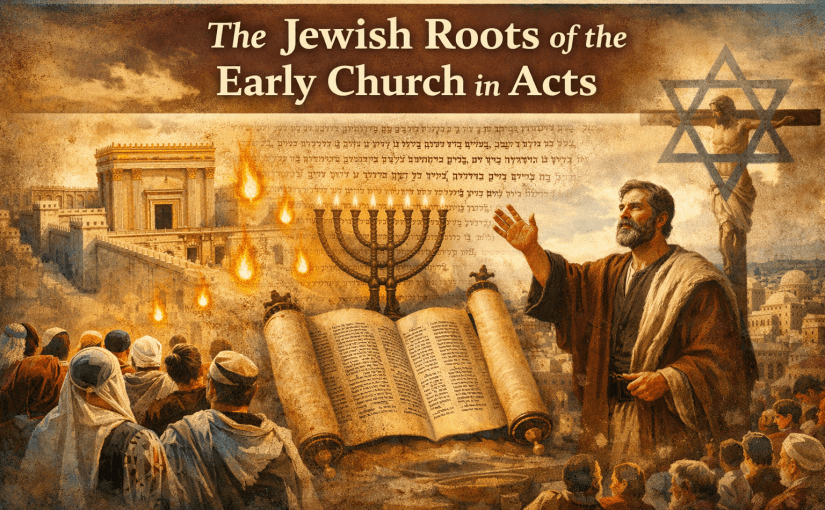
One of the clearest demonstrations of the church’s “Jewishness” is found in Acts 2 at Pentecost. This event did not happen in isolation, but took place during the major Jewish festival known as the Feast of Weeks, when devout Jews from many nations had assembled in Jerusalem.[4] The outpouring of the Holy Spirit and Peter’s sermon took place in a thoroughly Jewish context, and his message was directed to fellow Jews, proclaiming that Jesus is the long-awaited Messiah promised in the Scriptures.[5]
Further examples appear throughout the early chapters of Acts. The believers continued to meet “daily in one accord in the temple”(Acts 2:46, King James Version, 2001), demonstrating that they did not see themselves as abandoning Judaism but as fulfilling it.[6] Peter and John went to the temple at the hour of prayer (Acts 3:1), maintaining established patterns of Jewish worship. Additionally, the apostles consistently grounded their preaching in the Old Testament, as seen in Peter’s sermon (Acts 2) and Stephen’s speech (Acts 7), both of which trace God’s covenant faithfulness from Abraham onward.[7]
The presentations on Pentecost and the Jewish setting of early Christianity highlight that the early church understood itself as the continuation of God’s covenant people, or what might be called “restored Israel.” This explains why Luke emphasizes themes such as promise, fulfillment, and the role of the Spirit. The gospel did not begin as a new religion detached from Judaism; rather, it emerged as the fulfillment of God’s promises to Israel.
Why Luke Went to Great Lengths
Luke likely went to great lengths to portray this authentic Jewish foundation for several reasons. First, it establishes the credibility of the Christian message by rooting it in God’s longstanding covenant history. Second, it demonstrates continuity, as Jesus was not a break from Israel’s story but its climax. Third, it helps explain the initial spread of the gospel, which moved from Jerusalem outward, just as Jesus had instructed (Acts 1:8).[8] Additionally, Luke reflected the strong group culture of the family represented by Psalms 133:1, as well as intertestamental writers who wrote, “God is delighted by harmony among brothers.”[9]
Why this is Important to the Church Today
For Christians today, grasping these Jewish foundations is essential: it gives greater understanding of Scripture, brings clarity to Jesus’ identity as the Messiah, and anchors our faith in God’s enduring promises across generations. The church did not begin in a vacuum, it was born in fulfillment of God’s redemptive plan, revealed first to Israel and then to the world.
[1] Walter A. Elwell and Robert W. Yarbrough, Encountering the New Testament: A Historical and Theological Survey, ed. Walter A. Elwell, Fourth Edition, Encountering Biblical Studies (Grand Rapids, MI: Baker Academic, 2022), 196.
[2] Ibid., 196
[3] Ibid., 197.
[4] Ibid., 200.
[5] Ibid., 200-201.
[6] Ibid., 202.
[7] Ibid., 198, 205.
[8] Ibid., 198.
[9] Joseph H. Hellerman, When the Church was a Family: Recapturing Jesus’ Vision for Authentic Christian Community (B&H Academic, 2009), 47.

 Fighting for My Pea Patch