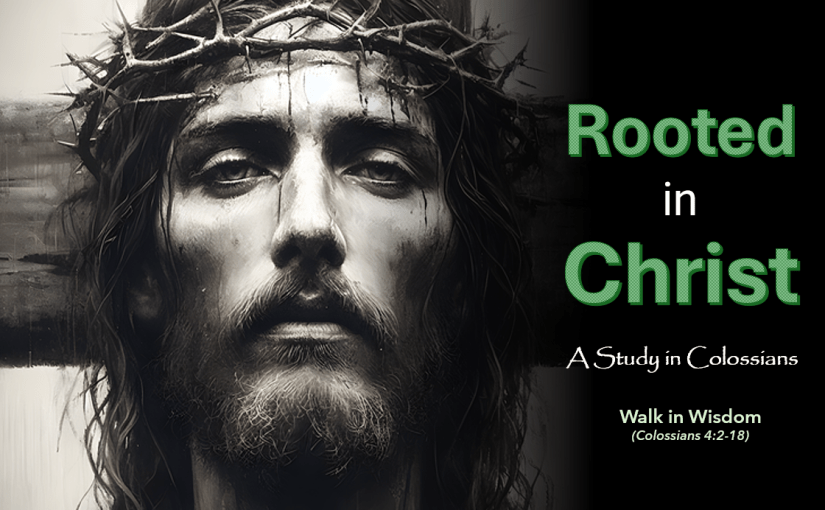
For the past couple of months, we’ve been going through this series titled “Rooted in Christ.” We began by sharing that this was an epistle, a letter, that was written from a Roman prison, by the Apostle Paul, addressed to these believers at Colossae to encourage them in the fact that their fruitfulness was not contingent upon their circumstances, but upon Christ abiding in them. Paul therefore was exhorting them to have relationships that were both deep and wide, and that they were to grow the gospel and grow in grace. I think if there is anything the church today needs – we need grace!
Then Paul shares this powerful prayer, and I shared with you how I get nervous when people tell me they are praying for me, cause I just don’t know what they are going to pray. And secondly, I say to myself, “UTOH, what did I do now?” But Paul shares what I believe is one of the most powerful, purposeful prayers I believe anyone has ever prayed. In fact, if you want to know what to pray for me, pray that prayer!
Then Paul shifts his focus and begins to give what is probably the best message in all the Bible about the Supremacy of Christ, how Jesus is “the visible image of the invisible God,” and “in Him, dwells all the fulness of God.”
At Christmas, we talked about how Jesus stepped into our broken world to give us a breakthrough, and how we have the power to overcome simply by the fact that “Christ lives in us – the hope of glory!” Then Paul begins to encourage us to “walk in Christ,” and reject the counterfeit offers the world has to offer. That Christ is greater than, and in fact is the fulfilment of THE LAW.
Then we took a walk through the Scriptures and saw little pictures of a much larger picture, how that Christ gave us “a nail in a sure place,” a nail all which all my failures, all my disappointments, all my sin hang. And thank God you and I can say with confidence “It’s all nailed down.”
We talked about how we come to an altar, we accept Jesus as Lord and Savior, and then everyone around us begins telling us, or giving us, a list of does and don’ts. So, we then asked the question, “Is Christ Enough?” Or do we need to add rules, or rituals, or Laws, or religion?
And of course, there was the encouragement from Paul to “Take off our stinking Grave clothes and put on our grace clothes.” Encouraging us to walk worthy of the life we have in Christ. And finally, last week, we talked about where this battle starts, and it starts in the home.
Now we are looking at this final chapter in this great book. The Christian life is often described as a walk. It is not merely a set of beliefs to affirm, but a way of life to be lived. Throughout Colossians, Paul has shown us who Christ is—supreme over creation, sufficient for salvation, and central to the church. Now, as he closes the letter, Paul turns from doctrine to daily practice.
In Colossians 4:2–18, Paul shows us what it means to walk in wisdom.
Don’t be confused between knowledge and wisdom. Knowledge is learning, whereas wisdom is application of that knowledge. It is one thing to know something, it is another to actually know what to do with it.
Knowledge is knowing that a tomato is a fruit, whereas wisdom is knowing not to use a tomato in a fruit salad.
Now wisdom can be a type of knowledge, but knowledge is not necessarily a type of wisdom.
The philosopher Socrates said, “The only true wisdom is knowing you know nothing.”
Someone once said, “It’s not what you look at that matters, it’s what you see.”
And I like this statement, “Knowledge is no good if it isn’t practiced!”
After all that Paul has shared in this letter to the believers in Colossae, he is going to leave his final bit of advice/encouragement, and that is to WALK IN WISDOM.
Walk in Wisdom Through Devoted Prayer (v. 2–4)
Paul begins his call to walk in wisdom where wisdom always begins—with prayer. In Colossians 4:2, he exhorts believers to “continue steadfastly in prayer, being watchful in it with thanksgiving,” highlighting several essential qualities of wise prayer. Prayer requires perseverance, as the phrase “continue steadfastly” conveys persistence and refusal to quit; wise believers are not occasional prayers but consistent intercessors who view prayer not as a last resort, but as daily dependence on God.
Prayer also requires watchfulness, calling believers to remain spiritually alert and attentive, discerning the times, recognizing spiritual dangers, and staying awake to God’s ongoing work. Alongside perseverance and vigilance, prayer must be marked by thanksgiving, for gratitude guards the heart from self-centeredness and anchors prayer in remembrance of God’s past faithfulness while trusting Him for present needs.
Finally, prayer fuels the mission of the gospel. Paul asks for prayer not for personal comfort, but for open doors to proclaim Christ clearly, even while imprisoned (vv. 3–4). In this way, wise believers walk in wisdom by praying gospel-shaped prayers that advance God’s mission.
Walk in Wisdom Toward Outsiders (v. 5–6)
Paul now shifts from prayer to public witness, calling believers to live wisely before those outside the faith. In Colossians 4:5, he urges, “Walk in wisdom toward outsiders, making the best use of the time,” emphasizing that wisdom is made visible through everyday conduct. The command to “walk” points to daily behavior, reminding believers that outsiders are watching not only what Christians say, but how they live. When marked by integrity, humility, and love, wise conduct adorns the gospel.
Paul also stresses that wisdom redeems the time; the phrase literally means to “redeem the time,” underscoring that opportunities for witness are fleeting and must not be wasted. Wise believers recognize and seize the moments God provides. This wisdom also governs speech. In verse 6, Paul instructs, “Let your speech always be gracious, seasoned with salt,” indicating that Christian speech should reflect Christ’s kindness while being marked by truth, clarity, and preserving influence. Such speech is both attractive and faithful, knowing how to answer each person appropriately—not with harshness or compromise, but with truth spoken in love.
Walk in Wisdom Through Faithful Partnerships (v. 7–14)
Paul closes this section by naming his coworkers in the gospel, reminding us that these personal references are not filler but theology in action. In Colossians 4:7–14, figures such as Tychicus, Onesimus, Aristarchus, Mark, Epaphras, Luke, Demas, Nymphas, and Archippus. Each represent a story of grace, growth, and service, showing that the gospel advances through people.
Wisdom recognizes that the Christian life and ministry are to be lived out in community; no one walks wisely alone. Most of these individuals are largely unknown to history, yet they were known to Paul – and more importantly, to God.
These co-laborers with Paul were made up of Jews and Gentiles, slaves and free, pastors and encouragers, all united in Christ. This diversity reflects God’s design for unity within difference. God has something for all of us, young or old, educated, uneducated, male or female.
Walk in Wisdom Through Persevering Obedience (v. 15–18)
Paul concludes with final exhortations and a deeply personal word that ties the letter together. He first emphasizes that the Word of God must be read and shared, instructing the churches to exchange letters so that Scripture would be heard, taught, and applied among the believers (v. 16). Wisdom, therefore, submits to God’s Word and actively ensures its spread within the life of the church.
Paul then turns to a specific exhortation, reminding believers that every follower of Christ has a calling. Addressing Archippus, he urges, “See that you fulfill the ministry that you have received in the Lord” (v. 17), underscoring that wisdom finishes what God assigns. Calling is not optional or temporary; it demands perseverance and faithfulness.
Finally, Paul closes with a reminder of both the cost and the comfort of discipleship: “Remember my chains. Grace be with you” (v. 18). Wisdom does not forget the suffering that may accompany faithfulness to Christ, yet it ultimately rests in the sustaining grace of Christ that empowers believers to continue the walk.
Conclusion
As we bring this series, “Rooted in Christ,” to a close, Paul’s final exhortation reminds us that the Christian life is not merely about what we know, but how we live. To be rooted in Christ is to walk in wisdom, depending on God through devoted prayer, living with intentional witness before the world, embracing the gift of gospel-centered community, and persevering in faithful obedience to the calling God has given us.
Wisdom is the daily, Spirit-empowered application of the truth we have received, lived out in real relationships, real conversations, and real faithfulness. The same Christ who Paul taught is supreme, sufficient, and central is the One who sustains us as we walk today. So let us leave this letter committed not just to admire Christ, but to walk in Him, rooted deeply, bearing fruit faithfully, and resting in His grace.

 Fighting for My Pea Patch