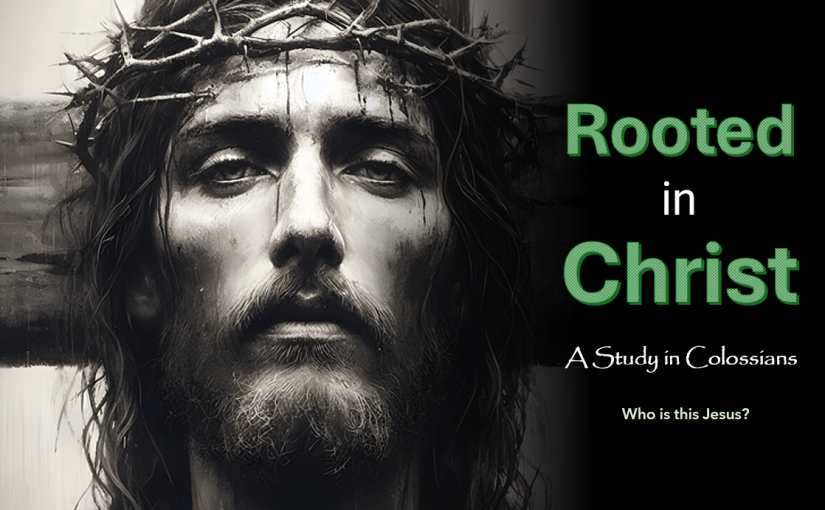
We are continuing this study in the Book of Colossians under the title “Rooted in Christ.” The first two weeks we learned that Paul, who is in prison at the time, is writing to this church that he hasn’t met, a people that he doesn’t know, but he hears of their faith from Epaphras. And though Paul does not know them, and though he has never met them – he is spending time in prison, in the midst of hardship, in the midst of suffering, he is praying for them. Paul is writing to let them know that they are prayed for. And so we were challenged to have, not deep and deep relationship, but deep and wide relationship.
I believe the prayer that Paul prayed for this group of people was a model prayer for you and I today. In fact, if you want to pray a prayer for me, I hope that you will pray, “Father, let my pastor be filled with knowledge, with all wisdom and spiritual understanding. Father give him the strength to walk worthy of the Lord and to be fruitful in all he does. Let him daily increase in knowledge. Lord, strengthen him with your power and give him patience and longsuffering. Help him to be thankful that he is a partaker of the inheritance. And to never forget that he is a part of that ole blood bought crowd!”
Listen, that’s the prayer I want you to pray for me and that is the prayer I am praying for you.
Now, the message beginning in verse 15 is going to become perhap some of the greatest Christological verses in all the Bible concerning the Sufficiency and the Supremacy of Christ.
One commentator said, “This passage, the most famous in the letter, is one of the Christological high points of the New Testament and provides a critical basis for the teaching of the letter.”
Biblical Scholar, N.T. Wright said, “The next 6 verses of the letter are generally, and rightly, reckoned among the most important Christological passages in the New Testament.”
I’m gonna ask you to do something different with me this morning, I’m going to ask you to stand with me as we read these verses. Colossians 1:15-20:
While Paul is thanking God for this church at Colossi, and as he is praying for them, he is reminded of who God. And in the midst of thinking about who God is, BOOM – we get these 6 verses talking about who Christ is. Pick up with me in verse 15:
“15 Who is the image of the invisible God, the firstborn of every creature: 16 For by him were all things created, that are in heaven, and that are in earth, visible and invisible, whether they be thrones, or dominions, or principalities, or powers: all things were created by him, and for him: 17 And he is before all things, and by him all things consist. 18 And he is the head of the body, the church: who is the beginning, the firstborn from the dead; that in all things he might have the preeminence. 19 For it pleased the Father that in him should all fulness dwell; 20 And, having made peace through the blood of his cross, by him to reconcile all things unto himself; by him, I say, whether they be things in earth, or things in heaven.” The title of the message this morning is WHO IS THIS JESUS? Let’s Pray.
The first Century church, if you will remember is made up of both converted Jews, stuck in the Law, and Gentiles, who had many gods, both with different views of who Christ is. Gnosticism was a real problem that creeped into every one of the churches established in the New Testament, with varying views of just who Jesus is. Whether Jesus was born a man who became God or God who became man was at the heart of the issue.
Every generation of believers must answer the same question: Who is This Jesus? Not who do we want Him to be, or who our culture imagines Him to be, but who God’s Word reveals Him to be. In Colossians 1:15–20, Paul pulls back the curtain and gives one of the most breathtaking descriptions of Jesus Christ found anywhere in Scripture. Writing to a young church threatened by false teaching that reduced Jesus to a spiritual helper or one among many divine beings, Paul responds with a hymn-like declaration exalting Christ as Supreme over revelation, supreme over creation, supreme over the church, and supreme in salvation. These verses remind us that Jesus is not a part of our lives , but He is the center.
CHRIST SUPREME IN REVELATION (v. 15)
“He is the image of the invisible God, the firstborn of all creation.”
Paul begins with a staggering statement: Jesus makes the invisible God visible. He is the image (Greek: eikōn), the exact representation, the perfect manifestation, of God Himself. Some people would call the object I’m holding in my hand a phone – I would call it a lot of things, but a phone is not one of them. I would call it a Wife neglecting, Child neglecting device; I would call it a hand computer, a calculator, and often – a camera. With this camera, I can take pictures, crop and adjust the color of the pictures – all kinds of neat stuff you can do with it. But this device is anything but a phone.
How many of you remember real cameras? I mean the one’s you had to open the back, put some film in it, close the back, and when you click the photo, you had to hold the camera real still until the shutter went off. Then when your roll of film was done, you’d take it to Sears, or JC Penny, or to the Drug Store to get your film developed (because there wasn’t a Walmart in our town back then). When they got the film, they’d pull the roll out, take it to a darkroom, drop it into some liquid then transpose the image onto photo paper. At first, you could not really see the image, but then it began to develop – what was once invisible began to become visible. That’s what Paul is saying about Jesus.
If you want to know what God is like, you look at Jesus:
- His compassion shows God’s compassion.
- His commands reveal God’s authority.
- His purity displays God’s holiness.
- His mercy reveals God’s heart for sinners.
When Paul calls Jesus the “firstborn of all creation,” he does not mean Jesus was created. “Firstborn” is a title of rank, not origin. In the Old Testament, the firstborn was the heir, the one with authority. Jeremiah 31:7-9, we find that Jacob appoint Ephriam to be the first born. But he was not actually the first born. Joseph had two sons, Manasseh and Ephriam. Manasseh was by birthright the the firstborn, but Ephriam was appointed the first born. Psalm 89:27-28 says, “I will make him my firstborn, higher than the kings of the earth. My mercy shall I keep for him for evermore and my covenant shall stand fast with him. “ the King among many kings . . .” Does anyone know what Saul, before he became Paul was? He was a Pharisee, a Hebrew of the Hebrew, as touching the Law – blameless. This means that Paul memorized the Old Testament. So no doubt when Paul is finding words to describe Jesus, these verses probably came to his mind. Paul is saying: Jesus stands over creation as its rightful Lord – He’s the rightful heir.
Christ reveals God perfectly and reigns over creation sovereignly.
CHRIST SUPREME IN CREATION (v.16-17)
“For by Him all things were created…created by Him and for Him . . . by Him all things consist.”
Paul expands this truth in three breathtaking ways:
All things were created BY Him (v. 16). “Created by Him . . .”
Jesus is not part of the created order, He is the Creator. Everything exists because He spoke it into being: Every star in the sky, Every angelic power, Every atom in your body.
Nothing exists apart from His creative Word. He is the divine agent of creation. Everything owes its existence to His power. No wonder the psalmists said, “Oh Lord, OUR Lord, how excellent is Thy name in all the earth . . .”
All things were created FOR Him (v. 16). “All things were created for him”
This is the purpose statement of the universe. You were made for Jesus. Your life, your gifts, your future, everything finds meaning in Him. (Talk about the big gapping hole)
All Things are Held Together By Him (v. 17). “By him all things consist”
Not only did He make the world, He sustains it. The universe is not running on autopilot. The One who died on the cross is the One keeping your heart beating, keeping gravity in place, and upholding the cosmos. He is before all things in time, rank, authority, and importance.
Christ is Supreme in Revelation, He is Supreme in Creation,
CHRIST SUPREME IN THE CHURCH (v. 18)
“He is the head of the body, the church.”
Christ is not merely a mascot for the church – He is the Head. The church is not upheld by human personality or organizational strength but by Christ Himself.
- He gives the church life.
- He gives the church direction.
- He gives the church unity.
- He gives the church mission.
Paul continues: “He is the beginning, the firstborn from the dead.” Christ is supreme in creation. “That in everything, he might be preeminent.”
Let me illustrate this:
If you were to ask me “Who I am?” I couldn’t tell you Who I am apart from telling you who Kim is. 22 years ago, we meet in Baghdad, Iraq – and since that day in April of 2004, I can’t get into a long conversation about WHO I AM apart from telling you WHO SHE IS. One because I love her, and two, she’d break my neck if I didn’t.
But here is our problem today – we get to caught up in WHO WE ARE rather than WHO HE IS. So we think that our values, our morales, our hurts, our wants define WHO WE ARE. That only leads to two types of groups in here: You either end up in PRIDE – thinking too much of yourself, or in depression – thinking too little of yourself. And it’s not that God hasn’t made you for a PURPOSE, but that you have looked over the God of the PURPOSE. You’ve looked for your identity outside of the God who gave you your identity. And because of it, in America, and in our churches – we have an identity crisis, because WHO WE ARE has come before WHO HE IS.
But let me remind you of some things about WHO HE IS: We were made By Him; We were made TRHOUGH Him, and we were made FOR HIM. And without HIM we are nothing. So, if you really won’t to know who you are, you have to start with who HE IS. Jesus does not share first place. He does not compete for loyalty. He reigns in absolute supremacy.
CHRIST SUPREME IN SALVATION (vv. 19–20)
“For in Him all the fullness of God was pleased to dwell.”
Paul reaffirms that Jesus is fully God, not partially divine, not a spiritual guide, but the complete “fullness of the Godhead bodily.”
The fullness of God dwells in Christ (v. 19).
Everything that makes God God is found in Jesus. In fact, it is impossible to look at Jesus and see less of God, because Jesus is the fulness of God!
Christ reconciled all things through His blood (v. 20).
This eternal, cosmic Christ became the crucified Christ. The One who created all things is the One who shed His blood to restore all things.
Paul says Christ “made peace” through the blood of His cross. We are not reconciled to God by our works, our spirituality, or our morality. Peace with God comes only through the atoning death of Jesus.
Christ’s reconciliation extends to creation itself (v. 20).
Sin fractured the universe. Christ will restore the universe. The One who created the world is also the One who will renew it.
So, what does all this mean to us, what does it mean to me?
First, it means Christ can’t be a supplement – He is either your Lord of all, or He isn’t your Lord at all. He must be supreme in our lives—our decisions, relationships, priorities, ministries, and identity.
You can trust Christ with every detail of your life. I may not know what tomorrow brings, but I know who holds tomorrow! He holds all things together, including you. Your anxieties, your future, your needs are safe in His sovereign hands.
The church must exist for Christ’s glory – not our preferences. Our ministries, music, preaching, and mission must all be centered on Christ, not trends, not personalities, not comfort.
Salvation is found in Christ alone. There is no peace with God apart from the blood of the cross. No “add-ons.” No competing saviors. Christ is sufficient.

 Fighting for My Pea Patch