By: Pastor Joe Moore, Liberty University Theological Seminary Student
From the earliest chapters of the Gospels, Jesus invites individuals into follow Him on a transformative journey that is not instantaneous but progressive (Matthew 4:19, King James Version). After more than three years of following Christ, the lives of the disciples had transformed to the point that they were entrusted carrying out the mission of taking the Good News to all the world (Matt. 28:19-20, KJV). This research will focus on the stages the disciples of both yesterday and today must go through, how these stages affect the spheres of their lives, where I am personally in this disciple development process, as well as the areas I need improvement, and finally, what it means to submit to Christ.
The Five Stages of Discipleship
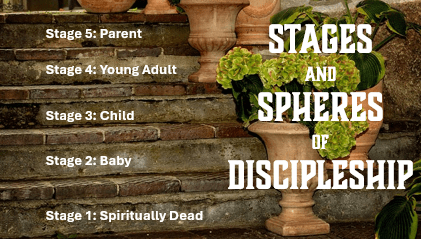
Dempsey and Earley describe the key to discipleship as every “disciple realizing their potential is trusting God and taking the next step of faith and obedience.”[1] Dietrich Bonhoeffer says the steps of following Christ is more than a spoken confession of faith in Christ, but is an obedient deed.[2] Bonhoeffer further states that discipleship is “a commitment solely to the person of Jesus Christ.”[3] This section will focus on the Five Stages of Discipleship described by Putman and Harrington[4] that begins with the realization that without Christ, all are dead in their trespasses and sin. Upon answering the call to follow Christ, the disciple becomes a spiritual babe, grows into a child, then progresses to a young adult, and culminates with becoming an adult. It is the responsibility of the disciple to identify where people are in these stages to help them get where they need to be.[5]
Stage 1: Spiritually Dead
This level is best described as an exploratory stage. Until a person makes the conscious decision to follow Christ, the Apostle Paul describes them as those “who are dead in trespasses and sins” (Ephesians 2:1, King James Bible). Putman and Harrington refer to this as the pre-conversion discipleship phase.[6] Greg Ogden states, “Just because Jesus focused on a few doesn’t mean He lost focus on the multitude.”[7] In fact Jesus’ purpose in coming was to “seek and to save that which was lost” (Luk. 19:10, KJV). His purpose in discipling His disciples is reflects this in His final command to, “Go into all the world and preach the Gospel to every creature” (Mark. 16:15, KJV). Peter reinforces this by stating that the Lord is “not willing that any should perish, but that all should come to repentance” (II Peter. 3:9, KJV).
It is in the stage that those who are dead in the trespasses and sins “act according to their dead nature.”[8] Putman and Harrington state that it is in this stage “they need love through honest friendships and relationships with believers. We often preach our best sermons with our lives and not our words”[9] The great news is, a person in this stage “can be born again (John. 3:3-5).”[10]
Stage 2: Infants
This is the stage where those who were dead in trespasses and sins make a commitment to follow Christ. Putman and Harrington describe those in this stage as those who “have made a decision to follow Christ, but that’s about as far as they have gotten.”[11] I Peter 2:2-3 describes these as “new-born babes” (KJV). As babes, those in this stage are needy and require a lot of attention. Discipling babes requires a lot of patience and an understanding that a lot of mistakes will be made.[12] Putman and Harrinton state “eventually they will learn to feed themselves, but at this point, they don’t really know how.”[13] They conclude this stage by stating “they need the truths of the Christian faith taught and modeled for them.”[14]
Stage 3: Children
The next spiritual stage of growth is becoming children. John says, “My little children, these things write I unto you . . .” (I John 2:1, KJV). In referring to these believers in Ephesus, John refers to them as children. This maybe a term of endearment, recognizing they are part of the family of God, but could also addresses where they are in the discipleship development stage. In this stage, they are learning to feed themselves and are learning to speak the believer’s language.[15] However, they have not figured out that ministry is not about them. Putman and Harrington state, “Children still need care and guidance from their parents.”[16] In this stage, the authors state, “they need teaching about who they are in Christ, how to have close relationships with other believers, and what to expect (and not expect) from Christians.”[17]
Stage 4: Young Adults
Putman and Harrington state that those in this stage are, “making a shift from being self-centered to being Christ-centered.”[18] At this stage they are becoming doers of the Word, not just hearers (James 1:2, KJV). They are eager and find joy in serving God.[19] For those in this stage, Putman and Harrington state, “they need a place where they can learn how to serve . . . They need deep relationships with people who will both encourage them and hold them accountable.[20] This is also the stage where the transformation process is taking shape in their lives (Rom. 12:1, 2, KJV).
Stage 5: Parents
For this stage, Putman and Harrington chose to use the term parent over adult to emphasis the need for spiritual reproduction.[21] These are mature Christians that are able to teach others and are steeped in the Word of God.[22] Spiritual parents are not perfect, but they do reflect maturity and readiness to carry out the Great Commission. Putman and Harrington said, “They are feeding themselves God’s Word so that they can feed others.[23]
The Four Spheres of Discipleship
Though discipleship unfolds in stages, it touches every area of our lives. Putman and Harington describe growing into disciples “involves four main spheres of life . . . since people grow at different speeds, we should take care to disciple them in a way that is appropriate to their level of spiritual maturity.”[24] The four spheres encompass our relationship with God, with our families, with other believers, and with the lost, and highlight that Christ’s Lordship must be central.
Relationship With God
The first and most important sphere is our relationship with God. Bonhoeffer said, “the call to discipleship is a commitment solely to the person of Jesus Christ.[25] Now that the believer is “in Christ Jesus” (Rom. 8:1, KJV), according to Earley and Dempsey, “they are to be transformed by the renewing of their minds.”[26] Believers are to be in a transformational stage where they are learning daily to look less like themselves and look more like Jesus. This sphere is essential to grasp the other spheres.
Relationship with Other Believers
Acts 2:42-47 describe how the believers lived out the four pillars of faith: teaching, fellowship, breaking of Bread, and prayer. Living in community or doing life with other believers “strengthens the relationship with have with God by being in a relationship with other believers . . . as we walk with God, we learn to love our brothers and sisters in Christ.[27]
Relationship with Family
Discipleship extends into the home. Paul’s instructions in Ephesians 5:22–6:4 show that marriage and parenting are places where the gospel is lived out. Learning to live in Christian community and learning the Christian language should naturally bleed over to the home. After all, as Putman and Harrington state, “the best place to make disciples is in your family.”[28]
Relationship with the World
Though we are called not to love the world, nor the things of the world, we are called to live in the world, to be a light to the world (I John 2:15-17, KJV). How we act at work, at sporting events, in the grocery store, at the gas station reflects our relationship with Christ. Putman and Harrington state, “our relationship with Jesus necessarily affects how we live and work in the world.[29]
My Current Stage of Discipleship
I most closely identify with being an Adult/Parent in my current stage. Though age is not the determinate factor by any means, I am 62 years old, have been in a relationship with Christ since I was six years old, surrendered to the call preach after 14 years of active military service, and now 30 years into ministry. I have mentored 7 men of over my 30 years pastoring that have answered the call to preach and are now making disciples themselves.
Two years ago, I planted a church for the motorcycle community. This has been both rewarding and challenging. Rewarding in the fact that I have people I am mentoring at every stage of their relationship to Christ. This has also proven to be a challenge as I have very few people capable of mentoring others themselves. So, the burden to disciple rests squarely on me.
Spheres of Life Needing Submission to Christ
I believe one of my spheres of life is my relationships with other believers. The older I get, the less patience I have. It is frustrating to disciple people, only to see them begin to regress in the spiritual stage they are in. Sometimes the shear amount of work to do and lack of laborers to help in the harvest weighs heavy on me. Of course, this frustration also bleeds over to my relationships in the home. Altogether, the work of making disciples can be so overwhelming that it cuts into my relationship with God. Reminds me of Eleazar, who was fighting for his king, right where he was supposed to be, fighting when everybody else ran off, but he was giving it everything he had. Although he was where he was supposed to be and doing what he was supposed to do, “his hands got weary” (II Sam. 23:10). In short, getting weary can affect every sphere of submission to Christ.
Submission to Christ: A Theological Perspective
Submission to Christ, from a theological perspective, is both the foundation and the ongoing posture of discipleship. The Gospels show us that Christ’s invitation to “follow Me” (Matt. 4:19, KJV) is not merely a call to observe His teaching but to enter into a lifelong process of transformation. Submission is not a one-time act but a progressive journey of surrender, as seen in the disciples’ own lives. For more than three years, they walked with Jesus, learning obedience through both their failures and growth, until finally they were entrusted with the mission to carry the Gospel to all nations (Matt. 28:19–20, KJV). Theologically, this points to the reality that discipleship requires both recognition of Christ’s Lordship and an active yielding of one’s will, desires, and ambitions to Him. Bonhoeffer rightly insists that discipleship is not simply confession but obedience—the willingness to give up autonomy and embrace Christ’s authority in every sphere of life.
True submission means aligning one’s entire being under the reign of Christ, allowing His Spirit to guide the process of sanctification. As Putman and Harrington describe through the stages of discipleship, believers must move from spiritual infancy to maturity, learning at each stage to submit more deeply to Christ’s Word and will. Likewise, submission touches every sphere of life: our relationship with God, our fellowship with believers, our families, and our witness to the world. Theologically, submission is inseparable from transformation (Rom. 12:1–2, KJV); it requires dying daily to self (Luke 9:23, KJV) so that the life of Christ may be fully formed within us. To submit to Christ, then, is to embrace His call to discipleship as the central organizing reality of life, trusting that obedience, even when it is difficult, leads to greater intimacy with Him and effectiveness in carrying out His mission.
In conclusion, discipleship is a progressive journey of transformation that requires intentional submission to Christ in every stage and sphere of life. From spiritual death to becoming a spiritual parent, the process of growth involves both God’s grace and our active obedience to His call. The stages described by Putman and Harrington remind us that discipleship is not instantaneous but marked by continual steps of faith, learning, and service. Likewise, the four spheres emphasize that following Christ is not limited to personal devotion but extends into our families, relationships with believers, and witness to the world. True discipleship is about faithfully abiding in Christ, allowing His life to flow through me so that I may continue to make disciples who, in turn, will make disciples.
Bibliography
Jim Putman, Harrington, Bobby, and Coleman, Robert E., 2013. DiscipleShift: Five Steps that
Help Your Church to Make Disciples Who Make Disciples. Grand Rapids: Zondervan
Reflective, 55-75.
Earley, Dave and Dempsey, Rod, 2018. Spiritual Formation Is . . .: How to Grow in Jesus with Passion and Confidence. Brentwood: B&H Academic, 84.
Earley, Dave and Dempsey, Rod, 2013. Discipleship Making Is . . .: How to Live the Great
Commission with Passion and Confidence. Brentwood: B&H Academics, 58.
Bonhoeffer, Dietrich, 2003. Discipleship. Minneapolis, MN: First Fortress Press, 45.
Ogden, Greg, 2007. Discipleship Essentials: A Guide to Building Your Life in Christ, Expanded
Ed. Downers Grove, IL: Intervarsity Press, 20.
[1] Dave Earley and Rod Dempsey. Discipleship Making Is . . .: How to Live the Great Commission with Passion and Confidence, (Brentwood: B&H Academics, 2013), 58.
[2] Dietrich Bonhoeffer. Discipleship, (Minneapolis, MN: First Fortress Press, 2003), 45.
[3] Ibid, 59.
[4] Jim Putman, Bobby Harrington, and Robert E. Coleman. DiscipleShift, Five Steps that Help Your Church Make Disciples that Make Disciples, (Grand Rapids, MI: Zondervan Reflective, 2013), 55-75.
[5] Putman, Harrington, and Coleman. DiscipleShift, 55.
[6] Ibid, 63.
[7] Greg Ogden. Discipleship Essentials: A Guide to Building Your Life in Christ, Expanded Ed. (Downers Grove, IL: Intervarsity Press, 2007), 20.
[8] Putman, Harrington, and Coleman. DiscipleShift, 61.
[9] Ibid, 62.
[10] Ibid, 62-63.
[11] Putman, Harrington, and Coleman. DiscipleShift, 63.
[12] Ibid, 64.
[13] Ibid, 64.
[14] Ibid, 65.
[15] Ibid, 65.
[16] Ibid, 65.
[17] Putman, Harrington, and Coleman. DiscipleShift, 67.
[18] Ibid, 67.
[19] Ibid, 68.
[20] Ibid, 69.
[21] Ibid, 69.
[22] Ibid, 69.
[23] Ibid, 70.
[24] Putman, Harrington, and Coleman. DiscipleShift, 78.
[25] Bonhoeffer. Discipleship, 48.
[26] Dave Earley and Rod Dempsey, Spiritual Formation Is . . .: How to Grow in Jesus with Passion and Confidence, (Brentwood, TN: B&H Academics, 2018), 51.
[27] Putman, Harrington, and Coleman. DiscipleShift, 87.
[28] Putman, Harrington, and Coleman. DiscipleShift, 88.
[29] Ibid, 89.

 Fighting for My Pea Patch