By: Pastor Joe Moore, Liberty University Theological Seminary
Introduction
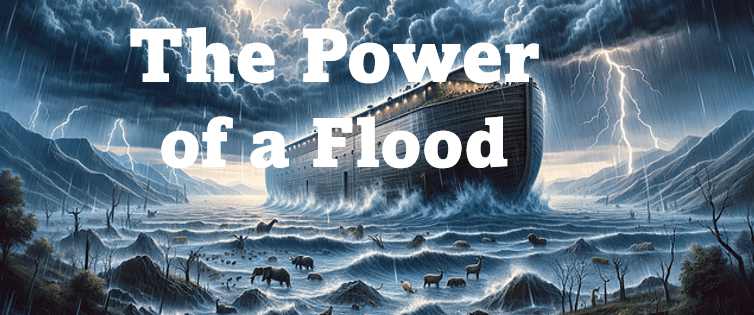
In the wake of devastating floods caused by the remnants of Hurricane Helene, which has caused catastrophic flooding in the southeast United States, Dr. Steven A. Austin’s article “Grand Canyon, Creation, and the Global Flood,” lends credence and insight to the power and impact of a flood event on a grand scale. This article discusses the differences between naturalistic, and old-earth view that the Grand Canyon was formed by slow moving events over a long period of time, verses the young-earth view that a single, catastrophic event like the flood of Noah caused the formation of the land mass, or earth’s surface, as we know it today. The power of a great flood event is presently being demonstrated on a small scale in the complete destruction and movement of earth in places like Lake Lure, Chimney Rock, and Asheville, North Carolina, Maggie Valley and Gatlinburg, Tennessee, and seen in the devastation caused to major arteries of travel throughout the southeast.
Article Strengths
In laying out a “framework of assumptions,” Dr. Austin contrasts the naturalistic, old-world (evolutionists) assumptions of the sedimentary strata of the Grand Canyon against the assumptions made by young-earth (Creationists) scientists. The evolutionists assume sedimentary layers of the Grand Canyon are a result of millions of years of history, formed by calm waters that advanced and retreated multiple times over a long period of time. Creation science assumes that the Grand Canyon was formed by the flood of Noah’s day, a catastrophic event that began on the ocean floor, covered the entire earth surface, and lasted for a period of one year.
To strengthen the young-earth science view, Dr. Austin discusses the discovery of fossilized marine organisms found within the layers of sandstone, limestone, and shale that died quickly and violently due to the force of ocean water rapidly covering the earth’s surface. According to the author, this can easily explain a major flood event. The various sediments themselves appear to validate this discovery. Coconino sandstone, once believed to be deposits of wind, show elements of dolomite, which is a marine sediment. According to Dr. Austin, these diagonally sloped cross-beds of sandstone closely resemble modern oceanic dunes caused by rapidly moving storms in the ocean.
In addition, Dr. Austin states that recent studies of a seven-foot-thick section of Redwall Limestone shows millions of shells of squid, which supports that this was caused by a submarine mudflow that happened within minutes. He also states that new discoveries of how shale layers are playing an important role in understanding the rapid formation of the Grand Canyon’s strata. Marine fossils found within these layers support rapid deposition by ocean water.
To further strengthen the young-earth view, Dr. Austin states that geologist reject the idea that the Grand Canyon was formed by a flowing river lasting millions of years. The deposits found in the Grand Canyon support a view that it was formed by a catastrophic event. He also states that recent findings show evidence of an event causing uplift and collapse that show a different event occurring that previously believed. All these findings support the young-earth view that a single event, the flood of Noah’s day, was an event in magnitude that could cause the movement of the earth to its present form.
Article Weaknesses
The weaknesses found in the article are not so much found in the research of the author, but rather in the perspectives brought to it by geologist. Dr. Austin gave an excellent example in his conclusion about two geologists looking at the same structure. Each geologist is looking at science from their own framework of assumptions. The evolutionists will approach science from that viewpoint that the earth was formed over millions of years and will test theories to prove their research using methods such as isotopes or radioisotopes. The creationists will approach science from the perspective that God could speak the earth into existence and that the formation of the earth as it is now, could well have been caused by a single, catastrophic event, such as the flood of Noah. Each, through their own bias, can cause one to not consider the proven science of the other. Interestingly, Dr. Austin mentioned several times how geologists have changed their views with recent discoveries of how the Grand Canyon was formed. Though some may have changed their initial view, rather than accept the possibility this was caused by s singular event, they will seek to find other explanations.
Conclusion
On a scale of one through five, I would rate it at a five. One of Dr. Austin’s concluding thoughts is that neither evolution geologists, nor creationist geologists, were alive at the time of the formation of the Grand Canyon. Therefore, this science must consider the historical events that have occurred. Dr. Austin’s research presents a solid geological view of the power contained within the forces of a singular catastrophic flood event. The evidence shown through discoveries of marine fossils in the Grand Canyon support and strengthen his view. Romans 1:20 states, “or the invisible things of him from the creation of the world are clearly seen, being understood by the things that are made, even his eternal power and Godhead; so that they are without excuse:” (KJV). God’s creation has revealed enough of itself to us that we have no excuse for rejecting the science of this one-time catastrophic event in history.
Reference
Austin, Steven A. (2012). Grand Canyon, Creation and the Global Flood. Christian Research Journal, volume 35 p. 1-6. https://www.equip.org/PDF/JAF11351.pdf
The Holy Bible: King James Version. Iowa Falls, IA: World Bible Publishers, 2001 (Romans 1:20)

 Fighting for My Pea Patch