ROOTED IN CHRIST: Complete in Christ – No Add-Ons Required

Remember with me, Paul is writing from Prison to a group of believers he has never met face to face, yet he fights for them in prayer and truth. Now, Paul didn’t volunteer to be in prison, yet he acknowledges he is there “by the will of God.” Paul understood that his fruitfulness was not contingent upon his circumstance. He understood that God wanted him to go deep and wide in his relationship with God and with others. So, Paul is writing these people he does not know, he has never meet and then lays out one of the most powerful prayers for them that you will find anywhere in the Bible, then establishes the Supremacy of Christ. We learned that Christ is the visible image of the invisible God. If you want to know what God looks like, look at Jesus. Last week, we discussed “Christ in You,” not beside you, not around you, but “IN YOU, the hope of glory.

But if you remember with me, Paul was not only writing to encourage this church in Colosse, but he was also writing to address some issues that had crept into the church, not only these churches, but many of the churches. One of the main problems was that of Gnosticism. False teachers were trying to sell a “Jesus-plus” faith:

  • Jesus plus rules,
  • Jesus plus rituals,
  • Jesus plus knowledge,
  • or even their own experiences.

But Paul is going to make it very clear that it is Christ plus Nothing.

THE STRUGGLE WE FACE – A Contending Concern (vv. 1–3)

Paul opens his heart to the Colossians, revealing the intensity of his spiritual struggle. This is not a struggle with people, politics, or circumstances – but a struggle for the souls of believers. Paul’s concern is deep and wide, and rooted in love. He contends daily in prayer and ministry for their spiritual well-being.

For I would that ye knew what great conflict I have for you, and for them at Laodicea, and for as many as have not seen my face in the flesh;” (v.1)

Notice first with me, Paul struggles/contends spiritually for the believers he loves. His struggle reminds us that following Christ is not passive. Love often demands effort, sacrifice, and vigilance. If we truly care for one another, we too must contend in prayer and encouragement, battling spiritual forces that threaten faith and unity.

That their hearts might be comforted, being knit together in love, and unto all riches of the full assurance of understanding, to the acknowledgement of the mystery of God, and of the Father, and of Christ;” (v. 2)

The goal of Paul’s struggle is not to confuse or overwhelm minds with endless rules or secret knowledge. His goal is strengthened hearts, he wants believers confident and courageous in Christ, knowing there are some things worth struggling for.

  • Spiritual strength comes from clarity, not complexity.
  • From knowing Jesus, not chasing mysteries.
  • Strength is found when our faith rests firmly in Him, not in human wisdom or clever arguments.

In whom are hid all the treasures of wisdom and knowledge.” (v. 3)

Finally, Paul desires stability, believers rooted in love and united in purpose. Stability does not mean stagnation but a steadfastness that keeps us grounded in truth, Rooted in Christ, and able to stand firm against division or deception. True wisdom and knowledge are hidden in Christ, and He alone is the source of lasting confidence and peace.

Here’s a lesson we can take from these three verses, “if what you are doing doesn’t lead you closer to Christ, it won’t make you stronger.” Life will present distractions, teachings, and practices that may seem appealing, but Paul warns us to measure everything by this standard: does it deepen my relationship with Jesus? If not, it is empty, even dangerous.

When we embrace the struggle with love, pursue the strength found in Christ, and cultivate stability in Him. Then we can walk in wisdom, united in love, confident that all spiritual treasures reside in Jesus alone.

THE SEDUCTION WE FIGHT – A Clever Counterfeit (vv. 4–5)

Here, Paul issues a sharp warning to the Colossians: the spiritual battlefield is not only about struggles we see but also about seductions we may not recognize. False teaching often wears the mask of reasonableness, even appearing deeply spiritual. It tempts, confuses, and pulls believers off course.

And this I say, lest any man should beguile you with enticing words.” (v. 4)

Notice the Deception: The danger is in how cleverly counterfeit teaching can sound. Smooth words, persuasive arguments, and flashy spirituality can deceive even the well-meaning. Just because something sounds holy does not make it biblical. Paul reminds us to be vigilant; the enemy’s tactics are often subtle, not overt. We must discern truth from error, rooting ourselves in Scripture, not in persuasive speech.

For though I be absent in the flesh, yet am I with you in the spirit, joying and beholding your order . . .” (v. 5a)

Fighting this Deception requires discipline. Faith is not about hype, trends, or emotional high points. It’s about training ourselves to recognize God’s truth, practicing prayer, and building understanding through God’s Word. Discipline strengthens our spiritual senses, so we can identify what truly leads us closer to Christ and what leads us astray.

“. . . and the stedfastness of your faith in Christ.” (v. 5b)

Finally, we need clear direction. Paul’s concern is that believers remain on the straight path of faith. Smooth talk can pull you off course, but disciplined hearts rooted in Scripture stay aligned with God’s purposes. Direction comes when we measure all teachings against Christ, who is the source of all wisdom, knowledge, and spiritual growth.

Listen, not everything that sounds spiritual is scriptural. Charm, charisma, or clever reasoning cannot replace God’s Word. The ultimate test of any teaching is whether it points us to Jesus and strengthens our faith in Him.

THE STAND WE TAKE – A Consistent Commitment (vv. 6–7)

When we come to Christ, we receive more than a one-time blessing, we receive a life that is meant to grow, mature, and endure. You don’t start with Jesus and finish with something else; the faith we receive is designed to shape every part of our lives.

As ye have therefore received Christ Jesus the Lord, so walk ye in him:” (v. 6)

First, remember what we’ve Received. Salvation is a gift, not a performance. We received Christ’s grace, forgiveness, and love freely. This is the foundation of our faith, the starting point that cannot be replaced or improved by anything else. Recognition of this gift keeps our hearts humble and our eyes fixed on Him.

Rooted and built up in him, and stablished in the faith, as ye have been taught. . .” (v. 7a)

Not only are we to remember what we’ve received, we are to be firmly rooted in Jesus. Like a tree planted by streams of water, we draw nourishment from Him daily. We are rooted in His Word, built up in His strength, and established in the faith. Being rooted means that life’s storms will not easily shake us, because our foundation is unchanging. It is not our plans, our pride, or our performance that hold us—it is Christ.

“. . . abounding therein with thanksgiving.” (v. 7b)

Finally, gratitude fuels resilience. When we remember that the same Jesus who saved us also sustains us, we find strength to endure challenges, face temptation, and keep moving forward. Resilience is not stubbornness; it is confidence in the unchanging power of Christ at work within us. The more we dwell on His faithfulness, the more our faith stands firm. Let’s rejoice in the fact that the same Jesus who saved us also sustains us.

THE SCAM WE REJECT – A Captive Philosophy (vv. 8–10)

Paul warns the Colossians about a subtle but dangerous threat: philosophies, human traditions, and worldly thinking that promise freedom but actually enslave. The enemy often dresses up lies as wisdom, tempting believers to chase ideas, rules, or “spiritual upgrades” that subtract from Christ instead of adding to Him.

Beware lest any man spoil you through philosophy and vain deceit, after the tradition of men . . .” (v. 8a)

The first danger is captivity. When we allow worldly philosophies or rigid traditions to dictate our faith, we are no longer free in Christ. These systems enslave our minds, divert our focus, and plant doubt. Paul reminds us to be vigilant; freedom in Christ must be guarded, because not every teaching that sounds wise or spiritual leads to life.

. . . after the rudiments of the world, and not after Christ.” (v. 8b)

Next is the counterfeit. False systems promise spiritual progress but subtract from the sufficiency of Christ. They tell us we are incomplete, need more rituals, knowledge, or human effort to “measure up.” But this is a lie. Any teaching that diminishes the centrality of Jesus is a counterfeit, a scam designed to make you dependent on something other than Him.

For in him dwelleth all the fulness of the Godhead bodily. And ye are complete in him, which is the head of all principality and power:” (v. 9-10)

Finally, Paul points to completion. Christ is fully God, fully sufficient, and fully able to provide all we need. In Him, we are complete. We don’t need upgrades, additions, or human inventions to make our faith whole. Our security and sufficiency rest entirely in Him.

Stand firm knowing that in Him, you are fully equipped, fully secure, and fully complete.

THE SURGERY WE EXPERIENCE – A Changed Condition (vv. 11–12)

Paul describes the radical transformation that occurs when we are united with Christ, a spiritual surgery that changes us from the inside out. This is not about outward rituals or behavior modification; it’s about a heart renewed and made alive in Him.

In whom also ye are circumcised with the circumcision made without hands, in putting off the body of the sins of the flesh by the circumcision of Christ:” (v. 11)

The first step in this spiritual surgery is cutting. Our old self, the flesh that clings to sin and self-reliance, is cut away. Just as circumcision in the Old Testament symbolized separation from the old ways, Christ removes the power of sin from our lives. This is painful, intentional work, but it is necessary for real transformation.

Buried with him in baptism, wherein also ye are risen with him through the faith of the operation of God . . .” (v. 12a)

After the cutting comes cleansing. Baptism represents being buried with Christ, dying to the old life, and being washed clean by His sacrifice. We don’t clean ourselves up through willpower or rules, Christ does the work internally. His grace penetrates the deepest parts of our hearts, removing guilt, shame, and the pull of sin, making us pure and whole before God.

“. . . who hath raised him from the dead.” (v. 12b)

Finally, there is coming alive. Being raised with Christ signifies resurrection power flowing into our lives. This is not a slow improvement or surface-level change, it is a new condition, a life empowered by the Spirit to live fully for Him. Transformation is evident not just in what we do, but in who we are becoming.

Christianity isn’t behavior modification; it’s heart transformation. When we allow Him to cut, cleanse, and resurrect us, we are allowing Him to unmake us so that He can remake us, from old habits to new life, from death to abundant life in Christ.

THE SALVATION WE CELEBRATE – A Complete Cancelation (v. 13)

Paul reminds us of the profound reality of salvation: before Christ, we were spiritually dead, separated from God, unable to save ourselves, powerless to change. But God’s grace did what we could never do on our own: He brought us to life in Christ.

And you, being dead in your sins and the uncircumcision of your flesh . . .” (v. 13a)

Notice first, we were dead. Like a rider whose bike has no engine, we were incapable of moving forward spiritually. Sin held us captive, and no human effort could restore life. Recognizing this truth humbles us and points us to the necessity of God’s intervention.

“. . . hath he quickened together with him,” (v. 13b)

Yet, though we were dead, through Christ, we weredelivered. God made us alive together with Christ. He delivered us from the power of sin and death, forgiving every transgression and breaking every chain. This is not partial deliverance; it is total and complete.

  • What sin stole, Christ restored.
  • What death demanded, Christ canceled.

“. . . having forgiven you all trespasses;

Finally, in Christ, we are declaredforgiven. Forgiveness is total, and new life is full. We are no longer defined by past failures, old habits, or spiritual deadness. God’s power has reactivated our lives, giving us purpose, hope, and direction.

There is nothing worse for a biker to walk out to the garage, jump on the bike only to find out it is dead! Christ is our charger – He alone brings us back to life! Today, we celebrate that God has taken us from death to life, from captivity to freedom, and from hopelessness to hope. We are fully alive, fully forgiven, fully His.

Conclusion

After walking through Paul’s words in Colossians 2, one powerful truth stands clear: Jesus Christ is enough.

  • No ritual can save you.
  • No rulebook can perfect you.
  • No secret knowledge can make you wiser than Christ.
  • No religious performance can replace Him.

Everything we need, salvation, strength, wisdom, and life, is found fully in Jesus. He is crucified, risen, reigning, and entirely sufficient.

Paul’s message calls us to simplicity and focus: Don’t add to Him. Don’t pile rules, rituals, or philosophies on top of Christ. Don’t drift from Him. Stay anchored in His Word, rooted in His love.

In Him, you are enough. Today, tomorrow, and always, let nothing replace Him, because Jesus is enough.

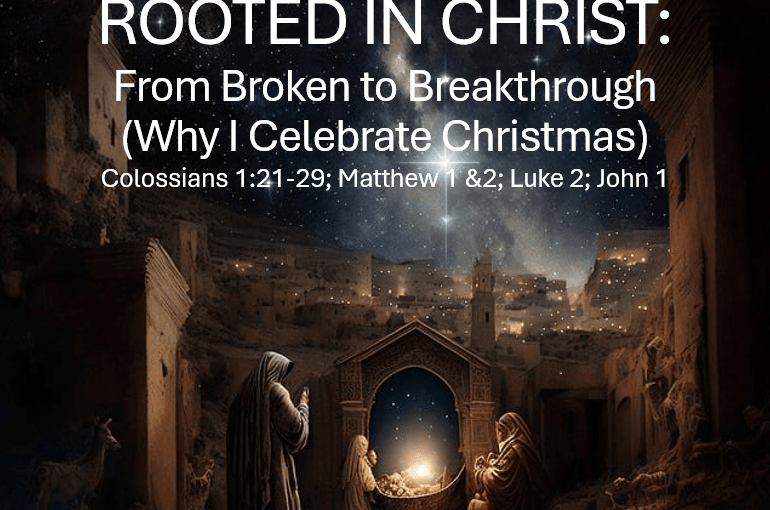
Rooted In Christ: From Broken to Breakthrough (Why I Still Believe in Christmas)

Luke 2:1–14; John 1:14; John 3:16; Matthew 1:21, Colossians 1:21-29

Every December the world celebrates Christmas – lights go up, songs fill the air, gifts are exchanged. But if we’re not careful, we can celebrate everything around Christmas and miss the reason for Christmas. Of course there are different opinions about Christmas. One argument is that Christmas is a Pagan Holiday, and for Christians to celebrate it, means that they have adopted Pagan practices. My first question here, “what is a Pagan?” In it’s original sense of the word, “Anybody that was not a semantic Hebrew Jew – meaning “Gentiles,” were Pagans. The sense being anyone that rejected God. Another argument is that Christmas is a man-made holiday, therefore it is not Scriptural. Well, in John 10, Jesus is in Jerusalem to celebrate the Feast of Dedication, what is now known as Hanukkah. This particular feast was not mentioned in the Torah, which is the Bible they had up to that point, so this was a celebration that was added by man, and Jesus didn’t have a problem celebrating this holiday. So, just because man may have made a holiday, does not instantly constitute it as a “pagan holiday,” or that it doesn’t honor God.

The biggest writing on Christmas being a Pagan holiday come from various camps, of which I am not. Truth is, for all the research you can find to say this is a pagan holiday, I can find just as much to support why it isn’t. But here is what I don’t won’t you to miss, I don’t believe for a minute that God would be opposed to the Christian Church setting aside one day a year to focus on the birth of His Only Begotten Son. I just can’t see God being angry or displeased because on this time of year: We open our Bibles and read the story of the birth of His Son; We sing hymns of praises to glorify His name; We lift up prayers of thanks for this great gift He has given us – and the truth is, I think that’s enough to make any Pagan squirm in the chairs.

Having said that, I also don’t believe God is honored when we get so wrapped up in giving and receiving gifts that we overlook the giving of the Greatest Gift. I don’t think God is honored when we run our families in debt to buy presents. Christmas is not about nostalgia, tradition, or sentimentality. Christmas is about God stepping into our broken world to give us a breakthrough!

So why do Christians celebrate Christmas? Because Christmas answers our greatest problem with God’s greatest solution.

CHRISTMAS CELEBRATES GOD COMING NEAR

Remember that between the Book of Malachi and the New Testament, there was 400 years of silence. No fresh word from God. Then after 400 years:

“And the Word became flesh and dwelt among us.” (John 1:14)

Paul said that through sin, we were “alienated and enemies in your mind by wicked works, yet now hath he reconciled.” (Colossians 1:21)

Christianity is unique because it proclaims that while you and I were alienated and enemies with God. Listen:

  • We were not neutral with God.
  • We were not undecided.
  • We were running full throttle away from God.
  • We were not a little dirty from sin – we were headed toward a cliff full throttle.

But God did not stay distant. He did not shout instructions from heaven. He came down. I’m glad that “God so loved the world that He gave his Only Begotten Son, that whosoever believes in him should not perish, but have everlasting life. For God sent not his Son into the world to condemn the world, but that the world – THROUGH HIM – might be saved!”

You are never too far gone, too broken, or too insignificant for God to come near to you.

CHRISTMAS DECLARES GOD’S LOVE IN ACTION

“For God so loved the world…” (John 3:16)


“You shall call His name Jesus, for He will save His people from their sins.” (Matthew 1:21)

“In the body of his flesh through death, to present you holy and unblameable and unreproveable in his sight:” (Colossians 1:22)

Christmas is not just about a baby – it’s about a mission. Jesus was born to die, and He died so we could live. He came so that you and I wouldn’t have a tune-up, but a full engine swap.

  • He didn’t come to clean-up our act, he came to drag us out of the darkness and into the Light.
  • He didn’t die to make us better – He died to make us new.
  • He came to unmake us so that he can Remake us.
  • He came so that this mortal could put on immortality.
  • He came so that this corruption could put on incorruption.
  • He came to take away out filthy stinking grave clothes to give us grace clothes!

He didn’t come to condemn the world, but to rescue it. The gift of Christmas is not earned by good behavior, or keeping some Law; it’s received by grace through faith. Grace is God’s gift before you ever deserved it.

CHRISTMAS PROCLIAMS PEACE FOR A BROKEN WORLD

Glory to God in the highest, and on earth peace, good will toward men.” (Luke 2:14)

To whom God would make known what is the riches of the glory of this mystery among the Gentiles; which is (and Paul drops this little nugget) Christ in you, the hope of glory:” (Colossians 1:27)

The angels didn’t promise peace through politics, prosperity, or power – They announced peace through a person, “Christ in you, the hope of Glory!”

  • That’s not religion.
  • That’s not church attendance.
  • That’s not wearing a Jesus patch on your vest.

That’s Jesus moving into the garage of your heart and taking over

  • It’s not Christ around you.
  • Not Christ beside you.
  • But Christ inside you.

Church, let me land this for a Christmas message: The same Jesus Paul talks about – Christ in you, the hope of glorydidn’t first show up with power tools in His hands or resurrection glory in His eyes:

  • He showed up small.
  • He showed up helpless.
  • He showed up in a borrowed barn – laid in a manger that smelled more like a biker’s garage than a church sanctuary.

What Christmas tells me is that God “Isn’t afraid of our mess.” Jesus didn’t wait for you to get polished, tuned up, or road ready. He stepped into the world the same way He steps into your life: Right in the middle of the dirt, the noise, the chaos, and the brokenness – THE WORD BECAME FLESH.

The manger wasn’t clean…Your heart wasn’t either. But He came anyway. Why? Because the hope Paul writes about, “Christ in you,” began right there in Bethlehem. Christmas is the proof that God reached future towards me than I could ever reach toward Him.

On that first Christmas night:

  • Heaven came down into humanity
  • Light invaded darkness
  • Hope climbed off the throne and laid down in straw
  • The King showed up undercover so every broken life could become brand new

Christmas isn’t just a cute story; it’s the opening scene of your rescue:

  • The baby in the manger is the Savior on the cross.
  • The Savior on the cross is the King who walked out of the tomb.
  • The King who walked out of the tomb is the One who now lives in you.

So this morning, don’t just admire the nativity…Invite the One in the manger to take the handlebars of your life.

Because Christmas means this:

  • You don’t have to stay ruined – He came to rebuild.
  • You don’t have to stay far – He came close.
  • You don’t have to ride alone – He came to ride with you.

This Christmas, don’t just celebrate that Christ came to the world, celebrate that He wants to live in you. Christ in you, the hope of glory.

CHRISTMAS CALLS FOR A RESPONSE

  • The wise men sought (Matthew 2:9-11)
  • The shepherds went and saw (Luke 2:8-14)
  • The angels worshiped (Luke 2:13)
  • Mary pondered (Luke 2:19)
  • Herod rejected (Matthew 2:12-18)
  • Paul proclaimed (Colossians 1:28) “Him we preach, warning every man and teaching every man…”

Everyone responded – but not everyone responded the same way. We’re not just a social club with loud pipes, we’re not just a Sunday pit stop or bar hop, we’re a garage for broken men and women.

WE ARE: Hope for the hopeless; Help for the Helpless; A Hospital for the hurting! And listen, that’s not always easy. In fact, Paul concludes Colossians 1 by saying he labors, he struggles. Look at verse 29, “Whereunto I also labour, striving according to his working, which worketh in me mightily.”

Where does that might come from? “Christ in you . . . the hope of Glory!

Christmas proclaims this unshakable truth: God didn’t send a message – He sent His Son. And folks, to me – that is worth celebrating.

Training Manual: Biker Church Small Groups

By: Pastor Joe “Mojo” Moore, Graduate Student, Liberty University Theological Seminary

Introduction

Developing small groups within a biker church is far more than a programmatic effort, it is a ministry shaped by biblical conviction, cultural awareness, and a passion for discipleship. Riders often carry heavy burdens, live fast-paced lives, and value authenticity above all else, making relational, Christ-centered groups essential for spiritual growth and community. A well-developed small group strategy provides the context where riders can experience brotherhood, accountability, and transformation, echoing Jesus’ own model of investing deeply in a small band of followers. By grounding the ministry in Scripture, establishing a clear and compelling vision, and shaping groups around the unique rhythms of biker culture, the church can create life-giving communities that reach the lost, disciple believers, and multiply leaders for the sake of the gospel.

Motivation for Developing Biker Church Small Groups

My motivation for developing biker church small groups flows from a desire to create a biblically grounded community where mentoring disciples can flourish, authentic relationships can grow, and bikers can be mobilized for mission. Jesus modeled this approach by forming a small circle of disciples and investing deeply in them (Mark 3:13–15, King James Version, 2001). In a biker church context, small groups provide a setting where men and women can move beyond surface-level faith and experience real spiritual growth through Scripture, accountability, and shared life. I am driven to see bikers find a place of belonging in Christian community, be shaped by God’s Word, and be equipped to reach other riders with the gospel. This motivation is not rooted primarily in reacting to crisis or meeting immediate needs, but in forming a vision-shaped ministry where conviction guides practice. As Dempsey and Earley caution, without clear, biblical direction, ministry leaders tend to drift rather than lead with intentionality, undermining both discipleship and mission.[1]

Goals and Dreams for Biker Church Small Groups

Dempsey and Earley state, “the potential of a man is measured by the goals he pursues.[2] In a biker-church context, the long-term vision for small groups is to cultivate a network of healthy, multiplying communities where riders experience spiritual growth through Scripture, prayer, fellowship, and mission.[3] These groups are designed to meet people where they are, often weary from life on the road, and guide them toward spiritual growth, helping participants mature in Christ through study, conversation, and application of God’s Word.[4] Creating authentic community is also essential in biker culture, which values brotherhood and belonging; small groups provide a safe environment where members can share life, support one another, and build meaningful, trusting relationships.[5]

Pastoral care also plays a vital role fulfilling these goals and dreams, ensuring that no one walks alone and empowering leaders to shepherd well in a context where life is often unpredictable and rugged.[6] Leadership development is equally critical, identifying, training, and releasing new leaders who can multiply groups and extend the reach of the gospel across the riding community.[7] As House states, “having a bigger picture of where you are going and what God wants for your church will allow you to adapt to acute needs while at the same time help you build more well-rounded community from the start.[8] The dream is that these groups will not remain inward-focused but will instead become vibrant hubs of discipleship, mission, and multiplication, spiritually open “garages” where lives are repaired, restored, and rebuilt, and where the life of Jesus is reproduced in others.[9]

Biblical Foundations for Biker Church Small Groups

            The biblical foundation for these groups is clear. Acts 2:42–47 shows that the early church devoted itself to teaching, fellowship, breaking bread, and in prayer, all practices that fit naturally within biker fellowship nights, garage groups, or meetups over food. Hebrews 10:24–25 highlights the importance of gathering regularly to encourage one another, something riders naturally do when they meet up before a ride or gather to work on bikes. Ephesians 4:11–16 teaches that every believer, no matter their background or rough edges, is gifted by God to contribute to the body’s growth. Additionally, Romans 12:4-8, shows that every believer has special gifts that are to be used in the context of the community. Passages like these demonstrate that discipleship is relational and that spiritual formation is strengthened when believers share life together.

Two Types of Groups Developed for Biker Church Small Groups

            Arnold and Dempsey & Earley describe several types of small groups that churches can use, and these categories adapt naturally to the relational culture of biker ministry.[10] In a biker church, the focus will be on two different groups. First, care groups, designed to provide a relational entry point where bikers experience biblical community, prayer, mutual support, and foundational engagement with Scripture. Rather than attempting deep, intensive discipleship, these groups emphasize belonging before becoming, creating a safe and consistent environment where riders can process life challenges, receive pastoral care, and begin forming spiritual habits. These groups align with Arnold’s emphasis on relational cells that integrate care, encouragement, and mission without overwhelming participants with overly technical spiritual expectations.[11]

The second type of group will be Disciple-Making Groups. Unlike the Care & Community Groups, these are intentionally designed for deeper spiritual formation and leadership development. These groups will consist of three to five committed riders who are ready to move beyond basic Bible discussion into intentional obedience, spiritual disciplines, accountability, and multiplication. These groups will initially be pastor-led and structured around a clear pathway of spiritual growth, aimed at producing disciple-makers rather than merely informed believers. This structure reflects Dempsey and Earley’s model of small, multiply focused discipleship groups that prioritize transformation, obedience, and leadership reproduction.[12]

In summary, by limiting the structure to two distinct group types, the ministry avoids confusion between care and discipleship while still honoring the biblical call to both community and spiritual maturation. Care Groups serve as the front door for relationship and spiritual stabilization, while Disciple-Making Groups function as the deep-rooted engine for transformation and multiplication. This clear distinction makes the pathway understandable for bikers entering the ministry and aligns with Arnold’s and Dempsey & Earley’s core principles of healthy, intentional small group ministry.

How to Lead Biker Church Small Groups

            Leading Disciple-Making Groups in a biker church context requires intentional spiritual direction, relational investment, and a clear focus on transformation rather than general care. These groups will not function as open-ended fellowship or support gatherings, but as structured environments focused on spiritual disciplines and obedient living. Meetings will follow a purposeful rhythm of prayer, in-depth Scripture engagement, spiritual accountability, and application aimed at measurable growth.[13] Unlike the Care Groups, the emphasis here will be on mentoring relationships, where leaders intentionally disciple members through personal guidance, regular spiritual check-ins, and modeled obedience to Christ.[14] A primary aim of these groups will be leadership multiplication through identifying, mentoring, and releasing emerging leaders who can form new disciple-making groups over time.[15] Elements of biker culture, such as shared rides and service-oriented outreach, will be used not as social activities but as practical training grounds for mission, spiritual leadership, and gospel-centered witness.[16] Through this model, the goal is to cultivate spiritually mature disciples who can actively lead others into transformation and Christ-centered living, rather than simply participating in community.[17]

The Plan to Grow and Develop Biker Church Small Group Ministry

Creating a thriving small group ministry in a biker church requires clear strategy, intentional investment, and Spirit-led guidance, all adapted to the relational culture of riders. The foundation begins with prayer.[18] Next, is to identify and equip leaders who grasp both discipleship principles and biker culture, clearly communicating the vision for small groups, and supplying curriculum, resources, and ongoing support designed to fit the unique rhythms and experiences of riders.[19] Groups should be launched intentionally, formed around life stage, existing riding relationships or club affiliations, or specific spiritual needs, promoted through fellowship events and rides, and made easy for new riders to join.[20]

Leaders are supported through regular gatherings, coaching, encouragement, prayer, and practical tools for teaching and conflict resolution, helping them shepherd their crews effectively.[21] Healthy group rhythms will be emphasized by engaging in the four essential practices of Word, prayer, community, mission, and worship, balancing deep fellowship with rides, outreach events, and service projects that connect with the biker lifestyle.[22] Multiplication is built into the system by identifying apprentices early, giving them opportunities to lead portions of meetings or rides, and preparing them to launch new groups within the riding community. By this, riders will learn to live on mission for God.[23] Integration with the larger church occurs as teaching aligns with discipleship goals, life-change stories from rides and fellowship are highlighted, and small groups become central, not optional, to spiritual formation in the church.

Ongoing evaluation in the biker church small group ministry will involve regularly gathering feedback from riders, monitoring leader and group health, addressing challenges early, and celebrating spiritual and relational growth both “on the road” and in everyday life. Rather than launching multiple group types at once, the ministry will begin with one or two core group models and will expand gradually as leaders mature, riders develop spiritually, and the church gains clarity about its needs and capacity. This phased approach reflects best practices in healthy ministry development, emphasizing prayerful discernment, leadership coaching, and sustainable growth rather than rapid structural expansion.[24] Growth will be guided by biblical vision, consistent support, and Spirit-led multiplication, allowing the ministry to develop organically.[25] Over time, this process will cultivate communities where riders experience authentic spiritual transformation, biblical accountability, and a mission-focused lifestyle that spreads the gospel through relationships, shared rides, and outreach.[26]

How to Develop Small Group Leaders (Biker Church Context)

Joel Comiskey states, “sorting out our biblical values will lead us to principles and conducts that glorify God and His ways.”[27] Small group leaders in a biker church are not simply facilitators; they are spiritual road captains who help guide riders into deeper discipleship. Leadership begins as a spiritual calling, not a technique or personality trait. Every leader is an essential part of the disciple-making mission and must be trained in a way that is prayerful, intentional, and rooted in relationships built on trust and respect.[28] Leader do not “have the salt,” they are the salt.[29]

Leaders are trained to pray daily for every rider in their group, recognizing that only God can change hearts, heal past wounds, and produce lasting spiritual growth.[30] In a culture shaped by brotherhood, loyalty, and shared stories, prayer becomes the fuel that keeps the group moving forward, especially during difficult seasons. Training must combine vision and hands-on practice. Prospective leaders should ride alongside experienced leaders through an apprentice model, learning how to listen well, shepherd conversations, and care for the spiritual health of the group before they ever lead their own.[31] Leaders are also trained to recognize the normal stages of group life, including seasons of unity, tension, growth, and transition, so they are not shaken by conflict but can guide their group through it with steady leadership.[32]

To guard against burnout, common in high-relational ministries like biker churches, leaders must be supported through ongoing coaching, accountability, and continuing development. Regular mentoring check-ins, leadership gatherings, and access to training resources are essential for keeping leaders spiritually strong and mission focused. Churches that consistently retrain and invest in their leaders experience healthier groups and more sustainable ministry impact.[33]

Leading a Biker Church Small Group

A Biker Church small group leader serves as a ride captain, not a preacher. The leader’s primary role is to guide the conversation, create a safe brotherhood/sisterhood environment, and help riders discover biblical truth together rather than delivering a one-way talk. The goal is to build trust, accountability, and spiritual depth through shared discussion, prayer, and life-on-life discipleship.[34]

Leaders must come prepared by spending time in personal prayer and careful study of the Bible passage or lesson before every meeting.[35] Preparation is not about having all the answers, but about being ready to guide riders toward discovering truth for themselves. A prepared leader gives confidence, direction, and spiritual stability to the group.

Meetings should start and end on time to show respect for riders’ schedules and responsibilities. The environment should invite open discussion rather than preaching. Every member should be encouraged to participate, but no one should be forced to speak. Silence should be seen as thinking time, not failure, and leaders should never answer their own questions because that shuts down group participation.[36]

Leaders are also responsible for practical logistics that create a welcoming space: ensuring the meeting location is comfortable, chairs are arranged for easy interaction, refreshments are available, and the atmosphere is relaxed and respectful. These details may seem small, but they communicate care and build trust within the group.[37] A strong Biker Church leader understands that every group moves through predictable stages of life: honeymoon (early excitement), conflict (tension and testing), community (deep trust and unity), and closure (season of transition or multiplication). Leaders must recognize these stages and guide the group wisely through each one without fear or avoidance.[38]

How to Grow Biker Church Small Groups

Growth in a Biker Church small group is twofold: spiritual maturity and numerical expansion. A healthy group is not measured solely by the number of riders in the room, but by the transformation of hearts and lives. Spiritual growth is evident when group members exhibit Christlike character, love, joy, peace, patience, gentleness, and faithfulness, both on the road and in everyday life.[39]

Numerical growth reflects the group’s outward health and evangelistic focus. A small group that is thriving spiritually will naturally attract others, but growth must be intentional. Groups stagnate when Bible study becomes purely academic or disconnected from real-life application. In a biker context, this means lessons should be applied to relational and mission-oriented situations; rides, outreach events, and serving the wider community.[40]

Leaders must cast vision regularly, modeling Christlike living and encouraging members to invite friends, family, and fellow riders into the group. Growth is also nurtured by shared leadership, relational investment, and creating opportunities for each member to contribute in meaningful ways; prayer, hosting, discussion facilitation, or outreach coordination.[41] Without a clear plan and intentional effort, groups will stagnate, lose momentum, and eventually decline. Healthy growth requires that leaders balance care for the group’s spiritual depth with outreach and evangelistic engagement, ensuring that the group remains vibrant, mission-focused, and transformational for all involved.[42]

How to Multiply Biker Church Small Groups

Joel Comiskey states, “Transformation takes place in a small group atmosphere.”[43] Multiplication is the natural outcome of a healthy Biker Church small group; it is not a program imposed from above. When a group grows beyond 12 – 15 riders, relational intimacy and meaningful discussion can decline, making multiplication essential to maintain both spiritual depth and relational connection.[44] According to Dempsey and Earley, small groups move through predictable stages: formation, exploration, execution, preparation, and multiplication.[45] In a healthy Biker Church group, multiplication typically occurs between 12 and 18 months, after the group has established strong spiritual habits and formed lasting relational bonds.[46]

Leaders should identify potential apprentice leaders early and provide hands-on mentoring. Responsibilities should be gradually released, allowing future leaders to gain confidence and skills while the original leader transitions into a coaching and prayer-support role. This is where small groups must shift from “attracting and gathering to developing and releasing.”[47] Multiplication can bring emotional tension, as members may resist change, but the spiritual fruit of new, vibrant groups far outweighs temporary discomfort.[48] Groups that fail to multiply within two years often enter a distortion stage, losing momentum, vision, and spiritual vitality. Effective Biker Church leaders view multiplication not as division, but as spiritual reproduction, expanding the group’s influence on more riders and communities.[49]

How to Develop and Transition to Biker Church Small Groups

Transitioning a Biker Church toward a small group model begins with spiritual vision and biblical alignment. Churches must decide whether they will be a church with groups, of groups, or a church that is groups. Senior leadership must model active participation, since disciple-making is central to pastoral responsibility. Structures should reflect the church’s culture while remaining anchored in biblical priorities of evangelism, discipleship, and mission.[50] Effective transitions include several key elements:

  • Formal leadership training before launching groups – Leaders must be equipped to facilitate spiritual growth and relational health in their groups.[51]
  • Strategic launch seasons – Timing group launches around seasonal rhythms (often in the fall) helps maximize participation and momentum.[52]
  • Ongoing retraining and coaching – Continuous support prevents burnout and ensures leaders grow in skill and confidence.[53]
  • Strong communication systems – Clear channels for sharing vision, announcements, and resources keep groups aligned with the church’s mission.[54]
  • Coaching structures – Tiered leadership models provide mentoring and accountability across multiple levels of group leadership.[55]
  • A deep culture of prayer – Prayer undergirds every multiplying group, sustaining spiritual vitality and discernment.[56]

Dempsey and Earley state “the church must be intentional in developing all of God’s children to reach their full potential.”[57] When Biker Churches prioritize disciple-making, they experience the promised presence and power of Christ in their ministry. This intentional focus transforms groups into communities of spiritual growth, relational support, and mission engagement.[58]

Conclusion

Developing small groups in a Biker Church is a strategic and Spirit-led ministry that integrates biblical truth, relational investment, and cultural awareness. When thoughtfully implemented, small groups provide riders with authentic community, discipleship, and opportunities for spiritual growth, accountability, and mission engagement. By clearly distinguishing Care Groups from Disciple-Making Groups, equipping and mentoring leaders, and building intentional rhythms of prayer, study, fellowship, and outreach, the church cultivates vibrant communities that reproduce spiritually mature disciples. Multiplication becomes the natural result of healthy groups, expanding the church’s influence and providing more riders with a place to belong, grow, and serve. Ultimately, small groups in a Biker Church are not merely gatherings, they are life-giving environments where Christ-centered transformation takes root, leadership is multiplied, and the gospel spreads through relationships, rides, and mission-focused engagement.


[1] Rod Dempsey and Dave Earley, Leading Healthy, Growing, Multiplying Small Groups (Wordsearch,

2018), 111.

[2]  Ibid., 117.

[3] Ibid., 111.

[4] Ibid., 112.

[5] Ibid., 117.

[6] House, Community, 58.

[7] Dempsey and Earley, Leading Healthy, Growing, Multiplying Small Groups, 114-115.

[8] House, Community, 89.

[9] Dempsey and Earley, Leading Healthy, Growing, Multiplying Small Groups, 137.

[10] Gary L. Arnold, The Big Book on Small Groups (Grand Rapids: Baker, 2008), 76–80; Dempsey and Early, Leading Healthy, Growing, Multiplying Small Groups, 90.

[11] Ibid., 76-77.

[12] Arnold, The Big Book on Small Groups, 76-77.

[13] Ibid., 67-68.

[14] Dempsey and Earley, Leading Healthy, Growing, Multiplying Small Groups, 114-115.

[15] Arnold, The Big Book, 76-77.

[16] Rod Dempsey and Dave Earley, Spiritual Formation Is . . .: How to Live in Jesus with Passion and Confidence (Brentwood, TN: B&H Academic, 2018), 86–87.

[17] House, Community, 45–47.

[18] Dempsey and Earley, Leading Healthy, Growing, Multiplying Small Groups, 119-121.

[19] House, Community, 147-149.

[20] Dempsey and Earley, Leading Healthy, Growing, Multiplying Small Groups, 90–92.

[21] Arnold, The Big Book on Small Groups, 76–77.

[22] Ibid., 80.

[23] House, Community, 174-175.

[24] Dempsey and Earley, Leading Healthy, Growing, Multiplying Small Groups, 94–96.

[25] Arnold, The Big Book, 120–122.

[26] House, Community, 88–90.

[27] Joel Comiskey, Biblical Values and Time-tested Principles, (JCG, 2011). https://jcgresources.com/2011/09/19/biblical-values-and-time-tested-principles-2/

[28] Arnold, The Big Book, 230.

[29] Dietrich Bonhoeffer, Discipleship, (Minneapolis, MN: Fortress Press, 2003), 96.

[30] Ibid., 231.

[31] Arnold, The Big Book, 250.

[32] Dempsey and Earley, Leading Healthy, Growing, Multiplying Small Groups, 173–174.

[33] Ibid., 183.

[34] Arnold, The Big Book, 232.

[35] Arnold, The Big Book, 232-233.

[36] Ibid., 233-235.

[37] Ibid., 231.

[38] Ibid., 231-232.

[39] Dempsey and Earley, Leading Healthy, Growing, Multiplying Small Groups, 176.

[40] Ibid., 176-177.

[41] Ibid., 178.

[42] Dempsey and Earley, Leading Healthy, Growing, Multiplying Small Groups, 179-180.

[43] Joel Comiskey, Why Cell Multiplication is Necessary, (JCG, 2010).  https://jcgresources.com/2010/11/07/why-cell-multiplication-is-necessary/

[44] Dempsey and Earley, Leading Healthy, Growing, Multiplying Small Groups, 180.

[45] Ibid., 181.

[46] Ibid., 182.

[47] Jim Putmand and Bobby Harrington. DiscipleShift: Five Steps that Help Your Church to Make Disciples Who Make Disciples, (Grand Rapids, MI: Zondervan, 2013). 202.

[48]Dempsey and Earley, Leading Healthy, Growing, Multiplying, Small Groups, 183.

[49] Ibid., 184. 

[50] Ibid., 181.

[51] Ibid., 182.

[52] Ibid., 183.

[53] Ibid., 183.

[54] Dempsey and Earley, Leading Healthy, Growing, Multiplying, Small Groups, 184. 

[55] Ibid., 184-185.

[56] Ibid., 185.

[57] Rod Dempsey and Dave Earley, Disciple Making Is: How to Live the Great Commission with Passions and Confidence, (Brentwood, TN: B&H Publishing, 2013). 41.

[58] Dempsey and Earley, Leading Healthy, Growing, Multiplying, Small Groups, 185. 

Bibliography

Arnold, Jeffrey. The Big Book on Small Groups (Revised Edition) (InterVarsity Press, 2017).

Bonhoeffer, Dietrich. Discipleship. Minneapolis, MN: Fortress Press, 2003, 96.

Comiskey, Joel. Biblical Foundations for the Cell-Based Church. Moreno Valley, CA: CCS Publishing, 2012.

Comiskey, Joel. Biblical Values and Time-tested Principles. JCG, 2011. https://jcgresources.com/2011/09/19/biblical-values-and-time-tested-principles-2/

Comiskey, Joel. Why Cell Multiplication is Necessary. JCG, 2010.  https://jcgresources.com/2010/11/07/why-cell-multiplication-is-necessary/

Dempsey, Rod and Earley, Dave. Disciple Making Is: How to Live the Great Commission with Passions and Confidence. Brentwood, TN: B&H Publishing, 2013, 41.

Dempsey, Rod and Earley, Dave. Leading Healthy, Growing, Multiplying Small Groups. Lynchburg, Va. Liberty University Press, 2016.

Dempsey, Rod and Earley, Dave. Spiritual Formation Is . . .: How to in Jesus with Passion and Confidence. Brentwood: B&H Academics, 2018.

House, Brad. Community: Taking Your Small Group off Life Support. Wheaton, IL: Crossway, 2011.

Putman, Jim and Harrington, Bobby. DiscipleShift: Five Steps that Help Your Church to Make Disciples Who Make Disciples. Grand Rapids, MI: Zondervan, 2013, 202.

Evangelistic Principles for Rural Church Growth

By: Pastor Joe Moore, Graduate Student, Liberty University Theological Seminary

Introduction

In Matthew’s Gospel, as Jesus went about preaching, teaching, and healing, He saw a great multitude of people lost as sheep with no shepherd. In response to that need, He said to His disciples, “The harvest truly is plenteous, but the labourers are few; Pray ye therefore the Lord of harvest, that he will send forth labourers into his harvest.”[1] That brings up the question, “What were these laborers to do?” Jesus answered that question with a command given in Mark 16:15 to, “Go ye into all the world, and preach the gospel to every creature.”[2]

The word “gospel” is taken from the Greek word euangelion (εὐαγγέλιον), meaning “good news,” and its verb euangelizō (εὐαγγελίζω), translated “proclaiming the good news.”[3] Simply put, this is the act of sharing who Jesus is, what He has done, and how people can respond through faith and repentance and follow Him. This principle of proclaiming the “good news” is applicable to all churches, whether in a metropolitan or rural settings. In fact, Coetzee, et. al. (2023) stated evangelism is “the heart and center of the churches’ mission.”[4] Accomplishing this mission of evangelism requires practical preparation, perseverance amid obstacles, proficient presentation, and purposeful post-evangelism partnerships that promotes making disciples.

Practical Preparation

                According to Vine, Unger, and White (1996), the Greek word for preparation is hetoimasia (ἑτοιμασία) meaning, “the state of being prepared or the act of preparing.”[5] Paul gives an example of this in Ephesians 6:15 by stating that we are to have our “. . . feet shod with the preparation of the gospel of peace.”[6] Peter states that we are to “. . . be ready always to give an answer to every man that asketh you a reason of the hope that is in you with meekness and fear.”[7] Being prepared means to be ready and equipped – mentally, physically, emotionally, and spiritually.

Keep the Main Thing the Main Thing

One way of being prepared is to remember to keep the message simple and focused. When sharing the gospel message, it is vital to stay on subject. The gospel is for everyone, regardless of their background, beliefs or religious affiliation. McGever and Senkbeil (2023) said:

The content of the good news is the word of God. The word of God is not the word of “me,” it is not the word of “you,” it is not the word of “our church,” it is not the word of “self-improvement.” The word of God is preeminently the word of the good news of Jesus Christ. There are endless temptations to make the news of evangelism a message that will point people in the wrong destination.[8]

The simple gospel message is For whosoever shall call upon the name of the Lord shall be saved.”[9] McGever and Senkbeil (2023) further state:

The only cornerstone worth building our proclamation of the good news upon is Jesus Christ. When Jesus Christ is the leading character in a salvation testimony, I have a sense that person is on firm ground, heading in the right direction, and the messenger, the evangelist, thank God, acted with great wisdom when delivering the message.[10]

Staying focused on the good news of Jesus Christ is the only way to keep the message simple and on track.

Go Praying and Believing that God will use You

To effectively evangelize the lost, one must spend time in prayer. According to Mark Dever (2007), those evangelizing should pray asking God to not only open the door to opportunities, but to also open their eyes to see those opportunities.[11] This could possibly be the intent of John 4:35, when Jesus said to His disciples, “Say not ye ‘there are yet four months then cometh the harvest?’ Behold, I say unto you, lift up your eyes and look on the fields, for they are white already to harvest.” Dever (2007) goes on to further state that sometimes opportunities are missed because of apathy and a blindness to see the opportunities God has given.[12]

Witnesses should also go praying and expecting the Holy Spirit to go before them to work in the hearts of those to be witnessed to. Dever (2007) states, “If the Bible teaches us that salvation is the work of God, then surely, we should ask Him to work among those we evangelize. ”[13] Jesus said in John 6:44 “No man can come to me, except the Father which hath sent me draw him: and I will raise him up at the last day.”[14] Dever (2007) concludes by stating, “If this is God’s work, we should ask Him to do it.”[15]

By keeping the message simple and focused, and going believing and praying that God will use them personally, witnesses can go in the power of the Holy Spirit. Afterall, it is God that will affect change in the hearts of those who are called unto salvation.

Perseverance Amid Obstacles

Though a vibrant evangelistic program is exciting and empowering, it is not with obstacles and complications. Due to the very nature of evangelism, Satan will do everything within his power to disrupt those efforts. Sometimes these obstacles are internal, and sometimes they are external.

Internal Obstacles

Internal obstacles are those which come from within those evangelizing. These internal obstacles mostly stem from fear but can also come from arrogance. Fears of failure, ability, rejection, and even ridicule have caused many to be apathetic toward evangelism. It is important to remember the promises found in Scriptures. II Timothy 1:7 says, “For God hath not given us the spirit of fear, but of power and of love and of a sound mind.”[16] In Acts 1:8, Jesus said, “But ye shall receive power, after that the Holy Ghost is come upon you: and ye shall be witnesses unto me both in Jerusalem, and in all Judaea, and in Samaria, and unto the uttermost part of the earth.”[17] Another internal obstacle is that of arrogance. To this point, McGever and Senkbeil (2023) asserts:

I am embarrassed and ashamed that, for me, evangelism can be a self-serving activity. It can also be a self-defeating activity. Let me explain this a bit. For whatever reason, I’m competitive. In sports, I strive to win and improve. In school and academics, I alwaysstrove to get 100 percent. I have thought a lot about my competitive and determined nature and have concluded that it is morally neutral – it is just a feature of how I think and work. The part that gets me in trouble is when my competitive nature interacts with my heart, my self-worth, my interactions with others, and with the Lord. This is why evangelism can be a dangerous task for me. When I think about my impulse to evangelize others, my motivation exists somewhere in the overlap of my thankfulness to the Lord for saving me, my obedience to God’s word to preach the gospel, and my competitive desire to “win” souls. It is the last part that is most dangerous for me because it could be morally neutral, or even noble in some way, but my impulse to evangelize requires a confession that I do it sometimes for selfish purposes:[18]

The mission of the evangelist is simply to deliver the good news of Jesus Christ.[19] There is no room for fear or arrogance. The good news shared is not the message of the messenger: it is a message from God, delivered through the power of the Holy Spirit. Doubt in the uniqueness of the message can sabotage evangelistic efforts. Dever’s (2007) said, “our fear should not be directed toward man, but toward God. When we don’t share the gospel, we are essentially refusing to live in the fear of the Lord.”[20]

External Obstacles

                External obstacles to evangelism are challenges from outside of the individual and churches that seek to share the good news of Jesus Christ. These are real challenges that can both hinder and discourage evangelistic efforts. One such obstacle is that of Culturalism. Modern American Culture tends to view all religions through the same lens, which hinders the uniqueness of the message of Christ. This has led to other obstacles like sharing faith in school, workspaces, or even in public spaces. Regarding workspaces, Devers (2007) states:

“. . . many of us have jobs for which employers are paying us to get a certain amount of work done, and they have a legitimate expectation. During those work hours, it may be that our evangelism distracts people, or reduces our productivity, or does other things that can cause our employer valid concerns. We certainly don’t want the sharing of the gospel to bring us or the gospel into dispute for any reason other than a disagreement with the message itself. We understand that everyone is, by nature, at enmity with God; but we simply don’t want to give people other reasons to oppose our evangel. We don’t want our evangelism to stand in the way of the evangel – the good news.[21]

Another obstacle to evangelism is that of misunderstanding or misrepresentation of the gospel. This is particularly true in rural communities that are steeped in tradition – some good and some not so good. There are countless people in rural communities that will not receive the good news because they themselves were hurt by a Christian “down yonder at that church,” or someone in the sphere of influence was. It is important to remember, as Dever (2007) says, “God may save anyone. And the more unlikely it appears, the more glory, we might even reason, he gets to himself when it happens.”[22]

Proficient Presentation of the Gospel

                One study regarding preparation describes “5 Ps” as Prior Planning Prevents Poor Performance.[23] Following these principles will help in developing a clear presentation of the Gospel. Being prepared not only helps the one who is evangelizing but will also make it easier for the receiver. Being able to articulate the message in an understandable way is crucial. This can be accomplished by organizing your message in a simple, understandable way. Presenting the message in the Book of Romans is one way of presenting a clear, organized message. In preparing for a presentation, be prepared with additional verses that will address issues that may arise.

Stay in One Book for Simplicity – for You and for Them

                Perhaps the most well-known and used section of the Bible for soul-winning is found in the Book of Romans, partly because this enables the user to stay within one book of the Bible without causing confusion for the witness or those being witnessed to.  By outlining a “map” in their Bible, witnesses can easily and quickly share their message with those they are witnessing to.

Have a Presentation Planned and Rehearsed

Mark Devers (2007) states “Referring to a clear teaching of the Bible shows our friends that we are not simply giving them our own private ideas; rather, we are presenting Jesus Christ in his own life and teaching.”[24] Romans Road in an excellent example of presenting a clear presentation of the gospel message. This will provide an opportunity to plant in the minds of those witnessed to that all have sinned. Romans 3:23 says, “For all have sinned and come short of the Glory of God.”[25] Knowing that all have sinned brings with it the realization the need for a Savior.

Some may ask, “Why am I guilty of sin?” Because according to Romans 5:12, the Bible says, “Wherefore, as by one man sin entered into the world, and death by sin; and so death passed upon all men, for that all have sinned:”[26] Man was created in the image of God, but through the sin in the Garden of Eden, man marred that image, and that sin has passed to all through all.

Realizing that all are guilty of sin, one must also realize there is a penalty for sin. Romans 6:23says, “For the wages of sin is death, but the gift of God is eternal life through Jesus Christ our Lord.”[27] There are consequences for sin, and all are hopeless without the shed blood of Jesus Christ. 

Even though all have sinned, God commended His love toward the world. Romans 5:8says, “But God commendeth His love toward us, in that, while we were yet sinners, Christ died for us.”[28] Even though no one is worthy of God’s saving Grace, He sent His only Begotten Son to die for all. That is love! But thank God He wouldn’t diagnose a problem without giving a solution – there is salvation for those who believe. Romans 10:9states “That if thou shalt confess with thy mouth the Lord Jesus, and shalt believe in thine heart that God hath raised him from the dead, thou shalt be saved.”[29] If sinners will confess and believe, He will forgive!

Additional Verses to Address Issues

The Book of Romans is not the only place that one can find verses dealing with salvation.  The Bible is filled with verses because it is ultimately a Book about a Person – the Lord Jesus Christ. The following verses are by no means exhaustive but are given to assist the witnesses of Christ in sharing the good news. Some of these verses give assurance of salvation, while others will address issues that may arise.

Assurance of salvation is the promise that He will forgive all who will come. John 6:37 says, “All that the Father giveth me shall come to me; and him that cometh to me I will in no wise cast out.”[30] Assurance also comes by following God’s process. John 5:24 says, “Verily, verily, I say unto you, He that heareth my word, and believeth on him that sent me, hath everlasting life, and shall not come into condemnation; but is passed from death unto life.”[31]

Assurance also comes from growing in knowledge. I John 5:13 states, “These things have I written unto you that believe on the name of the Son of God; that ye may know that ye have eternal life, and that ye may believe on the name of the Son of God.”[32]

One common excuse often heard is, “God cannot forgive a person of their sin. According to I John 1:9, “If we confess our sins, he is faithful and just to forgive us our sins, and to cleanse us from all unrighteousness.”[33] Another common excuse is that a person has too much sin in their life. Romans 5:20 says, “Moreover the law entered, that the offence might abound. But where sin abounded, grace did much more abound:”[34]

Proactive Post-Evangelistic Partnership Which Promotes Making Disciples

There are two schools of thought regarding evangelism and discipleship. One study argues that both have separate identities with one beginning where the other ends. Evangelism leads one to faith in Christ, where discipleship takes over from there in developing follow-up ministry.[35] The same study shows the other side of the coin by stating, “. . . evangelism and discipleship are seen as inseparable and even indistinguishable from each other. Evangelism is discipleship or faith-sharing in a relationship of trust, so even if one could distinguish between evangelism and discipleship, they are so interwoven that they cannot be separated.[36] Additionally, although evangelism and discipleship can be differentiated, they are linked and intertwined.[37]

Christians are called to live lives within their communities. As they are discipled, or becoming more Christ-like, their walk becomes a greater testimony to that community and more effective their evangelistic efforts. A missionary was once asked what he did. His response was, “I’m living my life on mission.” That is in essence what believers of Christ are to do. Regarding missional evangelism, Coetzee said, “From the quantitative research, it seems that church members are seen as disciples (people following Jesus) and that evangelism is an invitation to follow Jesus. The critical connection between discipleship and evangelism can, however, be better understood if disciples are seen as people who share their faith spontaneously – as disciple-making disciples (missional discipleship).”[38]

Conclusion

Peter White (2023) says, “The central idea of the gospel is the expression of the love of God towards humankind despite our limitations, sinful nature and diversity in options.”[39] The purpose of evangelism is to passionately proclaim that life-changing message, fulfilling the biblical mandate to reach people wherever they are on their spiritual journey. This mission requires practical preparation, perseverance amid obstacles, proficient presentation, and purposeful post-evangelism partnership which promotes making disciples.

Bibliography

McGever, Sean, and Harold L Senkbeil. Evangelism: For the Care of Souls. 1st ed.

Bellingham: Faithlife Corporation, 2023.

Dever, Mark. The Gospel and Personal Evangelism . Wheaton: Good News Publishers, 2007.

Coetzee, Frederik R. L., Malan Nel, and Johannes J. Knoetze. Evangelism as an Invitation to

Missional Discipleship in the Kingdom of God. Verbum Et Ecclesia 44, no. 1 (2023), https://go.openathens.net/redirector/liberty.edu?url=https://www.proquest.com/scholarly-journals/evangelism-as-invitation-missional-discipleship/docview/2787811484/se-2.

W.E. Vine, Merrill F. Unger, William White, Jr., Vine’s Complete Expository Dictionary of Old and New Testament Words, (Nashville, Tn., Thomas Nelson, Inc., 1996), 483.

White, Peter. Proclaiming the Gospel in an Interfaith Environment: Missiological and

Ecumenical Approach.Hervormde Teologiese Studies, vol. 79, no. 2, 2023. ProQuest

Central, https://go.openathens.net/redirector/liberty.edu?url=https://www.proquest.com/scholarly-journals/proclaiming-gospel-interfaith-environment/docview/2902822371/se-2, doi:https://doi.org/10.4102/hts.v79i2.9024.

https://www.strategyexe.com/podcast/prior-planning-prevents-poor-performance

King James Bible (1982). Cambridge University Press (Matthew 9:35-38; Mark 16:15; John

5:24; 6:37, 44; Acts 1:8; Romans 3:23; 5:8, 20; 6:23; 10:9; Ephesians 6:15; II Timothy 1:7; I Peter 3:15; John 1:9)


[1] King James Bible (1982). Cambridge University Press (Matthew 9:35-38).

[2] KJV, Mark 16:15.

[3] W.E. Vine, Merrill F. Unger, William White, Jr. Vine’s Complete Expository Dictionary of Old and New Testament Words, (Nashville, Tn., Thomas Nelson, Inc., 1996), 208.

[4] Frederik R. L. Coetzee, Malan Nel, and Johannes J. Knoetze. Evangelism as an Invitation to Missional Discipleship in the Kingdom of God. Verbum Et Ecclesia 44, no. 1 (2023), https://go.openathens.net/redirector/liberty.edu?url=https://www.proquest.com/scholarly-journals/evangelism-as-invitation-missional-discipleship/docview/2787811484/se-2.

[5] Vine, et. al. Vine’s Complete Expository Dictionary of Old and New Testament Words, 483.

[6] KJV, Ephesians 6:15.

[7] KJV, I Peter 3:15.

[8] Sean McGever and Harold L Senkbeil. Evangelism: For the Care of Souls. 1st ed.

Bellingham: Faithlife Corporation (2023). 56.

[9] KJV, Romans 10:13.

[10]McGever and Senkbeil. Evangelism: For the Care of Souls, 57.

[11] Mark Dever. The Gospel and Personal Evangelism. Wheaton: Good News Publishers (2007). 26.

[12] Ibid., 27.

[13]Ibid., 60.

[14] KJV, John 6:44.

[15]  Dever. The Gospel and Personal Evangelism, 60.

[16] KJV, II Timothy 1:7.

[17] KJV, Acts 1:8.

[18] McGever and Senkbeil. Evangelism: For the Care of Souls, 20.

[19] Ibid., 56.

[20] Dever. The Gospel and Personal Evangelism, 27.

[21]Dever. The Gospel and Personal Evangelism, 21. 

[22] Ibid., 23.

[23] https://www.strategyexe.com/podcast/prior-planning-prevents-poor-performance

[24] Dever. The Gospel and Personal Evangelism, 62. 

[25] KJV, Romans 3:23

[26] KJV, Romans 5:12.

[27] KJV, Romans 6:23.

[28] KJV, Romans 5:8.

[29] KJV, Romans 10:9

[30] KJV, John 6:37.

[31] KJV, John 5:24.

[32] KJV, I John 5:13

[33] KJV, I John 1:9

[34] KJV, Romans 5:20.

[35] Coetzee, et. al. Evangelism as an Invitation to Missional Discipleship in the Kingdom of God, 2.

[36] Ibid., 1.

[37] Ibid., 2.

[38]Coetzee, et. al. Evangelism as an Invitation to Missional Discipleship in the Kingdom of God, 2.

[39] Peter White. Proclaiming the Gospel in an Interfaith Environment: Missiological and Ecumenical Approach. Hervormde Teologiese Studies, vol. 79, no. 2, 2023. ProQuest Central, https://go.openathens.net/redirector/liberty.edu?url=https://www.proquest.com/scholarly-journals/proclaiming-gospel-interfaith-environment/docview/2902822371/se-2, doi:https://doi.org/10.4102/hts.v79i2.9024.

Who Is This Jesus?

We are continuing this study in the Book of Colossians under the title “Rooted in Christ.” The first two weeks we learned that Paul, who is in prison at the time, is writing to this church that he hasn’t met, a people that he doesn’t know, but he hears of their faith from Epaphras. And though Paul does not know them, and though he has never met them – he is spending time in prison, in the midst of hardship, in the midst of suffering, he is praying for them. Paul is writing to let them know that they are prayed for. And so we were challenged to have, not deep and deep relationship, but deep and wide relationship.

I believe the prayer that Paul prayed for this group of people was a model prayer for you and I today. In fact, if you want to pray a prayer for me, I hope that you will pray, “Father, let my pastor be filled with knowledge, with all wisdom and spiritual understanding. Father give him the strength to walk worthy of the Lord and to be fruitful in all he does. Let him daily increase in knowledge. Lord, strengthen him with your power and give him patience and longsuffering. Help him to be thankful that he is a partaker of the inheritance. And to never forget that he is a part of that ole blood bought crowd!”

Listen, that’s the prayer I want you to pray for me and that is the prayer I am praying for you.

Now, the message beginning in verse 15 is going to become perhap some of the greatest Christological verses in all the Bible concerning the Sufficiency and the Supremacy of Christ.

One commentator said, “This passage, the most famous in the letter, is one of the Christological high points of the New Testament and provides a critical basis for the teaching of the letter.”

Biblical Scholar, N.T. Wright said, “The next 6 verses of the letter are generally, and rightly, reckoned among the most important Christological passages in the New Testament.”

I’m gonna ask you to do something different with me this morning, I’m going to ask you to stand with me as we read these verses. Colossians 1:15-20:

While Paul is thanking God for this church at Colossi, and as he is praying for them, he is reminded of who God. And in the midst of thinking about who God is, BOOM – we get these 6 verses talking about who Christ is. Pick up with me in verse 15:

15 Who is the image of the invisible God, the firstborn of every creature: 16 For by him were all things created, that are in heaven, and that are in earth, visible and invisible, whether they be thrones, or dominions, or principalities, or powers: all things were created by him, and for him: 17 And he is before all things, and by him all things consist. 18 And he is the head of the body, the church: who is the beginning, the firstborn from the dead; that in all things he might have the preeminence. 19 For it pleased the Father that in him should all fulness dwell; 20 And, having made peace through the blood of his cross, by him to reconcile all things unto himself; by him, I say, whether they be things in earth, or things in heaven.” The title of the message this morning is WHO IS THIS JESUS? Let’s Pray.

The first Century church, if you will remember is made up of both converted Jews, stuck in the Law, and Gentiles, who had many gods, both with different views of who Christ is. Gnosticism was a real problem that creeped into every one of the churches established in the New Testament, with varying views of just who Jesus is. Whether Jesus was born a man who became God or God who became man was at the heart of the issue.

Every generation of believers must answer the same question: Who is This Jesus? Not who do we want Him to be, or who our culture imagines Him to be, but who God’s Word reveals Him to be. In Colossians 1:15–20, Paul pulls back the curtain and gives one of the most breathtaking descriptions of Jesus Christ found anywhere in Scripture. Writing to a young church threatened by false teaching that reduced Jesus to a spiritual helper or one among many divine beings, Paul responds with a hymn-like declaration exalting Christ as Supreme over revelation, supreme over creation, supreme over the church, and supreme in salvation. These verses remind us that Jesus is not a part of our lives , but He is the center.

CHRIST SUPREME IN REVELATION (v. 15)

He is the image of the invisible God, the firstborn of all creation.”

Paul begins with a staggering statement: Jesus makes the invisible God visible. He is the image (Greek: eikōn), the exact representation, the perfect manifestation, of God Himself. Some people would call the object I’m holding in my hand a phone – I would call it a lot of things, but a phone is not one of them. I would call it a Wife neglecting, Child neglecting device; I would call it a hand computer, a calculator, and often – a camera. With this camera, I can take pictures, crop and adjust the color of the pictures – all kinds of neat stuff you can do with it. But this device is anything but a phone.

How many of you remember real cameras? I mean the one’s you had to open the back, put some film in it, close the back, and when you click the photo, you had to hold the camera real still until the shutter went off. Then when your roll of film was done, you’d take it to Sears, or JC Penny, or to the Drug Store to get your film developed (because there wasn’t a Walmart in our town back then). When they got the film, they’d pull the roll out, take it to a darkroom, drop it into some liquid then transpose the image onto photo paper. At first, you could not really see the image, but then it began to develop – what was once invisible began to become visible. That’s what Paul is saying about Jesus.

If you want to know what God is like, you look at Jesus:

  • His compassion shows God’s compassion.
  • His commands reveal God’s authority.
  • His purity displays God’s holiness.
  • His mercy reveals God’s heart for sinners.

When Paul calls Jesus the “firstborn of all creation,” he does not mean Jesus was created. “Firstborn” is a title of rank, not origin. In the Old Testament, the firstborn was the heir, the one with authority. Jeremiah 31:7-9, we find that Jacob appoint Ephriam to be the first born. But he was not actually the first born. Joseph had two sons, Manasseh and Ephriam. Manasseh was by birthright the the firstborn, but Ephriam was appointed the first born. Psalm 89:27-28 says, “I will make him my firstborn, higher than the kings of the earth. My mercy shall I keep for him for evermore and my covenant shall stand fast with him. “ the King among many kings . . .” Does anyone know what Saul, before he became Paul was? He was a Pharisee, a Hebrew of the Hebrew, as touching the Law –  blameless. This means that Paul memorized the Old Testament. So no doubt when Paul is finding words to describe Jesus, these verses probably came to his mind. Paul is saying: Jesus stands over creation as its rightful Lord – He’s the rightful heir.

Christ reveals God perfectly and reigns over creation sovereignly.

CHRIST SUPREME IN CREATION (v.16-17)

For by Him all things were created…created by Him and for Him . . . by Him all things consist.

Paul expands this truth in three breathtaking ways:

All things were created BY Him (v. 16). “Created by Him . . .

Jesus is not part of the created order, He is the Creator. Everything exists because He spoke it into being: Every star in the sky, Every angelic power, Every atom in your body.

Nothing exists apart from His creative Word. He is the divine agent of creation. Everything owes its existence to His power. No wonder the psalmists said, “Oh Lord, OUR Lord, how excellent is Thy name in all the earth . . .”

All things were created FOR Him (v. 16). “All things were created for him”

This is the purpose statement of the universe. You were made for Jesus. Your life, your gifts, your future, everything finds meaning in Him. (Talk about the big gapping hole)

All Things are Held Together By Him (v. 17). “By him all things consist”

Not only did He make the world, He sustains it. The universe is not running on autopilot. The One who died on the cross is the One keeping your heart beating, keeping gravity in place, and upholding the cosmos. He is before all things in time, rank, authority, and importance.

Christ is Supreme in Revelation, He is Supreme in Creation,

CHRIST SUPREME IN THE CHURCH (v. 18)

He is the head of the body, the church.”

Christ is not merely a mascot for the church – He is the Head. The church is not upheld by human personality or organizational strength but by Christ Himself.

  • He gives the church life.
  • He gives the church direction.
  • He gives the church unity.
  • He gives the church mission.

Paul continues: “He is the beginning, the firstborn from the dead.” Christ is supreme in creation. “That in everything, he might be preeminent.

Let me illustrate this:

If you were to ask me “Who I am?” I couldn’t tell you Who I am apart from telling you who Kim is. 22 years ago, we meet in Baghdad, Iraq – and since that day in April of 2004, I can’t get into a long conversation about WHO I AM apart from telling you WHO SHE IS. One because I love her, and two, she’d break my neck if I didn’t.

But here is our problem today – we get to caught up in WHO WE ARE rather than  WHO HE IS.  So we think that our values, our morales, our hurts, our wants define WHO WE ARE. That only leads to two types of groups in here: You either end up in PRIDE – thinking too much of yourself, or in depression – thinking too little of yourself. And it’s not that God hasn’t made you for a PURPOSE, but that you have looked over the God of the PURPOSE. You’ve looked for your identity outside of the God who gave you your identity. And because of it, in America, and in our churches – we have an identity crisis, because WHO WE ARE has come before WHO HE IS.

But let me remind you of some things about WHO HE IS: We were made By Him; We were made TRHOUGH Him, and we were made FOR HIM. And without HIM we are nothing. So, if you really won’t to know who you are, you have to start with who HE IS. Jesus does not share first place. He does not compete for loyalty. He reigns in absolute supremacy.

CHRIST SUPREME IN SALVATION (vv. 19–20)

For in Him all the fullness of God was pleased to dwell.”

Paul reaffirms that Jesus is fully God, not partially divine, not a spiritual guide, but the complete “fullness of the Godhead bodily.

The fullness of God dwells in Christ (v. 19).

Everything that makes God God is found in Jesus. In fact, it is impossible to look at Jesus and see less of God, because Jesus is the fulness of God!

Christ reconciled all things through His blood (v. 20).

This eternal, cosmic Christ became the crucified Christ. The One who created all things is the One who shed His blood to restore all things.

Paul says Christ “made peace” through the blood of His cross. We are not reconciled to God by our works, our spirituality, or our morality. Peace with God comes only through the atoning death of Jesus.

Christ’s reconciliation extends to creation itself (v. 20).

Sin fractured the universe. Christ will restore the universe. The One who created the world is also the One who will renew it.

So, what does all this mean to us, what does it mean to me?

First, it means Christ can’t be a supplement – He is either your Lord of all, or He isn’t your Lord at all. He must be supreme in our lives—our decisions, relationships, priorities, ministries, and identity.

You can trust Christ with every detail of your life. I may not know what tomorrow brings, but I know who holds tomorrow! He holds all things together, including you. Your anxieties, your future, your needs are safe in His sovereign hands.

The church must exist for Christ’s glory – not our preferences. Our ministries, music, preaching, and mission must all be centered on Christ, not trends, not personalities, not comfort.

Salvation is found in Christ alone. There is no peace with God apart from the blood of the cross. No “add-ons.” No competing saviors. Christ is sufficient.

How to Grow a Small Group

By: Pastor Joe Moore, Graduate Student, Liberty University Theological Seminary

Introduction

            Small groups play a vital role in shaping the discipleship culture of the church, and the combined insights of Brad House, along with Earley and Dempsey, provide a comprehensive framework for strengthening these communities, particularly within unique ministry contexts such as a biker church. House challenges the church to reset its assumptions by grounding community in biblical identity, gospel rhythms, and Spirit-empowered mission rather than programs or weekly events. Earley and Dempsey complement this vision by offering practical, reproducible habits that move small groups from maintenance to multiplication, while Verge principles reinforce the importance of relational mission and everyday evangelistic presence.

Together, these authors paint a compelling picture of small groups as transformational communities where clarity of direction, openness to newcomers, meaningful relationships, and missional intentionality create the conditions for genuine spiritual formation. Within a biker-church setting, where authenticity, loyalty, and shared experience are especially valued, these principles offer a pathway for building groups that are both deeply relational and boldly missional.

Summary of House: Chapters 4–7

In Chapters 4–7 of Community: Taking Your Small Group off Life Support, Brad House develops a robust vision of Spirit-empowered community by calling the church to reset its expectations, what he describes as a “Control-Alt-Delete” moment for small groups.[1] Instead of reacting to problems or building groups around temporary needs, House urges leaders to form communities from a clear biblical vision, allowing convictions, not crises, to shape practice. When groups focus too narrowly on care or a single ministry objective, they stagnate as needs change; but when they begin with God’s design for community, they foster transformation at every stage of church life.[2]

House argues that community must be grounded in purpose rather than product. If groups aim merely at belonging, activity, or relational harmony, they may succeed while missing Jesus altogether.[3] Instead, the goal is discipleship, producing worshipers who exalt Christ. To accomplish this, House roots community in the Imago Dei, emphasizing that identity precedes activity: believers are image-bearers, worshipers, family, and missionaries because of what Christ has done, not because of what they accomplish.[4] Community groups, then, must reflect this corporate identity, living as a chosen race and royal priesthood who proclaim the excellencies of Christ together.[5]

A major shift House advocates is redefining community as a lifestyle rather than an event. Healthy groups prefer one another, share life beyond weekly meetings, and experience community as a life-giving blessing rather than an obligation.[6] Acts 2:42–47 provides the rhythms of such a Spirit-formed community: devoted Scripture study, confession and repentance, worship, prayer, hospitality, the exercise of spiritual gifts, and mission.[7] These practices are not rigid checklists but creative expressions of a gospel-centered people who gather around Jesus and encourage one another toward maturity.

Chapters 5–7 expand this framework into a missional approach, arguing that mission is often the most neglected element of community life.[8] House calls groups to embody the gospel incarnationally, entering the world as Jesus did rather than expecting unbelievers to come to church first.[9] He introduces the concept of increasing “gospel density” by saturating neighborhoods with outposts of Christian community, small groups that exist as visible witnesses of Jesus throughout the city.[10] Effective mission requires contextualization, communicating the gospel in a way that connects to a particular people, place, and culture without altering its truth.[11] Community groups are uniquely equipped to contextualize both at the neighborhood level and the personal level, allowing believers to reach their immediate relational networks with clarity and compassion.

In the end, these principles remind us that small groups thrive when leaders intentionally cultivate clarity, trust, and shared commitment. By grounding their ministry in biblical wisdom and practical structure, leaders create environments where spiritual growth becomes both expected and experienced. Ultimately, a well-crafted covenant does more than outline expectations—it shapes a community that reflects Christ and pursues His mission together.

Summary of Earley and Dempsey: Chapters 29-39

Earley and Dempsey emphasize that effective small group leadership begins with clarity of direction. As Yogi Berra famously quipped, “If you don’t know where you’re going, you might not get there,” a truth they echo when warning that unclear groups simply wander like Israel in the wilderness.[12] Healthy, multiplying groups begin by defining point A, where the group is now, and point B, a clear picture of where God is calling them to go.[13] The Verge principles reinforce this: vision must be simple, concrete, and compelling enough that every member can articulate and embody it. When leaders create clarity, they create movement.

A major theme in these chapters is the priority of open groups. Open groups intentionally welcome new people at any time, understanding that discipleship and evangelism are not two separate streams but one river.[14] This parallels Verge thinking: mission should be woven into the weekly rhythms of life, not added as a separate layer. Such groups embrace Jesus’ call to see the urgent harvest (John 4:35, King James Version, 2001) and Paul’s insistence that “now is the day of salvation” (2 Cor. 6:2). Open groups cultivate purpose, mission, and an outward posture rather than an inward holy huddle of “us four and no more.”[15] When a group knows where it’s going and remains open, “there is no stopping what you can accomplish.”[16] Verge adds that openness requires margin, relational availability, and the willingness to shift personal habits to make space for people far from God.

To move effectively from vision to reality, Earley and Dempsey introduce eight habits of a highly effective small group leader: dreaming, praying, inviting, contacting, preparing, mentoring an apprentice, planning fellowship, and personal growth.[17] These habits are simple, universal, doable, and catalytic habits that awaken the “sleeping giants” of ordinary believers.[18] Verge emphasizes that movements are built not on superstar leaders but on empowered everyday disciples who take simple steps of obedience. Dreaming big unlocks untapped potential: small groups can become spiritual hospitals, leadership incubators, evangelistic teams, and movement-multiplying engines, just as the Methodist revival began with a small group.[19]

Of these habits, prayer receives special emphasis. Prayer, they argue, is “Job One,” the single most important activity for multiplication.[20] Verge thinking aligns strongly here: prayer is the engine of movement, the posture that shifts a group from human effort to Spirit-empowered mission. Leaders who pray consistently see God move in ways human effort never could; prayer invites God to work where the leader cannot and becomes the greatest spiritual weapon against discouragement and spiritual attack.[21]

Chapters 33 – 39 develop practical habits: inviting, contacting, preparing, and partying. Inviting is essential; statistics show leaders must invite them broadly and consistently to see regular growth.[22] Verge reminds us that invitation is not an event, it is a lifestyle, a posture of everyday mission. People are most open to God during certain “seasons of the soul,” and wise leaders lean into these moments.[23] The “empty chair” principle keeps evangelistic urgency visible and prayerful.[24] Contacting members between meetings strengthens shepherding, reveals needs, and builds relational bridges that deepen community.[25] Preparation, spiritual, environmental, and logistical, is the quiet foundation of strong gatherings.[26] And finally, fellowship and parties matter profoundly: God Himself commanded joyful gatherings, and social events often double attendance and open doors for unchurched friends.[27] Verge adds that celebrations reinforce identity, strengthen relational glue, and create natural access points for new people.

Together, these chapters paint a compelling picture of what God can do through ordinary believers who practice extraordinary habits. When leaders dream big, pray hard, prepare well, invite boldly, shepherd intentionally, and celebrate joyfully, open groups become unstoppable avenues for making disciples who make disciples. In this vision, small groups are no longer just weekly meetings but dynamic, Spirit-led communities that multiply hope, deepen faith, and extend the mission of Christ into every corner of the church and neighborhood.

The Importance of Growing Small Groups

Growing a small group within a biker church context is essential because community is one of the most powerful discipleship tools available to believers who often come from rugged, independent backgrounds. Many bikers’ value freedom, loyalty, and authenticity, qualities that translate beautifully into small-group life when shepherded well. A thriving group gives new riders a place to belong, seasoned believers a place to lead, and the whole church a place to foster discipleship that feels real, relational, and non-religious. Growth is not just numerical; it is spiritual maturity, deeper trust, and increasing missional engagement.

The Verge article “Simple Ways to be Missional in Your Neighborhood,” emphasizes that groups grow when they stay outward-focused rather than becoming comfortable, closed circles.[28] For a biker-small group, this might mean intentionally inviting riding buddies to cookouts, group rides, or hangout nights where the atmosphere is low-pressure, but the relationships are warm. The Verge article “10 Simple Ways to be Missional in Your Community,” also stresses that groups must practice “missional living,” small, local, repeatable acts of service that build gospel presence in the community.[29] Biker groups are uniquely positioned for this, whether through charity rides, serving at a local shelter, or helping a neighbor with repairs.

Earley and Dempsey highlight several practices that directly support group growth in contexts like a biker church. They describe prayer as “Job One,” the foundational spiritual discipline that drives group multiplication and keeps leader’s dependent on God.[30] Consistent invitation of new people, described as inviting someone to visit the group weekly, ensures that the group remains outward-focused and relationally expansive.[31] Leaders are also encouraged to maintain regular contact with group members between meetings to deepen trust and provide pastoral care, which is especially effective in relationally tight-knit communities like a biker church.[32] Thoughtful preparation for each group meeting, spiritual, environmental, and logistical, ensures that gatherings remain meaningful and transformation-focused, even in informal settings such as rides or cookouts.[33]

Finally, Earley and Dempsey stress a multiplication mindset, training groups not just to maintain themselves but to raise new leaders and start new groups, a strategy that fits well with the mobility and relational networks common among bikers.[34] Jeffrey Arnold states, “Just as the early Church was blessed so that they carry God’s blessings to others, small groups are a significant means through which people can be brought to Christ.[35] Together, these principles provide a roadmap for biker-church small groups to grow authentically, missionally, and spiritually, creating a space where every rider is welcomed, challenged, and equipped to help someone else take their next step in faith.

Three Suggestions for Growing a Biker-Church Small Group

One suggestion would be Outward-Focused and Relationally Inviting. The goal of ministry is to deepen the gospel’s reach in our cities, focusing its impact where people naturally live and interact.[36] For a biker church, this could include inviting riding buddies to group rides, cookouts, or casual hangouts, creating low-pressure opportunities to build relationships and introduce them to Christ. Joel Comiskey infers this is “a chance for face-to-face interaction that will bring us in contact with people and a chance to practice community.”[37] Dempsey and Earley state “growing groups are here to reach out to the people who are not yet here.”[38] These are great illustration of living outward-focused and relationally inviting.

A second suggestion is to Prioritize Prayer and Spiritual Leadership. Leaders should regularly pray for new participants, open hearts, and divine opportunities for connection.[39] Earley and Dempsey emphasize that prayer is foundational for growth and multiplication, keeping leader’s dependent on God and guiding the group toward relational and spiritual effectiveness.[40] Putman and Harrington state that good leaders shift their focus from informing people to equipping people.[41]

The final suggestion is to Practice Missional and Relational Discipleship. Small, repeatable acts of service, like helping neighbors, charity rides, or volunteering locally, foster spiritual engagement and demonstrate the gospel in action. Encouraging members to disciple new believers one-on-one and invite friends aligns with Earley and Dempsey’s emphasis on relational evangelism and group multiplication.[42]

By putting these strategies into practice, a biker-church small group can experience authentic growth. Such a group fosters a community where riders feel genuinely welcomed and supported. Members are then both challenged and equipped to grow spiritually, individually and together.

Greatest Challenges to Growing a Small Group

One of the most significant challenges in growing a small group is dealing with the barriers, practical, cultural, and perceptual obstacles that keep people from experiencing gospel community. Practical barriers include issues of time, space, and accessibility that make engagement difficult.[43] Cultural barriers such as unfamiliar language or behaviors can make people feel alienated before they ever hear the gospel, while perceptual barriers, past hurts, stereotypes, or negative experiences with the church, shape how people view Jesus and community.[44]

Many small groups struggle because they operate as weekly events rather than communities that share life together. House argues that gospel-centered community cannot be contained in “a two-hour event once a week.”[45] Shifting to an opportunity-based rhythm, where the group sees itself as a people, not an event, requires leaders to rethink time, location, and the substance of gatherings.[46] This transition is challenging and requires patience and intentional leadership.

Another major challenge is opening relational space for neighbors and seekers who want to belong before they believe. House notes that people today often join a community and “test drive” it before embracing its values.[47] This requires small groups to cultivate hospitality, service, and participation spaces, not just fellowship, so nonbelievers can build trust without feeling pressure or bait-and-switch evangelism.[48] Balancing gospel intentionality with relational patience is a significant growth challenge.

Conclusion

Taken together, the teachings of House, Earley and Dempsey, and the Verge movement present a unified vision: small groups thrive when they cultivate biblical identity, intentional leadership, relational mission, and practical structures that empower ordinary believers. These principles are especially potent within a biker-church context, where community must be authentic, accessible, and outward-facing to engage riders who value freedom and relational honesty. By forming open groups, practicing daily mission, emphasizing prayer, and building environments where people can belong before they believe, leaders create space for real transformation. Ultimately, small groups become far more than weekly gatherings—they grow into dynamic communities where the gospel is lived, shared, and multiplied. When these elements work together, small groups can expand the church’s reach, deepen discipleship, and carry the mission of Christ into the everyday roads where riders live and thrive.


[1] Brad House, Community: Taking Your Small Group off Life Support (Wheaton, IL: Crossway, 2011), 88.

[2] Ibid., 87-89.

[3] House, Community, 89-90.

[4] Ibid., 91-93.

[5] Ibid., 94-96.

[6] Ibid., 96-98.

[7] Ibid., 91-93.

[8] House, Community, 105.

[9] Ibid., 105-106.

[10] Ibid., 106-107.

[11] Ibid., 107-109.

[12] Rod Dempsey and Dave Earley, Leading Healthy, Growing, Multiplying, Small Groups (Wordsearch, 2018), 111.

[13] Ibis., 111–112.

[14] Dempsey and Earley, Leading Healthy, Growing, Multiplying, Small Groups, 111.

[15] Ibid., 112.

[16] Ibid., 112.

[17] Ibid., 114.

[18] Ibid., 114-117.

[19] Dempsey and Earley, Leading Healthy, Growing, Multiplying, Small Groups, 117.

[20] Ibid., 119-120.

[21] Ibid., 120.

[22] Ibid., 122-123.

[23] Ibid., 124.

[24] Ibid., 126.

[25] Ibid., 130-132.

[26]Dempsey and Earley, Leading Healthy, Growing, Multiplying, Small Groups, 133-135.

[27] Ibid., 137-138.

[28] Verge, 25 Simple Ways to be Missional in Your Neighborhood, https://vergenetwork.org/25-simple-ways-to-be-missional-in-your-neighborhood/

[29] Verge, 10 Simple Ways to be Missional in Your Community, https://vergenetwork.org/10-simple-ways-to-be-missional-in-your-city-part-4/

[30] Dempsey and Earley, Leading Healthy, Growing, Multiplying, Small Groups, 119-120.

[31] Dempsey and Earley, Leading Healthy, Growing, Multiplying, Small Groups, 122-123.

[32] Ibid., 130-132.

[33] Ibid., 133-135.

[34] Ibid., 111-112.

[35] Jeffrey Arnold, The Big Book on Small Groups (Revised Edition) (InterVarsity Press, 2017), 202.

[36] House, Community, 107.

[37] Joel Comiskey, Biblical Foundations for the Cell-Based Church (Moreno Valley, CA: CCS Publishing, 2012), 160.

[38] Dempsey and Earley, Leading Healthy, Growing, Multiplying Small Groups, 112.

[39] Ibid., 119-123.

[40] Ibid., 119-120.

[41] Jim Putman, Bobby Harrington, and Robert E. Coleman, DiscipleShift: Five Steps that Help Your Church to Make Disciples Who Make Disciples (Grand Rapids: MI: Zondervan Reflective, 2013). 98. 

[42] Dempsey and Earley, Leading Healthy, Growing, Multiplying Small Groups, 122-123.

[43] House, Community, 129.

[44] Ibid., 129

[45] House, Community, 148.

[46] Ibid., 149-150.

[47] Ibid., 132-133.

[48] Ibid., 134-137.

Bibliography

Arnold, Jeffrey. The Big Book on Small Groups, Revised Edition. InterVarsity Press, 2017, 202.

Comiskey, Joel. Biblical Foundations for the Cell-Based Church. Moreno Valley, CA: CCS Publishing, 2012. 160.

Dempsey, Rod, and Dave Earley. Leading Healthy, Growing, Multiplying Small Groups. Lynchburg, Va. Liberty University Press, 2016.

Dempsey, Rod, and Dave Earley. Discipleship Making Is . . .: How to Live the Great Commission with Passion and Confidence. Brentwood: B&H Academics, 2013..

House, Brad. Community: Taking Your Small Group off Life Support (Wheaton, IL: Crossway, 2011), 88.

Putman, Jim, Harrington, Bobby, and Coleman, Robert E. DiscipleShift: Five Steps that Help Your Church to Make Disciples Who Make Disciples. Grand Rapids: MI: Zondervan Reflective, 2013. 98. 

Rooted in Christ – The Power of Prayer

Colossians 1:9-14

We are continuing our study in the Book of Colossians. We started this study last week, beginning in Colossians Chapter 1 and we looked at the first 8 verses. Paul writes this letter to a church he has never met or seen before.  A local church planter by the name of Ephaphras pastor’s this church and he often visits Paul in prison, and as we learned last week, this is one of the Prison Epistles.

So, from Prison, Paul hears about these believers in Colossi, and he hears what God is doing and some of the challenges they face by Ephaphras. Paul writes to encourage them in the Lord, and maybe even to correct some things that probably needed to be corrected. But his main purpose is to Root this Church, that is made up of 1st generation believers in Jesus Christ and how being Rooted in Christ can carry us through the tough seasons of our lives.

When times get tough, we need to be rooted, so that we can make sense of the struggles and rough times we face in the world. We also learned that we need to have Roots both Deep and Wide! Because God not only expects us to have Deep roots, He expects us to go wide in our relationships with others. Have we gone wide in our prayer lives, not only for the people we can see, but also those we can’t see? And as we sang last week, we don’t want to go “Deep and Deep,” but we want to go “Deep and Wide.” Pray more, love more, reach more!

Finally, last week we discovered that TRUE GRACE IS A GRACE THAT IS ROOTED IN TRUTH. Just as God has called us out of the Darkness to walk in the Light, He has given us the Grace to walk in His Truth!

My granddaughter shared with me a couple of weeks ago a message I preached from this passage back in May titled “Pray for One Another.” I hope to show you this morning how God’s word is fresh and new every morning! We will only look at 5 verses – 9-14, and beginning in verse 9, “For this cause we also, since the day we heard it, do not cease to pray for you, (So this is a continuing thing. Paul, and the friends who are visiting him in prison are frequently lifting this church in prayer) and to desire that ye might be filled with the knowledge of his will in all wisdom and spiritual understanding; 10 That ye might walk worthy of the Lord unto all pleasing, being fruitful in every good work, and increasing in the knowledge of God; 11 Strengthened with all might, according to his glorious power, unto all patience and longsuffering with joyfulness; 12 Giving thanks unto the Father, which hath made us meet to be partakers of the inheritance of the saints in light: 13 Who hath delivered us from the power of darkness, and hath translated us into the kingdom of his dear Son: 14 In whom we have redemption through his blood, even the forgiveness of sins:” I’m glad thank God this morning I AM FORGIVEN!

How many of you have ever had someone come up to you and say, “I’m praying for you,” and in the back of your mind you were thinking, and I don’t mean to sound unchristian, but in the back of your mind you were thinking, “I hope they don’t pray for me” – cause you just don’t know what they are praying for. I mean there are just some people I’m just not sure I want them talking to the LORD on my behalf.

Then on the other side of that, you think to yourself, “I wonder what they are praying for? What did they actually say to God about me?” Especially when you get that surprise prayers, who come up, put their hand on your shoulder and whisper, “I’m praying for you.” And you think to yourself, “Ut Oh, what did I do now? What are they seeing that I’m not seeing?”

The truth is, the content of people’s prayers on our behalf usually don’t come across our ears. But in Colossians Chapter 1 and verse 3, Paul tells this church that he is praying for them, and now in verses 9-14, Paul is telling them what he is praying about. So, Paul is giving them insight into exactly what he is petitioning God to do on their behalf. Which is encouraging to us, because it shows us a pattern of how we can pray for each other and pray for those that we have not met.

Keep in mind, the church at Colosse were under persecution for their faith. Paul and these men were praying for a group of people who were outcasts because they had decided to follow Jesus. They are praying for a group of people who did not understand how to stand in the face of all the obstacles they were up against, in the face of persecution of this 1st Century Church.

Paul is writing to Root them in Christ, and to share with them the Truth of WHO God is. So, Paul is going to pray a FOUR PART PRAYER over them.

PRAY FOR THE KNOWLEDGE OF GOD’S WILL (v9)

The first is found in verse 9, “For this cause we also, since the day we heard it, do not cease to pray for you, and to desire that ye might be filled with the knowledge of his will in all wisdom and spiritual understanding;”

A Prayer for Discernment – “filled with the knowledge of His will”

The first part of Paul’s prayer, we find him going to God, on behalf of these believers of Colossi, so that they would understand and know God’s will for them in the midst of what is going on around them.

Written more eloquently, “Knowledge of God’s will is knowing and being able to discern what God is up to in what you are going through.”

I think as believers, we have all been through seasons of life where we recognize that God is Sovereign and He is in control, and so we had a sense of what was going on. However, having eyes to see what God is doing in challenging times can be very difficult.

So, Paul is saying, “In my prayer for you: in your suffering, in your obstacles, in your valley, My prayer is that you will be able to see what God is doing.” Isn’t that a great prayer?

How many of you, in the season that we are in, would like to be able to see what what God is doing, not just Know that God is sovereign and in control, but to actually see what He’s doing? To actually, see:

  • To actually His hand is at work.
  • To actually see the fruit.
  • To actually see His power in my life.

How many of you would love to see God at work in the midst of your circumstance? This is what Paul is praying for. I have to tell you, I’ve struggled a lot over my lifetime with trying to discern what God was up to in the midst of what I’ve gone through.

Paul reveals that true spiritual maturity begins with a mind shaped by God’s desires rather than our own. To be filled means to be dominated or controlled by something. Paul longs for the Colossians to be governed by a deep, experiential knowledge of what God wants. This is more than information—it is illumination. He prays they would grasp God’s purposes so clearly that His will becomes the guiding compass of their lives. A PRAYER OF DISCERNMENT

A Plea for Direction (The are the keys to Knowledge)– “in all wisdom and spiritual understanding”

Knowledge must be accompanied by wisdom. Wisdom is the ability to apply truth to life, while “spiritual understanding” refers to insight given by the Holy Spirit for navigating the complexities of daily decisions. Paul prays for believers to have divine direction—not worldly cleverness but Spirit-taught judgment. The Christian life requires both knowing the truth and perceiving how to live it.

Spiritual Wisdom is different than worldly wisdom. Spiritual Wisdom is rooted in “the fear of the Lord.” Proverbs 9:10. This “fear of the Lord” is not a frightful fear, but it is a reverent fear.

Let me illustrate reverent fear. A couple of weeks ago, we took a ride up to Ceasar’s Head (see the image). Looking out over that vast domain, you can’t help but recognize the beauty of all that God has created. But the reverent aspect comes into to play in that with one huge gust of wind, or one catastrophic movement of the earth – we’d could be gone. Or, just too close to the edge on one of those rocks and hit an icy spot – you’d be gone. That is reverent fear.

PRAY TO WALK WORTHY OF GOD’S WILL (v. 10)

A Worthy Walk – “that you might walk worthy of the Lord”

Here the emphasis shifts from knowing to doing. Knowledge of God’s will must lead to a lifestyle that reflects His character. A worthy walk is one that is consistent with the nature of Christ, honoring Him in priorities, choices, attitudes, and relationships. To “walk worthy” is to conduct one’s life in such a way that Christ is not misrepresented but magnified.

A Worshipful Work – “being fruitful in every good work”

A worthy walk produces visible fruit. Paul envisions believers yielding spiritual results, acts of obedience, deeds of compassion, gospel witness, and faithful service. Fruitful living is the outward expression of inward transformation. Our works do not save us, but they reveal the life of Christ growing within us. Matthew 4:19, Jesus said, “Follow me, and I will make you – FISHER’S OF MEN.” God’s desire for my life and for your life is that we obey a simple command to not only be disciples, but be disciples that are making disciples, who will make dsciples.

A Widening Wisdom – “increasing in the knowledge of God”

The more we obey God, the more we know Him. Obedience opens the door to deeper revelation. Spiritual growth is not static; it is a continual deepening relationship. Paul sees knowledge as relational, knowing God better through fellowship, worship, Scripture, and surrender. This increasing knowledge fuels further obedience, creating a cycle of growth.

PRAY FOR THE POWER OF GOD’S WILL (v. 11)

Strengthened with His Might – “strengthened with all might, according to His glorious power”

The Christian life cannot be lived in human strength. Paul prays for them to receive divine empowerment, strength that flows from God’s own glory. This is not a small measure of help; it is strength “according to” God’s power, meaning in proportion to the infinite resources of heaven. Dr. Jerry Falwell said, “Believers are not called to be ordinary, we are called to be extraordinary.” That’s what it means to be “strengthened with all might.”

Steadfast in Hardship – “unto all patience”

This divine strength is given for perseverance. “Patience” refers to endurance under difficult circumstances—the ability to remain unmoved and faithful when life is heavy. God does not always remove trials, but He empowers His people to remain steadfast through them. Spiritual strength enables us to stay the course with courage. The writer of Hebrews says, “Let us run with patience the race that is set before us.

Serene in Heart – “and longsuffering with joyfulness”

Longsuffering is endurance toward difficult people, responding with grace rather than resentment. But Paul adds an unexpected element: joyfulness. Only the Spirit can produce joy in adversity. Christian joy is not based on circumstances but on confidence in God’s presence and promises. Spirit-given strength creates a settled joy even in seasons of struggle.

PRAY WITH PRAISE AS A PARTAKER OF GOD’S WILL (v. 12–14)

The Gift of a Glorious Inheritance – “made us meet to be partakers”

Paul turns from prayer to praise. God has “qualified” us, made us fit, to share in the inheritance reserved for His saints. No believer earns this inheritance; God Himself prepares us through the righteousness of Christ. The Father has turned former rebels into rightful heirs of eternal glory.

The Grace of a Great Deliverance – “delivered us from the power of darkness”

God has called us out of the spiritual bondage that held us captive to darkness, into the Light of His forgiving Grace. He has rescued us, snatched us from the grip of Satan’s domain. This is not a partial escape but a full pardon. The believer is no longer under the tyranny of evil but has been liberated by divine intervention.

The Granting of a Gracious Dominion – “translated us into the kingdom of His dear Son”

Salvation is not only deliverance from something but entrance into something. God has transferred us from darkness to the kingdom of Christ. We now live under the rule, reign, and redemptive care of the Son. This kingdom is marked by love, grace, and truth, the opposite of the former domain of darkness.

The Gain of a Guaranteed Redemption – “in whom we have redemption… the forgiveness of sins”

In Christ, we possess redemption—freedom purchased through His blood. Redemption means release from sin’s penalty and slavery. Forgiveness wipes the record clean, removing every accusation against us. This blessing is not future but present: we have redemption. The believer stands forgiven, freed, and fully accepted in God’s Dear Son – Jesus Christ.

Leading a Biker Church Small Group

By: Pastor Joe Moore, Graduate Student, Liberty University Theological Seminary

Introduction

In biker church ministry, community is forged not in pews but in shared roads, shared stories, shared wounds, and shared transformation in Christ. Bikers thrive on authenticity, loyalty, and relational brotherhood, values that align naturally with effective small group discipleship. This report explores the foundational principles necessary to lead a strong small group within the biker church context, drawing from Jeffrey Arnold’s Small Group Leaders Handbook (chapters 4–5), Dave Earley and Rod Dempsey’s Disciple Making Leaders (chapters 22–28), and the 5 W’s model (Welcome, Worship, Word, Witness, Work). The goal is to adapt these principles to a ministry culture marked by strong relational glue, highly authentic expectations, and an evangelistic passion for reaching those who might otherwise avoid traditional church settings.

Small groups in biker churches function not only as Bible studies but as spiritual garages, environments where broken lives are restored, rough edges are refined, and disciples are shaped for kingdom impact. These groups provide a safe space where authenticity is valued over pretense, allowing members to share struggles, victories, and life experiences without fear of judgment. They also leverage the strong bonds of the biker community to foster accountability, mentorship, and mutual encouragement. This research applies standard small group methodology to the unique relational dynamics, lifestyle rhythms, and missional opportunities found in biker communities.

Summary of Arnold: Chapters 4–5

Jeffrey Arnold’s The Big Book on Small Groups serves as a comprehensive guide for anyone seeking to lead or participate in a small group within a church setting. Arnold begins by acknowledging the anxiety many new leaders face, comparing early leadership to learning to drive—awkward at first but becoming natural over time.[1] He emphasizes the importance of prayer and dependence on God when gathering group members, noting that even Jesus sought divine guidance in selecting His disciples (Luke 6:12–16, English Standard Version, 2001).[2] Leaders are encouraged to discern carefully whom to invite, focusing on those willing to grow as disciples, while considering potential apprentice leaders and hosts for the group.[3] Face-to-face invitations and thoughtful logistics, such as central meeting points, demonstrate care and foster trust among members.[4]

A key element of Arnold’s framework is the development of a group covenant, which establishes mutual expectations, roles, and communication guidelines. These covenants are initially short-term and focus on identity, tasks, communication, and roles, helping groups navigate early relational dynamics.[5] Task planning, meeting structure, and role assignment ensure clarity and accountability, while ground rules such as confidentiality, honesty, and respect maintain Christ-centered interactions.[6] Arnold identifies three stages of group development: “just getting started,” mature groups, and later groups preparing to terminate. Each stage has unique leadership responsibilities and focuses, with mature groups balancing community, discipleship, and outreach.[7]

Arnold categorizes small groups into types, cell groups, discipleship groups, ministry groups, special-needs groups, affinity groups, and house churches, highlighting their purposes, membership profiles, and strengths and weaknesses.[8] Across all types, the overarching goal is discipleship, which requires intentional community-building and thoughtful planning.[9] Effective groups prioritize past, present, and future sharing, enabling members to understand one another’s experiences, challenges, and aspirations, which fosters deeper relationships and spiritual growth.[10] Leaders model relational skills, address individual needs, and reinforce positive communication rules such as honesty, confidentiality, and the avoidance of gossip.[11]

Finally, Arnold underscores the biblical foundation of Christian community, drawing from Acts 2 and Ephesians 2 and 5. Believers are united not by similarity but by a shared future in Christ, learning to love and obey God together in an atmosphere of acceptance and mutual care.[12] In sum, Arnold provides both theological grounding and practical strategies, emphasizing that successful small groups require prayerful dependence on God, intentional structure, and a commitment to authentic community.

Summary of Earley & Dempsey: Chapters 22–28

Earley and Dempsey’s chapters 22–28 provide a strategic framework well-suited for biker churches, where mission and relationship intersect naturally. Chapter 22 focuses on prayer as foundational for small group leaders, analogous to oxygen for life, it sustains leadership and spiritual effectiveness. Earley and Dempsey stress that consistent prayer is essential for personal and group growth. Historical Christian voices, including Baxter, Spurgeon, Finney, Bounds, Hudson Taylor, Pierson, Gordon, Luther, Jowett, Billy Graham, Falwell, and Baxter, underscore that prayer is central to spiritual awakening and transformation.[13] Research by Joel Comiskey supports this, showing that leaders whose groups multiply regularly pray approximately an hour daily.[14] Leaders are encouraged to set intentional prayer goals, schedule specific times, focus on concrete needs, and involve others for accountability.[15]

Chapter 23 focused on Small Group Covenants. A clear covenant fosters clarity, unity, and purpose in a small group. Earley and Dempsey outline ten key components: Priority, Prayer, Outreach, Growth, Openness, Multiplication, Availability, Confidentiality, Accountability, and Love.[16] Early and frequent discussion of these points builds trust, aligns expectations, and helps the group flourish. Leaders are encouraged to customize covenants for their context, communicate with pastors or coaches, and use covenants as relational and spiritual guides.[17]

Chapter 24 covered Asking Good Questions. Effective questions deepen relational and spiritual engagement. Drawing from Jesus’ example, leaders are encouraged to craft questions that provoke thought, connect members, and foster discussion.[18] Icebreakers are particularly important for new or distracted participants. Questions should balance relational connection and scriptural insight, avoiding simple yes/no answers to encourage deeper reflection and personal application.[19]

Chapter 25 covers the topic of Leading Discussions. The focus is on applying Scripture to real life. Leaders should avoid lecturing, encourage participation, and ensure discussions move from observation to meaning to application.[20] Preparing discussion guides, whether from published curriculum or original outlines, requires clear objectives for learning, feelings, and behavioral change. Structured discussions include icebreakers, Scripture reading, observation, discussion, and application questions to maximize group impact.[21]

Chapter 26 will direct attention to Apprentice Training. Leadership development relies on modeling and mentoring. Earley and Dempsey emphasize “learning by example” and practical apprenticeship.[22] Potential leaders are identified through F.A.I.T.H. (Faithful, Available, Integrity, Teachable, Heart for God), given incremental responsibilities, and gradually entrusted with leadership tasks.[23] Continuous support, prayer, and evaluation ensure successful multiplication of leaders and groups.[24]

Chapter 27 shifts to Ministering to Difficult People. Handling challenging personalities requires patience, prayer, and skill. Leaders are guided to redirect those who dominate, acknowledge wandering topics, respond to incorrect answers, embrace silence, and admit when they don’t know an answer.[25] Prayerful love and modeling Christlike behavior are central to maintaining group harmony and spiritual growth.[26]

The final chapter topic is on Integrating Children. Children can be intentionally incorporated into small group meetings. Earley and Dempsey suggest planning for participation in opening segments, engaging youth or mature adults for supervision, and customizing strategies based on group needs.[27] Reflection on Scripture passages (Mark 9:37; 10:13–16) encourages the group to evaluate and enhance their ministry to children, fostering inclusion and spiritual growth.[28]

Earley and Dempsey’s framework offer biker churches a practical and spiritually grounded roadmap for cultivating healthy, mission-driven small groups. Their emphasis on prayer, covenants, meaningful questions, and discussion-based learning equips leaders to foster authentic relationships and real-life transformation. By training apprentices, navigating difficult personalities with grace, and intentionally integrating children, their model supports long-term growth and community impact. Together, these chapters provide biker church leaders with tools to build Christ-centered groups where discipleship, unity, and spiritual renewal thrive.

Beginning Steps for Creating a Group (Biker Church Adaptation)

Beginning a small group in a biker church requires intentional clarity of purpose, cultural awareness, and a relational approach that honors the rhythms of biker life. The first step is clarifying the purpose, the “why” of the group. In a biker church setting, the aim extends beyond discipleship to creating a safe spiritual space for riders who may never feel comfortable in a traditional church environment.

The goal becomes establishing a brotherhood of believers (the Who), where riders can grow in Christ, support one another, and reach fellow bikers with the gospel. Ultimately, the goal is to create disciples for Christ that will grow into spiritual maturity and fulfill the Great Commission, producing disciples for Christ.[29] Arnold describes this “brotherhood,” as a group of people willing to grow under your leadership.”[30] This requires a clear vision at the outset helps attract the right participants that the leader can work with and feel the most comfortable with.[31] Small groups may form around seasoned riders, new bikers exploring faith, men or women recovering from addiction, club members seeking deeper discipleship, or veterans active in biker ministries. Arnold notes that groups thrive when members share common life experiences, which for bikers often includes road stories, shared dangers, and a sense of camaraderie that creates the groups’ identity.[32]

The next step involves determining the meeting logistics (when and where). Unlike traditional groups that meet in living rooms, biker small groups thrive in locations such as garages, clubhouses, outdoor picnic areas, coffee shops popular with riders, or biker-themed church spaces. Arnold emphasized that details and logistics matter.[33] Consistency of location and schedule matter more than formality, enabling riders to settle into a dependable rhythm. Biker culture values authenticity and face-to-face invitation, which make effective use of interactions at rallies, gas stations, biker nights, charity rides, or local bike shops. This is indicative of the 1st Century church in Acts 2.[34]

Preparing curriculum (what), requires choosing content that is biblical, practical, and deeply connected to real-life struggles such as addiction, anger, forgiveness, identity, loyalty, and the meaning of brotherhood. The Scriptures provide a biblical foundation on which these riders can live out their identity in Christ.[35] Riders tend to appreciate story-driven, real-world application rather than abstract theological material. Curriculum should be designed to move the small group members “past their daily efforts of surviving, and into the joy of being a Chrit’s child in the world.”[36]

Finally, establishing expectations (how), ensures that members understand the group’s values and commitments. Because biker culture values honesty, clarity, and direct communication, setting simple and straightforward expectations builds trust and prevents misunderstandings from forming later in the group’s life. By laying out simple, clear guidelines from the beginning, leaders build trust, reduce confusion, and prevent misunderstandings as the group grows together.

Biker Church Group Outline: The 5 W’s with Contextual Adaptation

A biker small group can be effectively organized around the 5 W’s, with each element adapted to the culture and rhythms of biker ministry. The Welcome sets the tone through coffee, snacks, or even a cookout, creating space for riders to share “road stories” from the week and participate in icebreakers that resonate with their lifestyle, such as discussing favorite rides. Worship follows in a simple, authentic format, acoustic guitar, familiar songs, or reflective Scripture readings, alongside opportunities to share praises or “road blessings.” The Word segment focuses on Bible study connected to real-life issues bikers face, fostering open discussion, spiritual transformation, and mutual accountability. In Witness, the group prays for friends in biker clubs, plans outreach rides or charity events, and encourages members to be bold yet humble representatives of Christ within biker culture. Finally, the Work component covers ministry updates, service ride planning, and practical care for group needs such as hospital visits or helping with bike breakdowns. This adapted structure supports both the relational depth and missional focus that define effective biker church small group ministry.

The Importance of a Group Covenant (Biker Church Version)

A covenant is essential in a biker small group because it safeguards the integrity of the community, especially in a culture where loyalty, trust, and commitment are already deeply ingrained. Dempsey and Earley emphasize that many small groups begin without a clear picture of what the leader hopes to accomplish, and this lack of clarity leads to confusion and dysfunction.[37] Their reminder, echoing Ziglar’s maxim that “if you aim at nothing, you will hit it every time,” underscores the need for explicit expectations from the very beginning.[38]

In biker ministry, where many riders have experienced betrayal, trauma, addiction, or disappointment with traditional churches, a covenant provides clarity, stability, and protection. It sets clear expectations, ensuring that members know what the group is about and what commitment looks like.[39] It also protects vulnerability by establishing confidentiality, a principle Dempsey and Earley identify as essential for building trust and openness.[40] This is especially important among bikers who may carry painful histories or legal and relational wounds that require a safe and trustworthy environment.

A covenant also strengthens the sense of brotherhood, something already central to biker identity, by giving spiritual shape to values such as loyalty, accountability, and mutual care. Dempsey and Earley outline ten key covenant components, including priority, prayer, outreach, growth, openness, multiplication, availability, confidentiality, accountability, and love.[41] These elements serve as a springboard for conversation within the group, helping members understand the spiritual commitments they are making to one another. When these covenant points are discussed early and revisited often, they dramatically increase a group’s clarity, harmony, and unity.[42]

A covenant is essential for reducing confusion in group life, especially since miscommunication is one of the most common sources of conflict.[43] Because God relates to His people through covenants, and because human frailty requires clear agreements, Arnold notes that covenants help establish shared expectations rather than relying on assumptions.[44] For this reason, he recommends that new groups adopt an initial short-term covenant to define purpose and promote accountability from the very beginning.[45]

Finally, a covenant aligns bikers around a Christ-centered mission, ensuring the group is more than a social gathering. It reinforces a collective commitment to reach other riders with the gospel, serve one another in tangible ways, and grow together into Christlikeness. For a biker church, a covenant becomes more than a document; it formalizes the very loyalty and relational integrity the culture already values, redirecting it toward the purposes of Christ.[46]

Types of Small Groups and Those Used in a Biker Church

Arnold and Earley & Dempsey describe several types of small groups that churches can use, and these categories adapt well to the unique relational culture of biker ministry.[47] In a biker church, life groups, often functioning as brotherhood groups, tend to be especially effective because they emphasize relationships, prayer, community support, and life transformation, much like Arnold’s description of cell groups that blend care, Bible study, and mission.[48] Discipleship groups also play a central role, typically involving three to five riders who focus on accountability, spiritual growth, and personal transformation. Arnold explains that these smaller groups mirror the intensive relational model Jesus used with His disciples, offering deep commitment and meaningful change.[49]

Outreach or missional ride groups parallel Arnold’s ministry groups, blending evangelism, mission, and community engagement through rides, charity events, or service-oriented projects that connect naturally with biker culture.[50] Additionally, biker churches often benefit from support groups, which align with Arnold’s special-needs groups designed for healing, recovery, and relational restoration.[51] These groups help riders address addiction, PTSD (common among veteran bikers), grief, anger, or marriage struggles within a safe, gospel-centered environment. Affinity-based small groups, another model Arnold identifies, arise naturally among riders who share the common bond of motorcycle lifestyle and community.[52] Finally, home churches are mentioned by Arnold, function as a church, but operate in a home. One danger to this group is creating the “spectator complex.”[53]

Given these options, the primary group I plan to lead is a hybrid discipleship–life group that integrates relationship, accountability, biblical teaching, and evangelistic outreach rides. This model fits both Arnold’s emphasis on relational discipleship and Earley & Dempsey’s focus on mission and multiplication. The group will meet weekly, follow the 5 W’s structure, and intentionally reach unchurched riders while developing new leaders capable of launching future groups within the biker community.

Conclusion

Leading small groups within a biker church requires flexibility, authenticity, and a deep understanding of the values that shape biker culture. Arnold’s principles of trust-building and facilitation equip leaders to create safe, honest environments where riders can grow spiritually. Earley and Dempsey’s strategic framework provides essential tools for planning, structuring, and multiplying groups that make disciple-makers. Combined with the 5 W’s model, these principles help biker church leaders form groups that function as relational brotherhoods, spiritual garages, and mission hubs. A well-led biker small group becomes a transformative community where riders meet Christ, grow in His Word, support one another through life’s challenges, and ride together into God’s mission.


[1] Jeffrey Arnold, The Big Book on Small Groups (Revised Edition) (InterVarsity Press, 2017), 62–63.

[2] Ibid., 63.

[3] Ibid., 64.

[4] Ibid., 64-65.

[5] Ibid., 65-68.

[6] Arnold, The Big Book on Small Groups, 71-72.

[7] Ibid., 73-75.

[8] Ibid., 76-80.

[9] Ibid., 83-84.

[10] Ibid., 89-93.

[11] Ibid., 96-98.

[12] Arnold, The Big Book on Small Groups, 85-88.

[13] Rod Dempsey and Dave Earley, Leading Healthy, Growing, Multiplying, Small Groups (Wordsearch, 2018), 85-87.

[14] Ibid., 87.

[15] Ibid., 85-87.

[16] Dempsey and Earley. Leading Healthy, Growing, Multiplying, Small Groups, 88-89.

[17] Ibid., 90.

[18] Ibid., 91.

[19] Ibid., 91-92.

[20] Ibid., 93-94.

[21] Ibid., 94-95.

[22] Dempsey and Earley. Leading Healthy, Growing, Multiplying, Small Groups, 88-89.

[23] Ibid., 97-99.

[24] Ibid., 100.

[25] Ibid., 101-103.

[26] Ibid., 104.

[27] Ibid., 105-106.

[28] Dempsey and Earley. Leading Healthy, Growing, Multiplying, Small Groups, 106.

[29] Jim Putman, Bobby Harrington, and Robert E. Coleman, DiscipleShift: Five Steps that Help Your Church to Make Disciples Who Make Disciples. (Grand Rapids: MI: Zondervan Reflective, 2013). 98. 

[30] Arnold, The Big Book on Small Groups, 63.

[31] Ibid., 64.

[32] Ibid., 68.

[33] Ibid, 70.

[34] Ibid., 86.

[35] Earley, Dave and Dempsey, Rod. Spiritual Formation Is . . .: How to Live the Great Commission with Passion and Confidence. Brentwood: B&H Academics, 2018. 64.

[36] Arnold, The Big Book on Small Groups, 104.

[37] Dempsey and Earley, Leading Healthy, Growing, Multiplying Small Groups, 88.

[38] Ibid., 88.

[39] Dempsey and Earley, Leading Healthy, Growing, Multiplying Small Groups, 88.

[40] Ibid., 89.

[41] Ibid., 89.

[42] Ibid., 90.

[43] Arnold, The Big Book on Small Groups, 65-66.

[44] Ibid., 66.

[45] Arnold, The Big Book on Small Groups, 67.

[46] Dempsey and Earley, Leading Healthy, Growing, Multiplying Small Groups, 90.

[47] Arnold, The Big Book on Small Groups, 76–80.

[48] Ibid., 76-77.

[49] Arnold, The Big Book on Small Groups, 77-78.

[50] Ibid., 78.

[51] Ibid., 78-79.

[52] Ibid., 79-80.

[53] Ibid., 80.

Bibliography

Arnold, Jeffrey. The Big Book on Small Groups, Revised Edition. InterVarsity Press, 2017.

Dempsey, Rod and Earley, Dave. Discipleship Making Is . . .: How to Live the Great Commission with Passion and Confidence. Brentwood: B&H Academics, 2013. 21, 22.

Dempsey, Rod, and Dave Earley. Leading Healthy, Growing, Multiplying Small Groups. Lynchburg, Va. Liberty University Press, 2016.

Demsey, Rod and Earley, Dave. Spiritual Formation Is . . .: How to Live the Great Commission with Passion and Confidence. Brentwood: B&H Academics, 2018.

Putman, Jim, Harrington, Bobby, and Coleman, Robert E. DiscipleShift: Five Steps that Help Your Church to Make Disciples Who Make Disciples. Grand Rapids: MI: Zondervan Reflective, 2013. 19. 

Rooted in Christ – The Truth of the Gospel

Beginning today, and for the next few months, we are going to begin a new series of message from the book of Colossians titled “Rooted in Christ.” I will stay on this topic until we finish this study, no matter how long it takes.

Here is what I want to encourage you to do in order to maximize or get the most out of this series. First – SHOW UP. When I mean SHOW-Up, there are two ways to show up – you can show up like you show-up to the gym – or you can show -up like you’re going to a Liberty Football game, or an Atlanta Braves Baseball game. I mean you got all the gear, the hat, the shirt, the clear bag. I mean you SHOW-Up. Or like taking a trip to Disney, you got the t-shirt, the Mickey or Mini ears on – you SHOW-Up. YOU ARE ALL IN. So, I want to encourage you to be “All In.” Send me questions, read through this study.

A second way, if you can’t be in the service, read the message online at our websites: Rallypointbikerchurch.com or fightingformypeapatch.com. Stay on top of it because we don’t won’t anyone to miss their opportunity to grow in Christ.

What I’m trying to say is, “If you are going to do church – DO CHURCH. Come expecting God to do something extraordinary. Get in the closet with God and get your cup full BEFORE you get here. You can’t just open your Bible on Sunday morning, or at small group and expect God to fill your cup up. Get in the Bible, get in prayer daily. Truth is, you can’t live in the darkness all week long then expect to show-up here on Sunday morning all spirit-filled!

What I’m really trying to say is this, “HORSE, HERE’S WATER – DRINK IT!” I’ll tell you, if you do that, you will begin to see yourself, not as a flabby, out-of-shape Christian, but one that is Spiritually fit!

Now, look with me at Colossians 1, beginning in verse 1, “Paul” – he is the author, probably written around 62 A.D., “an Apostle of Jesus Christ,” this denotes someone that has actually seen the Lord Jesus. Now I know there are folks who run around calling themselves Apostles, but I’m telling you straight up, they are liars and have mistitled themselves. The reason the New Testament books are attributed to being Canon of Scripture is because they are known to have been directly connect to the Apostles – those who had actually seen the Lord Jesus Christ. Then Paul continues, “by the will of God.” Listen, Paul didn’t volunteer for the mission God gave him. Paul didn’t volunteer to be stoned and drug outside of Lystra; Paul didn’t volunteer to be beat with the cat-of-nine-tails 3 times: Paul didn’t volunteer to become ship-wrecked. Paul was called to be and Apostle to the Gentiles “by the will of God.” How many of you have said this before, “Well, if it’s God’s will, we’ll do it; If it’s God’s will, we’ll endure it.”  “It’s God will, but it’s not what I would have chosen.”

Listen, does anyone know where Paul wrote this letter from? PRISON. This letter is part of the Prison Epistles. Paul is likely in chains. Do you think that’s the place Paul would have chosen to be preaching from? Of course not.

However, when you are firmly planted in the Lord Jesus Christ, fruitfulness is not determined by circumstance. When you are spirit-filled, when you are in Christ Jesus:

  • You can bear fruit with chains, or without chains.
  • You can bear fruit in good health and in bad health.
  • You can bear fruit on the mountain top or in the valley.
  • You can bear fruit in success and in failure.

Your circumstances do not determine your ability to bear fruit for Christ. Because the fruit we are called to bear is not dependent on us, or our abilities, or our circumstances, they are dependent on us “abiding in Christ.” And, as a child of God, we can “abide in Christ” no matter where we are in life.

GROW IN DEPTH IN RELATIONSHIPS

Paul, an Apostle of Jesus Christ by the will of God, and Timothy our brother.”

Now Paul was in prison, but to our knowledge, Timothy wasn’t. From his prison cell in Rome, Paul was allowed to have visitors. So Timothy, and understudy of Paul, Paul’s “son in the faith,” has taken on the task of going and visiting Paul.

Most of us, if we heard Paul was in jail, we would have begun gossiping about that “jailbird.” We would have been saying something like, “Well, what did he do now?” “Can you believe he’s in jail again?” If we saw Paul walking on our side of the sidewalk, we’d cross to the other side, wouldn’t we?

Though Paul was in the isolation of Jail, he as not in the isolation of community. Paul may have been in a very isolating season, but there are someone’s who keep showing up.

In verse 1, “Timothy our brother,” is with Paul. In verse 7, “As you also learned from Epaphras . . .” How did Paul know what to write this church in Colossi? Because Epaphras kept showing up at Prison. So, Paul is writing here from PrisonBUT NOT FROM ISOLATION. The difference is, “Who you are with.” Someone of you are in isolation because of who you are with, or better yet, NOT with. That’s why we so strongly believe in “doing life together” REGARDLESS of the season in your life.

Paul has Timothy and Epaphras there to share the ministry – that’s why he is continuing to bear fruit! So I guess my question to you is this: WHO ARE YOU WITH WHEN LIFE GET’S OFF TRACK? WHO ARE YOU WITH WHEN YOU REALLY NEED A FRESH TOUCH FROM HEAVEN? I think this is why small groups are so important to the life of our church – it’s a place where we can bear one another’s burdens together!

GROW IN WIDTH IN RELATIONSHIP

Verse 2-5, “To the saints and faithful brethren which are in Colosse: Grace be unto you, and peace, from God our Father and the Lord Jesus Christ. We give thanks to God and the Father of our Lord Jesus Christ, praying always for you. Since we heard of your faith in Christ Jesus, and the love which ye have to all saints. For the hope which is laid up for you in heaven . . .

There is an old child’s song we used to sing that goes: Deep and Deep; Deep and Deep, there’s a fountain flowing deep and deep.

NO – that’s not how the song went. It goes:

Deep and Wide, Deep and Wide there’s a fountain flowing Deep and wide.

Paul is writing here to a group of people that he has never met before. He may have heard names mentioned by Ephaphras, but he’s never seen their faces. So, Paul is so burdened for these people he has never seen before, never meet before, but he is so burden about their condition and the Gospel message that he is taking them before God in prayer.

Just a confession on my part – isn’t it funny how we have no problem going before God and praying for people we have never seen before, people we have never met before, yet we struggle to pray for the people we know, the people we see regularly, even our own families?

So, let me ask you how wide is the reach of your grace to those around you and those you’ve never met? How wide is your thanksgiving for others? prayer life? The question is not “When’s the last time you prayed for yourself, or your needs,” but when is the last time you were so burden for the Gospel of Jesus Christ that you bent a knee before God and cast a wide prayer?

Paul, in prison, on mission, and he takes the time to pray for people he has never seen and never met. So, one of the challenges I throw out to you during this series, is this, “How can you grow a deeper, wider prayer life?” So I am inviting you to join me in not praying selfishly but praying selflessly for others.

It is not enough for us to be deep in God’s word – we have to be wide in our love and burden for others. God is not looking for Pharisees to join Him on mission, He is looking for those who are willing to sit with the tax collector, the outcast of society, the oppressed. As a child of God, we are never relieved of loving God’s kingdom – DEEP AND WIDE. Wide means we are gonna have to be willing to get outside of our comfort zone.

When is the last time we celebrated someone’s faith? Nothing should excite us more than people surrendering their lives to Jesus Christ.

GROW THE GOSPEL

Verse 5b and 6a, “. . . whereof ye heard before in the word of truth of the Gospel. Which is come unto you, as it is in all the world; and bring forth fruit, as it doth also in you . . .”

Paul is talking here about Gospel growth. You may start off in a far away place when you first come to Jesus – but He doesn’t expect you to stay there. The Gospel does not stay dormant. When you accept the Gospel, it produces transformational change. You may not be who you ought to be, but you are certainly nol longer who you used to be!

What Paul is saying to the church at Colossi, is there has been a citizenship change. The reason you are so uncomfortable now is that you don’t fit in with the culture anymore. The winds have shifted.

  • You have become salt to bitterness.
  • You have become Light in the darkness.

There is something in you now, that causes you not to fit into this world.  We used to sing this little song as kids:

This little light of mine, I’m gonna let it shine;

This little light of mine, I’m gonna let it shine;

Let it shine, let it shine, let it shine.

Hide it under a bush OH no, I’m gonna let it shine;

Hide, it under a bush OH no, I’m gonna let it shine;

Let it shine, let it shine, let it shine.

So, we have this idea that because we are Christians now, everything is going to be easy, we’ll just let our little light shine and every bodies gonna come to Jesus. But, If I read the book of Revelation right, the Bible says that one day, the heaven’s are gonna be rolled back, the light is gonna shine, what are the crowds gonna do? Shack their fist at Him!

Listen, if the world rejected Jesus when He was here, and if they are going to reject Him when He returns, I’m pretty certain there will be many times in your Christian life you will be uncomfortable and REJECTED in the World.

The only thing that can transcend diversity, the only thing that can transcend the stuff that divides us in this world – it is not conservativism or wokeness – the only thing that can unite us – is the Truth of the Gospel of Jesus Christ.

Peter, in I Peter 2:9, says we are a “peculiar people.” Does that mean we are a weird people, and odd people? No. What it means is that we are the possession of God in order to be a demonstration of the Power of God.

Paul says, He tired his whole life to boast in the fact that he was righteous on his own, he tried to be holy – on his own, he tried to please God on his own. BUT – none of it worked. So now Paul boast, not that it’s the work of man that makes him righteous, it’s not the work of man that makes a man holy, IT IS THE WORK GOSPEL OF GOOD NEWS IN MAN THAT MAKES HIM RIGHTEOUS AND HOLY.

What I am trying to say is this – the Gospel doesn’t just get you saved – it gets you growing – transforming. And once you begin to grow in the Gospel – though you may not be appetizing to the world, your fruitfulness will increase.

I think it matters that Paul is saying this FROM PRISON. Some of the greatest testimonies for God is not found in the easy things of life, but in our struggles – when we can clearly see the hand of God that brought us through that valley, through that storm, through that tough time. When God shows up in such a way that there is no doubt that it was God and credit can be given to anyone but Him!

It is great to know that God is not going to give up on you, He is not going to forsake you – His mercy and grace are fresh and new to you each morning! You can press into God no matter what is happening in your life – GOSPEL GROWTH.

GROW IN GRACE

Verse 6b, “since the day you heard of it, and knew (understood) the grace of God in truth.”

Most of what we understand about grace is from man’s perspective. But Paul says that the grace of God is found in what? TRUTH.

So there is a difference between the world’s version of grace, and God’s version of grace. One is grace that is a lie, and is not grace at all – the other is grace that is TRUE, and it is free and unmerited, and it is given – but it comes with a cost.

Let me show you the difference between Biblical Grace and False Grace.

BIBLICAL GRACEFALSE GRACE
Rooted in the Cross – Jesus’ death paid the price for sin and offers new life (Rom. 5:8)Ignores the cost – treats Jesus’ sacrifice like a free pass, rather than a call to surrender (Hebrews 10:29)
Leads to Repentance and Transformation (Titus 2:11-12)Leads to complacency and indulgence in sin (Jude 4)
Empowers Obedience (Rom. 6:1-2; I Cor. 15:10)Excuses disobedience in the name of “freedom” (Gal. 5:13
Results in humility and Worship (Eph. 2:8-9; Rom. 12:1Breathes entitlement and self-centeredness (II Tim. 3:1-5)
Produces the Fruit of the Spirit (Gal. 5:22-23Leaves the flesh unchecked. No real evidence of Spiritual fruit (Matt. 7:16-20)
Acknowledges sin honestly and seeks cleansing (I John 1:9)Redefines or minimizes sin – makes conviction seem like legalism (Isa. 5:20)

The whole point of the book of Colossians is that if you GET JESUS – YOU’VE WON! But if you are holding on to Jesus, and holding on to the world – you have reason to fear – WHY? Because you may not have gotten Jesus.

And what does it profit a man if he gains the whole world and lose his soul?Biblical Grace works through our weakness to show God’s power.

Biblical grace is personal and relational

GO TO GROW!

Verses 7&8, “As ye also learned of Epaphras our dear fellowservant, who is for you a faithful minister of Christ; Who also declared unto us your love in the Spirit.

Again, when you read the name Epaphras, his name doesn’t rank in the Top 10 List of Who’s Who in the Bible. But he was used mightily by God to plant the Gospel seed in Colossi. You see, God uses people who are willing to be used – not for their Glory – but for God’s Glory. Epaphras wasn’t in it to get his name on a list.

And here’s the problem in our society. Many people follow and give honor to online preachers – and I’m not saying that’s wrong. However, we are quick to give honor to someone who you’ve never meet; they won’t be visiting you when you are in the hospital; they won’t be there when your marriage falls apart. Yet, you people that have labored for Christ, sewn seeds in your life for Christ – shared the Gospel with you – yet not once have you ever gone to them said THANK YOU for planting a seed in my life.

I thank God this morning for Claudia and Freddie James. You ever heard of them? Claudia and Freddie taught me the Bible when I was 6 years old. They never served on deacon boards, or elder boards, they never pastored a church – they simply taught a kids Sunday Class at 4th Street Baptist Church. They never had their lesson online; they never had written papers published; they didn’t have a college degree – yet most of what I know about the truth of the Bible I learned from them. They were the Epaphras’ in my life.

Never think that your role here is insignificant and doesn’t matter – because EVERYTHING you do for Christ produces fruit. And who knows, maybe one day, some of our fruit will be pastoring this church or another church – or better yet – planting a church.

Critical Book Review of Misreading Scripture with Western Eyes

By: Pastor Joe Moore, Graduate Student, Liberty University Theological Seminary

Introduction

Kaiser and Silva assert, “the Bible is a divine book, and so we require special training to understand it.[1] Part of understanding Scripture demands awareness of the cultural lenses a reader brings to the text. In Misreading Scripture with Western Eyes, E. Randolph Richards and Brandon J. O’Brien argue that modern Western Christians unknowingly filter biblical interpretation through individualistic, rationalistic, and egalitarian assumptions that distort the text’s meaning. Their central thesis asserts that proper interpretation must account not only for biblical culture but the culture of the reader, particularly the Western worldview that values personal autonomy, linear thought, efficiency, and privacy. In fact, the authors imply, “the primary goal is to help us learn to read ourselves.”[2] This critique will summarize the book’s major themes, analyze the authors’ argumentative structure, assess the sufficiency of their examples, and evaluate the work’s contribution to hermeneutical discourse. Ultimately, while Richards and O’Brien occasionally overgeneralize, their work provides an excellent entry point for addressing cultural bias in biblical interpretation.

Summary

Richards and O’Brien contend that Western Christians often approach Scripture with blinders formed by modern values rather than first-century social realities. Their motive in writing is pastoral and practical: without cultural awareness, the church risks inadvertently misunderstanding and misapplying the message of Scripture.[3] They organize their work around nine misreadings, moving from surface-level assumptions (individualism, race, language) to deeper, unconscious values (honor/shame, patronage, collectivism).

The authors first address how the community we are raised in influence our cultural mores, and we should be aware of these to live more faithful Christian lives.[4] Similarly, Western readers assume egalitarianism, flattening ancient social hierarchies the text assumes. Another key theme is race and ethnicity, where modern assumptions about skin color are read back into a world that categorized identity according to lineage, geography, and religion.[5]

As the book progresses, the authors explore more profound cultural differences. The ancient world prioritized honor and shame, not guilt and innocence. Biblical hospitality thus becomes a matter of public virtue, not private convenience. Likewise, ancient societies embraced patron-client relationships, a system foreign to Western meritocracy. From reading genealogies to interpreting parables, ignoring these implicit dynamics results in misapplication.

Finally, the book examines how Western time-orientation and rule-based ethics distort the relational nature of ancient morality. For Richards and O’Brien, Scripture must be read with sensitivity to collectivism, reciprocity, and communal identity. Their conclusion encourages humility, reminding readers that biblical interpretation is not merely linguistic, but profoundly cultural.

Analysis

Richards and O’Brien write from an explicitly “white,” evangelical perspective, assuming biblical authority while critiquing common interpretive habits.[6] Their perspective is implicitly get beyond culture to finding the true, theological meaning of Scripture. This approach is advantageous for clergy and students who are hesitant to engage with critical scholarship; the authors speak their “church language” and thus open a space for cultural self-evaluation.

Clarity and Logical Flow

The argument progresses logically from visible cultural assumptions to deeper conceptual frameworks. Each chapter follows a consistent pattern: a cultural assumption, a biblical example, and pastoral application. This consistency improves readability, particularly for undergraduate or ministry contexts. Their thesis, that Western values distort biblical interpretation, is stated clearly and defended consistently throughout. The authors observe, “habits have histories, and we will try to point out not only what we assume when we read the Bible but also why we assume these things.”[7]

However, the authors occasionally risk oversimplification. Not every Western reader is individualistic to the same degree, and collectivist assumptions survive in many subcultures. Likewise, describing “Western culture” broadly may unintentionally exclude diverse immigrant expressions within Western churches. Acknowledging the complexity of “the West” would strengthen their argument.

Use of Evidence

Richards and O’Brien support claims with illustrations drawn from their missionary and pastoral experience. These anecdotes are vivid and relatable, though occasionally more descriptive than analytic. For example, their discussion of collectivism relies heavily on narrative observation without engaging sociological data.[8] While this conversational approach benefits general readers, academic audiences may desire deeper engagement with anthropological research.

Their discussion of honor and shame is effectively presented. Richards and O’Brien insert, “because Westerners – especially Americans – assume we should be internally motivated to do the right thing, we also believe we will be internally punished if we don’t.”[9] However, honor and shame mean different things in different cultures. Their use of biblical narrative, particularly David and Uriah’s story, illustrates how cultural honor can often conflicts with God’s system of honor.

Where the book occasionally struggles is in its discussion of race. While I understand the authors’ reminder that there is ultimately only one “human race,” they make a compelling case that ancient societies did not define identity by skin color but by ethnicity. They further note that many of these ethnic distinctions occurred even within a single tribe. A modern parallel can be seen in the differences among Christian denominations today, such as immersion versus sprinkling in baptism, the practice or non-practice of speaking in tongues, or differing perspectives on predestination. Richards and O’Brien add, “failing to come to terms with our assumptions about race and ethnicity will keep us blind to important aspects of biblical teaching.”[10]

Cultural Self-Awareness

One of the book’s greatest contributions is its insistence that hermeneutics requires self-diagnosis. Richards and O’Brien effectively communicate, “people who speak one language, which is most Americans, often assume that there is a one-to-one relationship between languages.”[11] By illustrating how collectivist societies read Scripture differently, the authors demonstrate that the Western reader is not default.

Their most powerful point is that cultural blind spots are often invisible to those who possess them. This insight aligns with the broader hermeneutical tradition that recognizes pre-understanding as unavoidable. Klein, Bloomberg, and Hubbard state, “No one comes to the task of understanding as an objective observer. All interpreters bring their own presuppositions and agendas, and these affect the ways they understand as well as the conclusions they draw.”[12]

Potential Limitations

The authors sometimes present collectivism as inherently closer to biblical culture, implying that Western individualism represents a fall from theological virtue. While collectivism certainly aligns in some respects with ancient thought, it can also enable unhealthy forms of conformity, control, or suppression. A more balanced comparative critique would acknowledge that both cultural systems have redemptive and problematic potentials.

Consistency and Coherence

The argument remains coherent throughout, with the final chapter capturing the overall themes of embracing complexity, being aware of overcorrections, being teachable and embracing errors and differences.[13] Overall, the work succeeds as an accessible introduction to cultural hermeneutics.

Theological and Hermeneutical Contribution

Richards and O’Brien offer significant value to biblical interpretation and pastoral practice. Their pastoral tone makes cultural hermeneutics approachable for church leaders intimidated by academic theory. They illustrate that historical-grammatical exegesis alone is insufficient; the reader’s cultural assumptions must also be interrogated. As they state, “the presuppositions we carry to the Bible influence the way we read it is commonplace in both academic and popular conversations about biblical interpretation.”[14]

Their contribution intersects with ongoing conversations about global Christianity. As the demographic center of Christianity moves toward the global South, Western churches must recognize that their interpretive traditions are not universal. This book helps Western readers understand why African, Latin American, and Asian believers read texts differently, and why those differences are not necessarily incorrect.

Practical Implications

Pastors who read this book may find themselves reconsidering preaching strategies that target personal application while neglecting communal transformation. Seminary students will benefit by learning to slow down, ask cultural questions, and seek non-Western commentary. Missionaries may use this book to avoid exporting Western expectations disguised as gospel mandates. Similarly, small-group leaders may rethink assumptions about hospitality, conflict, and leadership roles. As Duvall and Hays state, “Along with knowing about the writer’s background and ministry, you will also want to understand more about the specific relationship between the writer and the people he was addressing.”[15]

Conclusion

Misreading Scripture with Western Eyes significantly enriches the conversation on cultural hermeneutics. Its strength lies in making the reader aware of the water they swim in, values so normal they seem invisible. While the authors occasionally generalize, their clarity, pastoral tone, and narrative examples render the work accessible and persuasive. This book would be helpful for pastors, seminary students, missionaries, and church leaders seeking to interpret Scripture faithfully in a globalizing world. It adds a crucial dimension to hermeneutics by moving beyond historical background to self-examination.

Ultimately, Richards and O’Brien remind the Western church that humility is not merely a virtue but a hermeneutical necessity. Recognizing cultural blind spots is not an academic luxury; it is essential for hearing Scripture as its authors intended. Gentry and Wellum imply, “given that Scripture is God’s Word through human authors, we discover God’s intent by reading what the biblical authors say; hence the expression, what God says, Scripture says (i.e. the biblical authors), and vice versa.”[16]

Bibliography

Duvall, Scott J. and Hays, Daniel J., Grasping God’s Word: A Hands-On Approach to

Reading, Interpreting, and Applying the Bible, Fourth Edition. Grand Rapids, MI: Zondervan Academic, 2020, 114.

Gentry, Peter J. and Wellum, Stephen J., God’s Kingdom Through God’s Covenants.

Wheaton, ILL: Crossway, 2015, 27.

Kaiser, Walter C. and Silva, Moises, Introduction to Biblical Hermeneutics: The Search for

Meaning. Grand Rapids, MI: Zondervan Academic, 2007, 17.

Klein, William W., Blomberg, Craig L., and Hubbard, Robert L. Jr., Introduction to Biblical

Interpretation, Third Edition. Grand Rapids, MI: Zondervan, 2017, 45.

Richards, E. Randolph and O’Brien, Brandon J., Misreading Scripture with Western Eyes:

Removing Cultural Blinders to Better Understand the Bible (Downers Grove, IL: InterVarsity Press, 2012), 15-17, 19, 20, 49, 52-68, 76, 97, 115, 212-216.


[1] Walter C. Kaiser and Moises Silva, Introduction to Biblical Hermeneutics: The Search for Meaning. (Grand Rapids, MI: Zondervan Academic, 2007), 17.

[2] E. Randolph Richards and Brandon J. O’Brien, Misreading Scripture with Western Eyes: Removing Cultural Blinders to Better Understand the Bible (Downers Grove, IL: InterVarsity Press, 2012), 16.

[3] Richards and O’Brien. Misreading Scripture with Western Eyes, 17.

[4] Ibid., 49.

[5] Ibid., 52-68.

[6] Richards and O’Brien. Misreading Scripture with Western Eyes, 20.

[7] Ibid., 19.

[8] Richards and O’Brien. Misreading Scripture with Western Eyes, 97.

[9] Ibid., 115.

[10] Richards and O’Brien. Misreading Scripture with Western Eyes, 68.

[11] Ibid., 76.

[12] William W. Klein, Craig L. Blomberg, and Robert L. Hubbard Jr., Introduction to Biblical Interpretation, Third Edition (Grand Rapids, MI: Zondervan, 2017), 45.

[13] Richards and O’Brien. Misreading Scripture with Western Eyes, 212-216.

[14] Ibid., 15.

[15] J. Scott Duvall and J. Daniel Hays, Grasping God’s Word: A Hands-On Approach to Reading, Interpreting, and Applying the Bible, Fourth Edition (Grand Rapids, MI: Zondervan Academic, 2020), 114.

[16] Peter J. Gentry and Stephen J. Wellum. God’s Kingdom Through God’s Covenants. (Wheaton, ILL: Crossway, 2015). 27.